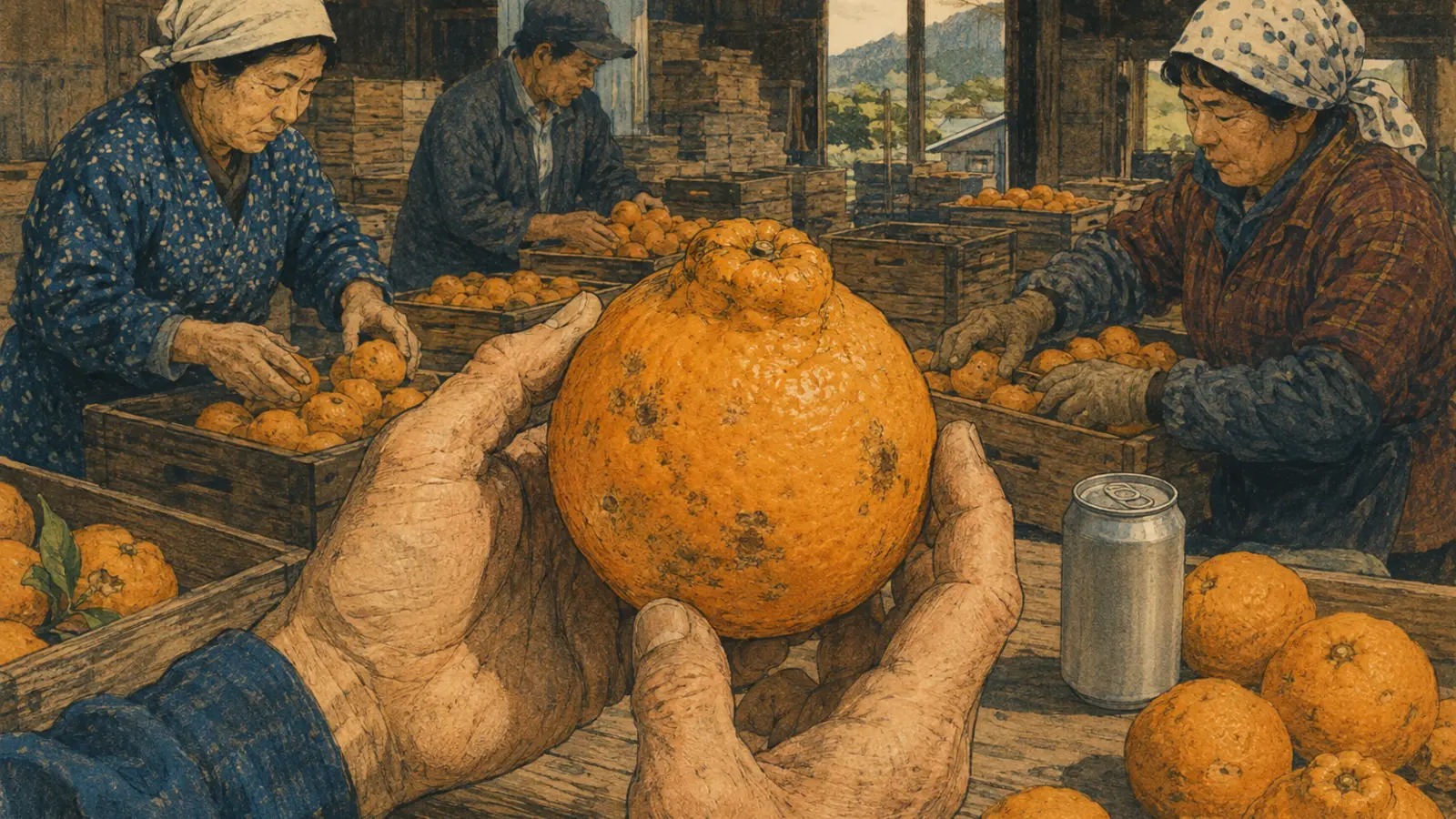
Shiranui is conspicuous by design. The skin rises around the stem, forming a little forehead above the round fruit. That bump—its celebrated deko—is not a defect but an identity. Yet let another mark cross the same peel, let the sun bleach a patch or let the body grow a little beyond the packing grade, and the fruit can fall out of the line bound for a fresh-market shelf.
Open it and the juice can be just as sweet. “Even when it is nonstandard, the deliciousness does not change,” a Kumamoto grower identified as Okamura said in Kirin's announcement. But the fresh-fruit market is governed not only by the tongue. It is governed by eyes, boxes, grades and a gift culture in which appearance is part of what has been purchased.
That rejected line now has another exit. On August 18, Kirin Brewery launched Kirin Hyoketsu Mottainai Kumamoto Shiranui nationwide. The canned chu-hai comes in 350- and 500-milliliter sizes, contains 4% alcohol and 0.2% fruit juice, and is being sold as a year-round product rather than a brief seasonal edition.
Kirin's planned raw-material scale is about 62 metric tons, the equivalent of roughly 250,000 fruit. The company says they were expected to be discarded because of scars, sunburn, irregular shape and similar appearance issues. Dole Japan, drawing on its relationships in produce regions, helped find the fruit and connect Kumamoto with Kirin. Production is planned at Kirin plants in Sendai, Toride, Nagoya and Okayama.
A fruit born from postwar science
Shiranui is not an ancient Japanese landrace. Its history begins in the postwar project of fruit breeding. In 1972, researchers at the Ministry of Agriculture's Kuchinotsu fruit-tree station—now part of the National Agriculture and Food Research Organization—crossed Kiyomi with Nakano No. 3 ponkan. Kiyomi contributed juiciness and ponkan a concentrated sweetness. The resulting fruit can reach high sugar levels while retaining substantial acidity at harvest, so storage is often used to let the flavor settle.
The variety was bred at a national station, but Kumamoto built its commercial story. According to JA Kumamoto materials, Japan's first market shipment left the prefecture on March 1, 1991. The Uki area describes itself as Shiranui's birthplace and leading production region. Heated greenhouses, unheated houses, rain shelters, open fields and storage extend shipping from winter into early summer.
That commercialization produced a second famous name: Dekopon. The distinction is one of variety and brand. Shiranui is the cultivar. Dekopon is a registered trademark that can be used for qualifying Shiranui shipped through licensed JA organizations under common standards, including at least 13 degrees Brix and no more than 1% acidity. The mark was registered in 1994 and licensed through the cooperative system.
So every Dekopon is Shiranui, but not every Shiranui is Dekopon. The size of the bump does not decide it. At a cooperative sorting center, people examine appearance while optical sensors measure sugar and acid. The grades promise consistency to buyers; they also create price.
1972 · Kiyomi and Nakano No. 3 ponkan are crossed at the Kuchinotsu station.
1991 · Kumamoto makes Japan's first market shipment of Shiranui.
1994 · Dekopon is registered as a trademark.
2001 · Kirin launches the Hyoketsu ready-to-drink brand.
2021 · Dole begins its Mottainai Banana project.
2024 · Kirin launches Hyoketsu Mottainai with Hamanashi pears.
August 2026 · Kumamoto Shiranui becomes the series' second year-round product.
Why edible fruit leaves the grade
Calling the fruit “ugly” makes the problem sound simple. Commercial standards have practical reasons. Uniform sizes pack more efficiently and shift less in transit. Skin damage can make freshness and decay harder to judge. Predictability builds trust at retail. For premium fruit and formal gifts, a flawless surface is part of the product.
But a commercial grade is not the same thing as edibility. Shiranui can be scarred by contact with branches and wind, marked by strong sun, affected by disease or simply shaped by uneven growth. Some of those marks have little effect after the peel comes off. If the fruit cannot command a fresh-market price and there is insufficient processing demand, its value descends: a lower-price outlet, animal feed or fertilizer, fruit left unharvested, or disposal.
The phrase “food loss” needs care here. Japan's government defines it as edible food that is discarded. The Consumer Affairs Agency and agriculture ministry estimate 4.61 million metric tons in fiscal 2024—2.24 million from households and 2.37 million from businesses. But those supply-chain estimates do not form a precise denominator for all fruit that never becomes a farm sale. Dividing Kirin's 62 tons by the national total would make an impressive story look vanishingly small without producing a meaningful evaluation.
What can be said is that national processing demand gives a buyer to a batch of fruit with limited outlets. What cannot yet be said is whether all 62 tons would otherwise have been burned or landfilled, how much more growers will retain after harvesting and sorting, or whether the same order will return next year.
Dole brought the relationship; Kirin brought scale
The drink did not begin with a beverage executive wandering into a sorting shed. According to Dole, a contact in Kumamoto's produce sector approached it about nonstandard Shiranui with limited outlets. Dole acted as the intermediary between the region and Kirin.
Dole began its Mottainai Banana project in September 2021. Bananas that could not move through the normal fresh channel because of scratches, size or ripeness were sorted again and directed to frozen fruit, puree, powder, sweets and drinks. In 2024, the project expanded to other fruit. Dole says it worked with more than 200 organizations and made use of about 5,000 metric tons of nonstandard bananas in fiscal 2025. Material unsuitable for food can become fertilizer or feed. The important design is not a single rescue outlet, but a ladder of outlets matched to condition.
Kirin contributes the absorption capacity of a national brand. Hyoketsu launched in 2001, its diamond-cut can and bright fruit profile helping make it Kirin's largest ready-to-drink brand. The company says cumulative sales reached about 15 billion 350-milliliter-equivalent cans by the end of 2025. The brand turned 25 in 2026.
Hyoketsu Mottainai, launched in 2024, redirects a small part of that enormous flow toward out-of-grade fruit. The first edition used Hamanashi, a branded pear from Yokohama. Kirin says it sold about 270,000 cases in 2024—150% of its target—and used approximately 34,000 pears. A sales-linked support program produced a ¥5,993,296 donation to the Yokohama agricultural cooperative. The line later expanded to fruits including Kochi ponkan.
How can 0.2% juice use 250,000 fruit?
The can's most surprising number is its 0.2% juice content. Arithmetically, that represents 0.7 milliliters in a 350-milliliter can and 1 milliliter in a 500-milliliter can. Set beside 62 tons and 250,000 fruit, it can look implausibly small.
National beverage runs operate on another order of magnitude. Even a trace amount of juice absorbs a substantial raw-fruit lot when multiplied across tens of millions of cans. The two claims are not inherently contradictory. But Kirin has not disclosed the planned can volume, the usable juice yield of the raw fruit, or the concentration and flavor-processing steps. An outsider cannot reconcile the figures independently.
| What is disclosed | What is not disclosed | Why it matters |
|---|---|---|
| About 62 tons, equivalent to about 250,000 Shiranui | Method for confirming disposal risk and the fruit's former outlet | Separates avoided waste from a shift away from lower-value uses |
| 0.2% juice, 350ml and 500ml cans, 4% ABV | Number of cans, extraction yield and processing method | Allows the raw-material and finished-product claims to be reconciled |
| Part of sales will support Japanese fruit farmers | Per-can amount for this product, recipient and payment date | Distinguishes the donation from ingredient purchases |
| A new outlet for nonstandard fruit | Purchase price, incremental grower income and contract term | Measures the farm business result, not only waste tonnage |
A low juice percentage is not proof that the project is trivial. A lightly dosed mass-market product may accept more fruit, more predictably, than a niche drink loaded with juice. But when an environmental claim rests on scale, the numbers that make that scale auditable should follow.
This is also an alcoholic drink, not a serving of fruit. The 350-milliliter can contains 11.2 grams of pure alcohol and the 500-milliliter can 16 grams. It is not for anyone under 20, anyone who is pregnant or nursing, or anyone who will drive.
Grower value travels by three routes
The project can reach farms in at least three ways. First comes payment for an ingredient that previously had little or no market value. Second comes the donation of part of product sales to fruit-farmer support. Third is the promotional effect of putting the words “Kumamoto Shiranui” on shelves across Japan and encouraging interest in the fresh fruit and its region.
Those routes should not be blurred. If the ingredient price is too low, growers may not recover the added cost of harvesting, sorting and transporting the fruit. A donation spent on research, seedlings, equipment or successor training can strengthen the producing region separately from the fruit price. National brand exposure may be valuable, but it is the least measurable benefit.
The Shiranui release says only that “part of sales” will be donated; it does not state an amount or mechanism. Later products in the broader Mottainai program have disclosed a ¥1-per-item model, and the Hamanashi edition reported its actual donation. If Kirin publishes Shiranui can sales, ingredient payments, donation value and use after the selling period, consumers will be able to connect an emotional word—mottainai, “what a waste”—to a result.
- At what point, and by what method, was the fruit classified as likely to be discarded?
- Without the product, would it have gone to disposal, feed, fertilizer or lower-value processing?
- After harvesting, sorting and transport, how much additional income reached growers?
- After counting factory residues and unsold finished goods, how much total loss was avoided?
- Will a one-year story become a multi-year purchase contract and investment in the region?
Build the outlet before a hotter harvest
Out-of-grade fruit is as old as agriculture. But the growing environment is becoming less stable. Japan's summer of 2025 was the hottest in the national record beginning in 1898, with an average temperature anomaly of 2.36 degrees Celsius. Kumamoto Prefecture has been testing and promoting heat countermeasures for agriculture after successive record temperatures.
Heat can contribute to sunburn, poor coloring, fruit drop, pests and changes in ripening. There is no evidence that all 62 tons in this project were caused by climate change, however. Wind, branches, disease and ordinary variation also scar and shape fruit. Climate should not become a convenient advertising backdrop. The more accurate conclusion is that volatility makes diversified outlets more valuable.
Farmers need more than the good fortune of being discovered after harvest. They need a planned ladder: top fresh grades, affordable household packs, juice and alcohol, sweets, frozen ingredients, then feed or fertilizer. When processors agree on quantity, specifications and price before picking begins, “nonstandard” becomes another raw-material specification instead of a prelude to disposal.
The future will be measured in contracts, not cans
Hyoketsu Mottainai Kumamoto Shiranui will not solve Japan's food-loss problem. Sixty-two tons is small beside the national estimate of 4.61 million. Buying alcohol is not a substitute for responsible production and consumption.
Still, the product contains an important piece of design. It connects visually rejected raw material with a processor that can produce a consistent flavor at national scale, then gives it a year-round shelf rather than a one-week novelty. Fruit that might have been a disposal cost—or no income at all—can become a purchased ingredient. Millions of consumers may also learn that Shiranui is the cultivar, Dekopon a controlled trademark, and appearance grades an economic choice rather than a test of edibility.
The next requirement is transparency: actual tons used, cans sold, ingredient payments to the region, donations, use of processing residue and the following year's contract. Those figures would turn “fruit saved” from an evocative package number into a supply-chain result that can be checked.
The future of Shiranui will not be made only from perfect fruit. A tree in Kumamoto carries fruit for a presentation box, fruit for a family bag and fruit whose aroma can enter a can. If the market accepts those differences as steps of value—and replaces the lowest step, disposal, with use—a scar stops being the mark of failure.
The fruit was still sweet when the peel came off. The true story of these 250,000 Shiranui is whether a buyer of national scale can write that fact into a contract before the next harvest—and whether another order arrives when the trees bear again.
- Kirin's August 4, 2026 product announcement — specifications, fruit volume, grower comment, food-loss and donation claims.
- Dole Japan's Shiranui project announcement — intermediary role, reasons for nonstandard status and distribution.
- Dole's Mottainai Fruit program — sorting and use for food, feed and fertilizer.
- JA Kumamoto on Shiranui/Dekopon sorting and standards; JA Kumamoto Uki's 2025-crop report.
- Wakayama fruit-tree research station variety guide; JA Kumamoto Fruit Federation's Dekopon trademark page.
- Kirin's Hyoketsu 25th-anniversary release; Hamanashi results; Hamanashi farmer-support donation.
- Consumer Affairs Agency fiscal 2024 food-loss estimate; agriculture ministry business-sector breakdown.
- Agriculture ministry 2025 warming-impact report; Kumamoto Prefecture heat-adaptation project.
Editor's note: Japan.co.jp compared Kirin, Dole and JA disclosures with government sources. The 62-ton and 250,000-fruit figures, stated disposal risk and farmer-support commitment are organization-reported. We did not independently audit purchase contracts or completed diversion.