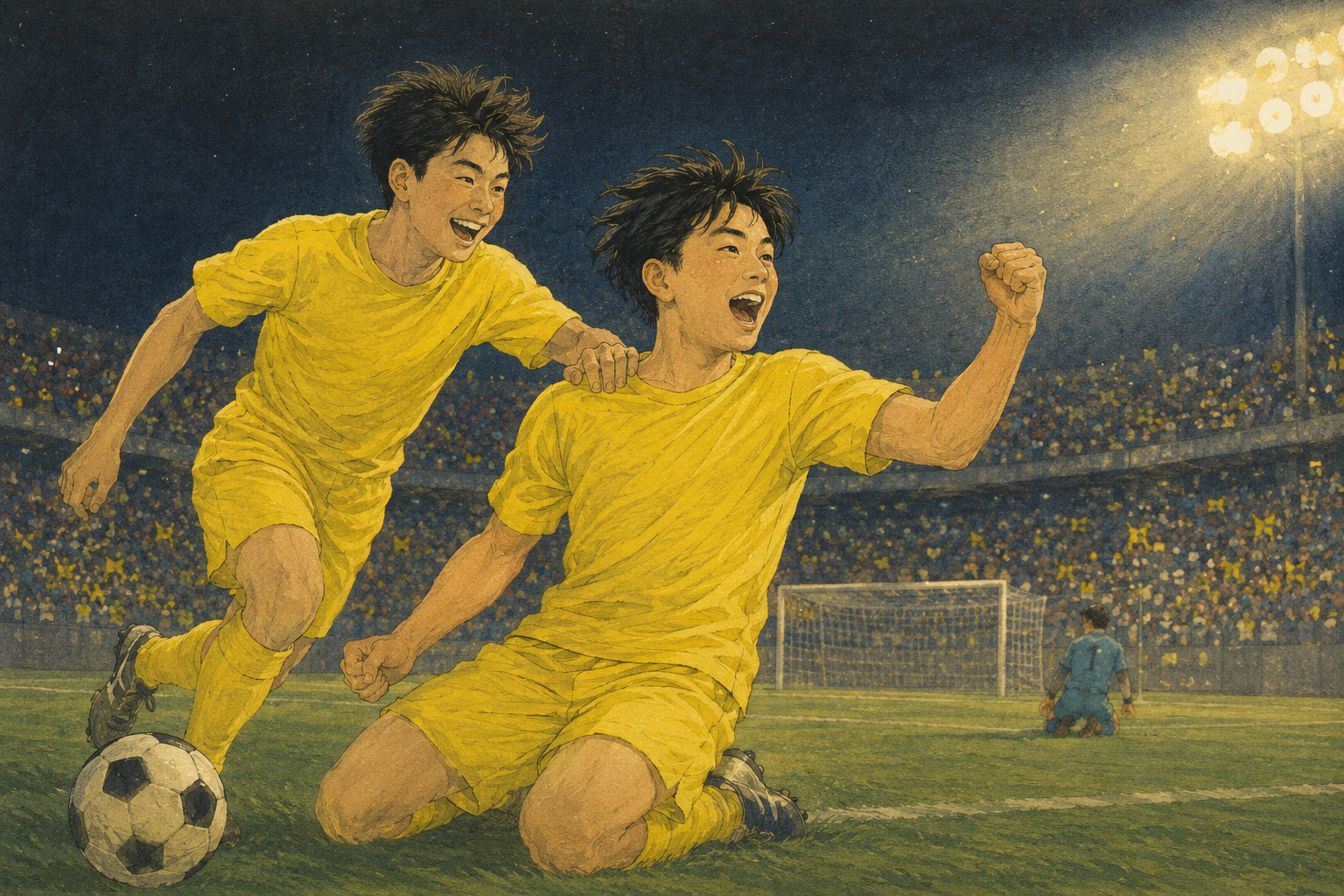
For eighty-three minutes, Kaiji Chōnan owned a Kashiwa Reysol record that no teammate had ever held at a younger age. The 17-year-old was in the starting eleven for the club’s Emperor’s Cup second-round match on August 26. When the whistle sounded at Hitachidai, Kashiwa announced that Chōnan—born April 7, 2009—had become the youngest player to appear in an official senior match for the club, aged 17 years, four months and 19 days.
Then the fourth official raised the board. Ryo Igarashi, born December 19, 2009, entered for Kenshin Yuba in the 83rd minute. The record fell for a second time before the same game had ended. Igarashi was 16 years, eight months and seven days.
The novelty of a record changing twice in one night can disguise the harder fact: neither player entered a ceremonial match. Kashiwa were leading Senshu University 2–1 in a knockout tie. Chōnan had made both Kashiwa goals possible. Igarashi came on while the university champion of Kanagawa still needed only one clean strike to force extra time.
A debut measured in decisions, not birthdays
Kashiwa’s opener in the 33rd minute began on the left and moved through Hiroshi Mitsumaru, Makoto Mitsuta and Seiya Baba. Chōnan received in a crowded central lane. His first instinct was to shoot; he later said he saw that the attempt would hit a defender. He found Yusuke Segawa instead. Segawa controlled in the restricted space and finished with his right foot.
In first-half stoppage time, a Baba shot ricocheted into Chōnan’s path. This time the lane was open. The teenager settled himself and scored. The Japan Football Association lists the goal at 45+1; Kashiwa’s page displays it as the 46th minute, two conventions describing the same play.
Senshu refused the role of respectful visitor. Kaito Okada intercepted centrally and drove in a long shot seven minutes after halftime. Kashiwa produced 17 shots to the university’s six, hit the frame and failed to finish the contest. Chōnan left after 59 minutes for Yusei Yamanouchi; Kashiwa’s established forward Mao Hosoya came on in the same substitution window. The favorite still had to defend a one-goal lead to the final whistle.
Chōnan’s post-match account was strikingly unsentimental. He said that, looking back, he had not been good enough to play during 2025 despite signing a professional contract. There were periods when he did not even make the training games. His response was to keep working on small details. After scoring, relief outweighed delight because he regarded the cup match as an audition for a place in league matches.
The ball person crosses the line
Igarashi described Hitachidai from a revealing angle. As a Kashiwa U-18 player, he had watched senior matches from the touchline while serving as a ball person. On August 26 he crossed from the support operation into the contest. He remembered the atmosphere and the supporters’ encouragement and reduced his first reaction to something disarmingly simple: it was fun.
The seven minutes were not spotless. Igarashi received a caution for a rough challenge in the fourth minute of stoppage time. That belongs in the record alongside the age. A competitive debut is not a promotional video; it includes mistakes, pressure and the obligation to preserve a result.
Igarashi admitted he had thought a little about the youngest-player mark, but said making the squad first required results in training within a crowded senior roster. Chōnan’s goal and assist immediately sharpened his ambition. He wanted his own goal, had not been involved in one, and would have to work for it.
His route already contained substantial achievement. Igarashi captained Regista FC to the JFA’s national under-12 championship in 2021, scoring twice in the final, then moved through Kashiwa U-15 into U-18 and received under-16 national-team selection. Yet none of that supplies senior credit. His top-team ledger began at zero and now reads seven cup minutes.
Two teenagers, two legal positions
“Academy prospect” is too broad to explain the pair. Both are second-year high-school students at Nippon Sport Science University Kashiwa High School and members of Kashiwa U-18. Both appeared on the JFA’s cup roster with the notation dai-nishu, the registration category for youth players of high-school age who have been made eligible for the senior team. Their contracts are not the same.
Kashiwa signed Chōnan to a professional contract in April 2025, calling it the youngest professional agreement in club history. He continued to belong to U-18 while holding top-team eligibility. Igarashi was registered with the senior squad on August 7, 2026. Kashiwa announced a second-category registration, not a professional contract.
| Player | Birth date and match age | Published status | August 26 contribution |
|---|---|---|---|
| Kaiji Chōnan 長南 開史 | April 7, 2009 17y 4m 19d | Kashiwa U-18; professional contract signed in April 2025; second-category senior eligibility. | Started, played 59 minutes, assisted the opener and scored the second. |
| Ryo Igarashi 五十嵐 陵 | December 19, 2009 16y 8m 7d | Kashiwa U-18; registered with the senior team in August 2026 as a second-category player. | Entered in the 83rd minute and became the club’s youngest official-match player. |
That distinction protects accuracy and reveals the purpose of the system. A youth player can be tested at senior level without being removed from his age-group environment. The bridge, however, creates obligations: school, academy matches, national-team camps and senior training must be coordinated; a growing body must not be treated as an unlimited resource; and a headline appearance must not substitute for a development plan.
Manager Ricardo Rodríguez called the two debuts highly meaningful for the club and academy. His assessment did not erase the match’s warning. Kashiwa allowed a university side back into the tie, missed chances for a third and fourth goal, and carried risk until the end. The teenagers’ achievement happened inside an imperfect team performance.
The geography of the academy
Kashiwa’s development model can be walked. The home stadium, senior training ground, U-18, U-15, U-12 and school facilities occupy the same Hitachidai property. A child does not need to imagine the first team as a remote institution. It trains next door.
The arrangement dates to April 1986, when the Hitachi Soccer School Kashiwa opened with the completion of the Hitachi Kashiwa comprehensive grounds. Its stated objectives were local participation and player development. Today the academy’s philosophy is to develop “players and people whom others want to support.” It says its graduates should be capable of becoming central figures for Kashiwa, national teams and the world—and of contributing beyond football.
Its output is visible in Kashiwa’s current senior list: Hayato Nakama, Kohei Tezuka, Kenta Matsumoto, Taiyo Koga, Yushi Yamada and Mao Hosoya are among the U-18 graduates identified by the club. Hiroki Sakai and the late Masato Kudo belong to the broader lineage. A list of successes, however, cannot measure the academy alone. Most academy players will not establish a professional career. Education, transition to university or employment and welfare after release are part of the same duty.
Chōnan entered Kashiwa’s pathway after starting at Yanagisaki SC Junior and has been with the organization since elementary school. Igarashi joined from Regista FC at U-15. Their years inside differ; the final physical approach to the stadium did not. Igarashi’s ball-person memory is the academy’s geography converted into biography.
Why the Emperor’s Cup makes the test real
The Emperor’s Cup is structurally suited to this kind of night. The JFA describes it as open to first-category affiliated teams without regard to professional or amateur status. Its first edition, the All-Japan Association Football Championship, was played in 1921. The 106th tournament runs from August 19, 2026 to a final scheduled for January 1, 2027.
Senshu University had earned every part of its place. It beat SC Sagamihara—an Emperor’s Cup quarterfinalist the previous year—1–0 in the Kanagawa qualifying final. In the national first round, it trailed the seeded University of Tsukuba from the 19th minute, then scored in the 85th and 88th to win 2–1. When Okada cut Kashiwa’s lead on August 26, the comeback was not theoretical. It was Senshu’s established route through the competition.
This is why describing the teenagers’ minutes as “experience” is insufficient. A friendly can be arranged around development. A cup tie cannot. Chōnan and Igarashi were asked to represent a J1 club against a prefectural champion that had already eliminated strong opposition. The tournament’s openness placed high-school, university and professional pathways on the same field and allowed only the score to decide whose work counted.
Kashiwa also carry a deep cup inheritance. The club’s ancestor, Hitachi’s head-office football team, was founded in 1940. Hitachi won the competition in 1972 and 1975; Kashiwa Reysol won the 92nd edition in the 2012 season. The JFA’s 2026 team introduction explicitly presents the current club as the continuation of that history and names a first title since 2012 as its aim.
1940 Hitachi’s head-office football team is founded.
1972 and 1975 Hitachi wins the Emperor’s Cup.
1986 Hitachi Soccer School Kashiwa opens at Hitachidai.
1995 Kashiwa Reysol enters the J.League.
2011 Kashiwa wins its first J1 title.
2012 season Reysol wins the 92nd Emperor’s Cup.
April 2025 Chōnan signs Kashiwa’s youngest professional contract.
August 26, 2026 Chōnan and Igarashi lower the appearance record in one match.
The danger inside a “next generation” story
Young-player records invite a tidy forecast: debut, breakthrough, national team, Europe. Football rarely complies. Growth, injury, tactical fit, a coaching change, academic demands and competition for minutes can accelerate or interrupt a career. A goal on debut is evidence of one completed action, not a certificate of future stardom.
The club’s work becomes more important after the publicity. Can it explain selection decisions during long spells without a match? Can it divide academy and senior loads rationally? Can it give Igarashi a transparent route from registration to contract—or to another educational and sporting path? Can it assess a late caution as a learning event without either romanticizing or punishing the boldness that earned promotion?
- Repeatable minutes: Do the teenagers earn meaningful senior time, not just a commemorative appearance?
- Broader trust: Can Chōnan add defensive and possession work to his obvious attacking return?
- Load control: Are academy, school, representative and senior schedules managed as one workload?
- Status clarity: Does each second-category player understand the criteria and options for the next step?
- Whole-cohort duty: Does the academy support players whose careers lead to university or life outside the professional game?
There is also a reporting responsibility. “Two teenage stars” is too easy. Igarashi has not been announced as a professional. Chōnan has one senior competitive appearance. The youngest-scorer inference is sound but not separately certified by the club. Precision is not an attempt to shrink their accomplishment. It prevents an accomplishment from being inflated into a burden neither player chose.
The future arrived as a match-winning action
By the end, the club record belonged to the player who had begun the night as a substitute. The winning goal belonged to the player whose record had just been taken away. That symmetry is almost too neat. The match itself was not. Senshu pushed, Kashiwa wasted chances, Igarashi was booked and the favorite survived by a single goal.
The teenagers’ composure after the game was more instructive than the ages. Chōnan spoke about readiness and the need to force his way into league consideration. Igarashi spoke about earning a squad place through training and wanting to affect a goal next time. They understood the record as a doorway, not a destination.
Hitachidai makes that doorway unusually visible. A ball person can look across the touchline at the role he wants; a U-18 player can train on the property where the senior team works; a coach can move a player across categories without moving him out of his educational environment. On August 26 the pathway shortened into seven minutes.
Neither Chōnan nor Igarashi can become Kashiwa’s youngest debutant again. That label expires immediately. What remains is the more severe and valuable measure: whether they make the senior team better. Against Senshu, one already decided the score and the other helped carry it home.
- Kashiwa Reysol — Official match record and post-match comments (Aug. 26, 2026; Japanese)
- Japan Football Association — Kashiwa Reysol v. Senshu University official record (Japanese)
- Kashiwa Reysol official social account — Chōnan’s youngest competitive-appearance record (Japanese)
- Kashiwa Reysol official social account — Igarashi’s same-night record (Japanese)
- Kashiwa Reysol — Chōnan professional contract, registration, reading and birth date (Japanese)
- Kashiwa Reysol — Igarashi senior registration, reading and birth date (Japanese)
- Kashiwa Reysol — Ryo Igarashi player profile (Japanese)
- Kashiwa Reysol — U-18 roster and official Romanization (Japanese)
- Kashiwa Reysol — Academy philosophy, Hitachidai layout, history and graduates (Japanese)
- Japan Football Association — Kaiji Chōnan U-17 profile (Japanese)
- Japan Football Association — 2021 U-12 national final and Ryo Igarashi (Japanese)
- Japan Football Association — Senshu University v. University of Tsukuba first-round record (Japanese)
- Japan Football Association — Senshu University team introduction and Kanagawa qualification (Japanese)
- Japan Football Association — Kashiwa tournament profile and roster (Japanese)
- Japan Football Association — Emperor’s Cup entry principle and history (Japanese)
- Japan Football Association — List of Emperor’s Cup winners (Japanese)
- Japan Football Association — 2026 player changes and Igarashi’s second-category listing (Japanese PDF)
Editor’s note: Japanese primary sources confirm the readings Chōnan Kaiji and Igarashi Ryō; the English order and macrons used here are editorial style. “Second-category player” renders dai-nishu tōroku senshu, the JFA/J.League youth-registration term. The record is confined to Kashiwa senior official matches. The JFA’s 45+1 and Kashiwa’s “46th minute” are two displays of the same goal. The supplied exchange-rate update—August 26 at 7:24 p.m. UTC—has been converted to August 27 at 4:24 a.m. Japan Standard Time.