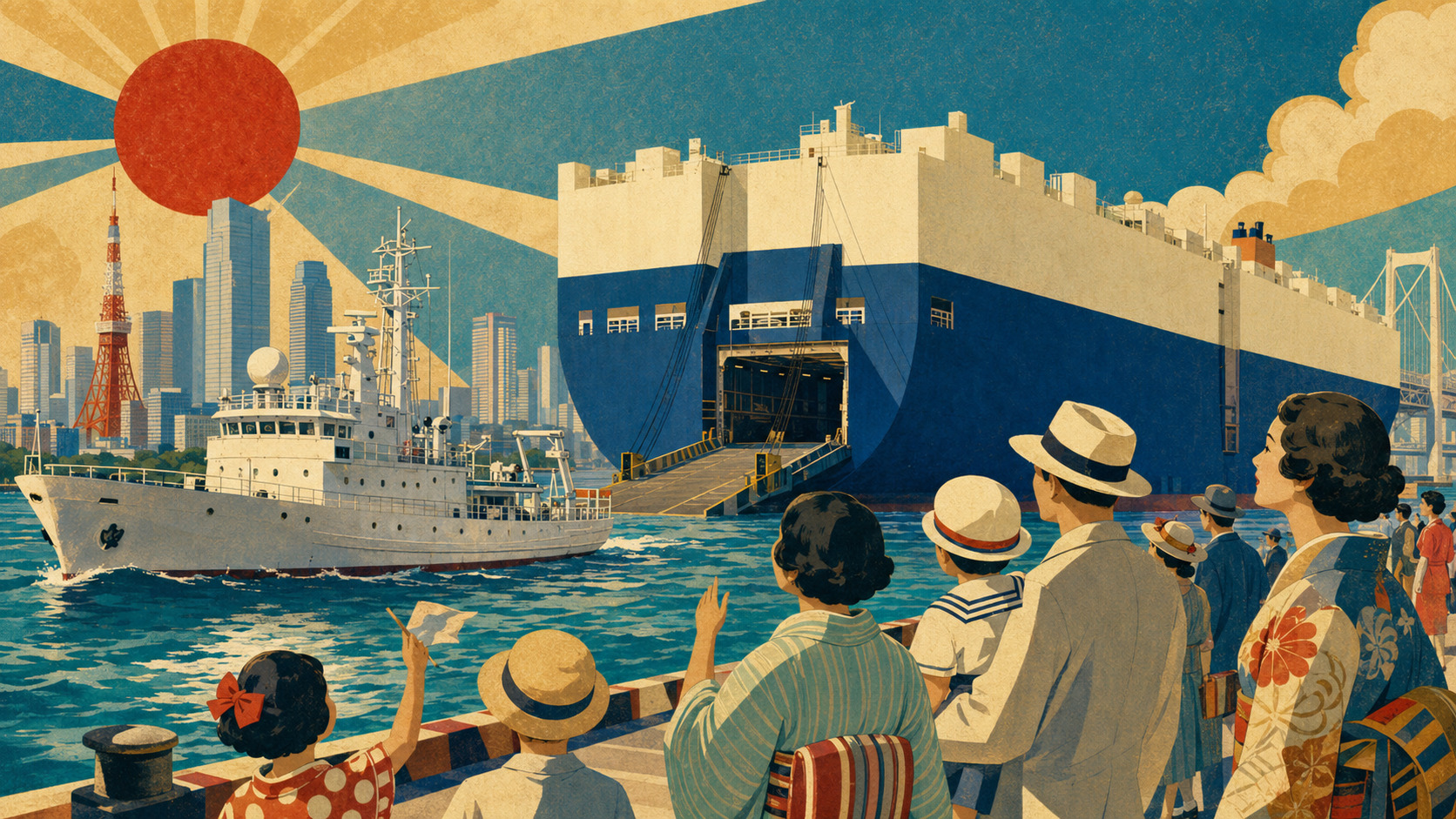
One quay, two ways the ocean supports daily life
The first ship turns seawater into knowledge. The second turns empty deck area into a moving city of cars. On Marine Day, Tokyo is placing those two systems side by side.
The official 2026 program runs from 10 a.m. to 5 p.m. at Tokyo International Cruise Terminal in Aomi, Koto Ward. Admission to the main event is free. The Headquarters for Ocean Policy, the Ministry of Land, Infrastructure, Transport and Tourism, and The Nippon Foundation are co-hosts. Government agencies, shipping and shipbuilding organizations, educators and maritime employers fill the terminal with exhibitions, performances and workshops.
The visual anchors are not museum pieces. Ryofu Maru completed its first full year of service only recently after delivery in March 2024. Lazulite Ace is newer still, delivered in March 2026. One works across the Northwest Pacific to produce observations that cannot be obtained with the same precision from space. The other moves up to 7,000 vehicles across trade routes in a single voyage.
What can a visitor actually enter today?
The word “open” needs qualification. The Japan Meteorological Agency vessel is the same-day opportunity. The organizer says anyone may tour Ryofu Maru during the published period, with reception ending at 2 p.m. Capacity, weather and operational circumstances can still affect access, so arriving well before the cutoff is the sensible plan.
Lazulite Ace is a different category. MOL’s approximately 90-minute onboard tour was limited to 600 people selected through advance application. Each group had to include a primary, junior-high or high-school student and could contain no more than six people. Applications ran from June 1 through June 28; notifications began July 6. Winners were instructed to bring the acceptance message and identification for every registered participant.
The application is closed. That does not close the terminal. MOL states that its indoor simulator, seafarer-work presentation, ambassador research displays and other workshops do not require the ship-tour reservation. The larger stage and booth program remains open as well.
| Experience | Time | Access on July 20 |
|---|---|---|
| Ryofu Maru onboard visit | From 10:00; reception closes 14:00 | Walk-up. Officially open to all during the stated period; go early and follow same-day instructions. |
| Lazulite Ace onboard program | 10:00–17:00; assigned gathering time; about 90 minutes | Advance lottery only. Applications closed June 28; no walk-up ship tour. |
| MOL terminal activities | Within the main 10:00–17:00 program | No advance ship-tour reservation required for terminal workshops and displays. |
| Exhibitions and stage | 10:00–17:00 | Main admission free. Programs may change or be cancelled for weather or operational reasons. |
Ryofu Maru: an 85-meter laboratory for a planet covered by water
The fourth Ryofu Maru is 85.63 meters long, 14 meters wide and makes 14 knots. JMA lists domestic gross tonnage at 1,986; builder Japan Marine United lists 2,373 international gross tons, a difference produced by the applicable tonnage systems rather than two conflicting hulls. The ship has capacity for 48 people under the builder’s particulars.
Its visible machinery serves unusually patient work. A conductivity-temperature-depth package, or CTD, is lowered from a dedicated crane and winch to as deep as 6,000 meters, recording pressure, temperature and salinity. Water bottles mounted with the instrument can capture samples from selected depths for analysis of dissolved oxygen, nutrients and the ocean’s carbon chemistry. During passage, the ship also observes carbon dioxide in the atmosphere and surface water.
Three laboratories divide the work: one principally for greenhouse-gas measurements, one for biological and other seawater components, and one for meteorological variables such as wind and waves. They are linked along a straight passage so samples and staff can move efficiently. Behind the bridge, a remote-control room gives operators a view of the observation deck during station work.
The propulsion system is designed for more than getting from port to port. A diesel-driven controllable-pitch propeller and an electrically driven, rotatable azimuth pod form a contra-rotating hybrid arrangement. The aft pod can direct thrust through 360 degrees and move the vessel slowly over short distances, helping it hold the controlled position and speed that deep-ocean work demands.
| Measure | Ryofu Maru | Lazulite Ace |
|---|---|---|
| Purpose | Oceanographic and marine meteorological observation | Pure car and truck transport |
| Delivered | March 1, 2024 | March 6, 2026 |
| Length / breadth | 85.63 m / 14.00 m | 199.93 m / 38.00 m |
| Gross tonnage | 1,986 domestic; builder also gives 2,373 international | 77,695 |
| Service speed | 14 knots | About 18 knots |
| Defining capacity | CTD observations to 6,000 m; 48 persons | 7,000 small vehicles; 18,435-ton deadweight |
Why a weather agency still needs ships in the satellite age
A satellite can repeatedly scan the sea surface; Argo profiling floats can rise and sink without a crew. Neither makes a ship obsolete. JMA explains that vessel observations still obtain high-accuracy measurements from the surface to near the seabed and collect chemical and biological variables that remote systems cannot fully replace.
The ship also looks upward. Water vapor over the East China Sea and other surrounding waters can feed the stationary rainbands that bring destructive downpours to Japan. A GNSS receiver measures the minute delay imposed on satellite-navigation signals by atmospheric moisture above the vessel. Ryofu Maru can move into an area where inflow is expected, combining that measurement with upper-air and surface observations. The resulting data support efforts to improve forecasts of linear precipitation systems.
Ocean and weather are not separate departments in nature. The heat stored below the surface, the carbon absorbed by seawater and the moisture entering the atmosphere are parts of the same coupled system. A tour of Ryofu Maru is therefore a view inside the infrastructure behind both tomorrow’s warning and the climate record measured over decades.
Four ships, one name, since 1937
The current vessel inherits a name first carried by a Central Meteorological Observatory ship completed in 1937. The original, 1,180-ton Ryofu Maru was built to support ocean observation related to cold-summer damage in northeastern Japan and to work south of the country. Wartime state service later changed its role; postwar observation had to rebuild from that rupture.
A second ship followed in 1966, at 1,599 tons, adding improved oceanographic instruments and the agency’s first weather radar aboard an observation ship. A third, 1,380-ton vessel entered service in 1995 and worked for nearly three decades. Its replacement in 2024 brought stronger observation and maneuvering systems, updated accommodation, equipment meeting nitrogen-oxide rules and ballast-water treatment.
Across those four hulls, the meaning of “weather ship” expanded. Early voyages measured the ocean to understand regional climate and support forecasting. Later programs added carbon dioxide, ocean acidification, abyssal warming, biological chemistry and now mobile vapor monitoring for concentrated rainfall. The name remains; the questions grow.
The 137°E line: the long history hidden inside one tour
The most important achievement associated with the name is not a dramatic single voyage but repetition. In the winter of 1967, the second Ryofu Maru began a survey along 137 degrees east longitude. The original section ran about 3,900 kilometers from southeast of the Shima Peninsula toward New Guinea, crossing the Kuroshio, the North Equatorial Current and other large Pacific systems while minimizing interference from islands and seamounts.
Summer observations were added in 1972, creating the core twice-yearly record. Temperature, salinity, dissolved oxygen, nutrients and chlorophyll have been maintained while new carbon-system variables were added as science developed. Ship generations and instruments changed, but quality control preserved comparability.
That persistence is the discovery. The 137°E data have been used in more than 100 scientific papers; seven papers using the section informed the IPCC’s Fifth Assessment Report. The record reveals changes in water masses, heat, dissolved oxygen, accumulated carbon dioxide and acidification. It earned a North Pacific Marine Science Organization monitoring award in 2016.
On the open day, a CTD frame may look like a ring of bottles and sensors. Historically it is a time machine: lower it to the same depths, along the same line, with comparable accuracy, and a slow planetary change becomes measurable.
Lazulite Ace: a vertical road system at sea
The car carrier answers a different question: how can thousands of finished machines cross an ocean without being packed into containers? A pure car and truck carrier is essentially a multi-storey garage wrapped in a hull. Vehicles drive through a stern or side ramp, climb internal ramps, are parked only narrow distances apart and are lashed against movement at sea.
Lazulite Ace, built by Tadotsu Shipyard in the Imabari Shipbuilding group, was handed over on March 6. It is 199.93 meters long, 38 meters wide and has a moulded depth of 38.76 meters; MOL describes the overall height as about 50 meters. Gross tonnage is 77,695, service speed about 18 knots and nominal capacity 7,000 small cars. The Liberian-flagged ship is new enough that this Marine Day call functions as a public introduction.
Inside, bulkhead-free cargo arrangements and wider, straighter ramps simplify vehicle routes and improve loading efficiency. Sections of deck can be lifted to vary clearance, allowing trucks and trailers as well as passenger cars. Visitors selected for the tour are meant to see the bridge, hear from seafarers and watch a loading demonstration—not simply gaze at the outer wall.
From Oppama Maru to a 7,000-car ship
The vessel arrives at the end of a 61-year industrial arc. In 1965, MOL placed Oppama Maru in service as Japan’s first specialized car carrier with dedicated loading and unloading equipment. The timing matched the rapid growth of Japanese automobile exports. An operation that began at roughly 1,200-car scale now uses ships able to carry 7,000 small vehicles, and MOL says its group car-carrier fleet numbers about 100.
The basic roll-on/roll-off idea transformed the cargo. Cars no longer had to be hoisted individually like conventional breakbulk. Driving them aboard reduced handling, but created a new architecture: many closely spaced decks, long internal traffic routes, ventilation, fire protection and precise securing. Because the tall, slab-sided hull catches wind, naval architecture also has to manage aerodynamic resistance and leeway.
The “ACE” names belong to MOL Auto Carrier Express, a brand that links this specialized fleet. Lazulite Ace combines that lineage with the company’s newer blue-hulled, LNG-fueled generation. The ship tour’s focus on students is deliberate: it turns an object usually encountered only as a distant rectangle into a workplace of navigators, engineers, loading planners and seafarers.
LNG lowers some emissions; it does not end the climate story
The shipbuilder says that, compared with a conventional heavy-fuel-oil vessel, Lazulite Ace cuts operational carbon-dioxide emissions by 25–30 percent, sulfur oxides by nearly 100 percent and nitrogen oxides by 80–90 percent when exhaust-gas recirculation is used. Boil-off gas from its LNG tanks can be consumed in generators and boilers rather than simply wasted.
Those are meaningful engineering claims, but they are not a declaration of zero emissions. The comparison published by the builder concerns the ship and its conventional-fuel reference. The International Maritime Organization’s life-cycle framework asks a wider question: emissions from extracting and producing the fuel, transporting and bunkering it, and using it aboard. It counts carbon dioxide, methane and nitrous oxide. Unburned methane, or methane slip, matters because methane is itself a powerful greenhouse gas.
Marine Day visitors can therefore read the blue ship honestly as a transition technology—cleaner for sulfur and nitrogen pollution, lower in direct carbon dioxide than the stated reference, and still part of a shipping system that must move toward full life-cycle decarbonization. Placing it beside a vessel that measures carbon and ocean change makes that unfinished work unusually visible.
A terminal built beyond the bridge
Tokyo Port formally opened to international trade on May 20, 1941. Containerization reshaped it from the late 1960s, and the Aomi and Oi waterfront became infrastructure for a metropolis whose food, energy and manufactured goods arrive by sea. The Marine Day site belongs to a newer chapter.
Tokyo International Cruise Terminal opened on September 10, 2020. Its Aomi position is seaward of Rainbow Bridge, solving a physical problem: the newest very large cruise ships could not pass under the bridge to reach the older Harumi facilities. The terminal has a four-storey, 19,000-square-meter building, two boarding bridges and a 430-meter berth with 11.5-meter water depth.
The pandemic made the opening quieter than planned, but international cruising resumed in 2023. Tokyo recorded 83 cruise calls in 2025, the highest annual total since the terminal opened. On July 20, 2026, the building designed for travelers becomes a classroom for the working fleet—a useful reminder that a passenger terminal is also a piece of industrial waterfront.
From an 1876 arrival to the 19th national award
Marine Day’s historical line begins with another government ship. On July 20, 1876, Emperor Meiji returned to Yokohama aboard the lighthouse-service vessel Meiji Maru after a tour of northeastern Japan and Hokkaido. The date became Marine Memorial Day in 1941. A broad campaign later turned the observance into a national holiday: the law was enacted in 1995, the first holiday was observed in 1996, and the date moved from July 20 to the third Monday in July in 2003. In 2026, that Monday is once again July 20.
The statutory purpose is to appreciate the benefits of the sea and wish for Japan’s prosperity as a maritime nation. The Tokyo program gives that abstraction working parts: observation, trade, seafaring, shipbuilding, rescue, policy, science and education.
At 10:30 a.m., the 19th Awards for Distinguished Contributors to a Maritime Nation follow the opening ceremony. The prime-ministerial award was created in 2008 to recognize individuals and organizations contributing to fields such as science, fisheries, maritime industry, public understanding and the natural environment. The first ceremony was also embedded in a Marine Day event. The sequence connects celebration to service: a maritime nation is not only ships, but people who produce knowledge and institutions around them.
| Year | Milestone | Why it matters today |
|---|---|---|
| 1876 | Meiji Maru reaches Yokohama on July 20 | The voyage becomes the date behind the modern holiday. |
| 1937 | First JMA-lineage Ryofu Maru completed | Begins an 89-year observation-ship lineage. |
| 1941 | Marine Memorial Day; Tokyo opens as an international port | National observance and the host port enter modern history in the same year. |
| 1965 | MOL’s Oppama Maru enters service | Japan’s first purpose-equipped specialized car carrier. |
| 1967 | 137°E observation begins | Starts one of the world’s exceptional long repeat-ocean records. |
| 1996 / 2003 | First Marine Day holiday / third-Monday schedule | Creates the national holiday calendar used in 2026. |
| 2008 | First Maritime Nation awards | The 19th presentation is part of today’s opening program. |
| 2020 | Tokyo International Cruise Terminal opens | A berth beyond Rainbow Bridge accommodates the largest cruise ships. |
| 2024 / 2026 | Fourth Ryofu Maru / Lazulite Ace delivered | Two of Japan’s newest working ships meet the public. |
The day beyond the two gangways
The Ministry’s schedule begins with a 10–10:30 a.m. opening ceremony and the award presentation from 10:30 to 11. The public-facing stage continues with a Japan Coast Guard band concert at 11:40. At noon, ships sound their whistles together; the organizer warns that the sudden volume may distress small children and people sensitive to loud sounds.
At 1 p.m., The Nippon Foundation presents a discussion with a Naoki Prize-winning writer on the ocean’s past and future. The Japan Ship Owners’ Association stages a science show at 2:20. A Tokyo Band detachment of the Japan Maritime Self-Defense Force plays Dixieland from 3:40, followed around 4:30 by a prize drawing tied to the visitor questionnaire.
Booths cover ocean policy and security research, shipbuilding, responsible seafood, Imabari as a maritime city, seafarer careers, diving, marine sports, the Coast Guard, the Tokyo port authority and major shipping lines. A special display looks back at a century of shipping and shipbuilding, while winning works from the “We Are Children of the Sea” art competition supply a different record of how young people imagine the ocean.
| Time | Official program |
|---|---|
| 10:00–10:30 | Opening ceremony |
| 10:30–11:00 | 19th Awards for Distinguished Contributors to a Maritime Nation |
| 11:40 | Japan Coast Guard Band Marine Day concert |
| 12:00 | Simultaneous sounding of ships’ whistles; loud-noise caution |
| 13:00 | The Nippon Foundation: reading the ocean’s past and future |
| 14:20 | Japan Ship Owners’ Association science live show |
| 15:40 | JMSDF Tokyo Band Dixieland concert |
| Around 16:30 | Visitor-survey prize drawing |
How to visit without building the day around a closed tour
The organizer states that there is no event parking and asks visitors to use public transport. From Yurikamome’s Tokyo International Cruise Terminal Station, the operator estimates an eight-minute walk. The station name is easy to mistake for arrival at the building itself; allow time for the waterfront approach, entry checks and queues.
If Ryofu Maru is the priority, arrive in the morning, not at the 2 p.m. cutoff. Wear secure, low-heeled shoes suitable for gangways, ladders and metal decks, carry as little as practical and follow crew instructions. Operational ships are not barrier-free in the same way as the terminal; ask staff before joining a queue if stairs or narrow passages are a concern.
If you did not win the Lazulite Ace lottery, do not bring identification in the hope of replacing a registrant or gaining a cancellation place: no such walk-up process is advertised. Build the day around Ryofu Maru, the terminal displays, simulator, talks, bands and the noon whistles. Monitor the official page on the morning of the event because weather and operating needs can alter ship access or the entire program.
A holiday that reveals infrastructure
Most days, both ships are almost invisible to the people they serve. Weather warnings arrive on a phone without showing the instrument lowered six kilometers into the Pacific. A finished car appears at a dealer without showing the decks, ramps, lashing and watchkeeping that carried it across oceans.
Tokyo’s Marine Day pairing corrects that invisibility for a few hours. Ryofu Maru shows how patient measurement makes environmental change legible. Lazulite Ace shows the scale and engineering behind ordinary trade, along with the difficult transition away from fossil carbon. The terminal shows the port that connects both systems to the city.
The two gangways do not offer identical access today, and they should not be described as though they do. But even from shore, their shared lesson is complete: Japan’s relationship with the sea is not only scenic. It is scientific, industrial, historical and worked every day.
Sources and official links
- C to Sea / Umi Coco: official Marine Day 2026 program: venue, public hours, stage schedule, booths, weather warning, parking notice and co-hosts.
- C to Sea: official ship-tour application page: closed application period, group rules, notification and identification requirements, and walk-up access to Ryofu Maru.
- Ministry of Land, Infrastructure, Transport and Tourism, July 13, 2026: opening ceremony, 19th awards, main hours and purpose.
- MLIT: official one-page event outline: exhibition themes, ship programs and public/official portions.
- Japan Meteorological Agency: fourth Ryofu Maru and rainband observation: 2024 delivery, mission, environmental equipment and mobile vapor observations.
- JMA’s 150-year history, ocean observation chapter: four generations, CTD work to 6,000 meters and scientific history.
- Japan Marine United technical review of Ryofu Maru: dimensions, laboratories, propulsion, CTD and GNSS water-vapor system.
- JMA: history and significance of the 137°E repeat section: 1967 start, observations, publications, IPCC use and monitoring award.
- Mitsui O.S.K. Lines: official 2026 car-carrier tour notice: 600 places, 90-minute visit, student-group rule, terminal activities and the seventh Marine Day tour.
- Imabari Shipbuilding: delivery and particulars of Lazulite Ace: capacity, dimensions, cargo decks, fuel system, emissions comparison and registry.
- MOL: car-carrier structure and history: 1965 Oppama Maru, ramps, lashing, liftable decks and wind-resistance design.
- International Maritime Organization: marine-fuel life-cycle GHG framework: well-to-tank, tank-to-wake and well-to-wake accounting for CO₂, methane and nitrous oxide.
- Tokyo Port Terminal Corporation: Tokyo International Cruise Terminal: September 10, 2020 opening.
- Tokyo Metropolitan Government Port and Harbor Bureau: cruise terminals: terminal dimensions, two-terminal strategy and 2025 call total.
- Tokyo Metropolitan Government: history of Tokyo Port: 1941 opening, containerization and the 2020 terminal.
- Tokyo Port Terminal Corporation: official access guide: Yurikamome route and eight-minute station walk.
- Japan Maritime Public Relations Center: history of Marine Day: the memorial day, national-holiday campaign and calendar changes.
- MLIT: creation of the Awards for Distinguished Contributors to a Maritime Nation: 2008 origin and scope.
Editor’s note: Event details are based on organizer material available July 18, 2026, Japan time. Ship access can change for weather, safety or operational reasons. Lazulite Ace emission reductions are the builder’s comparison with a conventional heavy-fuel-oil vessel; they are not a full well-to-wake assessment. JMA and the builder publish different gross-tonnage figures for Ryofu Maru because one is domestic and the other international tonnage. The hero artwork is an editorial illustration, not a documentary photograph.