Four programs, four clocks
The best time to see Sōya in full dress is the beginning of the day. The Museum of Maritime Science says the line of international signal flags will be displayed only from 10 a.m. to 3 p.m. The paper-craft handout for children ends at 4 p.m. or sooner if supplies run out. The Taro-and-Jiro photo setting and commemorative fan continue until 4:30 p.m., again subject to stock in the fan’s case. General museum hours extend to 5 p.m., but the final boarding of Sōya is 4:30.
The museum’s official Marine Day notice, dated July 8, and the detailed Tokyo Odaiba event listing agree on the schedule. Admission and each special activity are free. The felt-art display is on the aft upper deck; the paper model and fan are distributed at the boarding entrance. The model is for visiting children, while the fan is offered to all visitors. Both handouts end when supplies do.
| Program | Time and place | Important detail |
|---|---|---|
| Sōya in full dress | 10:00 a.m.–3:00 p.m.; viewed around the ship | The first special program to finish. International signal flags run from bow to stern. |
| Sōya paper craft | 10:00 a.m.–4:00 p.m.; boarding entrance | For children; free; distribution ends when stock is gone. |
| Taro-and-Jiro Antarctic photo setting | 10:00 a.m.–4:30 p.m.; aft upper deck | Life-size felt-art models, not preserved animals or a reconstruction of one exact historical scene. |
| Commemorative fan | 10:00 a.m.–4:30 p.m.; boarding entrance | For all visitors; designs feature successive Antarctic observation ships; while supplies last. |
What “full dress” means on a ship
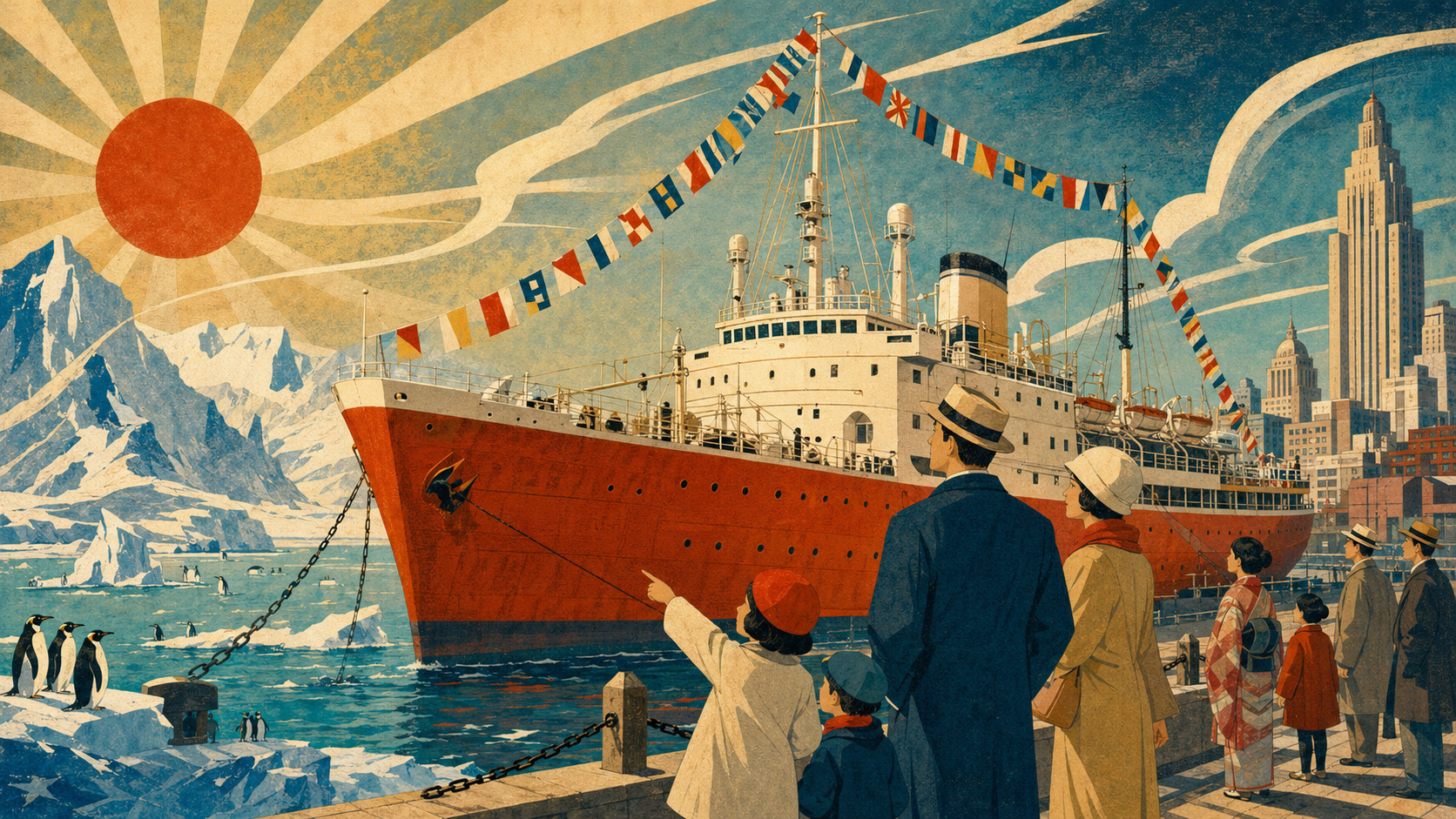
“Full dress” is not a new coat of paint. The museum defines mansenshoku—literally “full-ship decoration”—as the ceremonial display of international signal flags from bow to stern on occasions of celebration. Those flags ordinarily form a practical visual vocabulary used in ship-to-ship communication: alphabetic, numeric and special-purpose designs. In full dress, their repeated colors and geometries are used as a festive line across the vessel rather than as an ordinary operational message.
The gesture suits a ship whose public history is full of signals. When Sōya reached Tokyo on October 1, 1978, at the end of active service, the museum records that she was greeted by international signal flags spelling “WELCOME.” In 2026, the flags once more turn rigging into language—this time joining Marine Day with the 70th anniversary of the Japanese Antarctic Research Expedition.
The paper model and fan translate that same idea into things a visitor can carry. Folding a model exposes the ship’s proportions: a compact hull, high bow, working decks and the superstructure repeatedly altered for new assignments. The fan moves the story from one ship to a succession. Sōya’s six-voyage era ended in 1962; Fuji entered service in 1965, and later ships named Shirase extended a national logistical system that no longer depended on a converted prewar freighter.
Why 2026 is a double anniversary
Sōya was launched on February 16, 1938, making this her 88th launch anniversary year. Japanese Antarctic observation began in 1956, when the first expedition departed Tokyo aboard the ship, making 2026 the program’s 70th anniversary year. The Museum of Maritime Science has built a wider 70th-anniversary program around that overlap, running July 18 through August 30; the Marine Day activities sit inside it.
The anniversary pairing prevents a common simplification. Sōya was not designed from the keel up as an Antarctic research ship. Her polar career occupied only part of a much longer life. What deserves notice is precisely the adaptation: a hull ordered for one country and purpose became a Japanese merchant ship, a wartime auxiliary, a repatriation ship, a lighthouse tender, an Antarctic platform, a patrol and rescue ship, and finally a museum.
Born for Soviet ice, completed as Chiryō Maru
The ship began with a Soviet commercial order. In 1936, Kawanami Kōgyō’s Kōyagishima yard near Nagasaki started one of three ice-strengthened cargo vessels intended for the Soviet Union. The future Sōya was launched in February 1938 but, amid a delivery dispute and worsening international relations, was completed that June under the Japanese merchant name Chiryō Maru.
The Museum of Maritime Science’s official Sōya Q&A fixes the next change: the name Sōya dates to February 1940, when the Imperial Japanese Navy made the ship an auxiliary, or special-service vessel. The name refers to the Sōya Strait between northern Hokkaido and Sakhalin. During the war the vessel performed transport and survey work. Any account that jumps directly from “ice ship” to heroic Antarctic explorer erases this military service and the imperial war in which it occurred.
Survival did not make the ship’s purposes continuous. After Japan’s defeat, Sōya was used to bring people home in repatriation transport. She then entered the Maritime Safety Agency—the predecessor in name of today’s Japan Coast Guard—and supplied remote lighthouses. Food, fuel, replacement equipment and personnel had to reach isolated lights in difficult northern water. That working knowledge of cold seas helped make an old, ice-strengthened vessel imaginable for a new national project.
How an old working ship became Japan’s Antarctic choice
The postwar scientific opening came quickly. Japan decided to join the International Geophysical Year’s coordinated Antarctic work, and the government needed a ship on a compressed schedule. Sōya was selected and extensively converted in 1956. Hull strengthening, changes to the bow and propulsion, expanded accommodation and aviation capacity turned a lighthouse vessel into an expedition platform—but not into a modern, powerful icebreaker.
That limitation is essential to the history. Sōya’s value was not that she could defeat every ice condition. It was that ship and crews managed a difficult program despite narrow margins, learning to combine ice navigation, aircraft, helicopters, weather judgment and international assistance. The modifications also continued between expeditions. After the second voyage’s crisis, the ship was rebuilt again to carry two large helicopters for the third expedition, shifting more transport from fragile surface approaches to the air.
On November 8, 1956, Sōya left Tokyo’s Harumi Pier with the First Japanese Antarctic Research Expedition. The National Institute of Polar Research’s 70-year chronology records the departure and the opening of Shōwa Station in January 1957. On January 29, the expedition established the base on East Ongul Island. Eleven members remained for the first wintering. A converted 1930s ship had carried the material foundation of Japan’s continuing Antarctic presence.
The second expedition: trapped ice, an abandoned wintering, fifteen dogs left behind
The following season was the rupture in the success story. Sōya departed on October 21, 1957, earlier than the first voyage, but became immobilized in consolidated sea ice on December 31. The National Institute of Polar Research says the ship drifted with the ice for about 40 days. The United States icebreaker Burton Island came to assist, and the first wintering team’s eleven members were recovered by small aircraft. The second team could not begin its intended wintering.
Fifteen Sakhalin huskies remained at Shōwa Station. Aircraft fuel and lift constraints prevented their recovery. This was not a planned endurance experiment, and it should not be softened into an adventure in which everyone was known to be safe. The dogs had been vital transport partners during the first winter. Their abandonment arose from an emergency that had already exhausted the expedition’s options.
The museum’s history of the second expedition and the polar institute’s retrospective on the 1957 departure emphasize the rescue request, the ice drift, the failed wintering and the impossibility of bringing the dogs aboard. The full account belongs beside the 2026 photo setting because it explains what the familiar names Taro and Jiro actually carry.
Taro and Jiro: what was found, and what remains unknown
On January 14, 1959, members of the third expedition found two dogs alive near Shōwa Station: the brothers Taro and Jiro. Of the fifteen left the previous year, seven were found dead while still chained and six were missing. The station’s dog food had not been eaten. The polar institute says plainly that what Taro and Jiro ate to survive is unknown.
That uncertainty matters. Retellings often supply a clean survival mechanism that the evidence does not. The National Institute of Polar Research’s account preserves the harder numbers and the unanswered question. Jiro later died at Shōwa Station. Taro returned to Japan with the fourth wintering team and lived at the Hokkaido University Botanical Garden.
The 2026 photo spot does not claim to reproduce the discovery. It uses life-size felt-art models to bring two historical figures into a child-accessible setting on the ship that connected their story to Japan. Visitors can enjoy the photograph while recognizing three boundaries: the figures are art models; the two dogs were found alive, not theatrically “rescued” in one simple moment; and the other thirteen dogs must not disappear from the account.
Six voyages built the first chapter, not the whole science
Sōya served expeditions one through six from 1956 to 1962. The third expedition resumed wintering and found Taro and Jiro. The fourth made the first survey of the Yamato Mountains; it also suffered the death of expedition member Shin Fukushima. The fifth pushed inland work to 75 degrees south as the Antarctic Treaty entered into force in 1961. The sixth carried out withdrawal work when Shōwa Station was temporarily closed, and Sōya left Antarctic waters on February 16, 1962.
The polar institute’s expedition history makes clear that Sōya’s era was formative and incomplete. Observation paused, then resumed with Fuji and the reopening of Shōwa Station. Later teams reached the South Pole, found large collections of Antarctic meteorites, detected the ozone hole, began long-term atmospheric carbon-dioxide measurements and drilled deep ice cores at Dome Fuji. Those achievements were not made by Sōya, but they stand on the logistical and institutional beginning her six voyages helped establish.
This is why the commemorative fan’s successive ships are more than a lineup of silhouettes. Polar science depends on continuity across vessels, crews, laboratories, stations and decades. Sōya symbolizes the precarious beginning; her successors embody the capacity that grew from it.
After Antarctica, back to rescue work in the north
Leaving Antarctica did not end Sōya’s service. The ship returned to Japan Coast Guard patrol work in northern waters, where ice, fog, fishing traffic and severe weather produced a different kind of demand. The museum’s patrol-ship history credits Sōya with more than 350 emergency-rescue dispatches, 125 vessels rescued and about 1,000 people assisted over her career. The record earned the vessel the sobriquet “guardian deity of the northern sea.”
These figures change the scale of the ship’s biography. Six Antarctic expeditions are the best-known chapter, but the northern rescue totals represent repeated encounters with ordinary maritime danger. The same ship that carried scientists south returned to the working waters from which its lighthouse and patrol experience had grown.
Sōya retired in 1978. She arrived in Tokyo that October and opened to the public in front of the Museum of Maritime Science on May 1, 1979. The ship later moved across the water during cruise-terminal construction, but the museum continued preservation and public access. On September 6, 2024, the museum announced Sōya’s eight-millionth cumulative visitor.
A museum after the museum building
The site today is easy to misunderstand if remembered from older photographs. The Museum of Maritime Science says its main-building exhibitions, annex exhibition hall and outdoor exhibits have ended; current museum activity continues with the first Antarctic observation ship Sōya at its center. The vessel is therefore not merely one object in a large gallery. It is the primary public museum experience.
That changes the educational method. Visitors do not stand outside a glass case looking at a small model of a ship. They cross the gangway, move through the scale of working compartments and look back toward Tokyo Bay from a deck that once carried expedition equipment. The paper craft then reverses that relationship: after walking inside the full-size ship, a child can reduce it to folds and tabs and discover how a hull becomes volume.
Preservation also asks visitors to read alterations rather than search for a single “original” state. Sōya’s historical value lies in accumulation. Merchant hull, naval auxiliary, repatriation transport, lighthouse tender, polar ship and patrol vessel did not occupy separate artifacts. They were successive configurations of the same one.
Planning the visit
The ship is moored at Aomi in Kōtō Ward. The museum lists a walk of about five minutes from Tokyo International Cruise Terminal Station on the Yurikamome line, or about twelve minutes from Tokyo Teleport Station on the Rinkai line. Admission is free. There is no dedicated visitor parking. The normal weekly closure is Monday, moving to Tuesday when Monday is a holiday; Marine Day 2026 is Monday, July 20, and the special event confirms the ship is open.
| Visitor question | Answer for July 20, 2026 |
|---|---|
| Where? | Museum of Maritime Science / Sōya, Aomi 2-chōme waterfront, Kōtō Ward, Tokyo. |
| Nearest rail? | About 5 minutes on foot from Tokyo International Cruise Terminal Station; about 12 minutes from Tokyo Teleport Station. |
| Cost? | Admission and the four announced Marine Day programs are free. |
| Hours? | Museum 10:00 a.m.–5:00 p.m.; last Sōya boarding 4:30 p.m. |
| Best arrival? | Before 3:00 p.m. to see full dress; earlier for handouts that may run out. |
| Parking? | No dedicated visitor parking. |
| What should be checked again? | The official notice for operational changes, supply status and any weather-related adjustment. |
The neighboring Tokyo International Cruise Terminal is also hosting a larger Marine Day commemorative program. That makes the area unusually dense with ship visits and maritime exhibits, but it also creates a scheduling trap: Sōya’s full dress comes down at 3 p.m. A visitor treating the museum as the late stop may still board the ship but miss the day’s defining exterior display.
The most honest way to celebrate Sōya
Sōya is often called a “miracle ship,” and the survival narrative is understandable. The hull endured war, hard ice and decades of northern work. Yet miracle can become an excuse to remove institutions, labor, mistakes and losses from the story. The ship survived because people repaired and rebuilt it, because other vessels—including Burton Island—helped, because crews made decisions under uncertainty, and sometimes because the consequences were borne by people and animals who did not return.
Marine Day’s full dress works best when it does not cover those layers. The flags announce celebration. The photo setting opens a conversation about the dogs. The paper model makes engineering tangible. The fan sets Sōya inside a longer scientific succession. Together, the activities make a surprisingly coherent museum lesson: maritime history is not one voyage but a chain of changing purposes, technologies and responsibilities.
At 3 p.m., the signal flags are scheduled to come down. Sōya will remain what she was before the decoration went up—an 88-year-old working archive, held together not by one heroic legend but by the visible seams between many Japanese histories.
| Year | Sōya and Antarctic milestone | Why it matters today |
|---|---|---|
| 1936 | Construction begins on an ice-strengthened cargo ship ordered for the Soviet Union. | The polar capability starts in a commercial design, not an Antarctic plan. |
| 1938 | Launched February 16 and completed as Chiryō Maru. | 2026 is the 88th launch anniversary year. |
| 1940 | Renamed Sōya as an Imperial Japanese Navy auxiliary. | The ship’s wartime role is part of, not outside, its history. |
| Post-1945 | Repatriation transport, then lighthouse-supply and Coast Guard service. | The vessel changes from war work to returning people and supporting navigation. |
| 1956 | Converted and departs Tokyo with the first Antarctic expedition. | Japan’s 70-year observation history begins. |
| 1957 | Shōwa Station established; eleven members begin first wintering. | The permanent institutional base takes shape. |
| 1958 | Second wintering abandoned; fifteen dogs left at the station. | The expedition’s most painful emergency resists a simple heroic telling. |
| 1959 | Taro and Jiro found alive on January 14. | The 2026 felt-art setting refers to this documented survival. |
| 1962 | Sixth expedition withdraws; Sōya’s Antarctic service ends. | The first ship chapter closes before later observation ships expand the program. |
| 1978–79 | Sōya retires and opens as a museum ship. | A working vessel becomes a public historical source. |
| 2024 | Cumulative museum boardings reach eight million. | Preservation becomes a mass public encounter. |
| 2026 | Full dress and four Marine Day programs mark 88 and 70 years. | Celebration links ship, dogs, design and scientific succession. |
Principal sources and further reading
- Museum of Maritime Science, official Marine Day 2026 notice and Tokyo Odaiba detailed event listing: the four activities, locations, eligibility, hours and while-supplies-last conditions.
- Museum of Maritime Science, Japanese Antarctic observation 70th-anniversary program: the July 18–August 30 context around the Marine Day event.
- Museum of Maritime Science, “What is Sōya?” and official Sōya Q&A: six Antarctic expeditions, later Coast Guard service, completion as Chiryō Maru and the February 1940 naming.
- Museum of Maritime Science, second Antarctic expedition and fifth and sixth expeditions: ice emergency, assistance and the end of Sōya’s Antarctic work.
- Museum of Maritime Science, Sōya as northern patrol ship: more than 350 rescue dispatches, 125 vessels and about 1,000 people rescued.
- Museum of Maritime Science, farewell and museum-ship history: 1978 arrival, “WELCOME” signal flags and May 1, 1979 public opening.
- Museum of Maritime Science, eight-millionth visitor announcement: September 6, 2024 milestone.
- National Institute of Polar Research, 70-year timeline and history of Japanese Antarctic observation: ship succession, Shōwa Station, the first six expeditions and later scientific achievements.
- National Institute of Polar Research, second-expedition retrospective: December 1957 ice entrapment, approximately 40 days of drift, recovery of the first wintering team and the dogs left behind.
- National Institute of Polar Research, Taro and Jiro found alive: date, fate of the fifteen dogs, untouched food and the unknown survival diet.
- Museum of Maritime Science, current visitor information: free admission, 10:00–17:00 hours, last boarding at 16:30 and the present focus on Sōya.
Editor’s note: Research closed on July 18, 2026, Japan time. Event schedules and distribution stock can change; check the official museum notice before travel. “Full dress” is the museum’s ceremonial use of international signal flags, not a transcription of an operational message. Rescue totals reproduce the museum’s published history. The cause of Taro and Jiro’s survival remains unknown. The hero image is an editorial illustration, not a record photograph.