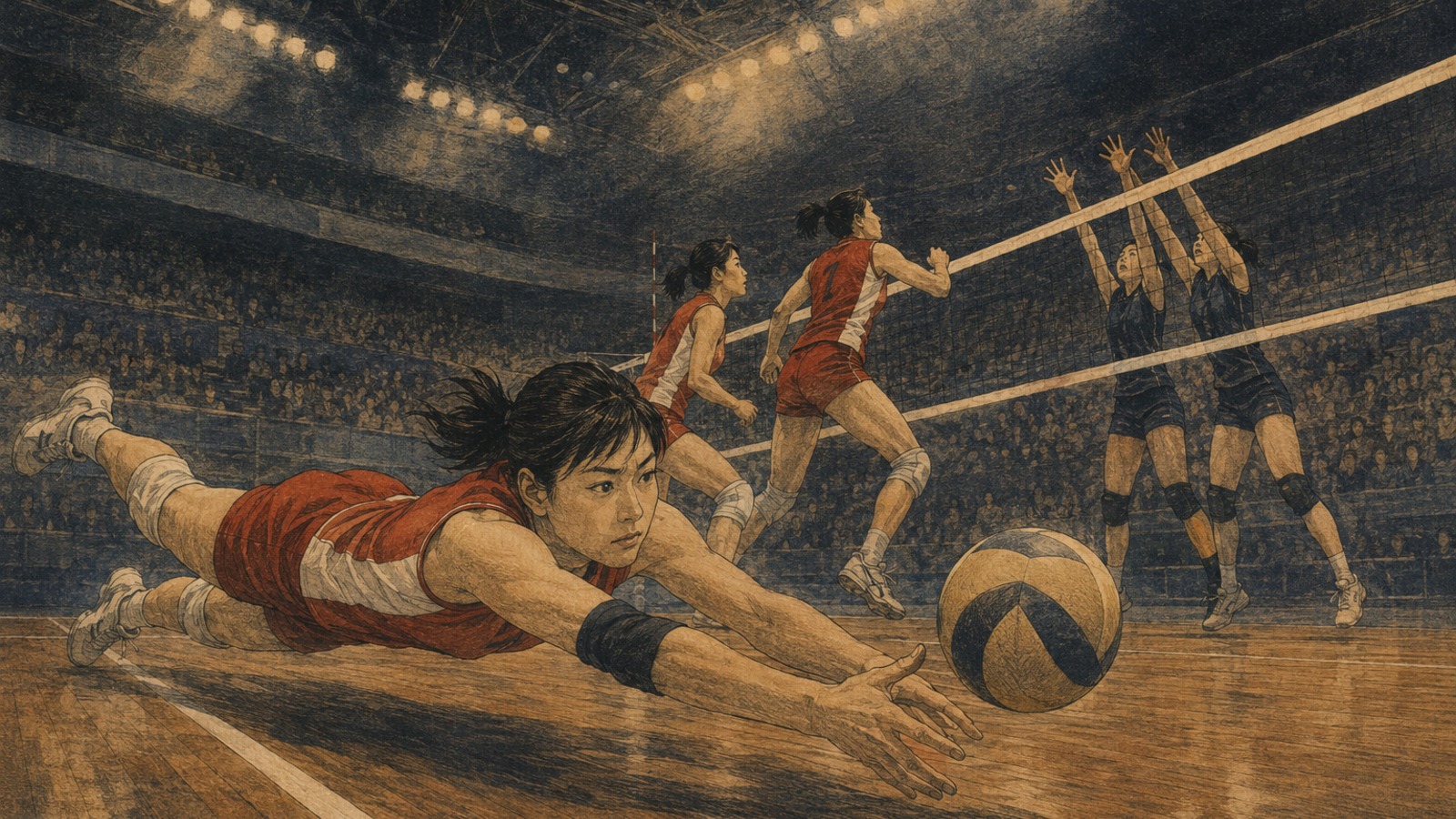
On August 30 in Tianjin, the last ball of the final will strike the floor. In that instant, the winner will receive more than a gold medal. With almost 23 months remaining before the Los Angeles Olympics, one country will already own its place in the tournament. The champion will be released from the qualification calculation. Everyone else will retain a path—but not a guarantee.
The AVC Women’s Volleyball Continental Championship runs from August 21 through 30 in Tianjin, China. The 12-team field consists of Japan, China, Thailand, Korea, Vietnam, Kazakhstan, Chinese Taipei, Australia, Indonesia, Iran, Lebanon and Hong Kong, China. The champion qualifies for LA28 as Asia’s continental representative. The top three also secure places in the 2027 FIVB World Cup, the competition formerly called the World Championship.
For Japan, this is more than an early qualifier. The Olympic history of women’s volleyball began with a Japanese victory. When the sport entered the official program at Tokyo 1964, a national team built around the Nichibo Kaizuka factory side defeated the Soviet Union and became the inaugural champion. Sixty-four years later, the first door toward Los Angeles opens through another Asian championship.
A new qualification system—and a different pressure
The LA28 women’s volleyball tournament will include 12 countries. The United States receives one place as host. The champions of the 2026 Asian, European, African, North and Central American and Caribbean, and South American championships receive five. The top three at the 2027 World Cup take three more, followed by three countries selected through the June 2028 world ranking.
That is a significant change from Paris 2024. Six countries qualified through three global Olympic Qualification Tournaments in 2023. Five more were selected through the world ranking at the end of the 2024 VNL preliminary phase. Japan failed to claim a ticket at the first stage and spent the following season watching ranking points and other nations’ results. On June 14, 2024, the federation was notified that Japan had mathematically met the standard.
The LA28 system restores explicit value to continental champions. It ensures that an actual champion from each region reaches the Olympics rather than allowing ranking alone to dominate the field. But for Asia’s strongest teams, it replaces a broad test of average strength with a concentrated test of tournament survival. A team can carry an excellent world ranking into Tianjin and lose its direct berth in one semifinal.
| Path to LA28 | Places | What it means for Japan |
|---|---|---|
| 2026 Asian Championship | Champion: 1 | Win in Tianjin and qualify immediately—the first opportunity. |
| 2027 World Cup | Top three | Requires a podium-level result against the world’s elite. |
| 2028 FIVB World Ranking | Three | Calculated after the women’s VNL preliminary phase, excluding countries already qualified and applying continental priority. |
| Host nation | One | The United States is guaranteed entry; its confederation uses a special procedure to determine its continental qualifier. |
1964: the origin of Japan’s volleyball identity
On October 23, 1964, at Komazawa Indoor Ball Sports Hall, Japan defeated the Soviet Union 15-11, 15-8, 15-13 to win the first Olympic women’s volleyball gold medal. Japan had already won the 1962 World Championship, yet some overseas observers still treated that victory as an anomaly. An undefeated Olympic campaign at home ended the doubt.
The players whom foreign media labeled the “Oriental Witches” were not physically imposing by international standards; the tallest member stood 170 centimeters. Under coach Hirobumi Daimatsu, they refined tumbling receives, relentless floor defense, speed and coordinated movement. The story of the factory team and its punishing training also reflects the demands placed on women athletes within postwar corporate Japan. It should not be reduced to a romantic slogan. Technically, however, the team established a lasting idea: Japan did not have to accept a height disadvantage if it could change the speed and organization of the game.
Japan won silver at Mexico City 1968 and Munich 1972, returned to gold at Montreal 1976 and took bronze at Los Angeles 1984. After a long absence from the podium, the 2012 team survived a five-set quarterfinal against China and swept Korea in the bronze-medal match, earning Japan’s first Olympic volleyball medal in 28 years.
Through Paris 2024, Japan’s women had appeared in 14 Olympic tournaments, missing only Moscow 1980 and Sydney 2000. Frequency of participation does not guarantee the next invitation. In Paris, Japan arrived after winning its first VNL silver medal, then lost to Poland and Brazil. A straight-set victory over Kenya left the team with a 1-2 record and elimination in the preliminary round. Being able to defeat an elite opponent and producing the necessary result during the most important three matches are different achievements.
1962 · Japan win the Women’s World Championship.
1964 · Gold at the first Olympic women’s volleyball tournament in Tokyo.
1976 · A second Olympic gold in Montreal.
1984 · Bronze at the Los Angeles Olympics.
2012 · Bronze in London, ending a 28-year Olympic medal wait.
2017 and 2019 · Back-to-back Asian titles.
2023 · Third at the Asian Championship.
2024 · VNL silver, followed by a preliminary-round exit in Paris.
2025 · Fourth in both the VNL and World Championship under Akbas.
2026 · The first LA28 berth is available in Tianjin.
Akbas inherits the search for an answer to height
After Paris, Japan appointed Ferhat Akbas. The Turkish coach became the first foreign head coach in the history of the women’s national team. Thirty-eight at the time of his appointment, he spoke of his respect for Japanese discipline, resilience and teamwork while accepting a long-term brief centered on Los Angeles.
In his first international season, Japan finished fourth in the 2025 VNL. At the World Championship, the team defeated defending champion Serbia and survived five sets against the Netherlands to reach its first semifinal since 2010. It again finished fourth. The medal remained out of reach, but Japan proved it could remain among the final four teams at the deepest global event.
For 2026, Akbas named a 37-player national pool that included 14 first-time selections. It reaches from athletes based in overseas leagues and established SV.League players to university and high-school prospects. Mayu Ishikawa is the captain. A central figure in Japan’s 2019 U20 world championship generation, she passed 1,000 career VNL points during the 2026 competition.
Yoshino Sato, Yukiko Wada, setter Nanami Seki, middle blocker Nichika Yamada and libero Satomi Fukudome have been among the core players in this summer’s senior international matches. Their presence in the season, however, should not be confused with an official Tianjin roster. At the reporting deadline, the Japan Volleyball Association had publicly listed the 37-player annual pool but had not announced the championship’s final traveling team.
The Poland match revealed both weapon and weakness
The match that best explains Japan’s 2026 side came against Poland in Osaka. The winner would advance to the VNL Finals. Japan lost the first set 20-25 and the second 14-25, repeatedly caught by Poland’s height at the net. A straight-set defeat seemed close.
Japan responded 25-19, 25-21, 15-13 in front of 7,107 spectators. Ishikawa scored 18 points, Sato 16 and Wada 27. Poland dominated kill blocks 16-2. Japan nevertheless won spike kills 68-56 and service aces 6-2. Instead of trying to erase height with height, Japan disrupted the first pass, extended rallies and converted defense into fast transition attacks. It was a classic Japanese route to victory.
The danger was visible in the same match. When reception drifts away from the net, the setter loses the middle and combination options. A large opposing block can wait on the wings. In a short continental tournament, Japan cannot assume there will always be time to recover after losing two sets.
Japan completed the VNL preliminary phase in sixth place with an 8-4 record. Brazil beat Japan 3-1 in the Macao quarterfinal, leaving the team seventh overall—below its 2024 runner-up result and fourth place in 2025. But the VNL was not only a medal campaign. It gave Akbas a competitive laboratory for a broad player pool. Tianjin is where the experimentation has to become a settled answer.
- Serve: Push the opponent’s reception away from the net and reduce its fastest, tallest attack options.
- First contact: Keep the setter’s full menu open so the block cannot camp on the outside hitters.
- Transition: Do more than keep the ball alive; convert floor defense into a quick scoring chance.
- Late-set judgment: After 20 points, use block touch, hands and open space rather than forcing the perfect kill.
China, Thailand and a tournament without “small” opponents
Only three countries have won the senior Asian women’s championship since it began in 1975: China 13 times, Japan five and Thailand three. The numbers describe a history of concentrated power. They do not divide the single 2026 Olympic berth in advance.
Host China brings reach, high contact points, a varied attack and the pressure of a home crowd in Tianjin. It is the most successful country in Asian Championship history and has won Olympic gold in 1984, 2004 and 2016. If Japan repeatedly attacks directly into a formed Chinese block, the match will belong to China’s preferred geometry.
Defending champion Thailand offers a different problem. In the 2023 Asian semifinal, Thailand defeated Japan 3-2, then beat China 16-14 in the fifth set of the final. Its speed, combinations and composure in a loud arena are not explained by height. Japan eliminated Thailand at the 2025 World Championship, but a prior winning streak does not provide even one point in the next match.
Vietnam can no longer be treated as a peripheral contender. It reached the Asian final four for the first time in 2023 and took Japan to five sets in the bronze-medal match. Korea won the 2026 AVC Women’s Cup. Kazakhstan and Chinese Taipei can turn a short match with serving and height. A format in which second place receives no Olympic ticket changes risk decisions before the semifinal stage.
The value of qualifying now
If Japan secure the place in Tianjin, the national-team program changes immediately. It can use the 2027 World Cup as an elite competition while selecting players with Los Angeles in mind. It does not have to rush an injured player back to protect ranking points in the 2028 VNL. It can give prospects international responsibility, manage the load on Ishikawa and other senior players, and spend more time studying Olympic opponents.
Failure to qualify in Tianjin would not constitute a crisis. Japan remain among the leading international teams. They reached the 2025 World Championship semifinals and the 2026 VNL knockout round. They have the ability to take a top-three World Cup place or remain high enough in the world ranking. But “capable of qualifying” and “qualified” are different states. Injury, generational turnover, ranking mathematics and results on other continents would enter every selection decision for another two years.
Early qualification carries a subtler risk. If urgency disappears and internal competition weakens, two years can become too much preparation time. Winning Asia would not mean Japan had solved Los Angeles. The challenge of maintaining side-out efficiency through repeated matches against large European and American teams would remain.
Beyond the ticket
At Japan’s May launch event, Akbas called 2026 a season in which the team had to secure its Olympic ticket “as early as possible.” He finished with another ambition: to put Japan’s flag at the highest point. At the Asian Championship, those two outcomes are identical. The flag goes up, and the Olympic place is won.
The history of Japanese women’s volleyball is often told through creative responses to physical disadvantage. In 1964, reception and coordinated movement altered what the game could look like. In 2012, floor defense and varied offense returned Japan to the podium. The 2026 answer cannot be a repetition of old rhetoric. It has to combine serving data, block-defense positioning, a deeper roster, overseas experience and load management into one team during a short tournament.
When the final rally begins in Tianjin, the 1964 gold medal will not contribute a point. Neither the world ranking nor a fourth-place finish from the previous year can put the ball on the floor. What remains is the accuracy of the first, second and third contacts—and the ability to return to the next point when the system breaks.
Win, and Japan go to Los Angeles. Lose, and the road continues. That simplicity is what makes these 10 days the heaviest of Japan’s 2026 season.
- Asian Volleyball Confederation: qualified teams for the 2026 Continental Championships — venue, dates, 12-team field and Olympic/World Cup implications.
- Japan Volleyball Association: LA28 qualification process — allocation and timing of the 12 places.
- JVA 2026 women’s national-team launch and 2026 registered player pool — Akbas’s objective and the 37 players.
- Volleyball World: Japan’s 2026 VNL comeback against Poland and quarterfinal against Brazil.
- FIVB: Ferhat Akbas appointed Japan head coach and JVA: Japan reach the 2025 World Championship semifinals.
- FIVB: Tokyo 1964 and Japan’s inaugural Olympic champions and Japan’s Olympic participation and medal history.
- AVC: Japan retain the Asian title in 2019 and AVC: Thailand win in 2023; Japan take bronze.
- JVA: Japan qualify for Paris 2024 and Japan’s final Paris preliminary match.
Editor’s note: The tournament draw, detailed schedule and final player registration may be added or changed in subsequent organizer and JVA announcements. This article reflects official information available at the reporting deadline and distinguishes the 37-player annual pool from the final championship roster. Because world rankings change with match results, no fixed ranking is used here as a prediction of the champion.