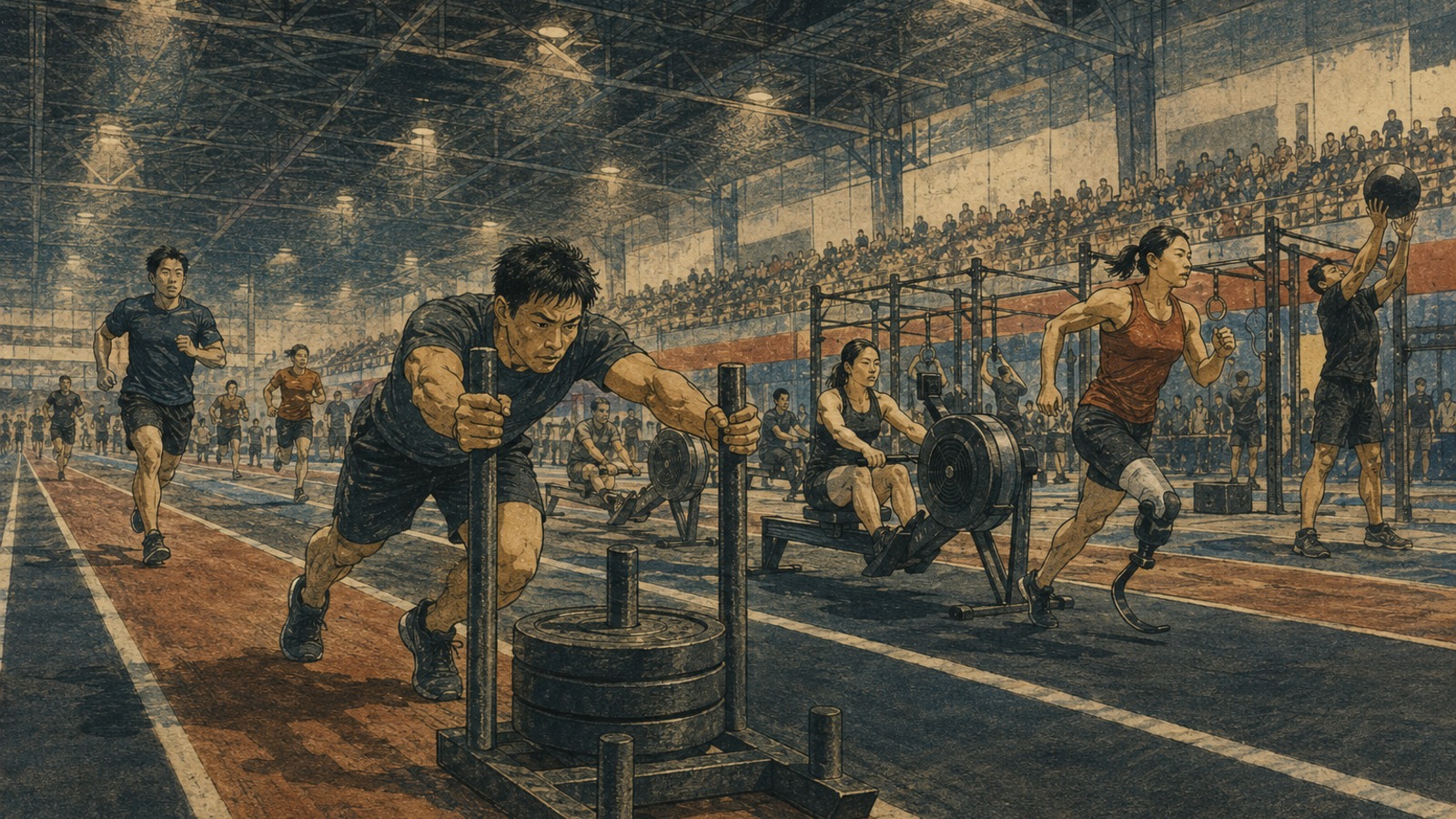
The first kilometer is a little too fast. The body feels light, and music and cheering ricochet through the exhibition hall. After 1,000 meters on the SkiErg, the athlete runs again. Station two is the sled push. Friction arrests the legs, and a pace that looked effortless moments earlier becomes a debt.
The essence of HYROX is not technical mystery. It places familiar actions—running, pushing, pulling, jumping, rowing, carrying and squatting—in an order that offers nowhere to hide. Each can be completed alone. The problem is doing the next one with the fatigue created by the last, while the same clock continues to move.
AirAsia HYROX Chiba, held August 6–9 in Halls 1 and 2 of Makuhari Messe, was Japan’s third HYROX. Before the race, organizers projected approximately 12,000 participants, 48% more than the 8,087 reported for Osaka early this year, and expanded to Japan’s first four-day event. Women and men in Open and Pro, Doubles, Mixed, Relay and Adaptive divisions started in waves from morning into the evening.
A fixed order creates the sport
The sequence is the same around the world. Run one kilometer, then complete 1,000 meters on a SkiErg. Run another kilometer, push a sled for 50 meters. Run again, pull the sled for 50. The pattern continues through 80 meters of burpee broad jumps, a 1,000-meter row, a 200-meter farmers carry and 100 meters of sandbag lunges. After the eighth kilometer comes the last station: 100 wall balls.
| Order | Workout | The fatigue problem |
|---|---|---|
| 1 | 1,000 m SkiErg | Pulling only with the arms spends the back and trunk needed later |
| 2–3 | 50 m sled push and 50 m sled pull | Strength must be converted through posture, stride, rope technique and floor friction |
| 4 | 80 m burpee broad jump | Repeated vertical and forward movement raises the cost of returning to the run |
| 5 | 1,000 m row | Too fast empties the legs; too easy abandons time |
| 6 | 200 m farmers carry | Grip, shoulders and trunk must hold while stride remains efficient |
| 7 | 100 m sandbag lunges | Fatigued legs must still reach a valid depth repeatedly |
| 8 | 100 wall balls | The athlete must preserve squat depth and target height at the finish |
Consistency is what turns the event from circuit training into a race. A 90-minute performance in Tokyo can be compared with one in Osaka or Hong Kong. The run layout, surface, congestion and transition distance are not perfectly identical from venue to venue, but participants confront the same station order, prescribed distance and repetition count. They can measure themselves against a previous result, an age group and a global leaderboard.
CrossFit competition emphasizes breadth and adaptation, often including events unknown until close to competition. HYROX made predictability the product. Like a marathon, a date can anchor a training cycle. Unlike an eight-kilometer road race, running fast is insufficient. Movements already familiar to gym members are transformed by a bib, timing mat, judges, spectators and a finish result.
Germany, 2017: a marathon for gym members
HYROX began in Germany in 2017. Its official history credits Christian Toetzke, an experienced organizer of mass-participation races; Moritz Fürste, a field hockey world champion and three-time Olympic medalist; and marketing executive Michael Trautmann. They saw a straightforward gap. Runners had 10Ks, half-marathons and marathons. Swimmers and cyclists had public events. But ordinary members combining aerobic work and strength several times a week had few large, repeatable competitions in which everyone recorded a result on the same course.
The design borrows proven elements from mass sport. No qualifying performance is required. Age groups and regular start waves make room for different speeds. An athlete can race alone in Open or with heavier Pro loads, divide station work with a Doubles partner, or split the event among four Relay members. The organization imposes no general finish-time cutoff and says more than 98% of starters complete their race. That completion claim is not accompanied on the history page by a detailed methodology and should be read as an organizer figure.
Indoor convention centers were another consequential choice. Weather is reduced as a variable, and multiple heavy sleds and ergometers can remain in fixed lanes. Spectators can move along the course and see a friend repeatedly. A marathon supporter may catch a runner for seconds; a HYROX supporter can find that athlete at the sled, row and final wall balls. The density makes an individual time trial feel communal.
The official history records more than 90,000 athletes in the 2022–23 season. Puma’s Japan operation says the 2024–25 season grew to 74 events and more than 650,000 participants, with more than 100 events planned for 2025–26. Definitions and forecasts should be checked season by season, but the underlying expansion is visible in the official calendar and in events that now require several consecutive days.
Japan grew from one day to four in a year
Japan’s first HYROX took place at Pacifico Yokohama on August 9, 2025. There were 3,820 registrations; the organizer’s post-event release described approximately 3,800 participants. Less than six months later, the January 30–February 1, 2026 event at Intex Osaka expanded to three days and a reported 8,087 participants. Six months after that, Chiba ran for four days with a pre-event projection of about 12,000.
2017 · HYROX is founded in Germany.
August 2025 · Japan debuts at Pacifico Yokohama: 3,820 registrations and about 3,800 participants reported.
January–February 2026 · Three days at Intex Osaka: 8,087 participants reported.
August 2026 · Japan’s first four-day event at Makuhari Messe: about 12,000 projected before the race.
January 2027 · The next Osaka event is scheduled.
April 2027 · Nagoya is scheduled to join the circuit.
June 2027 · Hong Kong is scheduled to host the first HYROX World Championships in Asia.
The sequence does not prove that the same domestic audience multiplied at every stop. Published figures mix registration and participation, and public data do not fully separate international visitors, relay members and repeat athletes. Still, moving from one day to three and then four is an operational commitment that requires substantial ticket demand and depth across divisions.
Before Chiba, HYROX APAC operations head Richard Cowley called the event “an important step” in establishing roots in Japan. He said the organization intended to deepen partnerships with local gyms and add cities and races. The announced 2026–27 regional calendar now includes another Osaka event and an April 2027 race in Nagoya. Chiba was therefore more than one large production; it tested whether Japan can support a touring competition economy.
Japan already has two large pools of potential racers
The domestic foundation exists in two exercise populations that have largely developed apart. A 2024 Sasakawa Sports Foundation survey estimated that 16.29 million Japanese adults performed strength training at least once during the year. The participation rate was 15.9%, more than double the 7.3% recorded in 2000. The same research program estimated 7.58 million adult joggers and runners, or 7.4%. That was below the 2020 peak of 10.2%, although the rate in Tokyo’s 23 wards remained 10.1%.
Those figures cannot simply be added into a HYROX market. Many people appear in both groups, and “at least once a year” includes infrequent activity. They do establish that millions already know the basic movements at the race’s entrance. For road runners, HYROX reduces total running distance while adding uncertainty under load. For strength trainees, it replaces maximum weight with the demand to keep moving while fatigued.
A race date also changes time inside the gym. “Get healthy” or “be in shape by summer” becomes: in 12 weeks, push a sled and sustain eight measured kilometers. Training partners can share the plan. Certified gyms, specialist classes, footwear, wearables, nutrition and travel form a market around it. In 2026, a facility in Motoyawata, Chiba, added an official HYROX training area, while a 24-hour Osaka gym prepared race-specific programming.
Commercial growth does not automatically diminish sport. City marathons grew alongside businesses in shoes, watches, tourism, charity and corporate teams. The better questions are whether participants receive safe preparation, consistent judging and value for their fee, and whether local coaches retain knowledge after the temporary arena is dismantled.
Strength alone is not enough; speed alone is not enough
The first pacing decision is uncomfortable. A runner can save time early and lose the legs on the sled. A powerful athlete can dominate the stations yet pay time on every kilometer. Movement through the transition area—the “Roxzone”—also remains on the clock, so drinking, navigation and entering equipment inefficiently can accumulate into minutes.
A peer-reviewed study published in 2026 analyzed 350 annual top-50 men’s Pro performances across seven seasons from 2018 through 2024. Total times improved by more than 20%, with significant reductions in running, workout and transition time. Wall balls, the sled pull and farmers carry produced some of the largest station improvements, while the eighth run improved most among the running segments. As the competition matured, elite athletes appear to have learned not merely to become fitter, but to preserve speed late and acquire event-specific technique.
The limits matter. This was a repeated cross-sectional analysis of publicly available elite men’s splits, not a seven-year longitudinal study of the same athletes. It cannot establish the physiological reason for improvement, and it should not be generalized directly to women, adaptive athletes or recreational entrants. Scientific study of HYROX remains young relative to its commercial growth.
The broader literature on concurrent strength and endurance training also resists a universal claim. A 2024 meta-analysis combined 59 studies and 1,346 healthy adults. Concurrent training produced a small reduction in lower-body strength adaptation among men but not women. Clear sex differences were not found for upper-body strength, power or maximal oxygen uptake; untrained participants, but not trained endurance athletes, showed impaired gains in maximal oxygen uptake. Training history, volume, intensity, recovery and exercise order can change the response.
- “It is only eight kilometers.” Every kilometer restarts on legs fatigued by a different task; pacing differs from a continuous run.
- “Strength solves the sled.” Floor friction, body angle, stride and rope management determine how force becomes time.
- “No cutoff means no risk.” A finishable design is not the same as safe participation without preparation.
- “Every segment should be maximal.” Seconds won early can become minutes lost during lunges and wall balls.
“Everybody” does not mean “identical”
HYROX admits participants from age 16 and provides Solo, Doubles and Relay paths. Open and Pro use different loads. The official standard, for example, lists a 102-kilogram sled push including the sled for Women Open and 152 kilograms for Men Open, with heavier Pro standards. Doubles partners run all eight kilometers together but divide station repetitions as they choose. In Relay, each of four participants performs two one-kilometer runs and two stations.
Those multiple entrances are central to growth. Someone anxious about running can begin with only two kilometers in a four-person team. A pair can develop division strategy; an experienced racer can progress to Pro. Participants share the venue and basic architecture while changing how much work and responsibility each individual carries.
An Adaptive division was also included, with 24 athletes projected before Chiba. During the event, Kinniku Ikyoku—a group of doctors, dentists and students involved in bodybuilding—and VAMOS TOGETHER announced a men’s relay project with a participant who has Down syndrome. Inclusion cannot be evaluated from a projected head count alone. Rules, implements, judging, routes, assistance and information must be reviewed against different disabilities, with post-event findings made public.
Being in the same event is not the same as competing under identical conditions, and identical conditions are not always equitable. Meaningful standardization identifies why an adaptation is necessary and honestly defines the range within which results remain comparable.
Why Makuhari Messe fits
Makuhari Messe has long absorbed vast flows of people for trade shows, games, music and sports. HYROX belongs in an exhibition center more naturally than a traditional stadium. A long running loop can fold through the hall; duplicate implements can be arranged in central lanes; waves can move through the system all day. Chiba used Exhibition Halls 1 and 2, operating from 8 a.m. to 10 p.m. on the first three days and ending at 2 p.m. on Sunday.
An indoor August event avoids direct sun and road closures. It does not eliminate thermal or medical load. Thousands of bodies, lighting and prolonged high-intensity effort make hydration, airflow, medical response and wave density part of race quality. When a competition grows from several thousand entrants to a projected five figures, important records include not only the fastest time but medical incidents, waiting, penalties and participant demographics.
A sport built on standardization can standardize its operational data as well. It can separate registrations, starters and finishers; report division, age, sex, nationality and adaptive participation; measure how floor material changes sled resistance; and publish venue-specific running and transition distances. Transparency strengthens the promise that an athlete can meaningfully compare Chiba with Hong Kong.
What turns a fitness trend into a sport
Fitness produces new methods in fast cycles. Painful movements that photograph well, limited-edition shoes and finish-line images can create temporary excitement. HYROX has all those commercial channels. It also has components capable of converting a workout fashion into an institution: fixed rules, public splits, age groups, year-round local training and a route toward a world championship.
The next evidence will be retention, not launch demand. How many first-time participants return? Who is injured or priced out? Do women, older athletes and adaptive participants remain? A few elite athletes becoming faster is not enough for a mass-participation sport. The stronger test is whether an ordinary worker can train safely with a local community, return one year later and improve.
Japan moved from one day in Yokohama to three in Osaka and four in Chiba within a year. Osaka, Nagoya and the Hong Kong World Championships are on the 2027 calendar. That speed is both opportunity and examination. Judge education, equipment consistency, medical planning, volunteers and results data must mature as quickly as ticket sales.
When an athlete reaches the final 100 wall balls at Makuhari, eight kilometers and seven other stations are already inside the legs. A ball that misses the target does not count. Squat, throw, catch, repeat. To the crowd, the motion looks the same each time. To the athlete, every repetition is a new negotiation: the legs want to stop, the clock continues, and the neighboring lane is suffering too.
Whether HYROX lasts in Japan will not be decided by the 12,000 projection alone. It depends on whether the people who found meaning in that repetition run again the following week, push again and invite someone else. Effort that had been private inside a gym became a shared result in Makuhari. New sports begin there.
- HYROX Japan: AirAsia HYROX Chiba pre-event release — projected 12,000 participants, 48% growth over Osaka, divisions, operations comment and future APAC calendar.
- Official HYROX Chiba event page and Makuhari Messe event listing — dates, venue, waves and athlete information.
- HYROX: official format, distances, loads and divisions, and official history — founders, mass-participation design and organizer completion claim.
- HYROX Japan: post-event release for Yokohama 2025, and post-event release for Osaka 2026 — growth of Japan’s events.
- Sasakawa Sports Foundation: Japan’s 2024 strength-training population, and jogging and running population.
- Rodríguez-Fernández et al. (2026): seven-season analysis of elite men’s HYROX results — 350 top-50 performances and pacing changes.
- Petré et al. (2024): systematic review and meta-analysis of concurrent strength and endurance training — 59 studies and 1,346 participants.
- HYROX: 2027 World Championships in Hong Kong.
Editor’s note: The 12,000 Chiba figure and 24 Adaptive athletes were pre-event organizer projections, not confirmed results. A final breakdown of registrations, starts and finishes had not been published by the reporting deadline. This article distinguishes organizer and corporate statements from independent survey data and peer-reviewed research. The cited research examined elite men or general concurrent training; it did not directly measure the full Chiba field.