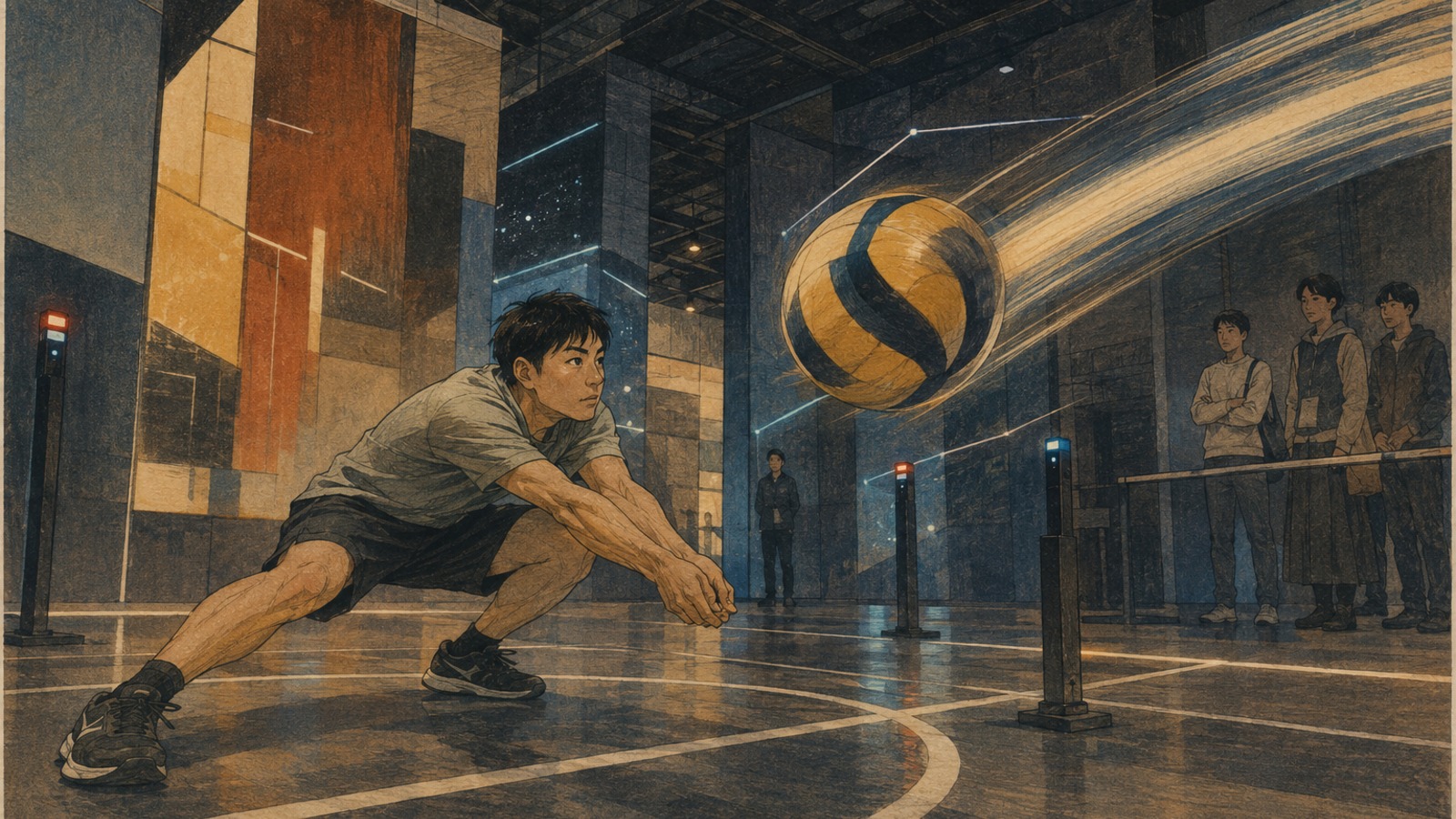
Stand on the footprints. A server takes shape on the screen. Toss, approach, contact. The visitor must infer where the ball will fall, move left or right and join the forearms into a passing platform. By the time the receive feels possible, the judgment has already been made.
“Gachi Receive Battle!” at Haikyu!! On the Court, an immersive volleyball exhibition at Bellesalle Roppongi in Tokyo, is not simply a place to watch celebrated anime sequences. It asks visitors to synchronize their bodies with a projected serve and grades how accurately they keep the ball alive. Four fictional servers—Yamaguchi, Oikawa, Ushijima and Miya—present different problems. Results range across five ranks, from “first day in the club” to “libero,” with six variations at each level and 30 result screens in all.
According to the organizing committee, the share of attempts that complete every receive and reach the highest libero result is 0.05%, or roughly one in 2,000. Nobuhiko Okamoto, the voice actor for Karasuno libero Yū Nishinoya, achieved a perfect result on his fourth try at the Tokyo media preview. His reaction was more illuminating than the rank: “I honestly had no idea how hard 0.2 seconds could be.”
From watching “jump, hit, connect” to doing it
The exhibition opened at Osaka’s Dojima River Forum from June 27 through August 2 before moving to Tokyo on August 7. Its Roppongi run is scheduled through September 13. Twelve anime characters, using newly recorded voices, guide visitors through three zones: “Jump,” “Hit” and “Connect.”
In the Jump zone, a net is projected on a wall about five meters high. A visitor selects one of six characters, gets 15 seconds to approach and leap, then receives a measured maximum reach. Former Japan captain Masahiro Yanagida reached 310 centimeters at the preview, below his own playing maximum of 340. The Hit zone’s “Synchro Court” spatializes four attacks: the minus-tempo quick, the broad attack, the back-row attack and the “don” jump. Viewers can consider speed, lateral distance, disguise and impact from positions on both sides of the imagined play.
The exhibition’s sharpest curatorial decision is to end with Connect. A jump and a spike look heroic at once. A receiver lowers the hips, absorbs the ball on the arms and gives it away. The scorer’s name survives in the box score; the benefit of a good pass appears indirectly as freedom for the setter and hitter. Spectators often notice its value only when it is absent.
| Zone | What visitors do | What becomes visible |
|---|---|---|
| Jump | Measure maximum reach after an approach | Takeoff, timing and aerial range beyond simple height |
| Hit | Watch four attacks from inside the court space | How speed, movement, decoys and timing open the floor |
| Connect | Read projected serves, move laterally and receive | Anticipation, positioning and first-contact quality before an attack exists |
A receive is not “just reflex”
Serve reception can look like a simple response: put two arms in front of an approaching object. It is actually a chain of information and action. The receiver reads the server’s toss, shoulder, elbow, wrist and contact point; estimates type and direction; judges responsibility within the passing formation; moves the body behind the path; and sets the platform toward the setter. Commit too early and late movement defeats the prediction. Wait too long and the ball is gone.
A 2015 study analyzed 347 serve receptions from five international matches played by the Netherlands men’s national team. The timing of the first foot movement was linked to elapsed time after the serve, while arm movement was organized relative to the remaining time before contact. In other words, an elite receiver does not operate on one clock. The feet begin securing a place from early information; the arms continue using the developing flight to shape the final interception.
That distinction explains the peculiar frustration of the attraction. Hurry the arms while the torso remains outside the ball’s path and the platform cannot send a controlled pass. Rush to a spot and freeze, and a jump float serve can move away late. QuizKnock member Shunki Sugai said the simulated jump float changed near him and proved difficult to track. A real low-spin serve similarly experiences uneven aerodynamic forces that can create late lateral movement or a drop.
Speed removes options as well. A 2024 peer-reviewed study measured 1,270 jump topspin serves by 65 male professional players. The average was 88.2 kilometers per hour, and reception quality deteriorated significantly as speed rose. Above 92 km/h, the serve offered a substantial advantage to the serving team, although the risk of an error also increased.
The meaningful outcome is not binary—returned or missed. A strong first contact brings the setter toward the planned position at the net and preserves attacks through the middle, both pins and the back row. A pass that is too low, drifts off the net or crosses it may technically continue the rally while shrinking the offense. Reception accuracy is converted, one contact later, into how much court the opposing block must defend.
What 0.2 seconds does—and does not—mean
Okamoto’s 0.2-second remark describes the severe decision or input window he felt inside the attraction. It does not mean that a physical volleyball always travels from the server’s hand to the receiver in 0.2 seconds. Flight time changes with speed, contact point and receiver position. A projection-and-sensor game also has a scoring window distinct from the full flight of a real ball.
Even Yanagida said the challenge felt faster than an actual serve, and he did not reach the top rank in the preview. That does not invalidate an elite player’s passing ability. It shows that learning screen depth, sensor thresholds and synchronization is not the same expertise as reading a physical ball.
In a match, the receiver can use the ball’s rotation and seams, the server’s full body, teammate locations, lighting, air movement and the recent serving pattern. A real ball carries mass into the arms and rebounds according to the platform angle. The exhibition can reproduce only part of that information. It instead compresses the decision for a brief public experience and converts deviation into an immediate result. The exaggeration creates both entertainment and an educational shock.
- It can teach: early recognition, lateral initiation, platform timing and the felt improvement of another attempt.
- It can teach: that different serve types look different and that a defensive mistake becomes visible immediately.
- It cannot reproduce: ball mass, spin, impact on the arms or the three-dimensional flight of a pass to the setter.
- It cannot measure: volleyball talent, match-level reception ability or an official reaction time.
How “Haikyu!!” made defense a protagonist
Haruichi Furudate’s Haikyu!! began in Weekly Shonen Jump in February 2012. Starting with the meeting of undersized jumper Shōyō Hinata and prodigious setter Tobio Kageyama, it follows Karasuno High as its players relearn how to become a team. The series ended in July 2020 after eight and a half years. Its 45 collected volumes have surpassed a reported 75 million copies in circulation.
The television anime began in 2014 and completed four seasons by 2020. The 2024 film Haikyu!! The Dumpster Battle drew more than 2.6 million admissions and ¥3.8 billion in Japan during its first nine days. By August of that year, distributor Toho said it had played in 79 countries and territories and surpassed ¥20.4 billion at the global box office. A school-club manga had become an international vocabulary that also appeared inside real volleyball arenas.
Popularity cannot responsibly be converted into a simple claim about participation. Japan’s shrinking youth population, changes in school clubs, national-team results, streaming access and many other forces operate at the same time. The institutional links are nevertheless concrete. The Japan Volleyball Association collaborated with the series across multiple Emperor’s and Empress’s Cup campaigns. In 2020, the FIVB described a V.League promotion pairing players from all 10 men’s first-division teams with Karasuno characters. Yanagida says he has met spectators drawn to real matches by Haikyu!! and seen its response while playing abroad.
One reason the story fits the sport so well is that it does not reserve narrative importance for scorers. Hinata’s leap and Kageyama’s set matter, but so do Nishinoya’s and Morisuke Yaku’s defense, Daichi Sawamura’s stability, a touch off the block and the extra step that covers a hitter. The rules themselves become drama: one player saves, a second organizes and a third finishes.
The libero is a relatively new guardian
The libero now feels inseparable from volleyball, but the international position is recent. The FIVB officially used the libero and rally-point scoring at the 1998 World Championships. Wearing a contrasting uniform, the backcourt specialist improved serve reception, extended rallies and created a prominent role in which reading and floor defense could matter more than height.
Haikyu!! does not treat that specialty as merely the refuge of a shorter athlete. Nishinoya puts his body behind attacks; Yaku erases lanes by standing so correctly that opponents prefer not to serve toward him. Great libero play contains a paradox. Proper positioning reduces the need for spectacular dives, and a defender whom servers avoid may receive fewer balls. Invisibility can be evidence of control.
That makes “libero level” an apt final rank. Beginners naturally admire the kill. The exhibition uses that desire as an entrance, then makes its hardest demand the contact before any attack is possible. The rank is not simply a difficulty label; it is an act of respect for the role.
From a story you watch to one in which you can fail
Manga can stretch an instant across panels. Anime uses slow motion, sound and changes of viewpoint to make thought visible. A reader can learn the server’s intention before seeing where the ball lands. On the court, the order reverses. There is no internal monologue to explain the cue. The body must answer first.
In a 2024 laboratory experiment, 26 expert and 23 amateur male volleyball players watched spike actions cut off at different points and predicted their outcome. Under the medium-information condition, experts achieved 68% accuracy against 55% for amateurs, and responded in about 475 milliseconds versus 726. The task tested spike anticipation rather than serve reception, involved a small male-only sample and should not be generalized beyond that design. It nevertheless supports a useful point: part of what looks like a faster reaction is the learned ability to extract information before the ball is struck.
On the Court is not a sports laboratory. It does give fans the same category of perceptual problem in a safe, repeatable form. Where is it going? When should I move? How long can I wait? After failure, cues that once looked like animation—the angle of a shoulder, the rhythm of an approach—begin to look like information. The strongest immersive exhibition does more than decorate a fictional world convincingly. It changes how visitors see the real one.
What remains after 0.05%
An extremely low completion rate makes an efficient headline. A shareable “libero” image becomes proof of achievement and an invitation to try again. But if an event uses the figure publicly, disclosing the number of attempts, dates, treatment of repeat visitors and the sensor definition of success would make 0.05% more meaningful. Transparency would not destroy the magic. It would fit a series admired for taking the mechanics of its sport seriously.
What can be said is that Okamoto completed it on his fourth attempt, while a former Japan captain did not escape the beginner result at his preview. It would be pointless to rank their volleyball ability from that outcome. Familiarity with the apparatus matters. The more interesting feature is that experts and people who have not touched a volleyball since physical education can share the same kind of failure—and move again to connect one ball.
No volleyball player can possess the ball for long. The value of a contact is completed by the next contact. A receiver may never score the point, yet the angle of the forearms expands the setter’s choices, divides the blockers’ attention and frees a hitter’s approach.
When the projected ball lands and the screen says “first day in the club,” the experience has not ended in failure. On the next attempt, the visitor watches the feet before the arms, the shoulder before the ball, and waits a fraction longer. The growth Haikyu!! has portrayed for years is not one miraculous play. It is that loop of correction.
The 0.05% statistic is a vivid entrance. What lasts after leaving the hall is something else. During the next televised match, a viewer notices that one second before the spectacular kill, somebody raised a nearly lost ball from the floor. At that moment, the receive challenge has achieved its most complete success.
- Haikyu!! On the Court organizing committee: Tokyo opening release — experience design, grading, preview results and comments, dates and venue. Figures and attributed remarks are organizer-supplied.
- Haikyu!! On the Court official site — current admission information, tickets and visitor notices.
- Shueisha’s official Shonen Jump page for Haikyu!! — 2012 debut, characters and 45 collected volumes.
- Toho: The Dumpster Battle “Last Match” event — distribution in 79 countries and territories and worldwide box office.
- Japan Volleyball Association: Emperor’s and Empress’s Cup collaboration, and FIVB: series and V.League collaboration.
- Benerink et al. (2015): different temporal bases for body and arm movement in reception — 347 events from five men’s internationals.
- Petrů and Vencúrik (2024): jump topspin speed and reception quality — 65 male professionals and 1,270 serves.
- Li et al. (2024): action anticipation by expert and amateur volleyball players — video-occlusion task and response time.
- FIVB: basic rules and the history of the libero.
Editor’s note: The 0.05% figure comes from the organizer and was not audited by Japan.co.jp. The release does not publish the sample size, collection period, treatment of repeat attempts or sensor standard for perfect completion. The scientific studies involve populations and tasks different from the attraction; they are used as background on real reception, not as validation of the game. Dates and admission conditions may change, so visitors should consult the official site before traveling.