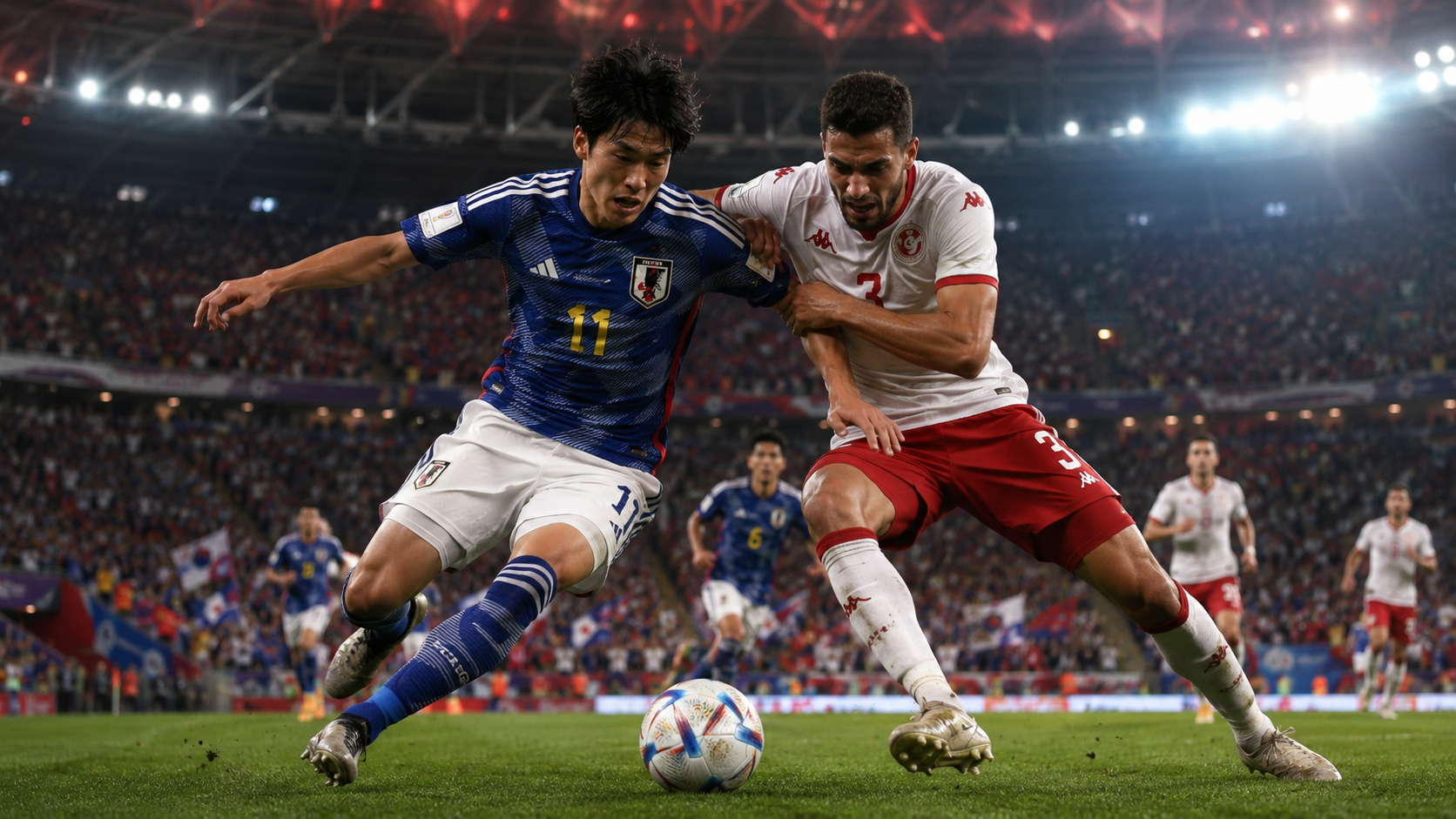
Japan’s next World Cup match is no longer just the second game of Group F. It has become a pressure test. Japan opened with a 2-2 draw against the Netherlands, showing resilience after a difficult start and taking a useful point from one of the group’s strongest teams. Tunisia, meanwhile, collapsed 5-1 against Sweden in Monterrey and responded by firing Sabri Lamouchi after one game, replacing him with Hervé Renard. What looked like a manageable fixture for Japan has become something stranger: a match against a wounded opponent under a new coach with almost nothing left to protect.
The danger for Japan is psychological as much as tactical. Tunisia’s heavy defeat may suggest weakness, but it also creates urgency. Renard is not an anonymous emergency caretaker. He has won the Africa Cup of Nations with Zambia and Ivory Coast, managed Morocco and Saudi Arabia at World Cups, and led Saudi Arabia to one of the great shocks of 2022 against Argentina. His appointment can restore order. It can also turn Tunisia’s desperation into a sharper, simpler, more emotional game plan.
The Dutch draw gave Japan hope — and homework
Japan’s opener against the Netherlands was a game of two very different halves. The first was controlled and cautious; the second burst open. Japan’s ability to fight back mattered. It suggested the team still has the nerve, pace and technical confidence to disturb elite opposition on a large stage. A point against the Dutch is a respectable platform.
But a point is not a ticket. Japan still conceded twice, still has to manage the absence of Wataru Endo, and still faces Sweden in the final group match. The Tunisia game therefore becomes the hinge of the campaign. Win, and Japan can approach the final match with room to breathe. Draw, and the mathematics become uncomfortable. Lose, and the courage of the Dutch match begins to look like an opportunity wasted.
Is Tunisia broken, or about to change shape?
Tunisia arrived with a reputation for defensive strength. In African qualification, that reputation had weight. Against Sweden, it collapsed. The 5-1 defeat exposed problems in structure, selection and confidence. Lamouchi had only been appointed in January and had little time to build a system before the tournament. His five-match tenure ended with Tunisia’s first group game.
Mid-tournament sackings are rare but not impossible, and Tunisia has its own history of abrupt coaching decisions. This one is both a punishment and a gamble. The federation did not simply accept that the tournament was lost. It reached for Renard, a coach whose career has often been defined by turning national teams into compact, emotionally committed units.
Renard as a short-term prescription
Renard’s reputation is built on more than charisma. He won African titles with Zambia in 2012 and Ivory Coast in 2015. He previously managed Morocco at the 2018 World Cup and Saudi Arabia in 2022. He is known for direct communication, defensive organization and the ability to make teams believe quickly. That matters when a coach has days, not months.
Still, there are limits. Renard cannot install a complex tactical model before facing Japan. He can simplify. He can narrow the midfield. He can ask the back line to defend zones rather than chase. He can make set pieces a weapon. He can tell players that one result changes the story. Japan must prepare not for the Tunisia that lost to Sweden, but for the Tunisia that may appear in reaction to humiliation.
What Japan must fear
The first danger is the opening 15 minutes. A wounded team under a new coach often begins with emotion and contact. If Japan allows Tunisia to make the match chaotic early, the stadium will feel different. The second danger is set pieces. A team with little training time can still attack corners, free kicks and second balls. The third danger is Japan’s own impatience. The idea that Tunisia is “there to be beaten” can lead to rushed attacks and exposed transitions.
Japan’s best path is control. Move the ball fast, but do not make the match frantic. Stretch Tunisia, but do not leave the centre unguarded. Force Renard’s new structure to make decisions repeatedly. If Tunisia presses, Japan can play behind it. If Tunisia sits, Japan must use width and patience. The match may be won not by a spectacular attack but by making Tunisia defend for long, uncomfortable stretches.

The Endo absence still matters
Before the tournament, Wataru Endo withdrew from Japan’s squad because of injury and announced his international retirement. The loss is more than symbolic. Endo was a ball-winner, a reader of danger and a player who gave Japan emotional balance in midfield. His absence changes the way Japan protects leads, resists counterattacks and manages transitions.
The question is not who becomes “the new Endo.” The question is how the team divides his functions. One player may screen. Another may lead pressing cues. Another may control tempo. Against Tunisia, where the game could swing between defensive blocks and sudden counterattacks, that collective midfield discipline will be essential.
The group math
Group F is already complicated. Sweden’s goal difference is strong after the 5-1 win. The Netherlands and Japan sit on one point each. Tunisia is at the bottom with a heavy negative goal difference, but the expanded 48-team tournament keeps third-place routes alive. That gives Tunisia a reason to fight and a reason not to settle for damage limitation.
For Japan, the calculation is clearer. Three points against Tunisia would turn the Sweden match into a platform rather than a rescue mission. A draw would leave Japan dependent on the final match and potentially third-place comparisons. A loss would make the Dutch draw feel like a missed chance. This is why the pressure is so real: the match is not glamorous, but it may define the campaign.
- Whether Japan survives Tunisia’s likely emotional opening spell.
- How quickly Renard can rebuild Tunisia’s defensive structure.
- Japan’s midfield balance without Endo.
- Set pieces, especially if Tunisia simplifies its attacking plan.
- The effect of the expanded format on risk-taking from both sides.
Monterrey at night, Japan at lunchtime
The match will be played at night in Monterrey and watched at lunchtime in Japan. The timing gives it a different national rhythm. This will not be a bleary-eyed dawn fixture. It will arrive in the middle of the day, carrying the power to turn a workday into a football moment.
Japan’s World Cup question has often been the same: can it move from impressive performances against giants to cold, controlled victories in matches that must be won? Tunisia is wounded, but wounded opponents can be dangerous. Japan cannot win this with narrative. It must win it with structure, concentration and the maturity to keep the match on its own terms.
The stakes are simple. Beat Tunisia, and Japan’s campaign has direction. Fail to do so, and Group F becomes a maze. Monterrey will test not only Japan’s talent, but its tournament character.
Sources and references
This JAPAN.co.jp report is based on public reporting and match information from FIFA, Reuters, Jiji-linked reporting and major international outlets.