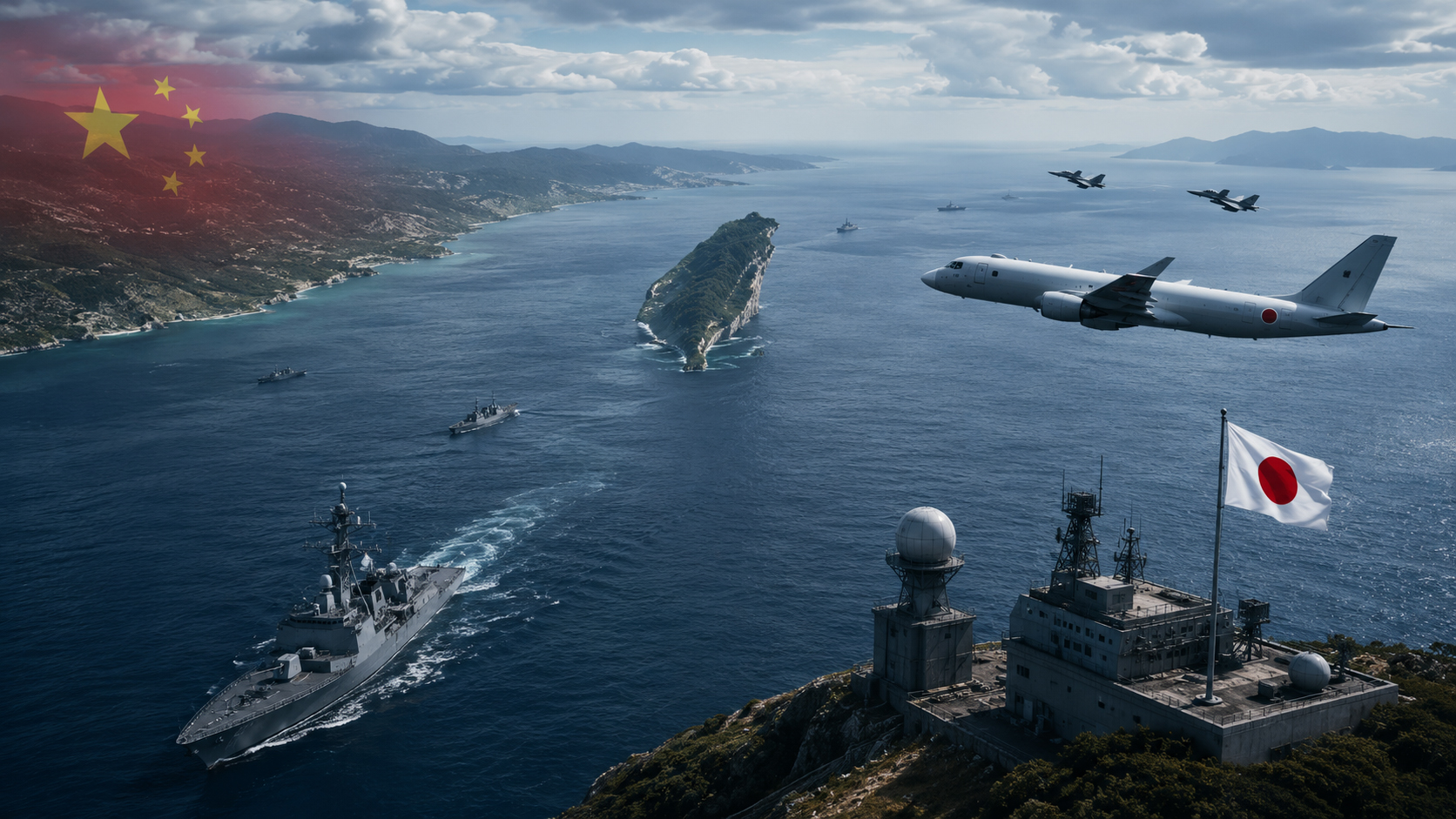
The Taiwan Strait is no longer a distant crisis for Japan. From the southwest islands, Taiwan is not an abstraction but a neighbor: roughly 100 kilometers from Yonaguni, tied to Japan by sea lanes, airspace, undersea cables, U.S. bases, semiconductor supply chains and the daily life of Okinawa’s outer islands. The sharper Beijing’s pressure becomes, the harder it is for Tokyo to keep speaking only in the old diplomatic language of careful distance.
In June 2026, Reuters described Japan as standing taller in the Pacific as China menaces Taiwan and the United States grows harder to predict. The point was not that Japan had become reckless. It was that geography had become impossible to ignore. Defense spending, missile deployments in the southwest, deeper cooperation with the Philippines and South Korea, long-range strike capabilities, and more explicit language about Taiwan are all part of a single strategic shift.
Why Japan is stepping forward
For decades, Japanese diplomacy lived by calibrated language. On Taiwan, Tokyo maintained practical ties while recognizing Beijing as the government of China. The official phrase was usually cautious: peace and stability in the Taiwan Strait are important. That ambiguity served Japan well when China’s rise still seemed manageable and the United States appeared strategically predictable.
But maps are blunt. Okinawa, Miyako, Ishigaki and Yonaguni sit near the very waters where a Taiwan contingency would unfold. If a blockade, missile campaign, cyber assault, refugee movement and pressure on U.S. bases happened together, Japan could not plausibly treat it as someone else’s emergency.
The southern shield
Cold War Japan looked north. The new Japanese defense map looks southwest. The island chain from Kyushu to Okinawa and Yonaguni now forms the front edge of Tokyo’s security planning. Japan’s fiscal 2026 defense budget overview says the country must defend territory spread over more than 3,000 kilometers and strengthen stand-off capabilities so it can respond to vessels and landing forces threatening remote islands from outside enemy missile ranges.
That bureaucratic phrase carries a clear meaning. If an adversary can keep Japanese forces away with missiles and aircraft, Japan needs range, dispersion, mobility, sensors, unmanned systems, cyber resilience and stockpiles. The goal is not to invite war. It is to make approaching Japan’s islands and surrounding waters too costly to attempt.
Yonaguni’s heavy geography
Yonaguni is small, beautiful and strategically enormous. Japan opened a Self-Defense Force coastal monitoring unit there in 2016. In 2026, Japan’s defense minister said surface-to-air missiles would be deployed to Yonaguni by fiscal 2031. On a planning map, that is deterrence. On the island, it is a change in the texture of daily life.
Island residents face the dilemma that now runs through Japan’s entire defense debate. A stronger Self-Defense Force presence may make the island safer by deterring aggression. It may also make the island feel more exposed. Japan’s security policy is not being written over empty space. It is being placed on communities with schools, ferries, farms, fishing ports and families.

Why Beijing calls it “new militarism”
China views Japan’s shift through a different lens. When Tokyo deepens maritime cooperation with the Philippines, strengthens U.S. joint operations, speaks more clearly about Taiwan and loosens defense export rules, Beijing frames the change as a return of Japanese militarism. History is not background in East Asian diplomacy; it is an active instrument.
Japan rejects that charge. Its argument is that China’s rapid military modernization, opaque spending, coast guard pressure and near-daily operations around Taiwan have changed the strategic environment. Tokyo says the issue is deterrence, not nostalgia. But deterrence has a communication problem: if it is too vague, it fails; if it is too explicit, the other side may call it provocation.
The United States: more important, less certain
The U.S.-Japan alliance remains the center of Japan’s defense posture. Yokosuka, Okinawa, Misawa, Iwakuni and Sasebo are not just bases; they are the infrastructure of deterrence in the western Pacific. Yet the more uncertain American politics becomes, the more Japan feels pressure to carry weight of its own.
This does not mean Tokyo is moving away from Washington. The opposite is more accurate. A more capable Japan becomes more valuable inside the alliance. If Taiwan becomes a crisis, Japan’s ports, airfields, ammunition, maintenance capacity, cyber networks, sensors and southern islands would be decisive to any allied response. Capability gives Japan both responsibility and influence.
Taiwan’s own budget fight
Taiwan is also racing to strengthen itself, but democracy is messy. In June 2026, President Lai Ching-te vowed to keep pushing defense spending after parliament approved only part of a proposed supplementary defense budget. The dispute affected domestically developed drones and missiles, precisely the sort of asymmetric systems that wars in Ukraine and the Middle East have made urgent.
Japan cannot ignore Taiwan’s internal politics. If Taiwan’s defense is underfunded, pressure on Japan’s southwest rises. If Taiwan arms rapidly, Beijing’s anger rises. Japan, Taiwan and the United States are trying to deter one crisis through three different political systems, three budget processes and three electorates. Deterrence is not only hardware. It is political endurance.
The grey-zone sea
A Taiwan crisis may not begin with an invasion. It may begin with coast guard patrols, research vessels, fishing fleets, cyberattacks, economic coercion, disinformation and claims of jurisdiction. In June 2026, Taiwan said it would not tolerate Chinese attempts to assert control over its waters after Chinese maritime operations east of the island. That area matters because Taiwan’s eastern side has long been treated as a strategic rear — deeper waters, access to the Pacific, submarine routes, undersea cables and possible allied operations.
If China can normalize “management” east of Taiwan, the geography of a contingency changes. Taiwan is less protected. Japan’s southwest is more exposed. The Philippines matters more. The U.S. Navy’s undersea and air operations become more complicated. This is why Japan’s Taiwan policy is also a maritime policy.
- How quickly a Taiwan contingency could spill into Japan’s southwest islands and U.S. bases
- Whether Japan’s stand-off capabilities create deterrence without appearing escalatory
- How far Beijing is willing to punish Japan economically or diplomatically over Taiwan
- Whether U.S. political uncertainty pushes Japan into a larger alliance role
- How Tokyo balances island-community consent with national defense planning
How far can Japan go?
Japan still operates under constitutional, legal and political constraints. The 2015 security legislation allows limited collective self-defense under strict conditions, but that does not mean Japan’s actions in a Taiwan crisis are automatic. Japan would have to define the situation legally and politically: important influence situation, survival-threatening situation, armed attack situation. Each step carries consequences.
That is why words matter. When Japanese leaders describe Taiwan scenarios too clearly, China reacts. When they avoid specifics, deterrence weakens. Tokyo is trying to walk between ambiguity and clarity. That narrow path is the defining difficulty of Japan’s 2026 security posture.
Updating the peace state
Japan’s postwar identity as a peace state was never only about not possessing weapons. It was about preventing war, supporting international order and using economic power to stabilize Asia. The question now is what a peace state must possess, say and prepare for when coercion moves closer to its shores.
The Taiwan Strait is not ending postwar Japan. It is forcing Japan to update the meaning of postwar restraint in a harsher environment. Tokyo does not want to provoke Beijing. But it can no longer pretend Beijing’s pressure is safely distant. Japan is standing taller in the Pacific not because strength has become fashionable, but because the crisis has moved too close to the map of Japan itself.
Sources and references
This Japan.co.jp report draws on Reuters reporting, Japan Ministry of Defense materials, Japan’s National Security Strategy, and public reporting on Taiwan and China.
- Reuters: As China menaces Taiwan and US grows unpredictable, Japan stands taller
- Reuters: Taiwan says it will not tolerate Chinese patrols
- Reuters: Taiwan president vows to continue defense spending push
- Japan Ministry of Defense: Overview of FY2026 Budget
- Ministry of Foreign Affairs of Japan: National Security Strategy
- The Guardian: Japan missile deployment plan for Yonaguni