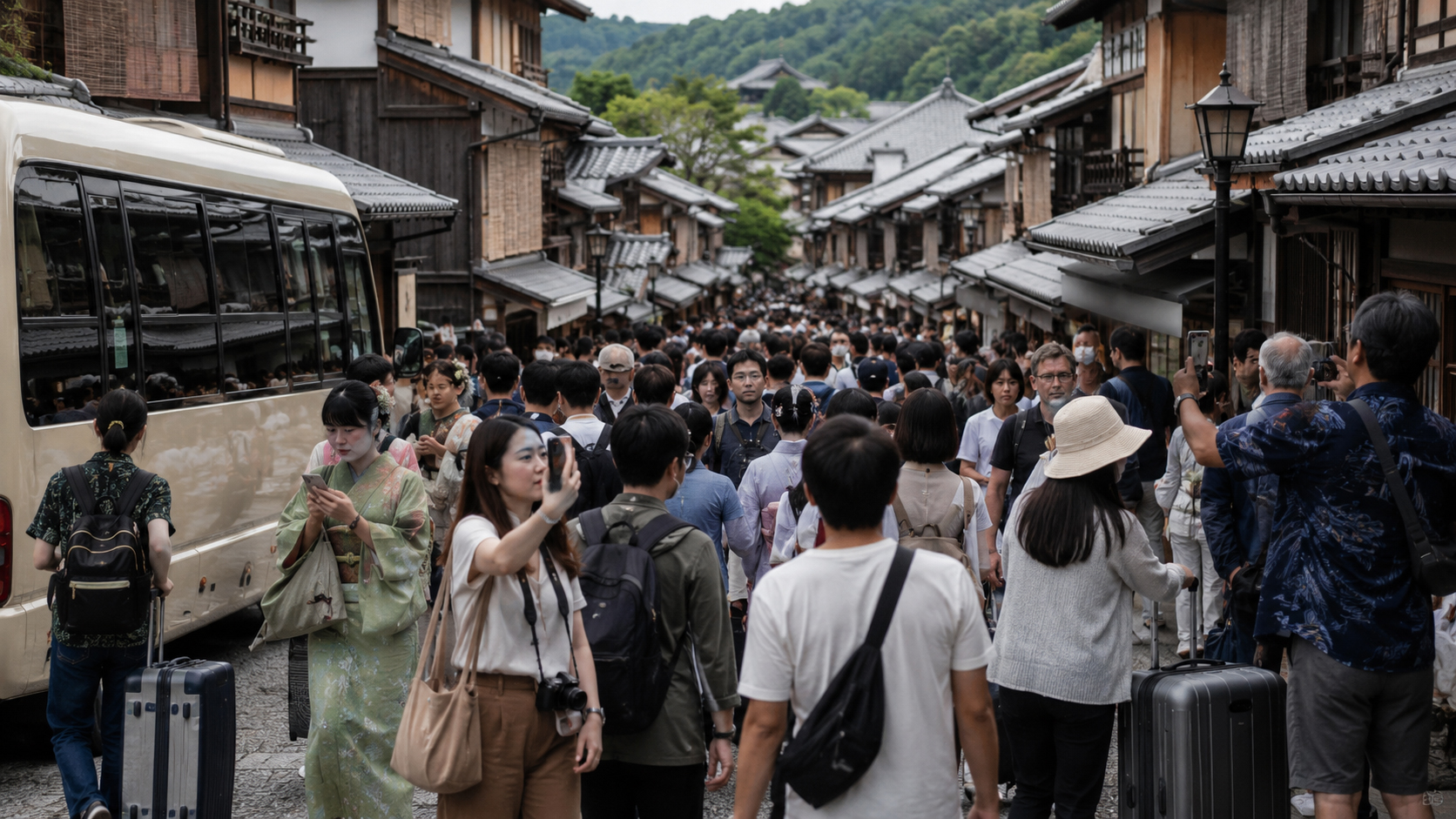
One of the most revealing sentences in Japan this year may be this: “There are fewer tourists, so why does everything still feel full?” By the headline number alone, the mood should have softened. According to the Japan National Tourism Organization, international arrivals in April 2026 came to 3,692,200, down 5.5% from a year earlier. But the lived experience in many tourist zones says otherwise. Buses are still clogged with luggage. Narrow streets still jam at photo spots. Residents still feel that ordinary routes are becoming visitor corridors. The reason is simple and important: overtourism is no longer a question of how many people come to Japan. It is a question of where, when, and how tightly they gather once they are here.
That distinction matters because Japan’s tourism expansion has been a genuine economic triumph. In 2025, Japan received 42.68 million international visitors, while inbound travel spending reached a record ¥9.4549 trillion. That is why tourism remains politically difficult to restrain. It supports hotels, restaurants, transport, retail, cultural businesses, and local employment. The government continues to target 60 million visitors and ¥15 trillion in spending by 2030. Yet the same policy framework, updated in March 2026, now explicitly emphasizes quality of life for residents and stronger measures against overtourism. In other words, Tokyo’s message has changed. Tourism is still a growth strategy—but growth without management is no longer acceptable.
Why the crowds persist
The answer lies in distribution. A national total tells us how many people entered the country, but not whether they dispersed evenly. In reality, they do not. Travel in Japan is intensely seasonal and highly concentrated. Cherry blossom weeks, fresh-green season, autumn foliage, powder snow, iconic shrines, classic old streets, and signature viewpoints all attract visitors in clumps. Social media intensifies the effect, pushing huge numbers toward the same “must-see” staircase, lane, gate, or overlook. Even if the overall number drops modestly, crowding can feel just as bad—or worse—if the same locations remain overexposed.
That is why Japan’s tourism challenge has evolved from a national demand story into a local capacity story. The issue is no longer just how many people Japan can attract. It is whether a neighborhood street, a bus route, a station platform, a mountain approach road, or a heritage district can absorb that popularity without eroding daily life. Overtourism is experienced not in national averages, but in the texture of mornings, transit, noise, waste, and public space.
It is that too much popularity is being funneled into too few places.
Why Japan still wants more tourism
Even critics of crowding understand why tourism remains central to national policy. For many regional economies, tourism is one of the few realistic growth sectors left. It can bring outside money into places with shrinking populations, aging residents, and limited industrial investment. Unlike a factory, tourism distributes spending across lodging, food, culture, farming, fisheries, retail, and local services. It is a kind of export performed on Japanese soil. The visitor comes to Japan, but the spending circulates inside Japan’s communities.
The weak yen has strengthened this effect. For foreign travelers, Japan often looks unusually good value relative to its quality. Safe streets, efficient transport, seasonal beauty, excellent food, and high service standards are now paired with a favorable exchange-rate story. That combination is powerful. It has made Japan attractive not only to bargain-minded visitors, but also to higher-spending travelers who see the country as offering premium experiences at comparatively accessible prices.
The second chapter of “Tourism Nation”
The government’s revised Basic Plan for the Promotion of a Tourism Nation, approved in March 2026, is revealing because it tries to hold two ideas together at once. Japan still wants to expand inbound demand. But it also now explicitly frames the balance between visitor growth and residents’ quality of life as a policy priority. That may sound bureaucratic, yet it signals a real conceptual shift. Tourism policy is no longer just about attraction. It is increasingly about flow design, congestion management, acceptance capacity, and local consent.
The plan also points toward a specific management architecture: more support for regions addressing overtourism, better data, stronger local coordination, demand dispersion, and systems that guide visitor behavior before pressure becomes unmanageable. The national goal of reaching 100 regions working on overtourism countermeasures by 2030 is significant not because it promises a neat solution, but because it acknowledges that overtourism must be governed at the regional level, with residents and local businesses in the room.


Overtourism is not anti-tourism
This is the point many debates miss. Measures against overtourism are not anti-visitor measures. They are sustainability measures. If local residents conclude that tourism brings revenue but steals everyday livability, backlash becomes inevitable. If heritage streets become unusable, if transit becomes unreliable, if noise and litter become routine, or if public space feels taken over, then tourism starts consuming the very qualities that made the destination valuable. In that sense, overtourism is not a side issue. It is a warning that the tourism model is beginning to damage its own asset base.
For Japan, the challenge is therefore not to suppress popularity, but to govern it. Can tourist revenue be recycled into cleaning, mobility, landscape protection, staffing, and local services? Can demand be shifted by time slots, route design, pre-booking, and better information? Can communities define the kind of tourism they want, rather than accepting whatever volume arrives? These are no longer peripheral questions. They are becoming the core of tourism policy.
The limits of “regional dispersion”
Japanese officials regularly promote regional dispersion as the answer. In principle, it makes sense: send more visitors beyond the classic circuit, spread economic benefits, and relieve pressure on hot spots. But dispersion is far harder than slogans make it sound. Tourists flock to the same places because those places are accessible, legible, iconic, and self-reinforcing. A famous district is easier to plan around than an unknown town. Social media deepens the pattern by rewarding replication. The more a place is seen, the more it gets seen again.
That means real dispersion requires more than telling travelers to “go elsewhere.” It needs transport links, multilingual guidance, reservation systems, quality lodging, curated experiences, and believable alternatives when weather or schedules change. It also needs something else: readiness from local communities. Because if a hidden destination suddenly becomes famous, it can inherit the same problems as the places it was meant to relieve.
The argument beneath the statistics
What makes overtourism politically difficult is that the benefits are easy to count while the burdens are hard to quantify. Spending, arrivals, and economic impact fit neatly into charts. Annoyance does not. Neither do blocked sidewalks, loss of quiet, crowded school routes, trash, fatigue among local workers, or the sense that a neighborhood has become a backdrop for somebody else’s itinerary. Yet these intangibles are exactly where public consent rises or collapses.
Japan’s tourism success has therefore entered a more mature and more serious phase. The country is no longer deciding whether inbound tourism matters. That question has been answered. The question now is whether Japan can preserve the legitimacy of that success by making tourism livable for the people who host it.
- Whether more regions move from rhetoric to concrete overtourism management
- How tourist revenue is reinvested into transport, cleaning, and local infrastructure
- Whether dispersion strategies create durable alternatives rather than temporary “hidden gems” booms
- How resident satisfaction and quality-of-life indicators are built into tourism policy
- How shifts in the yen and global travel conditions reshape the mix of visitors coming to Japan
Between “please come” and “this is too much”
Tourism policy in Japan is now trying to hold two contradictory truths at once. More visitors are welcome. More of the same concentration is not. The country wants rural spread, but not the destruction of local life. It wants higher value, but also public legitimacy. That tension is not a sign of failure. It is the sign of a tourism economy growing up.
Which is why April’s paradox matters. Fewer tourists did not mean fewer crowds because Japan’s real challenge is not volume in the abstract. It is concentration in practice. The next chapter of Japanese tourism will be decided not by how loudly the country markets itself, but by how intelligently it designs movement, protects residents, and shares the gains of popularity with the communities that bear the pressure.
Sources
This report was based on public materials from the Japan National Tourism Organization and the Japan Tourism Agency.
- JNTO: Number of visitor arrivals to Japan, April 2026
- JNTO Statistics: visitor arrivals data and graphs
- Japan Tourism Agency: Final results for inbound visitor spending in calendar year 2025
- Japan Tourism Agency: Basic Plan for the Promotion of a Tourism Nation, 2026
- Basic Plan summary: target of 100 regions addressing overtourism
- Japan Tourism Agency: initiatives to prevent and mitigate overtourism