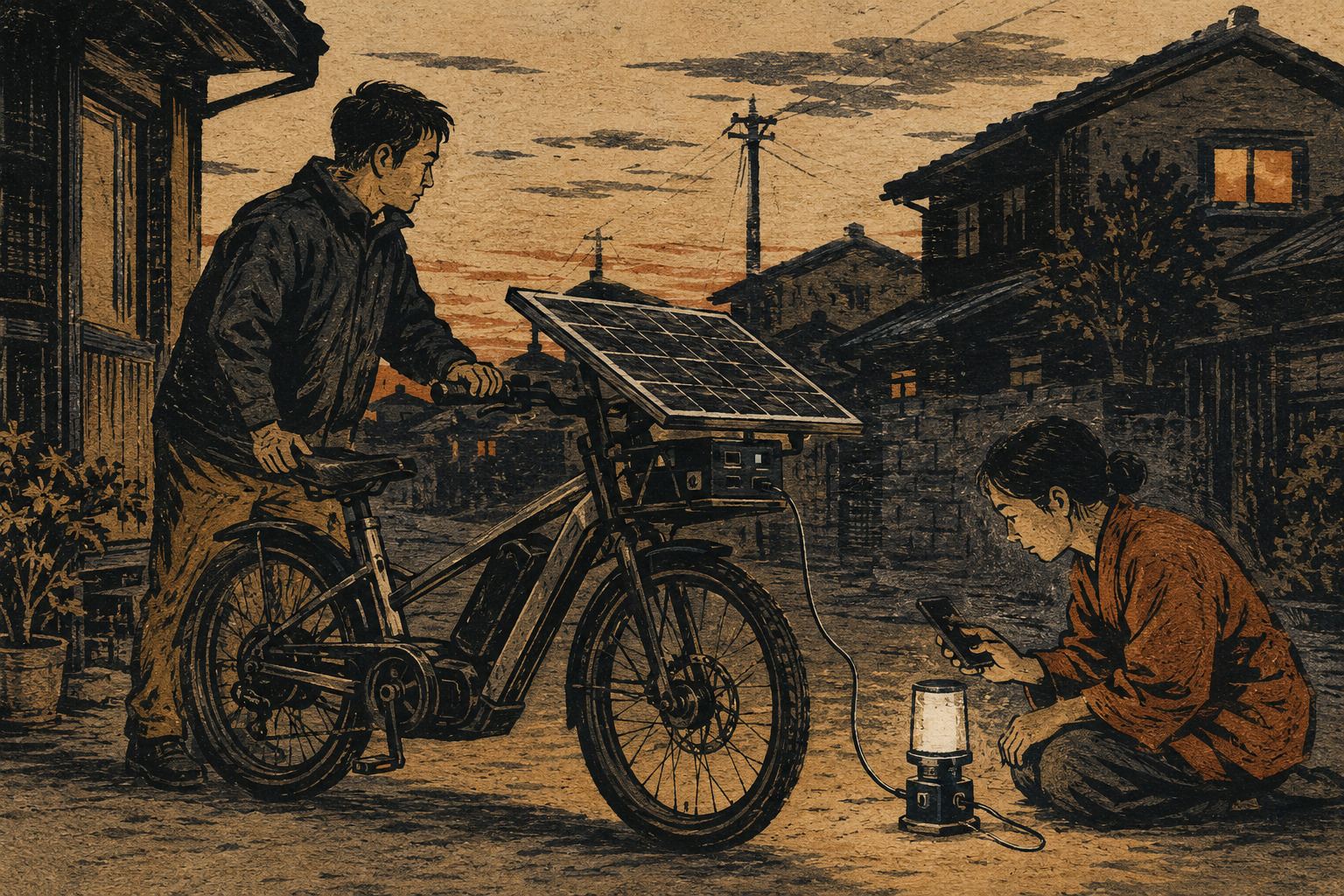
On the 18th floor of a building in Akasaka, one bicycle stood in for a damaged town. On August 21, 2026, Tokyo startup HelioX publicly demonstrated the completed prototype of its Solar E-Bike at the media-oriented Initial Disaster Prevention Expo. Pedal assistance moves the rider. Panels on the machine replenish the battery. When the bike stops, a USB Power Delivery connection can send as much as 60 watts outward.
The date gave the demonstration urgency. Just over three weeks earlier, at 4:27 p.m. on July 28, a magnitude 7.1 earthquake—still listed as provisional—had struck the Kumamoto region. The strongest Japanese intensity reading, 7, was recorded in Uki and Hikawa. At the peak, approximately 48,530 households lost electricity as road closures, water outages and evacuations spread.
But the two events must not be allowed to merge. HelioX cited the 2026 Kumamoto Earthquake as part of the need its machine is intended to address. The Solar E-Bike was not deployed there. Its public unveiling came afterward, and no performance record from the disaster zone has been released. Kumamoto is evidence of the problem, not evidence that this product solved it.
One bicycle, two energy ledgers
The machine makes sense only when its energy is divided into two ledgers. The first is mobility. Hills, wind, cargo, speed and the selected assistance level determine what the motor consumes. The second is electricity supplied to other devices. Phones, laptops, satellite communications equipment, LED lights and portable fans draw from the same finite store. Every watt-hour delivered outside is a watt-hour no longer available to help the rider home.
HelioX says the onboard battery provides roughly 80 kilometers of range. In clear conditions, the solar system can replenish energy equivalent to as much as 40 kilometers of travel per day. Start full, harvest favorable sunlight and the result is advertised as up to 120 kilometers of equivalent range. The company's own qualification is extensive: output and range vary with weather, season, irradiance, assist setting, terrain, load and operating environment. The figures are identified as assumed values for a prototype, not the results of a published certification test.
| Company statement | What it tells us | What remains unknown |
|---|---|---|
| About 80 km | HelioX's expected battery range | Speed, grade, temperature, load, assist mode and end-of-test charge |
| Up to 40 km/day equivalent | A distance conversion for a favorable solar harvest | Panel wattage and area, insolation, controller efficiency and monthly or cloudy-day results |
| Up to 60 W USB-PD | The maximum rate at which compatible devices may receive power | Usable watt-hours, runtime, port count, voltage profiles and conversion losses |
| Detachable Solar Box | A concept for separating the generating/supply unit from the bike | Weight, whether it stores energy, ingress protection, shock resistance, price and swapping procedure |
| Power-assisted bicycle | The legal vehicle class the company intends | Independent confirmation of conformity, total weight, payload and braking performance |
The phrase “40 kilometers of sun” is intuitive but not auditable on its own. To reproduce it, a purchaser needs panel rated power, measured irradiance, charging-controller efficiency and the bicycle's energy consumption under a defined test. “Almost no daily outlet charging” is possible only when routine consumption stays below the harvested energy, the bike can be parked in useful sun and the battery can bridge nonproducing hours. Building shade, the rainy season, short winter days, indoor overnight storage and a crowded shelter change the equation.
Sixty watts is not too small; it is a different job
Against household appliances, 60 watts looks modest. This is not a source for an electric kettle, microwave or space heater. Nor should an unspecified output be entrusted to a refrigerator, oxygen concentrator or another device requiring high starting current, long operation or medical-grade reliability.
During the first hours of a disaster, however, small electricity does not mean small value. A working phone can send an all-clear message, receive evacuation instructions and provide maps and contacts. An LED can illuminate a staircase or a registration desk. Some USB-C laptops and communications devices may operate within a compatible 60-watt profile. A generator serving one site and a small source carried to another are not competitors. They occupy different layers of the response.
HelioX also lists “small medical devices” among possible loads. That phrase requires exceptional care. Medical equipment has device-specific voltage, current, waveform, continuity and redundancy requirements. Until compatibility and safety are established, the bicycle cannot be described as backup for life-support equipment. Communications, lighting and information devices—loads that can more readily fall back to another source—are the responsible place to begin field trials.
The Solar E-Bike is not a moving power station. If the engineering holds up, it could become something narrower and useful: a moving outlet for the last few reachable kilometers.
Kumamoto showed how roads and electricity fail together
At 5:09 p.m. on July 28, the approximate peak power outage from the 2026 Kumamoto Earthquake reached 48,530 households. About 36,900 remained without power at 6 a.m. the following morning and about 22,940 early on July 30. High-voltage service was restored by the afternoon of July 31, while work on low-voltage lines and individual service connections continued.
Roads were injured at the same time. Initial regulated sections extended across roughly 142 kilometers. By August 21, restrictions had been lifted across about 135 kilometers, although several sections remained closed. The disaster produced a maximum 506 shelters and 9,931 evacuees. Water service stopped for as many as approximately 108,100 households. Infrastructure does not fail one category at a time.
A bicycle cannot cross a collapsed bridge by magic. Debris, landslides, flooding, heat and aftershocks are dangerous to riders too. Yet where cars are trapped, fuel is scarce or narrow roads cannot accept a large vehicle, a bicycle can inspect a passable route and cover more ground than a person walking. Assistance can ease hills and loads. At the same time, the handling penalty of panels and batteries—especially in wind and emergency maneuvering—has to be tested rather than assumed away.
- Reconnaissance: Check safe routes, isolated points, water stations and shelters.
- Welfare rounds: Visit older residents, people sheltering at home and households that have gone silent.
- Small deliveries: Carry medicine, documents, communications gear and limited hygiene supplies—subject to an undisclosed payload.
- Low-power supply: Serve communications, reception desks and lighting over USB-PD.
- Split operations: Leave the Solar Box at a hub while the bicycle continues to the next mission, once the concept is proven in the field.
From the 1993 PAS to legs, motor and sun
Japan's power-assisted bicycle did not begin as emergency equipment. Yamaha Motor developed a prototype in 1989 that blended human pedaling with motor assistance and launched the PAS in 1993 as the world's first production electrically power-assisted bicycle. The original weighed 31 kilograms, cost ¥134,000 and traveled about 20 kilometers per charge. Its problem was ordinary: hills, headwinds and shopping loads.
That everyday usefulness is also what can make the form resilient. Under Japanese rules, a power-assisted bicycle supplies power only when the rider pedals. Below 10 km/h, motor force may be no more than twice human force; assistance tapers from 10 km/h and must reach zero at 24 km/h. A conforming machine remains a bicycle, familiar and license-free. HelioX identifies the prototype as an e-bike in this class, but has not published independent conformity results.
Two years after the PAS appeared, the 1995 Great Hanshin-Awaji Earthquake showed the disaster value of bicycles already distributed through a city. With roads and public transport badly disrupted, officials used bicycles and motorcycles for damage surveys, messages and safety checks. A central government review later described bicycles as highly effective for assessment work. Nishinomiya employed abandoned and donated bikes. Their strength was not specialized emergency technology. They were present, repairable and familiar.
1989 — Yamaha develops a prototype that harmonizes motor support with pedaling.
1993 — The first PAS creates the production power-assisted bicycle market.
1995 — Bicycles prove useful for surveys and communications after the Hanshin-Awaji earthquake.
2011 — The Great East Japan Earthquake again fixes the joint loss of movement and electricity in public memory.
2014 — A Japanese disaster-prevention specialist proposes the “phase-free” concept.
2024 — HelioX is established and announces a Japanese solar-mobility business.
2025–26 — Its AGAO solar micromobility vehicle moves through trials and into a four-vehicle public rental operation in Mihara.
August 21, 2026 — The Solar E-Bike prototype receives its first public demonstration in Tokyo.
Preparedness that does not sleep in a warehouse
HelioX describes the machine as “phase-free.” The idea, proposed in Japan in 2014, is that products and services used in ordinary life can contain additional value during a disaster. It does not eliminate dedicated emergency gear. It addresses a familiar weakness: a generator, radio or tool stored for years may deteriorate, disappear behind other boxes or become unfamiliar to the people expected to use it.
A bicycle fits the theory well. Used for commuting, shopping, inspections or tourism, it reveals flat tires and weak brakes before the emergency. Riders learn its controls and the character of local hills and lanes. HelioX envisions individual models and fleets for companies, municipalities and sharing operators, eventually tied to IoT and software that track location, battery state and movement.
The company itself was incorporated in November 2024 with capital of ¥5 million. Solar E-Bike is not its first vehicle. Beginning in 2025, it demonstrated the solar-equipped AGAO, a different class of small motorized mobility, in communities including Mihara and Yokoze. On August 7, 2026, four AGAO vehicles entered staffed public rental at Mihara Station following local trials. The new bicycle can be read as an attempt to move solar mobility from a tourism-oriented novelty toward a more familiar daily form.
Daily use also means daily exposure. Theft, crashes, rain, salt air, ultraviolet light, hot pavement and repeated charging cycles may reduce emergency readiness. Ordinary use strengthens preparedness only when inspection records, parts, battery-health checks and repairs accompany it. Otherwise the vehicle can be highly familiar and quietly unfit.
A charging corner is more than a source of electricity
Case studies collected by Japan's Cabinet Office show why electricity distribution matters. Smartphones became essential for information and contact, so shelters established charging corners. Then operational problems arrived: too few power strips, a need for staff, and no settled rules for whether residents could charge only phones or also power banks, fans, computers and game devices.
Generation is only the first decision. Who gets priority? How long may a device remain connected? Who watches the equipment at night? Must users record a name or contact? Who supplies compatible cables? With a small 60-watt outlet, management determines how much social value each watt produces.
The detachable Solar Box is an intriguing response. Leave the power unit at a shelter or aid post, HelioX proposes, while the bicycle continues on patrol or delivery. Yet the announcement does not establish whether the box itself stores energy, how heavy it is, whether its panel can sit outside while connections remain safely inside, or what happens in rain. Outside brings sun, weather and theft; inside brings protection and shade. Field usefulness lives in these unglamorous details.
What a municipality should demand before buying
A public buyer should not award a disaster role on maximum catalog figures alone. It should measure watt-hours harvested and delivered through spring, summer, autumn and winter; after clear, cloudy and rainy days; on flat streets and hills; with different riders and loads. The claim of “40 kilometers per day” becomes reproducible only when panel wattage, irradiance and controller efficiency appear beside it.
Safety requires the same discipline. Lithium-ion storage batteries sold in Japan must meet standards under the Electrical Appliances and Materials Safety Act and carry the PSE mark. E-bike batteries have also been subject to Japanese recalls over smoke and fire risks. A commercial version needs disclosure of cell chemistry, thermal management, overcharge and short-circuit protection, water and dust resistance, shock and vibration testing, replacement intervals and disposal.
- Measured battery capacity and usable watt-hours, including a minimum reserve for mobility.
- Monthly and weather-specific solar yield, panel rated watts and time to recover a charge.
- Runtime and heat at a continuous 60-watt output, USB-PD profiles, ports and tested devices.
- Vehicle weight, payload, hill range, braking distance and automatic cutoff after a fall.
- Proof of power-assist conformity, PSE status, safety tests and ingress-protection rating.
- Battery capacity after three years, spare-parts inventory, repair time and disaster-service terms.
- A drill that assigns riders, routes, devices and priorities—not merely a parked vehicle.
Price, release timing and warranty have not been announced. HelioX's small capital base does not determine whether its engineering works. It does make continuity a separate procurement question. Who repairs a failed controller? For how many years will a battery remain available? If the company or specification changes, can a municipal fleet continue to operate? Innovation and long-term support must be evaluated independently.
Think of a placed network, not one heroic machine
The larger possibility is not to make one bicycle enormous. It is to know where many small vehicles are in ordinary life and whether they are ready. A community center, home-care office, visitor center, university, postal facility or delivery base could host one. If charge, position and maintenance are visible, machines can be gathered from outside an outage or deliberately left in districts likely to become isolated.
Success would not be the number purchased. It would be the share able to depart within 30 minutes of an earthquake; routes confirmed; kilometers traveled; watt-hours delivered; charging queues shortened; and crashes, flat tires, disconnections and depleted batteries recorded. Publishing failures would be as important as publishing distance. Evidence turns a symbol from a launch event into a public tool that can be compared with alternatives.
The bike will not replace large batteries, generators, electric vehicles with V2H or V2L, or the crews restoring the grid. Several cloudy days will constrain its harvest. In a mass shelter, 60 watts immediately becomes an allocation problem. Yet before large equipment arrives—or a few streets beyond where it can reach—small size can become mobility.
The first electricity for the last mile
The first PAS did not solve a planetary energy problem. It helped a person carrying shopping climb the hill in front of them. Over three decades, that ordinary intervention became part of Japan's streets. If the Solar E-Bike succeeds, it will earn trust in a similarly concrete way—not through the romance of energy independence, but by reliably moving limited energy to a place that otherwise has none.
HelioX's prototype gives physical form to a good question. When roads and power fail together, what changes if transportation carries a source, and the source can travel under its own power? The proposal to leave one unit generating at a shelter while the bicycle visits the next household describes a use of time that fixed equipment cannot offer.
Disaster value will not be decided by “up to 120 km” or “up to 60 W.” It will be decided by how many watt-hours the bike can leave at one house above a hill on the morning after rain—and still have enough kilometers to return.
The next meaningful venue is not an expo. It is a regional trial with hills, heat, rain and an imperfect crowd. Publish the battery capacity, open the test conditions, demonstrate safety and repairability, and let municipalities record failure as carefully as success. Then the machine can move from an illustration of a solar future toward a usable tool in a darkened present.
- HelioX — Solar E-Bike prototype announcement, assumed specifications and August 21 demonstration
- HelioX — Company profile, founding, capital and business areas
- HelioX — 2024 announcement of Japanese solar-mobility operations
- HelioX — Earlier AGAO product and company account of its post-3.11 development motivation
- HelioX and Machizukuri Mihara — AGAO public rental operation in Mihara
- Cabinet Office — 2026 Kumamoto Earthquake damage report, August 21, 2026
- Central Disaster Management Council — Bicycle and motorcycle use after the Great Hanshin-Awaji Earthquake
- Cabinet Office — Shelter charging-corner cases and operational problems
- Cabinet Office — Everyday objects and skills that retain value in disasters
- Phase Free Association — Definition and history of the concept since 2014
- Yamaha Motor — History of the world's first production power-assisted bicycle
- Yamaha Motor — Specifications of the 1993 PAS
- Consumer Affairs Agency — Legal power-assist ratios for bicycles in Japan
- Ministry of Economy, Trade and Industry — PSE marking and lithium-ion battery safety
Editor's note: This article compares company material with government and institutional sources available through August 21, 2026. Japan.co.jp did not independently test the prototype or interview HelioX, expo participants or Kumamoto disaster survivors. Range, solar replenishment and external output are company-supplied assumed values for a prototype, not independently verified field performance. The Kumamoto earthquake illustrates the problem the product is intended to address; it does not represent a deployment of this bike. The lead image is a conceptual illustration.