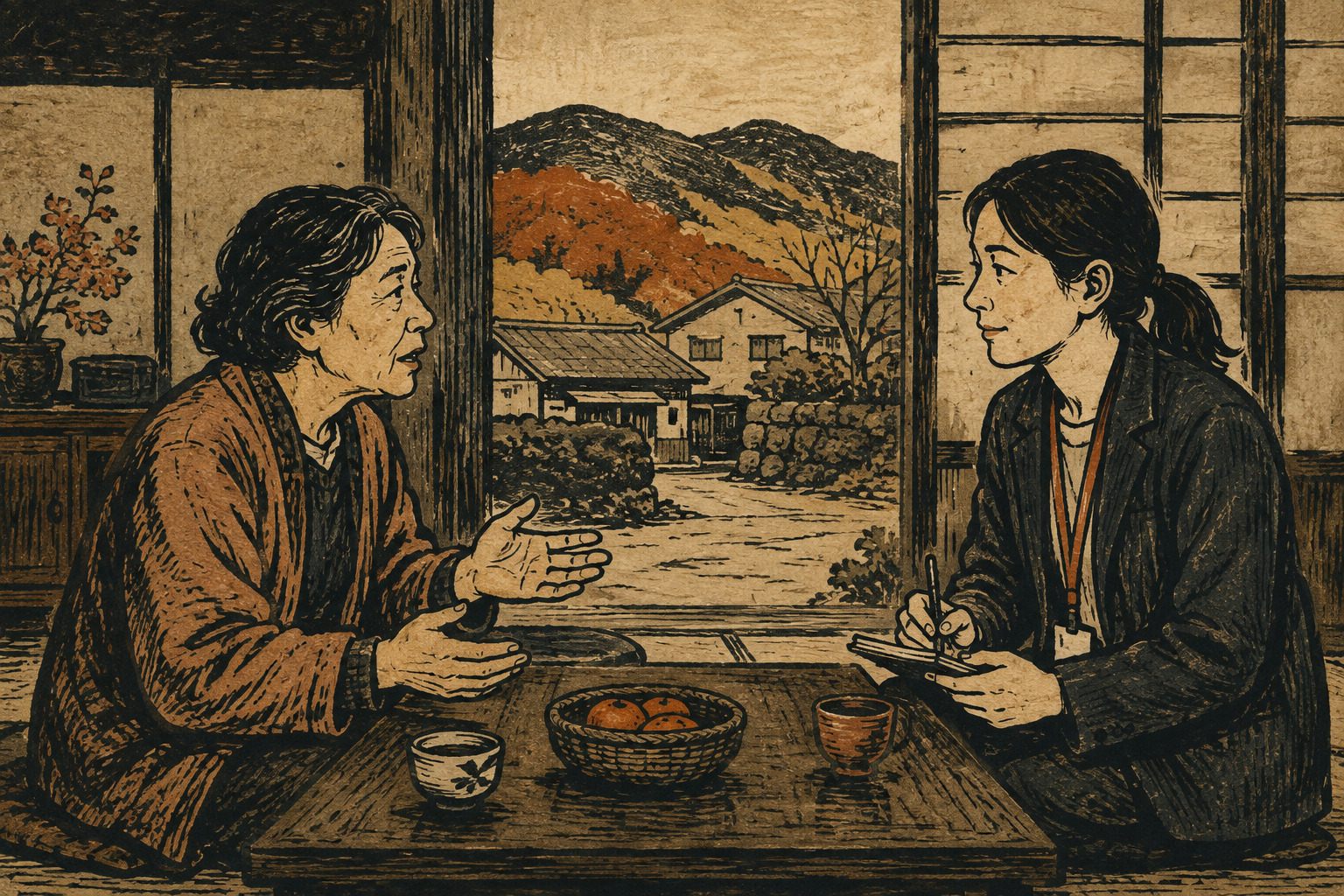
Loneliness does not always look lonely. A person can live alone and feel content. Another can have family, colleagues and hundreds of online contacts yet feel abandoned inside a crowded life. That makes the promise to “recognize loneliness” both useful and dangerous. Concern can open a door. It can also become surveillance, labeling or an unwanted attempt to rescue someone who never asked to be rescued.
Gunma Prefecture's Connection Supporter training tries to answer that problem by keeping the role deliberately small. Its participants do not receive authority to diagnose, investigate or treat. They are asked to understand loneliness and isolation, pay attention to people around them, listen within reasonable limits and know how to connect someone with a service or a place in the community when help is wanted.
Gunma announced the latest courses on August 21. The first will run from 10:30 a.m. to noon on September 16 at Fujimaru Hall in Fujioka, with room for about 80 people. The second will be held from 11:00 a.m. to 12:30 p.m. on October 24 at the Komochi Welfare Hall in Shibukawa, with capacity for about 100. Both are free, open to anyone interested in loneliness and isolation, and offer a completion certificate.
Put the doorway where ordinary life already happens
The Fujioka event will not consist of a lecture room standing alone. From 10 a.m. to 12:30 p.m., local employment-support and welfare organizations will sell baked goods, vegetables, bagels, plants and small crafts, introduce their work and operate a general welfare consultation booth. Someone who would never walk through a door marked “loneliness counseling” may stop at a market, buy something and begin a conversation beside it.
The Shibukawa course will be held inside a wider “Connecting Festival” across Komochi Fureai Park. That decision similarly places welfare on the route of an ordinary community day rather than isolating it in a specialist building. The setting enacts the policy: make asking and offering easier before a formal case exists.
| Venue | Time and capacity | Local connection |
|---|---|---|
| Fujimaru Hall 942-1 Fujioka, Fujioka | Sept. 16, 10:30 a.m.–noon About 80 people | Rumi Kanbe, head of the nonprofit Annaka Hidamari Marché, will teach. Welfare sales, activity booths and general consultation will operate around the course. |
| Komochi Welfare Hall 658-20 Fukiya, Shibukawa | Oct. 24, 11 a.m.–12:30 p.m. About 100 people | Tomokazu Fujii, support director at the Seikōsō disability-support facility, will teach during the Connecting Festival. |
The Gunma Council of Social Welfare, which runs the prefecture's public-private loneliness platform, is the organizer. The announced application deadlines are September 4 for Fujioka and October 9 for Shibukawa, although walk-ins may be accepted. The published figures are venue capacities. They must not be rewritten as “180 new supporters”; attendance and completion have not happened yet.
Loneliness and isolation are not synonyms
The national course text draws a foundational distinction. Loneliness is subjective: the painful sense of being alone or left behind. Social isolation is objective: having few relationships or sources of assistance. They can reinforce each other, but one does not prove the other. A person can be isolated without feeling lonely, or lonely in the middle of an active social network.
This matters because solitude is not a disease. Time alone can be chosen, restorative and worth protecting. The public problem begins when caregiving, unemployment, illness, debt, child-rearing, violence or another difficulty must be carried without anyone to ask for help—and when the problem becomes more complicated because no manageable route to help is visible.
The distinction sets the ethical limits of the supporter. Do not decide that every person living alone is unhappy. Do not treat absence from a neighborhood event as evidence of dysfunction. Do not dismiss online relationships as false or face-to-face contact as a cure. Respect the distance a person chooses while making an offer: “If something is difficult, I can listen,” or “There is a service that may help.”
Ending unwanted loneliness does not mean forcing everyone back into a group. It means protecting the freedom to be alone while ensuring that trouble does not have to be carried alone.
When nearly four in ten answer yes, whose problem is it?
In December 2025, the Cabinet Office sent Japan's fifth national survey on social connection to a random sample of 20,000 people aged 16 and older. It received 11,873 valid responses. Asked directly about loneliness, 4.5% said they felt it often or always, 13.7% sometimes and 19.5% occasionally. Together, 37.7% reported loneliness to some degree.
The strongest category was not concentrated among the oldest respondents. It reached 6.1% among people in their 30s, 5.7% in their 40s and 5.7% in their 50s, compared with 2.5% among people in their 70s and 3.0% among those 80 or older. The rate was 5.3% for men and 3.7% for women. Loneliness cannot be reduced to the image of an elderly person living alone. It also follows job changes, insecure employment, parenting, caregiving, divorce, bereavement and the quiet loss of a workplace identity.
On the more objective side of isolation, 9.7% said they never met family or friends outside their household to talk in person. A majority—53.3%—said they did not participate in any of the listed social activities. Yet 48.4% said they would actively approach or help someone around them who was worried or struggling. Gunma's course is aimed partly at that large group: people willing to help who may not know how to begin safely.
A policy born during COVID, for a problem that outlasted it
Japan's decisive shift toward loneliness as a named field of national policy came during the pandemic. In February 2021, the government created a ministerial-level loneliness and isolation portfolio. In December it adopted its first priority plan and conducted the first nationwide survey. Restrictions on movement and the suspension of face-to-face activity exposed fractures that had long been present: more one-person households, precarious work, shrinking neighborhood organizations, care burdens, withdrawal and poverty.
A national public-private platform followed in February 2022. The Act on Promotion of Policy for Loneliness and Isolation passed in May 2023 and took effect on April 1, 2024. Its principles moved the subject beyond personality and individual responsibility: society as a whole should respond, policy should be designed from the affected person's position, and people should be able to experience connection with society and one another.
The priority plan revised in July 2026 strengthens prevention among young people, in workplaces and in communities. It also promotes “social prescribing”: connecting people from everyday touchpoints not only to medical treatment but to libraries, meals, exercise, hobbies, meeting places and other local resources. Connection Supporters occupy the layer of that policy closest to daily life.
1917 — Okayama's Saisei Komon system begins the lineage of Japan's welfare commissioners.
1928 — The district commissioner model spreads nationwide.
1946 — The role takes its present name, minsei-iin, or welfare commissioner.
February 2021 — Japan creates a ministerial-level post for loneliness and isolation.
December 2021 — The first priority plan and first national survey.
2023 — Connection Supporter work begins nationally; the promotion act passes in May.
April 2024 — The act takes effect; Gunma establishes its public-private platform on May 16.
2026 — Gunma brings the next courses to Fujioka and Shibukawa.
A light new doorway built on a century of community welfare
Japan is not inventing the role of a resident standing between neighbor and state. The minsei-iin welfare commissioner system traces its origin to Okayama's 1917 Saisei Komon program and Osaka's 1918 district commissioner program. Its members identified hardship, assisted households and connected people with public relief. The system spread nationwide in 1928 and was renamed in 1946.
Later public movements developed related roles. Suicide-prevention “gatekeepers” learn to notice distress, reach out, listen, connect someone to necessary support and continue watching over them. Dementia Supporters were trained to reduce stigma and make ordinary communities more understanding. These precedents showed that a short course can change public language and make a specialist system easier to approach.
Connection Supporters resemble those models but are not interchangeable with them. Welfare commissioners are appointed under law and carry defined responsibilities. Suicide gatekeepers address the possibility of acute risk. Gunma's course places the threshold lower: anyone may attend, and the primary purpose is awareness and everyday attention.
That low threshold is both its power and its limitation. Participants can meet people who will never present themselves to a welfare office. But 90 minutes cannot make someone competent to handle mental illness, domestic violence, abuse, addiction, debt or a complex family system. Presenting the certificate as a counselor's license would make the program less safe, not more substantial.
What 90 minutes teaches: do not carry the whole problem
The Cabinet Office's April 2026 standard text runs 43 pages. It covers the difference between loneliness and isolation, structural changes in society, national survey data, participants' own connections, what to do when trouble appears, consultation services and local activities. Exercises ask where one might turn for caregiving, job loss, housing, child-rearing or thoughts such as “I want to disappear.”
The course is not only about saving somebody else. Participants are asked to consider who they themselves would call before a crisis and what services exist nearby. That breaks down the flattering but dangerous division between a strong helper and a weak recipient. Every supporter can also need support.
- Notice: Pay attention to a change without deciding what caused it.
- Ask: Open a door without demanding an answer: “If you want to talk, I can listen.”
- Listen: Do not rush to impose a solution; learn what the person wants.
- Connect: With respect for consent and choice, look together for a service or community resource.
- Do not absorb: Pass crises and specialist problems to the appropriate service, and protect the helper's own limits.
The national material gives modest examples: send a message when someone has not been in contact; ask a person who seems tired whether something is difficult; mention a community comprehensive support center to someone overwhelmed by a partner's care. It also tells supporters not to solve another person's problem alone and not to help so intensely that they themselves become unwell. Boundaries are not a retreat from kindness. They are what allow kindness to continue.
Keeping “notice” from becoming “watch”
Community monitoring contains power. Who lives alone? Who stopped attending? Whose mail is accumulating? Collect too much information and a support system becomes a classification system. Foreign residents, sexual minorities, people with disabilities, those who have experienced withdrawal and people under financial pressure may experience well-meant questioning as one more demand to explain themselves.
A supporter needs no registry of “lonely people.” The necessary tools are respect, choice, privacy and a route to advice when a situation exceeds the role. A person may choose not to talk. When a referral is offered, the supporter should, as far as circumstances allow, explain what will happen and what information may be shared rather than treating the person as an object to be passed along.
Immediate danger is different. Suicide risk, violence, abuse or acute illness cannot be contained by neighborly goodwill. Emergency services or specialist support must be contacted promptly. A safe course must make those escalation routes concrete. Warm language without a crisis procedure can leave both people in greater danger.
Gunma built the destination before recruiting more bridges
Asking residents to refer people is hollow if no one knows where the referral goes. After the national act took effect, Gunma held an information exchange with municipalities on April 12, 2024, a preparatory meeting on April 22 and launched its public-private loneliness and isolation platform on May 16. The prefecture contracted its operation to the Gunma Council of Social Welfare and opened a dedicated portal that makes services and community resources easier to find.
Materials presented to Gunma's Social Welfare Council in 2024 described 17 steering organizations and 48 general members in the platform. Municipal development was still uneven. A prefectural network can connect organizations across a broad area, but individual cases are usually handled closer to home. The effectiveness of the resident-facing course therefore depends on municipal consultation, case coordination and actual service capacity beneath the prefectural map.
Gunma planned a 300-capacity course in Maebashi in January 2025. That June and July it advertised five more venues—Numata, Takasaki, Nakanojō, Ota and Maebashi—with a combined capacity of 395. The two 2026 events are therefore not a one-off campaign but part of an effort moving around the prefecture. Still, capacity must not be added up and presented as the number already trained. Registration, attendance, completion and later action are separate measures.
Kind words cannot fill every structural hole
Loneliness is not produced only by a shortage of conversation. Low pay, job loss, long hours, insecure housing, unavailable transport, care work, disability, illness, exclusion at school and violence at home can all narrow a person's relationships. A supporter can listen carefully without reducing rent, restoring a bus route or creating another professional caregiver.
The World Health Organization estimated in 2025 that roughly one in six people worldwide experienced loneliness and argued that social connection deserves treatment as a major determinant of physical and mental health. Its range of solutions extends beyond individual outreach to transport, digital access, discrimination, public space, employment and health systems.
That is why citizen training cannot become a cheap substitute for professional welfare. Once a resident notices trouble, there must be a staffed service able to receive it, coordination that does not send the person endlessly from office to office, programs that actually meet the need, and routes available outside weekday office hours. If a government builds more entrances to a bridge while narrowing the bridge itself, both the supporter and the person seeking help will become exhausted.
Do not measure success by how many lonely people were “found”
A target based on the number of lonely people identified would be perverse. Part of loneliness can be known only by the person experiencing it, and a discovery quota would reward intrusion. The number of certificates is also inadequate. A better question is whether participants can still name local services months later, listen without imposing, understand the boundary of their role and seek advice when uncertain.
- Registrants, walk-ins, attendees and completers as distinct counts, including gaps by age and location.
- Knowledge, confidence in approaching someone and awareness of services before, after and months beyond the course.
- Whether connections to activities or specialist help worked, without violating consent or identifying individuals publicly.
- Wait times, receiving capacity, drop-off and repeated referral among the services at the far end of the bridge.
- The supporter's own burden, uncertainty, access to advice and need for refresher training.
Recruitment bias matters too. If only people already active in welfare attend, the program may miss working-age men and young adults who are prominent in the survey. National 2026 materials say only 14.4% of respondents knew the government was pursuing loneliness policy; recognition was 8.1% among people in their 20s and 9.8% among those in their 30s. Courses held in daytime halls need partners in workplaces, schools, shops, sports organizations and online communities.
Place a small, unnamed connection before the crisis has a form
Public systems often begin after a problem receives a name: care dependency, unemployment, abuse, poverty, depression, withdrawal. In a person's life, those categories do not first arrive as separate boxes on an application. Sleep becomes difficult. Mail remains unopened. Work becomes frightening. Caring for a parent consumes every friendship. The person does not know whom to tell. Small difficulties accumulate until one day they are a crisis.
The possible value of a Connection Supporter lies in that earlier, unnamed time. Because supporters are not specialists, they can be present in dining rooms, workplaces, schools, festivals, shops and next door. And precisely because they are not specialists, they must know where to stop and when to help someone cross into professional care.
A community safety net is not made only of people capable of dramatic rescue. It is made from someone able to ask, “How have you been?” and a real, open service behind that question.
Gunma's two 90-minute courses are far too small to eliminate loneliness. They may still move the starting line: away from a society that waits for a person in trouble to speak loudly enough, toward one in which someone can notice quietly and offer choices before the emergency.
The sentence after the certificate matters most. No diagnosis, no rush, no promise to carry everything: “Would you like me to help find somewhere to talk?” When an adequately staffed system stands behind that offer, ordinary human attention can become infrastructure before a crisis.
- Gunma Prefecture — 2026 Connection Supporter course announcement, August 21, 2026
- Gunma Loneliness and Isolation Support Portal — 2026 venues, instructors and community events
- Gunma Prefecture — Loneliness policy, public-private platform and support portal
- Gunma Social Welfare Council — Platform formation, membership and municipal coordination
- Gunma Prefecture — January 2025 Connection Supporter course
- Gunma Prefecture — Five-venue 2025 course series
- Cabinet Office — Purpose and scope of Connection Supporter training
- Cabinet Office — Connection Supporter standard course text, April 2026
- Cabinet Office — 2025 Basic Survey on Human Connections
- Cabinet Office — Priority plan, partially revised July 10, 2026
- Cabinet Office — You Are Not Alone support and consultation portal
- Ministry of Health, Labour and Welfare — History of welfare commissioners
- Ministry of Health, Labour and Welfare — Suicide-prevention gatekeeper role
- World Health Organization — Social connection and health, June 2025
Editor's note: This article is based on materials published through August 21, 2026 by Gunma Prefecture, the Gunma Council of Social Welfare, Japan's Cabinet Office and health ministry, and WHO. Japan.co.jp did not independently interview the instructors, organizers or prospective attendees. Announced capacity is not attendance or completion. The course confers no professional qualification, and individual crises must be connected to appropriate services. The main image is a conceptual illustration, not documentation of a real consultation.