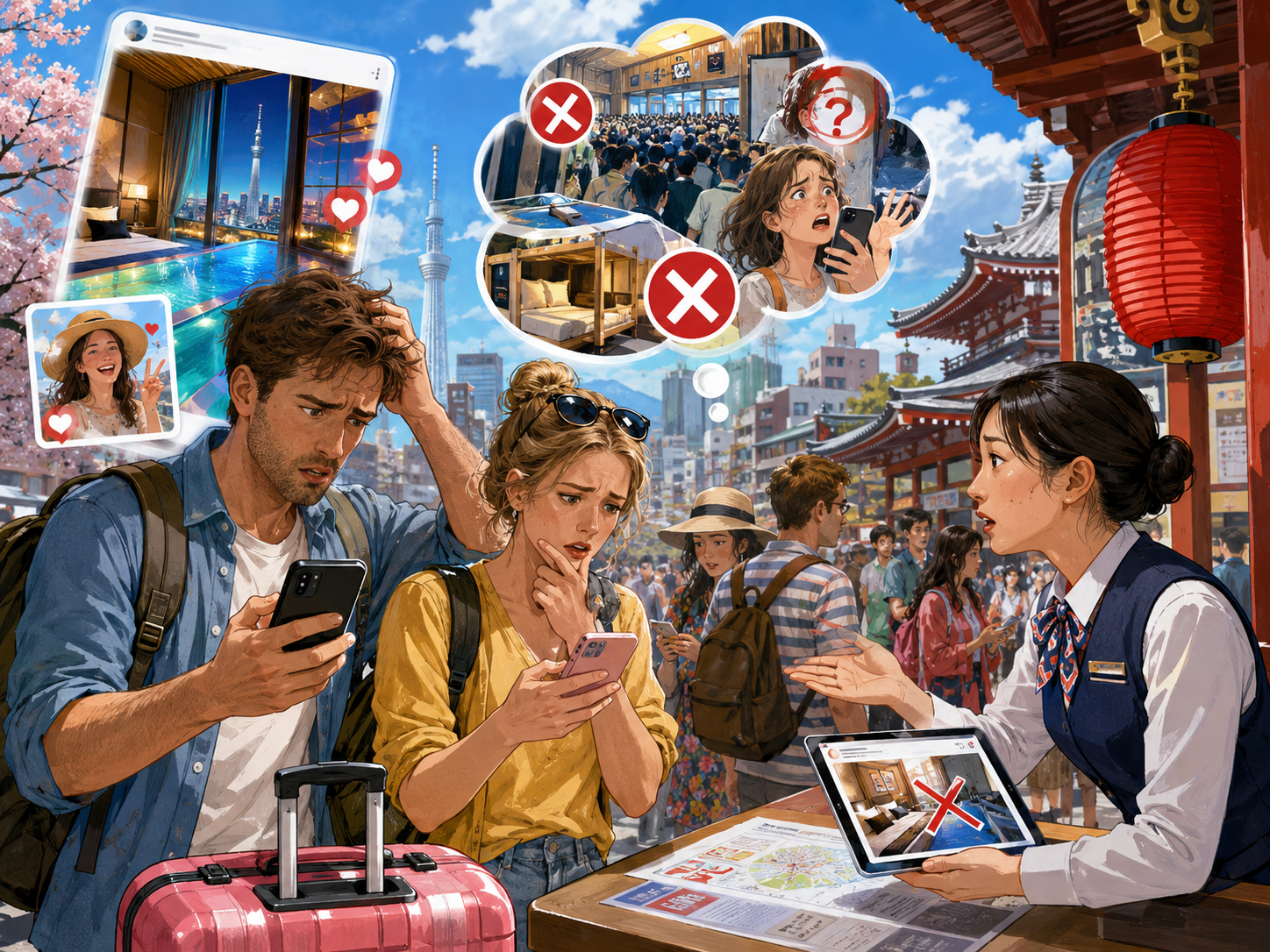
The trip begins before the airport. Before the suitcase closes, before the passport is found, before the first train from Haneda or Kansai, the traveler has already walked through Japan on a phone. Cherry blossom reels. A hotel with a mountain view. A secret sushi counter. A kimono rental package. A theme café. A limited-edition figure. A restaurant line that somehow looks short in every clip.
Online Japan is bright, edited and welcoming. But real Japan is more complicated than a vertical video. The hotel address may be almost right, but not quite. The booking confirmation may look official, but lead to a fake payment page. A room photographed with a wide lens may not match the traveler’s expectations. A “special price” may omit fees, taxes, cancellation rules, or the fact that payment must stay inside the official platform.
This is not a story about Japan becoming unsafe. Japan remains one of the world’s easiest and most trusted destinations. That trust is exactly what makes the new risk important. The trouble no longer begins only in a dark street or with a pushy tout. It often begins earlier — inside the phone, where a traveler is excited, rushed, and eager to believe the best version of the trip.
Smartphone-era travel trouble starts before anyone approaches you on the street. It begins with ads, reviews, DMs, booking confirmations, payment links and the dangerous moment when inspiration becomes a contract.
A tourism boom creates a larger help desk
Japan’s inbound boom has returned with force. JTB Tourism Research & Consulting, using JNTO data, reported an estimated 3,618,900 overseas visitors in March 2026 and more than 10.68 million arrivals in the first three months of the year. Cherry blossoms, the weak yen, revived air routes and social-media-fueled destination discovery have all helped make Japan feel newly reachable.
More visitors also mean more consumer friction. Japan’s National Consumer Affairs Center operates the Consumer Hotline for Tourists for visitors who encounter consumer trouble involving stores, restaurants, bars, transportation, or hotels. The number is 03-5449-0906, and the hotline offers advice in English, Chinese, Korean, Thai, Vietnamese, French and Japanese during weekday hours.
The existence of that hotline matters because travel trouble usually begins small: a booking cannot be found, a room does not match the photos, a cancellation fee seems impossible, a restaurant bill is hard to understand, a tax-free purchase has conditions the traveler missed, or a ticket refund becomes a maze. In a foreign country, a small consumer issue can quickly become a large emotional problem.
Social media has become the first travel agency
Travelers once relied on guidebooks, travel agents and hotel websites. Today, social media is often the first travel agent. A short video chooses the destination. A review chooses the restaurant. An influencer post chooses the hotel. A private message closes the sale. The traveler may not always know whether the content is a personal memory, an advertisement, a partnership, or a sales funnel.
Japan’s Consumer Affairs Agency has experimented with SNS-based consumer consultation, recognizing that many people — especially younger consumers — are more likely to seek help through chat or social platforms than by telephone. If the problem begins on the phone, the help system has to move closer to the phone as well.
Japan Times reported that social-media-related consultations to consumer centers in Japan exceeded 100,000 in the last fiscal year. That figure is not just a domestic consumer story. It is a tourism story, because travel is uniquely vulnerable to urgency: “last room,” “limited discount,” “only today,” “hidden local spot,” “pay now,” “DM for booking.” Scammers understand that excitement and scarcity make careful people less careful.
A beautiful photo is not a contract
The core problem is the distance between image and contract. Social travel is built on photos and video: the empty alley, the wide hotel room, the flawless hot spring, the sunrise over Fuji, the perfect breakfast tray. But photographs are not terms and conditions. Room size, location, refund policy, extra fees, platform responsibility and payment destination live somewhere else — often in small print, in another language, or behind another click.
The question travelers should ask is not only “Is this cheap?” but “Why is it cheap, and who is responsible if it goes wrong?” Is the same price visible on the official site? Does the host ask for payment outside the platform? Are recent reviews detailed and consistent? Is the same image used by another listing? Is the URL almost, but not exactly, the real brand? Does a booking email or SMS ask for credit-card details through a new link?
The U.S. Federal Trade Commission warns that travel scammers may hijack real rental listings and advertise them as their own. That same structure can follow demand anywhere, including Japan. The issue is not that Japanese businesses are especially risky; it is that global travel demand, platform booking, copied photos and urgent payment psychology have given fraudsters better tools.
Stealth marketing and the trust economy
Japan’s rules on stealth marketing became enforceable under the Act against Unjustifiable Premiums and Misleading Representations on October 1, 2023. As DLA Piper explains, the regulation targets business-backed representations that are difficult for ordinary consumers to recognize as business representations. That matters for travel because hotels, restaurants, beauty services, medical tourism, ticket packages, tours and souvenirs all live in the blurred zone between personal recommendation and promotion.
For travelers, the lesson is not that sponsored posts are bad. In fact, a clear PR label can be helpful because the relationship is disclosed. The risk lies in hidden advertising, exaggerated experiences, campaigns whose conditions differ from the social post, and private-message links that move the traveler away from safer booking channels.
Japanese operators also face a challenge. Many overseas visitors cannot read detailed Japanese conditions. If English pages simplify cancellation rules, fees or refund policies too aggressively, disappointment becomes distrust. In tourism, transparency is no longer just compliance. It is reputation infrastructure.
The shopping trip does not end at the shop
Travel trouble is not limited to hotels and restaurants. Many visitors come to Japan for anime, music, fashion, idols, games and character goods. They buy before arriving, reserve for pickup, enter lotteries, join fan events and continue buying from Japan after returning home. Tourism and cross-border e-commerce have merged.
A WTO-hosted presentation on online consumer protection in Japan noted that Cross-border Consumer Center Japan handled 6,371 consultations in fiscal 2023, the highest number since the center opened in 2011, and that online shopping and other e-commerce accounted for 98.7% of the total. The same material mentions problems involving online flight reservations and goods connected to idols, anime figures and cards.
That is a Japan travel story because the modern trip does not begin at immigration and end at the airport. It begins with a social post, moves through a booking screen, continues through a shop, and may last months through online purchases. The safety of the trip now includes the safety of the payment screen.
The joy is still real
None of this means travelers should stop dreaming. Japan is fun. That is why the online dream is powerful. Kyoto mornings, Kamikochi water, Tokyo nights, Osaka food, hot springs, local trains, festivals, record bars, sumo, anime locations — Japan is often better than the screen, not worse.
The goal is not suspicion. It is verification. Use official sites. Keep payments inside platforms. Save booking numbers and screenshots. Read cancellation rules. Check the address on a map. Be careful with urgent links. If trouble happens, contact the platform, card company, business operator, or the Consumer Hotline for Tourists sooner rather than later.
A social-media travel checklist
- Notice the difference between a personal post, a PR post and a sales page.
- Before booking, confirm the official site, address, cancellation rules and added fees.
- Pause if asked to pay outside the platform or through a private transfer.
- Do not trust urgent booking links in emails or texts; verify inside the official app or website.
- Save records and ask for help early if something goes wrong.
Japan.co.jp reads this not as the end of travel joy, but as a sign of travel maturity. When tourism grows, social media becomes the entrance and consumption crosses borders, delight and trouble start using the same road.
The Sunday advice is simple: do not stop dreaming. Just verify before paying. Japan is more interesting than the screen. Let the phone open the door, but let records, official sources and your own eyes keep the trip safe.
Sources and references
This Japan.co.jp Sunday Report is based on the National Consumer Affairs Center of Japan’s Consumer Hotline for Tourists, the Consumer Affairs Agency’s SNS consultation projects, online consumer-protection materials on Cross-border Consumer Center Japan, JNTO-based inbound statistics, legal analysis of Japan’s stealth-marketing rule, and travel-scam guidance from the FTC.
- National Consumer Affairs Center of Japan: Consumer Hotline for Tourists
- Consumer Affairs Agency: SNS-based consumer consultation experiments
- Online Consumer Protection in Japan / Cross-border Consumer Center Japan
- Japan-bound Statistics based on JNTO data
- DLA Piper: Japan stealth marketing regulation
- FTC: Avoid scams when you travel