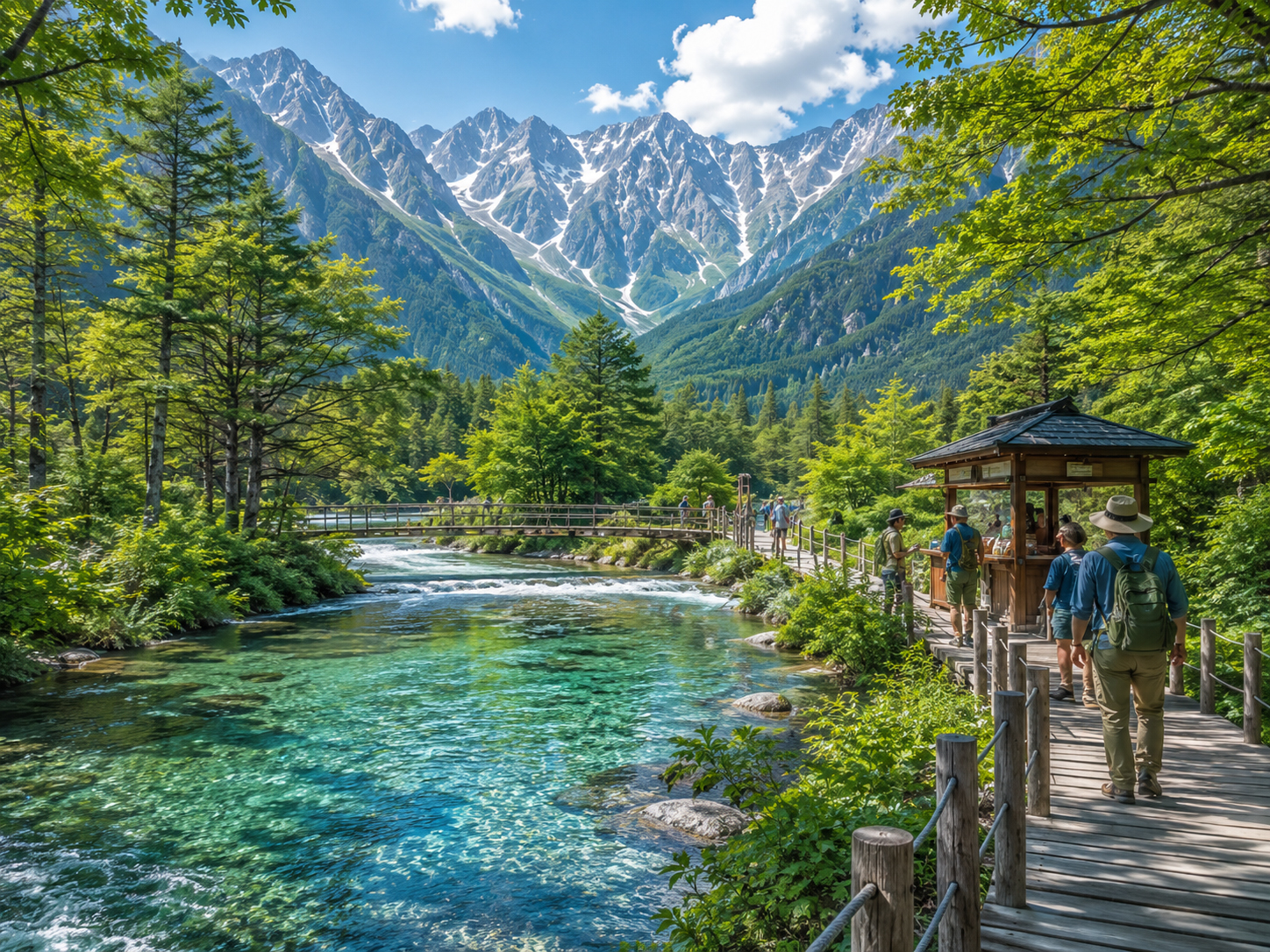
The first thing Kamikochi gives a visitor is not a view. It is a temperature. After the dense summer heat of Tokyo, Nagoya, Kyoto, or Osaka, the wind along the Azusa River feels like a reprieve. The water is blue-green and fast. The mountains look close enough to touch. On Kappa Bridge, the cameras come out immediately. But the more important story lies outside the frame: why does this place still look so clean, so open, so carefully restrained?
Kamikochi is often sold as nature, but it is also a managed public landscape. The official site places it inside Chubu Sangaku National Park and asks visitors to help protect its natural environment. Its basic rules are simple: do not collect plants or living creatures, do not feed wild animals, do not litter, do not bring pets or non-native species, and do not leave the paths. Bicycle riding on trails and drone flying are also restricted.
Those rules are not decorative. They are part of the destination. Private cars and motorcycles are not allowed into Kamikochi. Visitors approaching from the Matsumoto side or the Takayama side use gateway parking areas such as Sawando or Hirayu, then continue by bus or taxi. The official access guide says the transfer typically takes about 20 to 30 minutes. That inconvenience is one reason the valley still feels different. The cars stop. The pace changes. The mountain begins before the visitor arrives.
Kamikochi’s coolness is not only meteorological. It is social: a system that slows people down before they enter a fragile valley.
Is a “free view” really free?
The debate around a conservation cooperation fee is not simply about charging tourists more. It is about the hidden cost of preserving a mountain resort that millions of people want to experience. Boardwalks rot. Trails wash out. Toilets require maintenance. Signs need translation. Floods change the river. Wildlife learns from human behavior. Local businesses, transport operators, mountain huts, public agencies, and park managers all carry parts of the burden.
Japan’s Ministry of the Environment and related regional planning documents have already identified the need to consider visitor-contribution systems in the southern Chubu Sangaku National Park area, including Kamikochi, Yari-Hotaka, and Norikura. The idea is that those who benefit from the park should help support the conservation, scenery, and safe-use infrastructure that make the experience possible.
The real questions are practical and ethical. Who counts as a beneficiary? Day-trippers? Climbers? Hotel guests? Foreign visitors? How much should be requested, and how should it be collected? Is it voluntary cooperation or a formal charge? How can the money be tied visibly to boardwalks, toilets, wildlife management, multilingual signs, and river safety? If the system is transparent, the fee becomes participation. If it is opaque, it becomes just another travel cost.
Kamikochi Vision 2026: a map for the next decade
In April 2026, the Ministry of the Environment’s Chubu regional office announced Kamikochi Vision 2026, a new ten-year guideline for the valley. It is the first full revision since the 2014 vision, and it frames the central challenge clearly: conserve the natural environment while allowing appropriate use of one of Japan’s representative mountain scenic areas.
That balance is harder than it sounds. If the goal were only preservation, the answer would be to reduce access. If the goal were only tourism growth, the answer would be to add capacity. Kamikochi cannot be pushed fully in either direction. People come because the valley is beautiful; the local economy, mountain huts, guides, transport operators, and lodging businesses depend on that visitation. But if too many people come in the wrong way, the very qualities they came to see begin to erode.
This is why a conservation fee matters. It is not a wall. It is a bridge between use and protection. A visitor who contributes to trail maintenance, toilet upkeep, invasive-species work, wildlife information, river safety, and multilingual guidance becomes more than a consumer of scenery. The visitor becomes a small participant in the next person’s experience.
The Azusa River is not only scenery
In most photographs, the Azusa River is Kamikochi’s blue ribbon. But Matsumoto City’s “Regeneration and Safety” project shows a more complicated truth. Management roads and temporary structures in the Tokusawa and Yokoo areas support mountain huts, public toilets, and emergency transport. Yet when infrastructure sits in or near the river, it can narrow and simplify river channels, alter habitats for plants, butterflies, and aquatic life, and affect the view that visitors came to admire.
This is the paradox of protected places. A rescue route may save a life. A maintenance road may keep toilets operating. A bridge may be essential for supplies. But each intervention changes something. The work of managing Kamikochi is the work of negotiating these contradictions year after year.
For a conservation cooperation fee to make sense, this hidden labor must be made visible. Visitors do not need a lecture. They need to understand that the valley’s “natural” appearance is supported by many unglamorous tasks: drainage, repair, signage, animal management, waste prevention, emergency readiness, and careful restraint.
Bears, monkeys, and the less cute side of nature
Kamikochi is not a theme park. It is habitat. Rules against feeding wild animals and leaving food or garbage behind are not just etiquette. They are safety measures. If monkeys or bears learn to associate people with food, the distance between wildlife and humans collapses. That puts people at risk, and it often ends badly for animals.
Regional park planning documents call for better collection and sharing of information on Asiatic black bears and other wildlife, as well as education that helps visitors understand the animals they may never see. The point is not to make nature frightening. It is to remind visitors that they have entered a living system that has its own rules.
This is one of the quiet shifts in Japanese nature tourism. The old model was: come, look, photograph, leave. The emerging model is: come, learn the rules, respect the place, support the infrastructure, and leave the valley capable of receiving the next visitor.
The new value of “cool Japan”
As Japan’s cities grow hotter, cool places become more valuable. Kamikochi, at around 1,500 meters, is not only a scenic destination; it is a climate refuge for summer travelers. Chubu Sangaku National Park’s own destination information emphasizes the valley’s alpine setting, beginner-friendly trails, clear river scenery, and access to the Hotaka range. For international visitors, it offers a version of Japan very different from the crowded temples, shopping streets, and train stations of the urban golden route.
But the more valuable coolness becomes, the more people will seek it. The more people seek it, the more maintenance is required. A cool mountain valley is not a free air conditioner. It is supported by buses, toilets, boardwalks, guides, rangers, waste rules, emergency plans, and local people who must make tourism compatible with a fragile alpine environment.
If Kamikochi finds the right model, it could offer lessons for many other Japanese landscapes: Fuji, Oze, Yakushima, Shirakami, Shiretoko, Aso, Amami, Kerama. The issue is not only how to attract visitors. It is how to make beauty financially and ecologically durable.
Five ways to read Kamikochi
- The private-car ban is not an inconvenience; it is part of the conservation infrastructure.
- A cooperation fee should be explained as participation in trails, toilets, safety, and ecosystem protection.
- The Azusa River is both the photographic star and a difficult management site.
- Wildlife rules protect visitors and animals at the same time.
- “Cool Japan” will become a stronger travel value as summer heat intensifies.
Do not make it a fee. Make it a story.
A conservation fee succeeds only when people can see what it protects. Which boardwalk was repaired? Which toilet was maintained? Which invasive plants were removed? Which signs were translated? Which hazardous area was made safer? Which wildlife-management system was improved? If visitors can connect their contribution to the landscape, the charge becomes meaningful.
Kamikochi does not need to scold people. The place itself is persuasive. The river, the bridge, the wet forest, the sudden white face of the mountains: these make the argument before any signboard does. The task is to connect that beauty to the labor that keeps it possible.
A Sunday walk in Kamikochi is not only sightseeing. It is rest, education, and civic participation in miniature. The valley asks a simple question: are you only here to consume the view, or are you willing to leave a little of yourself behind so the next person can see it too?
Japan.co.jp reads Kamikochi not as a story about “paying for nature,” but as a story about making the support system for nature visible.
The value of Kamikochi is not only the Hotaka skyline. It is the car-control system, the trail crews, the people who manage toilets and wildlife information, the buses and gateways, and the visitors who agree to become part of the valley’s maintenance rather than just its audience.
Sources and reference
This Japan.co.jp Sunday Long Read is based on official Kamikochi information, Kamikochi Vision 2026, Ministry of the Environment and Matsumoto City materials, and national-park access and conservation guidance. Details of any future visitor-fee or cooperation-fee system remain subject to official decisions; travelers should confirm current rules before visiting.