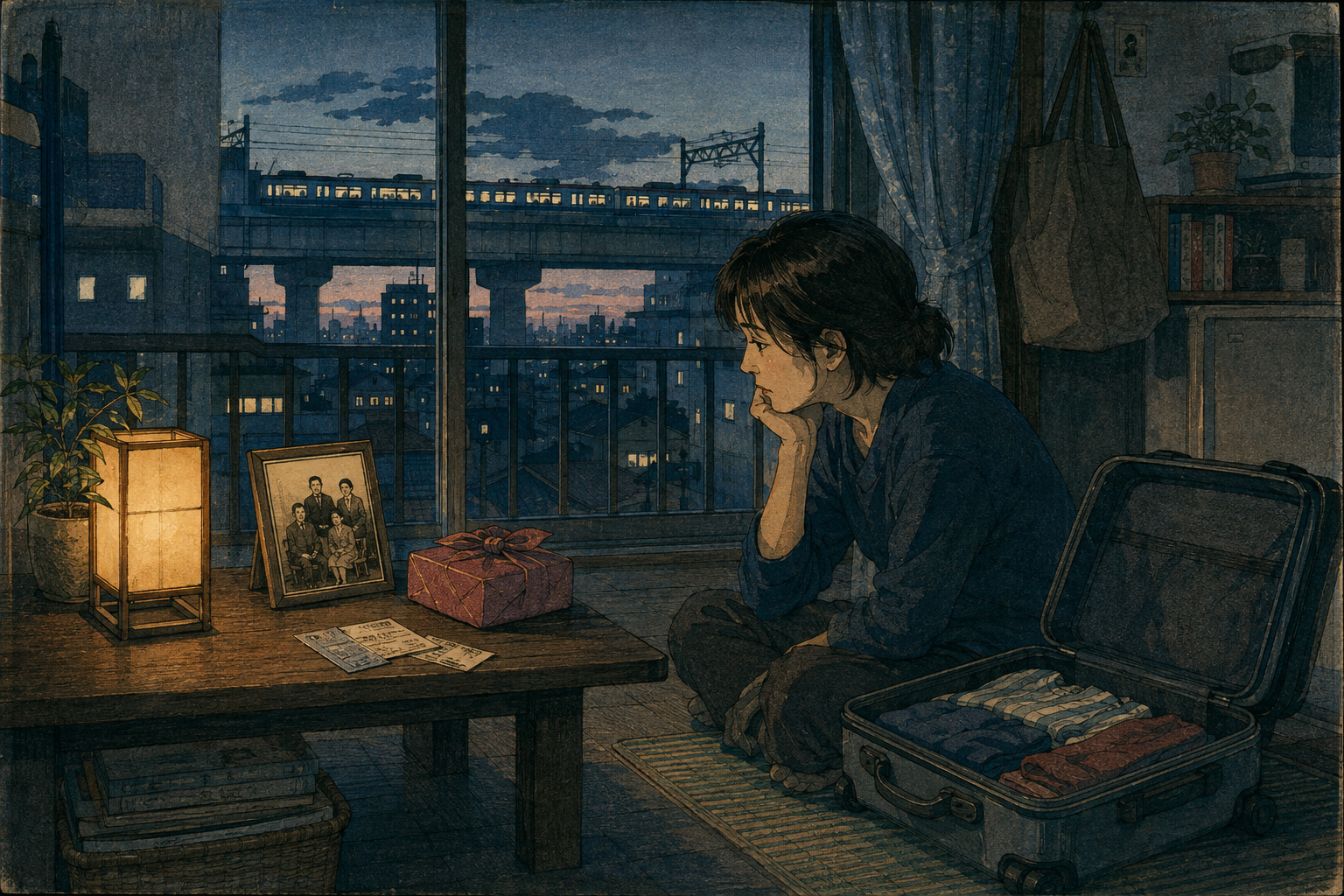
In the language of Obon, an adult who lives alone is often expected to leave home in order to go home.
The contradiction is easy to miss because everyday Japanese can keep the two places separate. There is the room or apartment where a person wakes, works, pays bills, cooks and sleeps. Then there is the jikka, the parental or family house, toward which the summer ritual of kisei—the family-home return—still points. One dwelling contains the present tense. The other contains childhood, ancestors and an inherited claim.
In July, the Hitorigurashi Research Institute, operated by real-estate group Able, asked people living alone whether they intended to return to their family home during Obon. Only 25.8% said yes. More than two-thirds, 67.3%, had decided not to go. Among non-returners, the most common reason was disarmingly ordinary: 37.1% wanted to relax at home. Transport expense followed at 23.4%.
It would be simple to cast these answers as evidence of a lonely, atomized Japan losing an old tradition. It would also be wrong. The survey does not show that people living alone lack families. It shows that their own homes are competing with the family home for time, meaning and legitimacy. An apartment is no longer necessarily a waiting room before marriage or a dormitory attached to an office. For a growing share of Japan, it is home itself.
What One Survey Can—and Cannot—Say
The poll covered 1,105 men and women aged 20–49 who were living alone, with different questions answered by different bases. It was conducted online from July 3 to July 6 and published by a company whose core business includes rental housing. That commercial connection does not erase the responses, but it matters: this was not a probability sample designed and weighted by the Statistics Bureau.
The sponsor reported that the planned return rate had fallen 1.7 percentage points from 27.5% a year earlier. The subtraction is correct. The comparison is not clean. The 2025 release reported 808 valid responses and an age range of 15–49; the 2026 survey had 1,105 respondents aged 20–49. Without the same population, recruitment and weighting, a movement that small should not be treated as proof of a national annual decline.
The larger patterns inside the 2026 sample are more informative. Among those going, 60.7% cited spending time with family, 43.1% the custom of returning at Obon and 40.3% seeing hometown friends. Among those staying, the desire to rest at home rose 10.6 points from the sponsor’s prior result, while transport cost rose 9.7 points. In the published age breakdown, family was especially important to returnees in their twenties; more than 70% of non-returning men and women in their forties selected rest at home.
Even these results describe choices, not causes. Someone may select cost after deciding that a crowded visit will be too tiring. Another may select rest rather than disclose a painful family relationship. Another may see parents in September, host them in Tokyo, or live close enough that “returning home” is the wrong category. A survey box cannot contain an entire family history.
| Published result | What it supports | What it does not establish |
|---|---|---|
| 25.8% planned to return | A minority of this living-alone, age-20–49 sample planned an Obon family-home visit. | That three-quarters never visit family, reject Obon or are estranged. |
| 67.3% had decided not to go | Non-return was the dominant plan for this particular holiday. | That family contact did not happen online, elsewhere or at another time. |
| 37.1% wanted to rest at home | The respondent’s present dwelling had positive value as a place of recovery. | That living alone caused isolation, unhappiness or selfishness. |
| 23.4% cited transport cost | Travel price was a substantial perceived barrier among non-returners. | The exact amount paid, or that cost alone caused the decision. |
The Long Shadow of the Ie
Obon’s homecoming ideal was shaped by a family order in which “home” meant more than the people currently under one roof. The prewar ie was a continuing household line: property, name, ancestor rites and status passed across generations, commonly through an heir. In the classic rural stem-family model, an eldest son and his wife remained with his parents while other children established branch households or left.
This was never the only way Japanese people lived. Region, class, occupation and local custom produced many arrangements. Still, the legal and moral weight of the ie made the household appear older than any member and more durable than individual preference. The family grave and Buddhist altar were not simply memorial objects. They helped locate the living inside that continuing line.
Japan’s postwar Constitution and the 1947 Civil Code abolished the ie as a legal institution and established equality of the sexes and individual dignity in family law. Custom did not change at the stroke of a pen. The eldest son could still be expected to inherit a house, support parents and maintain ancestral rites; daughters and daughters-in-law continued to perform much of the holiday labor. But the legal household head no longer possessed the former authority, and family life could increasingly be organized around a married couple and children rather than an intergenerational corporate house.
Long-running national attitude surveys trace the turn. Research covering 1950–1990 found support declining for the idea that one child must inherit status, property and ritual duties, and for the expectation that children must co-reside with and support parents. By the 1960s, preference for the conjugal family had overtaken support for the stem-family model. The inherited house remained emotionally powerful while becoming less able to command everyone’s life.
1947 The revised Civil Code abolishes the legal ie system and places family law on individual dignity and equality.
1950s–1970s Industrialization and metropolitan migration separate workplaces and young households from regional family homes.
1995 The Statistics Bureau begins a separate national income-and-expenditure survey for one-person households.
2002 One-person and multi-person household surveys are integrated into the Family Income and Expenditure Survey.
2020 One-person households reach 21.15 million, 38.0% of all households in the official projection base.
2050 They are projected to number 23.30 million and represent 44.3% of households.
From Exception to the Largest Household Form
The official category “one-person household” sounds clinical because it is. It tells statisticians how many people normally reside in a dwelling. It does not say whether the resident is single, married but living apart for work, divorced, widowed, studying, dating, raising children elsewhere, caring for parents from a distance or surrounded by friends. A household unit is not a measure of human connection.
But the category’s scale has transformed the country. The National Institute of Population and Social Security Research counted 21.15 million one-person households in 2020—38.0% of all households, already the largest household type. Its 2024 projection places the number at a peak of about 24.53 million in 2036. By 2050, after population decline has begun to reduce the absolute total, 23.30 million people are still projected to live in one-person households, accounting for 44.3%. Average household size falls from 2.21 people in 2020 to 1.92.
The transformation is visible in the history of statistics itself. Until the mid-1990s, the government’s main household budget survey did not fully incorporate the spending of people living alone. A separate one-person survey began in 1995 and was integrated into the Family Income and Expenditure Survey in 2002. The state had to redesign its lens because the older image of a household—usually a married couple with children—no longer described enough of the country.
Family sociology has likewise moved beyond the choice between co-residence and family disappearance. Recent research describes the modern Japanese ie less as a single shared household than as a network of cooperation among close relatives in separate residences. Parents may keep the altar while an adult child manages online banking, orders groceries, schedules care or visits for grave cleaning. A sibling near the hometown performs tasks another sibling finances from the city. The roof has split; the family system can persist across addresses.
Rest at Home Is Not an Empty Answer
The most revealing phrase in the survey may be “I want to relax at home.” The word reverses the direction of Obon. Convention says the city resident returns home to rest, eat family food and resume a child’s place for a few days. The respondent says rest is available where they already are.
That answer can contain simple exhaustion. Obon is customary leave rather than a national public holiday, and not every employer closes for the same days. The August return compresses booking, packing, gifts, heat, peak crowds and family expectations into a short interval. A person in a one-person household must manage the decision and the trip without dividing planning across a household. For some, an unstructured day in their own room is the scarcer luxury.
It can also contain autonomy. The family home may carry an old role: dutiful son, marriageable daughter, sibling who mediates, adult child who should explain work, income or relationships. The sponsor’s 2025 survey found that nearly 40% of women in their thirties said a return could leave them tired or stressed, and it recorded “awkward family relations” and discomfort at the parental house among reasons not to go. Those results do not apply to every household, but they remind us that reunion is labor as well as affection.
For decades, the one-room city dwelling was narrated as temporary—somewhere a young worker lived before forming a “real” household. Yet living alone now extends across the life course. A person may create continuity through furniture, a neighborhood bathhouse, a local temple, a balcony plant, a pet or the same grocer for twenty years. Calling the choice to remain there a rejection of home assumes that only the ancestral address deserves the name.
The Price of a Ticket—and the Price of Flexibility
Transport cost was not the leading reason for staying, but at 23.4% it was no footnote. The share was 9.7 points higher than the company’s preceding result. Headline inflation does not fully describe the calculation. A solo traveler buys fewer tickets than a family, but cannot divide a car’s tolls and fuel among several passengers. They alone absorb the cost of both directions, and some discounts assume a group.
One 2026 JR Central and JR West limited-sale product illustrates the design problem. It offered attractive counter-peak Shinkansen fares, but required at least two travelers, booking 40 days ahead and travel in specified directions and periods. It was not intended as a general Obon subsidy, and its restrictions served the operational goal of filling less crowded trains. Still, a person traveling alone could not buy it. A traveler who did not know their work schedule six weeks ahead could not buy it either.
This does not prove that solo travelers always pay more. Ordinary rail fares are charged by passenger, so one person’s total is lower than a family’s. Nor is every person living alone financially vulnerable. The point is narrower: households share some fixed costs and information work; a one-person household cannot. Products built around couples, family rooms, two-person minimums or advance certainty can make the market’s imagined customer visible.
For a fuller examination of inflation, peak-period products and the 2026 return rush, see Japan.co.jp’s companion report, The Price of Going Home. Here the essential fact is that money and emotion do not act separately. A ¥20,000 trip can feel worthwhile when the family home is welcoming and exhausting when the visit promises interrogation or labor. Cost is weighed against the quality of return.
New Year Complicates the Story
If people living alone were simply abandoning family reunion, another survey by the same organization would be difficult to explain. In a poll conducted January 3–4, 2026, Able reported that 70.9% of living-alone respondents had returned to their family home over New Year. Among those returnees, 59.6% stayed at least two nights, compared with 13.2% of returnees in family households; the latter were much more likely to make a day trip.
The January and July polls were separate surveys. They did not necessarily interview the same people, and differences in wording, timing and sample composition prevent a direct seasonal experiment. But the contrast is too large to support a flat story of detachment. People living alone may concentrate family reunion in the holiday that offers longer workplace closure, a stronger household celebration or a more comfortable season. They may visit once a year rather than twice.
New Year and Obon also ask different things of a family. New Year welcomes the living into a renewed household. Obon invites the dead back, directs attention to graves and temples, and often concentrates responsibility in the person who maintains the ancestral place. A person who happily shares osechi in January may not feel the same connection to August ritual—or may rely on a sibling who lives nearby to perform it.
Selection is not disappearance. In a society with more households and fewer people per household, relatives must coordinate across a larger number of doors. A lower Obon return rate can signal the rationing of time between holidays rather than the end of kinship.
- The present dwelling: autonomy, routine, work, neighbors, friends and recovery.
- The parental house: childhood, family roles, care, conflict, welcome and obligation.
- The ancestral place: grave, altar, temple and a lineage that may outlast the house itself.
- The hometown network: school friends and local memory, even after parents move or the old house is sold.
What a Physical Return Still Does
To defend a person’s choice not to travel is not to pretend the visit has no social function. The Obon return can be a form of informal family infrastructure. It puts adult children in the same room as parents whose declining health is easy to minimize on the telephone. It reveals the state of the house, the grave and the person who has been maintaining both.
A 2026 LIFULL survey selected 650 adults aged 30–60 who had recently met a parent living separately. Among that particular group, 74.2% said they noticed some sign of decline or something unusual; walking and mobility were the most common observations, followed by memory and cognition. Because respondents were chosen for having met a non-co-resident parent recently, the figure cannot be generalized to all Japanese parents. It does show why in-person contact can carry information that voice alone does not.
The same company found that inquiries to its eldercare-home service in 2025 rose after Obon, reaching an index of 128.8 two weeks after the holiday compared with 100 during Obon. The data come from a business, not the whole care sector, but the sequence is plausible: reunion makes change visible; families begin a difficult conversation after returning to their separate homes.
Prior Able research also found an association between frequent contact with parents and higher homecoming rates. Association is not causation. Close families may both call and visit more, while distance, conflict or illness can influence each behavior. What matters is that the one-person household does not stand outside care. It often becomes one node in a distributed system of calls, money, visits and emergency decisions.
Living Alone Is Not the Same as Loneliness
Japan has real problems of loneliness and social isolation, and the rise of one-person households makes support design urgent. But using “living alone” as a polite synonym for lonely obscures both the freedom of many solo households and the vulnerability of people who do not live alone.
The National Institute’s 2022 Social Security and People’s Life Survey received personal responses from 15,929 people. Across the population, 16.0% reported feeling lonely “often” or “sometimes.” Only 3% said they had a conversation no more than once every two weeks, but the figure rose to 15.0% for older men living alone and 5.3% for older women living alone. Risk was unequal by age, gender and social network.
That evidence should not be pasted onto Able’s 20–49-year-old respondents. The surveys cover different ages, methods and questions. It should instead guide policy beyond the holiday. Today’s younger solo resident may age without a spouse or child nearby; official projections show steep growth in older men and women living alone, including people who never married and people with no close relatives available. A system that assumes “the family” will notice every problem will miss more people.
The answer is not compulsory homecoming. It is thicker connection: workplaces that leave time for relationships, transport that does not punish uncertainty, local services that know a resident before crisis, housing that supports mutual aid, and rituals open to friends and neighbors as well as legal kin. Solitude can be chosen and nourishing. Isolation is a lack of support when support is wanted.
How Obon Changes Without Ending
Obon has never been one fixed national script. Regions observe it in July, August or according to a lunar calendar. Families light fires, visit graves, call a priest, dance, travel, pray at an altar or do only some of these. Calendar reform, urbanization and war changed the practice before the one-person household did.
The next adaptation may be less visible than a station rush. A city resident returns in September and joins the family by video on August 15. Siblings rotate grave care rather than all appearing every year. A parent visits the adult child’s apartment, reversing the direction of welcome. A grave-cleaning service maintains a distant site in dangerous heat. An unmarried friend is invited to a neighborhood dance; a person without an ancestral grave writes a name before a lantern.
Not every substitution carries the same meaning as standing together at the family grave. Traditions survive partly because presence matters. But a tradition that recognizes only one address, one heir and one correct route will fit fewer lives as one-person households approach half of the national total.
The July survey’s 25.8% is therefore not the measure of Obon’s health. It is a signal that the holiday’s inherited geography no longer matches the country’s household geography. The family has not vanished. It has been distributed.
At night, the apartment window and the lantern at the family house can both be lit. One does not extinguish the other. The adult who stays home may call a parent, remember a grandparent, rest, avoid an old wound or simply choose January for the long visit. Obon’s future depends less on forcing that person onto a train than on making room for a harder truth: home may now exist in more than one place, and sometimes the most honest homecoming is the decision to remain where one already lives.
Reporting note and principal sources
This article uses public information checked through August 14, 2026 at 7:04 AM JST. Corporate surveys are identified as such and are not treated as nationally representative. “Living alone,” “one-person household,” “unmarried” and “lonely” are distinct categories. Historical family forms are described as influential models rather than universal experience.
- Hitorigurashi Research Institute: 2026 Obon family-home survey, findings and methodology
- Able & Partners: full 2026 survey release and age breakdowns
- Able & Partners: 2025 Obon survey and prior sample details
- Able & Partners: 2026 New Year homecoming survey
- National Institute of Population and Social Security Research: Household Projections for Japan, 2024 edition
- National Institute: summary of 2020–2050 household projections
- National Institute: 2022 Social Security and People’s Life Survey
- Japan Association of Legal and Political Sciences: the ie system and 1947 legal reform
- Japanese Journal of Family Sociology: postwar change in family attitudes, 1950–1990
- Annual Review of Rural Studies: family continuity through separate-residence kin networks
- Statistics Bureau: history and scope of the Family Income and Expenditure Survey
- JR Central/JR West: 2026 limited EX Hayatoku sale conditions
- LIFULL: 2026 survey on noticing changes in parents during visits and post-Obon care inquiries
- Cabinet Office: 2025 White Paper on the Ageing Society, household composition and older people living alone
- Government of Japan: Obon customs and regional calendars
- Cabinet Office: official national holiday calendar