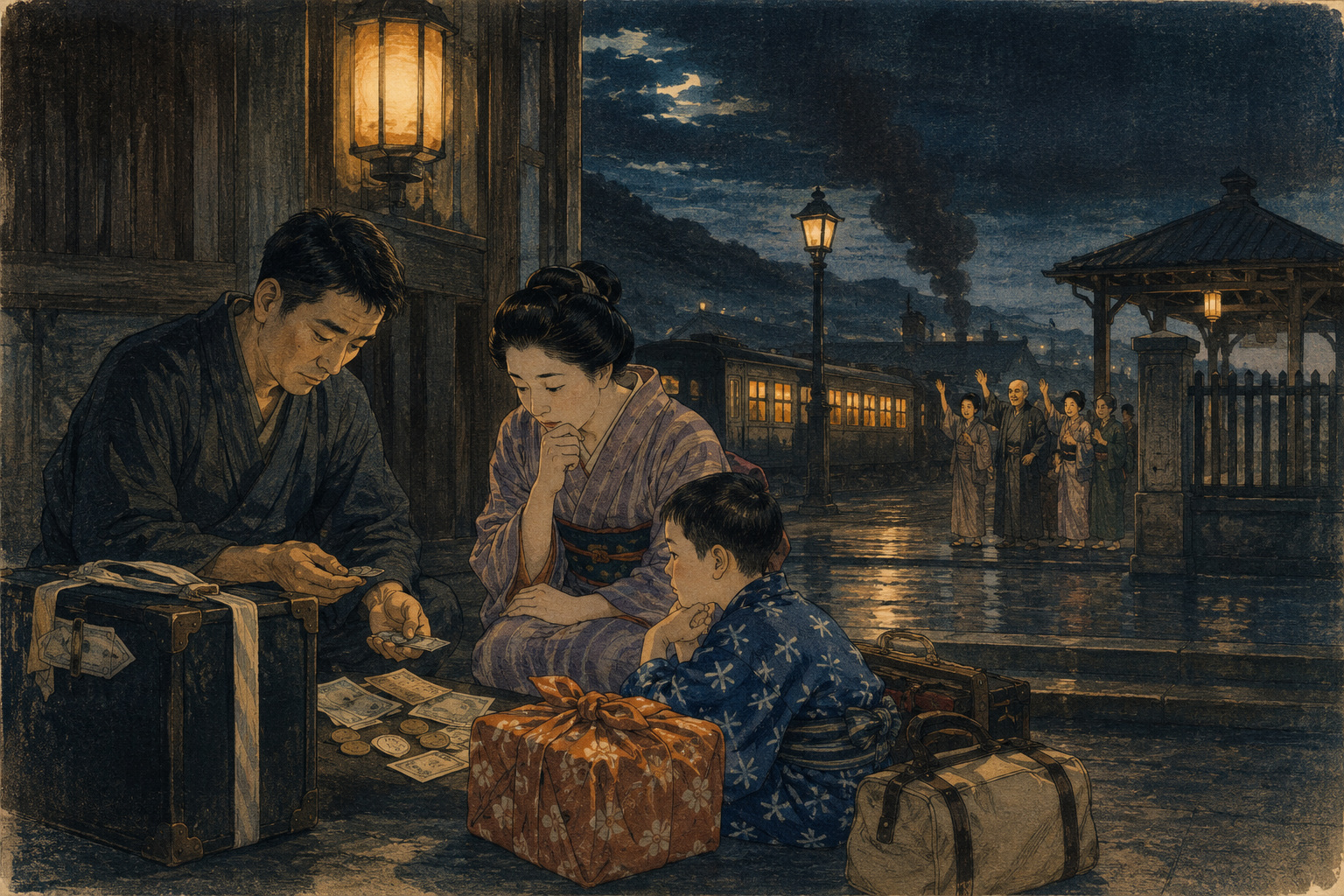
Before Obon becomes a traffic report, it becomes arithmetic.
There is the ticket from the city to the family home, multiplied by two directions and perhaps by two adults and two children. There is the local train or airport bus at either end. A car changes the columns, but not the calculation: fuel, tolls, parking, food at a service area and hours in congestion. Then come the gifts carried through the door, meals shared after arrival, money for children, flowers and incense for the grave, and sometimes a hotel because the house called “home” no longer has room.
None of those expenses cancels the meaning of Obon. That is precisely why they matter. A discretionary holiday can be removed cleanly from a budget. A family return is harder to classify. It is travel, ritual, caregiving, gratitude, obligation and pleasure packed into the same suitcase.
In a June survey released by WILLER MARKETING, 31.1% of 1,829 member respondents said they planned to return home during Obon. Another 21.9% were undecided. The largest group, 47.1%, had no such plan. Among those intending to go, exactly half said the cost had risen from the previous year. About eight in ten placed their ideal round-trip transport cost at no more than ¥10,000, while roughly half expected to spend beyond the amount they wanted.
Those results captured a genuine household strain. They also invite an easy but false conclusion: that an inflation-weary nation has simply stopped going home. Advance rail bookings told a different story. As of July 23, JR East had 1.55 million reserved seats booked for August 7–16, including 1.24 million on Shinkansen services. Both totals were 106% of the comparable 2025 level. On the Tokaido corridor, the main outward and return peaks were already taking shape.
Japan in August 2026 was therefore living with two realities. Many people were reconsidering, shortening or rejecting the trip. Many others were filling trains as vigorously as ever. The contradiction disappears once Obon is understood not as a national yes-or-no vote, but as a concentrated market for a scarce thing: the affordable right to be in the correct place on the correct day.
The Survey Says Less—and More—Than Its Headline
The first discipline is to keep the denominators straight. “Nearly half are not going home” describes the WILLER member sample, not all residents of Japan. “Half face higher costs” describes only the subset planning a trip. The survey was internet-based, conducted by a company whose members are more likely than the general public to use travel services, and published by a business with a commercial interest in bus travel.
That does not make the findings meaningless. It makes them situated. The respondents were close enough to the travel market to recognize its prices, compare modes and describe the compromises they were considering. The survey’s most revealing number may not be 47.1 or 50.0, but 12.7: the share of non-returners who selected transportation expense as a reason. Work or school commitments and the wish to avoid crowds and traffic ranked above it.
A person can have no Obon trip planned because their parents live nearby, because relatives are coming to them, because the ancestral home no longer exists, because they travel in July or September, because work continues, because congestion is exhausting, or because family relations are complicated. “No trip” is not a diagnosis. Nor does price act alone: an expensive ticket may be tolerable on a quiet day and intolerable when it also requires standing, queueing and surrendering the only flexible days in a short holiday.
The 21.9% who were undecided matter for the same reason. They occupied the space where a fare, a work schedule, a parent’s health or an available seat could still change the answer. Obon demand is not merely counted. It is negotiated until departure.
How Postwar Japan Invented the Return Rush
Obon is old; the mass synchronized kisei rush is modern. For much of the observance’s history, honoring ancestors was rooted in the place where people already lived. A nationwide surge from metropolitan workplaces toward distant family homes required a different Japan—one in which millions had moved away, paid urban wages and retained strong ties to another community.
Rapid economic growth supplied that geography. A 1968 Transport Ministry white paper recorded that the share of the population living in cities of at least 100,000 rose from 34.9% in 1955 to 46.5% in 1965, while primary-industry employment fell from 41.0% to 24.7%. Young people left farms, fishing towns and regional cities for factories, offices and schools in the great metropolitan belts. The hometown did not disappear. It became a destination.
Transport then compressed the distance. The Tokaido Shinkansen opened in 1964, turning Tokyo–Osaka into a four-hour rail journey at the start of service. Expressways, widespread car ownership and jet aviation created other ways back. By the 1980s, the government’s transport history described a public increasingly demanding speed, convenience, comfort and freedom of movement—and a system responding with Shinkansen expansion, highways, computerized reservations and motorization.
This history explains the emotional force of the station-platform image. The salary worker with gifts, the family with sleeping children, the lines at ticket gates and the televised tailbacks are not only travel scenes. They are the annual reverse flow of postwar urbanization. The cities that gathered labor release part of it back toward the places that raised it.
1955–1965 Rapid growth and industrial change push Japan’s urban share sharply upward.
1964 The Tokaido Shinkansen opens between Tokyo and Osaka.
1960s–1980s Expressways, private cars, jet services and reservation systems turn simultaneous long-distance return into a mass practice.
2025 Japan still records about 5.19 million moves between municipalities, including 2.52 million across prefectural borders.
2026 The inherited family geography meets higher everyday prices, new rail fares and tightly conditioned peak discounts.
The pattern did not freeze in the twentieth century. Statistics Bureau data show 5,190,548 municipal moves in 2025, of which 2,515,731 crossed prefectural borders. Tokyo’s 2025 census population was about 14.25 million, and the four-prefecture Tokyo metropolitan area held roughly 30% of Japan’s population. Obon continues to run through a country where work, housing and family are often located in different prefectures.
The 2026 Calculation Begins Before the Main Ticket
Japan’s national consumer price index in June stood 1.7% above a year earlier; the index excluding fresh food was 1.6% higher. Those figures are far calmer than the language of a household argument. They are averages across a vast basket. A family does not buy the index. It buys particular groceries, utilities, school needs and tickets from the income remaining that month.
A separate Intage survey of 5,000 people, weighted to national demographic shares, illustrates the distinction. The average planned summer budget rose 2.8% to ¥58,902 after two years of decline. That sounds like expansion until the reason is examined: 45.7% of those expecting to spend more cited inflation and the weak yen. The share planning to spend summer at home reached 38.6%. Among people planning an overnight domestic trip, intended expenditure climbed 6.4% to ¥109,305, with higher accommodation prices the leading explanation.
A larger budget can therefore describe a smaller holiday at a higher price. It may buy the same number of nights, fewer meals out or simply the unchanged act of seeing one’s parents. Nominal spending is not a reliable measure of abundance.
The family’s full Obon bill is also wider than the fare question in the WILLER survey. Food and gifts become more expensive at the same time as transport. A host household may absorb extra groceries and electricity. A visitor may arrive with omiyage, offer money at a temple, purchase flowers and incense, or hand obondama to children. Each item is modest in isolation. Obon bundles them on the same days.
A Peak-Period Market Rewards the Flexible
Transport operators do provide lower-cost choices. The difficulty is that the best price often requires the very resources a constrained household lacks: advance certainty, digital access, a group of the right size, a slower journey or freedom to travel against the crowd.
For August 2026, JR Central and JR West offered a limited “EX Hayatoku” sale with striking one-way prices: ¥10,000 from Tokyo to Nagoya, ¥12,000 to Kyoto or Shin-Osaka and ¥15,000 to Hiroshima. But the offer required at least two travelers, purchase 40 days before departure, limited inventory and travel in the less crowded direction—toward Tokyo on August 7–10 or away from Tokyo on August 13–16. It was a tool for balancing trains, not a general discount for the classic outward-then-return Obon itinerary.
The familiar lower-cost “Platt Kodama” package was unavailable from August 6 through 16. All Nozomi services on the Tokaido and Sanyo Shinkansen were reserved-seat only from August 7 through 16. A family making a late decision could find that the slower bargain it knew had disappeared and the fastest service required a reservation at the year’s most concentrated travel period.
Another structural change arrived in March. JR East revised ordinary and commuter fares across its area. It did not raise limited-express or Green Car surcharges, but ordinary base fares changed, some lower urban fare categories were folded into the trunk-line system, and the calculation for journeys crossing JR company boundaries was revised. The sale of traditional round-trip and continuous tickets ended at the same time. The old nationwide round-trip discount, which reduced base fares by 10% when one-way distance exceeded 600 kilometers, disappeared with that ticket format.
None of this means every 2026 Obon rail journey cost the same percentage more. Routes, operators, products and purchase dates differ. It means the traveler faces a more fragmented price map. Cheap travel still exists, but increasingly as a conditional product rather than a simple property of the route.
| Mode | Where the bill grows | Lower-cost route—and its tradeoff |
|---|---|---|
| Shinkansen / rail | Peak calendars, base-fare changes on JR East itineraries, reserved seating and the end of the old long-distance round-trip ticket discount. | Advance digital products, slower services or counter-peak travel; often limited by inventory, direction, group size and purchase deadline. |
| Air | Lower fare buckets disappear as flights fill; access to distant airports, baggage and schedule changes add to the effective cost. | Book early or accept less convenient times and airports; useful only when work and family dates are known. |
| Car | Fuel, tolls, parking, service-area spending and long congestion hours. | Share among several passengers or travel overnight; savings are purchased with driver fatigue and time risk. |
| Highway bus | Peak inventory and road congestion; long journeys carry a physical cost. | Often a lower cash fare, and a night bus can replace lodging; arrival time is less certain in heavy traffic. |
Time Is Part of the Fare
Price comparison tables make travelers look interchangeable. They are not. A university student can sometimes take a night bus and sleep the following morning. A parent traveling with an infant may reasonably pay for speed, a guaranteed seat and fewer transfers. An older traveler may need elevators and daylight arrival. A shift worker may learn their days off too late for a 40-day advance product.
That is why “just travel off-peak” is incomplete advice. Obon is synchronized by employer shutdowns, school calendars, memorial services and the availability of relatives. The 2026 statutory Mountain Day holiday fell on August 11, while common month-late Obon observances ran around August 13–16. Operators expected the strongest outward movement on August 8 and the main return on August 15–16. Families did not independently choose the same dates by accident; institutions selected them together.
The cheapest traveler is often the one who owns the most flexibility. They can leave on Tuesday, work remotely, reserve before the family has settled its plans, travel alone, or remain away longer. The household with fixed shifts, several tickets and care responsibilities is least able to meet a discount’s conditions. Peak pricing can therefore act like a charge on inflexibility.
- Local transport to and from the intercity terminal, plus baggage or airport access.
- Tickets for every household member and the cost of securing seats together.
- Gifts, grave flowers, incense, temple offerings and money for children.
- Extra meals and utilities borne by the host household.
- Lost work, an additional hotel night or a longer trip required to obtain a lower fare.
Why Crowded Trains Do Not Disprove Cost Pressure
The strong JR reservation count and the WILLER survey are measuring different things. One asks individuals about intention; the other counts booked seats on one operator’s services. A family of four creates four reservations. A person taking several train legs can appear in more than one service count. The rail data include leisure trips as well as homecomings, while the survey asks specifically about returning home.
More importantly, scarcity is compatible with exclusion. If ten people want eight seats and price pressure causes one to withdraw, the train can remain full. A national transport network can post strong revenue and crowded platforms while a meaningful minority stays home. The visible queue records those who cleared the financial, scheduling and physical hurdles; it tells us little about those who never entered the station.
Demand can also become more concentrated when families shorten trips. Someone who once traveled several days before the rush may now compress leave around a weekend. Someone who alternates between two family homes may choose only one. Someone who used to visit twice a year may preserve Obon and cancel New Year. Aggregate passenger counts cannot display the family visits that were traded away to protect the one that remains.
This is why the phrase “weakening the migration” should be used carefully. The evidence supports strain, substitution and unequal access. It does not yet establish a collapse. In 2026 the return rush was still powerful enough to fill peak trains; the threshold for joining it was becoming harder for some households to cross.
The Quiet Geography of Unequal Distance
A ¥10,000 ideal round trip means very different things depending on where “home” is. It can cover a short regional journey, barely reach a distant city one way, or be impossible for an island route. Distance in Japan is not simply kilometers. It is the number of company boundaries, transfers, flights, ferries and relatives traveling together.
The postwar model assumed that metropolitan earnings could maintain a relationship with a regional family home. But the two ends of that relationship have changed. Rural populations have aged, local rail and bus networks have thinned, and the city household faces high housing and child-rearing costs. A Shinkansen station can bring the prefecture closer to Tokyo while the final trip to a mountain village becomes slower. The expensive segment may be the famous train; the fragile segment is often the last one.
Family size magnifies this geography. A fare increase that looks modest for one adult becomes four times as large before a meal is purchased. Separated couples, blended families and people with parents in different prefectures must decide whose ancestors and which grandparents receive the finite visit. The arithmetic is social: a ticket choice can be interpreted as affection, duty or neglect.
There is also inequality at the destination. Some parents can help with fares or send food home with their children. Others need the visit precisely because they require help with a grave, a house, paperwork or health. The households most socially valuable to visit are not necessarily the ones best able to subsidize the journey.
What Families Change Before They Say No
Traditions rarely vanish in one decision. They bend. The WILLER survey itself found Shinkansen and highway bus tied at 58.7% among desired modes, with multiple answers permitted, and 47.8% citing highway buses as a saving tactic. That is not a wholesale switch from rail to road. It is evidence of comparison: speed for one leg, price for the other; daytime outbound, night-bus return; one parent and one child traveling instead of the whole household.
Families also move the calendar. A July visit can serve a region that observes July Bon; a September weekend can perform the family reunion without the August price. Some lengthen one trip to reduce annual frequency. Others conduct a short video call during Obon and promise a physical visit later. A relative already in the hometown may clean the shared grave. Gifts can be sent rather than carried.
These are practical adaptations, but they are not identical substitutes. A video call cannot lift a heavy box from an aging parent’s closet. A proxy grave cleaning cannot reproduce siblings standing together before a family stone. An off-peak visit may miss the cousins and grandchildren who can only gather when workplaces close at once. The efficiency of synchronized Obon is also its expense: it makes a whole family available, then makes the route to them scarce.
The Cost of Not Going
Household budgets record the saved ticket. They do not record what the absent journey might have discovered. A visit can reveal that a parent is walking less steadily, that an unused room has become unmanageable, that the family altar needs repair, or that the person who always cleaned the grave can no longer do it alone. These are not guaranteed outcomes of every homecoming, and family visits are not universally warm. But physical presence carries information that a scheduled phone call can conceal.
The destination also has an economy. Regional trains, taxis, shops, restaurants and gift counters depend on seasonal movement. Host households buy more food; temples, florists and cemetery services receive concentrated demand. When families reduce frequency or size, the effect is dispersed across thousands of small transactions and relationships. No single cancellation closes a local shop. A long drift can change which services remain available for the next visit.
There is emotional cost on both sides. Younger households may feel guilt for making a rational budget decision. Parents may avoid mentioning money or health because they do not want to force an expensive trip. The language of duty can turn a structural problem—work and family placed hundreds of kilometers apart—into a private moral failure.
Homecoming as Infrastructure
It is tempting to answer the 2026 squeeze with consumer technique: book earlier, compare modes, leave off-peak. Those measures help some travelers, and transport companies have reason to spread demand. They do not reach the underlying problem. A person cannot reserve 40 days ahead if their employer confirms leave ten days ahead. A two-person discount does not help a person traveling alone. A counter-flow sale does not help when the ancestral home lies with the peak.
If family contact, grave care and regional connection are considered socially valuable, then time policy matters alongside fare policy. Predictable leave, staggered shutdowns, remote-work flexibility where possible, transparent family discounts, through-ticket simplicity and transport links beyond the main station can change the effective price of a visit. So can caregiving support in the hometown, which reduces the amount of emergency labor compressed into a short return.
The useful question is not whether every person should go home at Obon. Some do not wish to; some have no safe or welcoming home to return to; some honor the dead differently. The question is whether price and inflexible time are making the decision on behalf of people who do want to go.
On August 15, the return flow toward Japan’s cities was at or near its height. Television cameras could show the platforms, the children holding souvenirs, the taillights and flight boards. The people absent from those pictures were harder to count. They were the 47.1% in one imperfect survey, and also everyone whose journey became shorter, later, solitary or uncertain.
Obon has survived calendar reform, industrialization, urban migration and enormous changes in the Japanese household. It will survive another expensive summer. Survival, however, is not the same as equal access. Before the lantern can be lit, before the grave can be cleaned and before someone can slide open the familiar door, there remains a smaller modern ritual: looking at the fare, looking at the balance, and deciding what “going home” is worth—and whether this year the household can pay it.
Reporting note and principal sources
This article uses public information checked through August 14, 2026 at 7:04 AM JST. Survey percentages are reported with their population and base; corporate surveys are not treated as official national statistics. Advance reservations measure booked seats, not unique homecoming travelers. Prices and product conditions can change, and examples are not purchasing advice.
- WILLER: 2026 Obon homecoming-cost survey, full findings and methodology
- Intage: 2026 summer budget and travel-intention survey of 5,000 people
- JR East: reserved-seat bookings for August 7–16, 2026
- JR East: March 2026 fare and ticket-system changes
- JR Central: reserved-seat-only Nozomi peak periods
- JR Central/JR West: 2026 limited EX Hayatoku sale conditions
- JR Central Tours: Platt Kodama prices and August exclusion dates
- Statistics Bureau: June 2026 national consumer price index
- Statistics Bureau: 2025 internal migration report
- Statistics Bureau: preliminary 2025 census population and metropolitan concentration
- Transport Ministry: 1968 white paper on rapid urbanization and transport
- Transport Ministry: historical account of growth, motorization and changing travel demand
- JR Central: Tokaido Shinkansen operating history
- Government of Japan: Obon customs and August observance