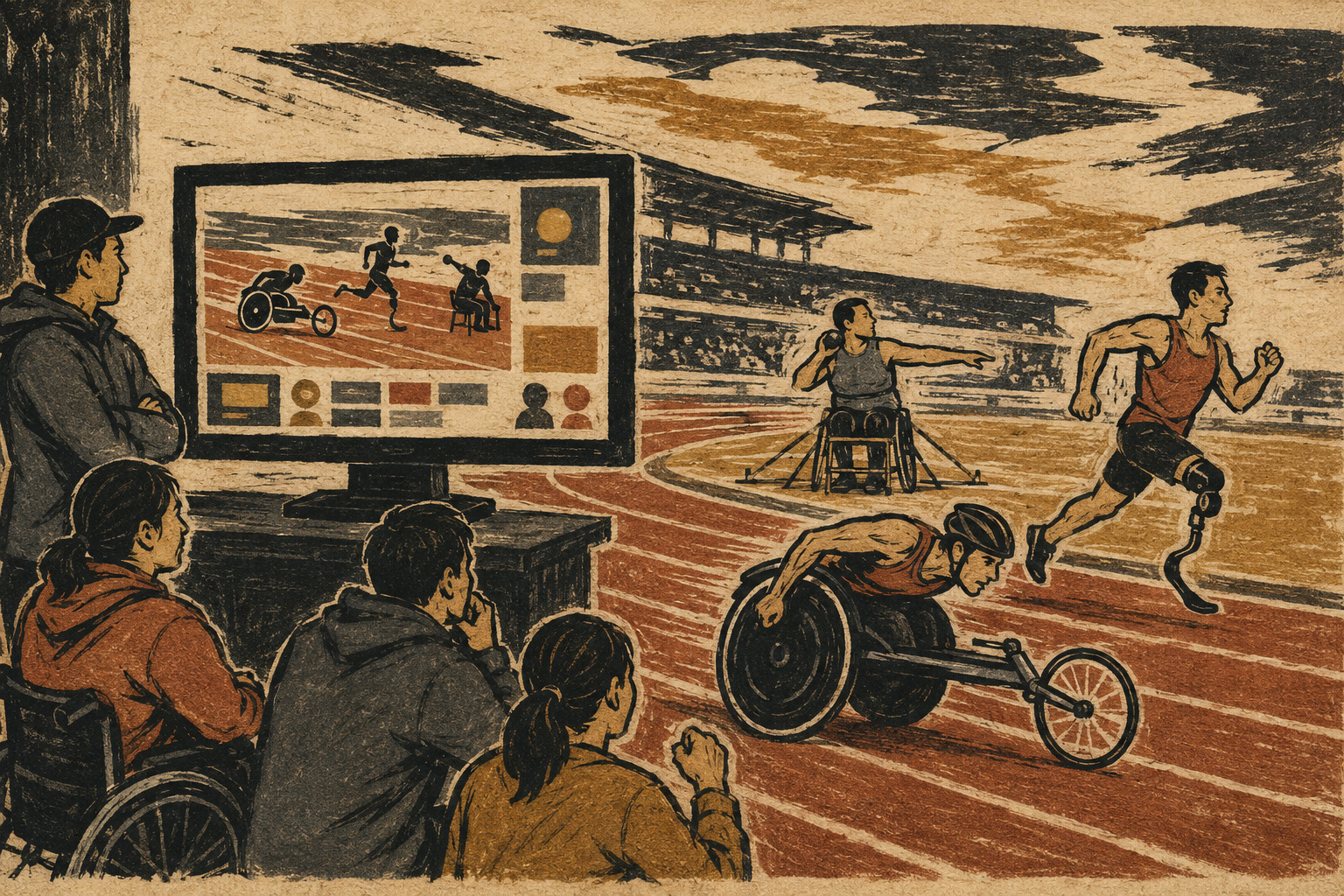
At one school, a teacher raises a hand 50 meters from a student waiting to run. At another, a tape is stretched across a gym floor to read the heel mark from a standing jump. At a regional meet, officials measure the wind and certify a 100-meter result. Japan's 2026 National Online Record Meeting did not bring those places together. It moved the records.
Results released by Japan Para Athletics on August 21 show participation from 35 schools. There were 521 athlete-level submissions: 82 in the Challenge division and 439 in the New Physical Fitness Test division. Because students could enter multiple fitness-test events, that division produced 1,476 event entries. The two divisions together reached 1,558 event entries.
Two outstanding athletes were selected: the students identified in the released results as 土屋朋 of Chiba Prefectural Chiba School for the Deaf and 平井琥白 of Shiga Prefectural Konan Upper Secondary School for Special Needs Education. On September 22, they are invited to race 100 meters at the NAGASE Cup at MUFG Stadium, the Japan National Stadium. The architecture of the program extends a school result toward the country's largest track.
One competition with two doors
The design did not force a student trying an event for the first time through the same door as an athlete already competing at formal meets. The New Physical Fitness Test division reused measurements schools ordinarily conduct. The Challenge division accepted athletics results already produced at approved competitions run by athletics associations, school federations and Para sport bodies.
| Division | Source of the record | Events | Purpose |
|---|---|---|---|
| New Physical Fitness Test | A fitness test already held at school; no new qualifier was staged for this competition | 50m, standing long jump, softball or handball throw, shuttle run | Turn ordinary physical education into a first national challenge |
| Challenge | Recognized meets run by athletics, school-sport, regional or Para sport bodies | 100m, 400m, 1,500m, long jump and, under the broader guidelines, shot put | Compare existing competitors and connect strong results to the next meet |
The eligible window ran from April 1, 2025 through July 31, 2026. Results from fiscal 2025 could be considered if the student remained enrolled. Groups of at least 10 used a school spreadsheet; nine or fewer could submit through a form. Schools, clubs or parents could apply under the broader guidelines. Entry was free. The system reused work that had already occurred instead of generating a new journey, venue booking, hotel stay and support-person schedule.
Overall outstanding schools were selected by total number of submissions, not by the fastest combined performance. Ehime Prefectural Uwa Special Needs School's intellectual-disability division led with 150 entries; Hiroshima Prefectural Numakuma Special Needs School followed with 64. The award can therefore be read as recognition for creating opportunities across a school rather than declaring a “fastest school.”
How a school measurement sheet became a national meet
Japan has a long culture of measuring physical performance in education. The education ministry has conducted its Physical Fitness and Motor Ability Survey since 1964. In fiscal 1999, it introduced the New Physical Fitness Test after a full review intended to reflect changing body size, advances in sports and medical science and an aging society. The 50-meter sprint, standing long jump, ball throw and 20-meter shuttle run became a familiar language across schools.
The online competition did not distribute an expensive new testing system. It selected running, jumping, throwing and endurance measures from a language schools already understood. A number measured once for physical education acquired a second meaning: comparison with peers around the country and an invitation to think of the activity as athletics.
That reuse addresses a real barrier. For a student with a disability to attend a meet, a family or school may need accessible transportation, personal assistance, medical planning, suitable equipment, staff time and travel funding. If recognized meets are scarce locally, the first competitive experience can require the largest commitment. Moving the record reverses the sequence: begin at school, then offer a route outward when a student wants more.
The event redefined a national meet from “moving everyone to one place” to “placing local achievements in one national story.” That made the first step shorter.
From Tokyo 1964 to the schoolyard
The Tokyo 1964 Paralympic Games were a turning point for organized disability sport in Japan. In 1965, the body that became the Japanese Para Sports Association was established using remaining assets from the Tokyo organizing committee. Sport expanded beyond rehabilitation through national events, specialist federations and international teams.
A gap nevertheless remained between an elite stage and the first moment a student recognizes a performance as sport. Para athletics is highly specialized. Athletes with vision, intellectual and physical impairments compete in sport classes designed for meaningful competition. Where access to classification and approved meets is limited, a pathway can remain invisible until after potential has already gone unnoticed.
1964 — Tokyo hosts the Paralympic Games; Japan's national physical-fitness survey also begins.
1965 — The organization that became the Japanese Para Sports Association is established.
1999 — The New Physical Fitness Test enters broad school use.
2022 — The published history identifies a National Special Needs School ID Online Record Meeting.
2023–24 — Outstanding schools continue to be recognized in the special-needs school online format.
2025 — Organizers describe a new competition style for elementary, middle and high-school students with disabilities.
2026 — Results from 35 schools and 1,558 event entries lead to two National Stadium invitations.
The progression in the official history is visible in the names. A 2022 event centered on ID, or intellectual disability, became a special-needs school competition in 2023 and 2024, then a broader entry point for school-age athletes in 2025 and 2026. This year's categories included intellectual disability, limb deficiency, cerebral palsy, wheelchair use, vision impairment, hearing impairment and Down syndrome. The system is trying to make potential visible before athletes enter a national performance program.
The numbers in the ranking did not come from identical conditions
The strength of a distributed meet is also its weakness. Was a 50-meter sprint run on dirt or an all-weather surface? Into a headwind or with a tailwind? Did a handheld timer react to the start in exactly the same way? Were the floor, shoes, number of attempts and measurement method identical for the standing long jump? In a shuttle run, the audio, turning line, encouragement and practical accessibility can affect the performance.
Challenge entries required identifying information about the meet, date and result, giving that division a stronger chain of verification. School fitness tests share ministry procedures, but local implementation is less controlled than a single-stadium competition. A ranking can motivate and reveal participation without proving that a tiny difference is a precise difference in ability.
| Value | Limitation | Possible improvement |
|---|---|---|
| Free participation without travel | Facilities, support and measurement conditions differ by school | Short video protocols; measurer checklist; report surface, timing method and assistance |
| Existing data can be reused | The eligible window spans 16 months while students grow | Display date and age or school year at measurement |
| Students can enter several events | Event totals can make the number of individual athletes appear larger | Always publish unique athletes beside total event entries |
| A national rank can motivate | A narrow time gap may be smaller than measurement error | Use ties, performance bands and personal improvement alongside rank |
Not creating a new qualifying event was a deliberate decision to control burden, and it fits the program's purpose. The more precise the ranking table appears, however, the more visible its note about measurement conditions must become.
An entry category is not an official sport class
Classification in Para sport does not simply arrange athletes by diagnosis. It evaluates how an eligible impairment affects activities fundamental to a particular sport, seeking to minimize that impact so that skill, training and tactics determine the result. The International Paralympic Committee calls classification the central nervous system of the movement.
The online meeting's labels—intellectual, vision, hearing, wheelchair and others—are broad, accessible doors. They are not the same as official World Para Athletics classes such as T/F11, T/F20 or T/F54. Deaf athletics also belongs to a distinct Deaf sport system. An online rank therefore does not automatically become an international rank, national-team result or certified record.
- School category: A broad entry point for students to participate safely and learn their performance.
- Domestic competition: A result produced under competition rules, specified equipment and timing, with classification where required.
- International sport class: An authorized panel assesses sport-specific criteria and records are handled at WPA-approved competitions.
This is a boundary of purpose, not a flaw. Requiring an international process at the first school entry would raise the barrier again. But when a promising result appears, the system needs a clear map: whom to contact, where classification is available, which meet to enter and where suitable equipment can be tried.
Thirty-five schools are progress, not the whole nation
The density of 1,558 event entries from 35 schools is striking. The number 35 alone does not reveal geographic coverage or how many schools could not participate. Ministry data identify many schools serving students with vision, hearing, intellectual and physical impairments or medical needs; some schools serve more than one group. Students in support classes and mainstream schools may also be eligible. The competition operated nationally, but its entries are not a representative sample of all eligible students.
Rewarding the largest submission totals recognizes staff who mobilized a school. It can also favor a large school with a well-established testing routine. Small schools, schools serving many students with complex medical needs, schools without a straight 50 meters and students for whom the standard shuttle run is not practical can disappear inside an entry-count award.
A stronger next edition could recognize first-time schools, geographic reach, small-school participation, improvement from a student's own earlier result and creative reasonable accommodation. A national table can exchange teaching knowledge—“this is how our school made the measurement possible”—as well as publish a top 10.
Protecting the names and records of minors
The guidelines said category and event rankings would be published online. Applicants could request that a name remain private, although the school name would still appear. In the released results, some names are replaced by letters, evidence that the choice was used.
School, age division, impairment category and performance may still identify a student in a small community. A record is a source of pride, but it can also reveal information related to a minor's disability. Students need an explanation they can understand: where the result will appear, whether search engines can find it, how long it will remain and whether removal is possible later.
Consent should not end when an adult submits a form. Publication could offer real name, initials, anonymous ranking or school-only feedback, plus a withdrawal route and a retention period. If a student can receive a certificate without appearing in the public ranking, choosing privacy does not have to mean losing the experience.
From the online table to National Stadium
The competition becomes more than a spreadsheet because it includes a bridge to an in-person event. The NAGASE Cup, to which the two students have been invited, began in 2022 as a World Para Athletics-approved event combining Para and non-Para categories. The first edition attracted 293 athletes. When the second moved to National Stadium in 2023, participation rose to 1,424, including about 450 Para athletes.
The 2026 cup will take place September 21 and 22 at MUFG Stadium with no entry or admission fee. The high-school online-meet guidelines say the event will cover an invited athlete's travel while lodging remains the individual's responsibility. Travel support matters, but costs can remain where a parent, assistant or equipment transport is needed. Whether an invitation becomes access depends on the student's full support arrangement.
The online model broadens the door. The stadium offers electronic timing, formal rules, other competitors, spectators, specialists and a felt sense of the next goal. Japan needs both: discover through distributed participation, develop through regional programs and connect athletes to approved competition when they are ready.
What the next national table should include
The 2026 results prove that a light operating model can make a large volume of activity visible. The next stage is to measure not merely size, but fairness at the entrance and certainty at the exit. These are Japan.co.jp recommendations for the next report, not commitments announced by the organizer.
| Question | What should be published | Why it matters |
|---|---|---|
| Reach | Schools by prefecture, first-time schools, school type and share of eligible schools contacted | Find the blank places inside the word “national” |
| Participants | Unique athletes, total events, age, gender and broad impairment category | Avoid inflating apparent participation through multiple events |
| Measurement quality | Surface, manual or electronic timing, wind, measurer training and accommodation | Explain comparability and its limits |
| Development | Personal-best improvement, continued participation and referrals to regional meets or classification | Show whether one ranking produced a next step |
| Access cost | School staff time, equipment, assistance and athlete-companion cost for invitations | Expose the costs outside a “free” entry fee |
| Privacy | Name-display choices, withdrawals, retention period and complaints | Keep a minor's record under the student's meaningful control |
Schools should also receive something useful back. Rather than a single national average, feedback could include performance bands for a comparable age and category, a confidence note on measurement, safe practice resources, regional Para athletics clinics and a contact for the next step. Talent identification is not only finding the fastest child. It is showing every child who wants to continue where continuing is possible.
A national meet that does not make the nation one venue
Competition usually creates fairness by assembling athletes in the same place, under the same rules, at the same time. The online meeting did not reject that principle. At the first stage of participation, it chose another kind of fairness: a national window for students whose ordinary physical-education result might otherwise remain inside one school.
The rank visible through that window is not as controlled as the result of a certified championship. Its value therefore depends on an honest label. This table does not decide a Japanese record. It makes interest, school effort and possible next athletes visible.
The winner is not only the number in first place. It is the local result that no longer ends at the school gate—and becomes a reason to begin tomorrow's practice.
Thirty-five schools do not yet form a complete national network. They do form an initial line from a school stopwatch to National Stadium. The next work is to find the missing schools, describe measurement differences, protect personal information and hand a result toward regional coaching and certified competition. A meet does not become national only when everyone travels to Tokyo. It becomes national when a next step travels back to the school farthest away.
- Japan Para Athletics — 2026 National Online Record Meeting results, August 21, 2026
- JPA — Challenge division top 10
- JPA — New Physical Fitness Test division top 10
- JPA — Outstanding schools, entry totals and outstanding athletes for 2025 and 2026
- JPA — 2026 National Online Record Meeting guidelines announcement
- JPA — Guidelines for special-needs schools, support classes and other schools
- JPA — Guidelines for high schools
- JPA — Purpose and results publication for the 2025 online record meeting
- Ministry of Education — Physical-fitness survey since 1964 and New Physical Fitness Test introduced in fiscal 1999
- Ministry of Education — Fiscal 2024 special-needs education data
- Japanese Para Sports Association — History of Para sport in Japan and the association's 1965 founding
- International Paralympic Committee — Purpose and principles of classification
- World Para Athletics — Competition and classification rules
- NAGASE — Structure and participation in the first and second NAGASE Cups
- NAGASE — Dates, venue and free entry and admission for the 2026 NAGASE Cup
Editor's note: This report compares competition results, official guidelines, government material and sport-governing documents available through August 21, 2026. Japan.co.jp did not independently interview the organizer, schools or athletes. The 521 figure is the organizer's school-total entry count; 1,558 is the event-entry total including multiple events and is not the number of unique athletes. Online-meet rankings are not equivalent to World Para Athletics-approved Japanese records or national-team qualifying results. The lead image is an editorial illustration and does not depict identifiable athletes or schools.