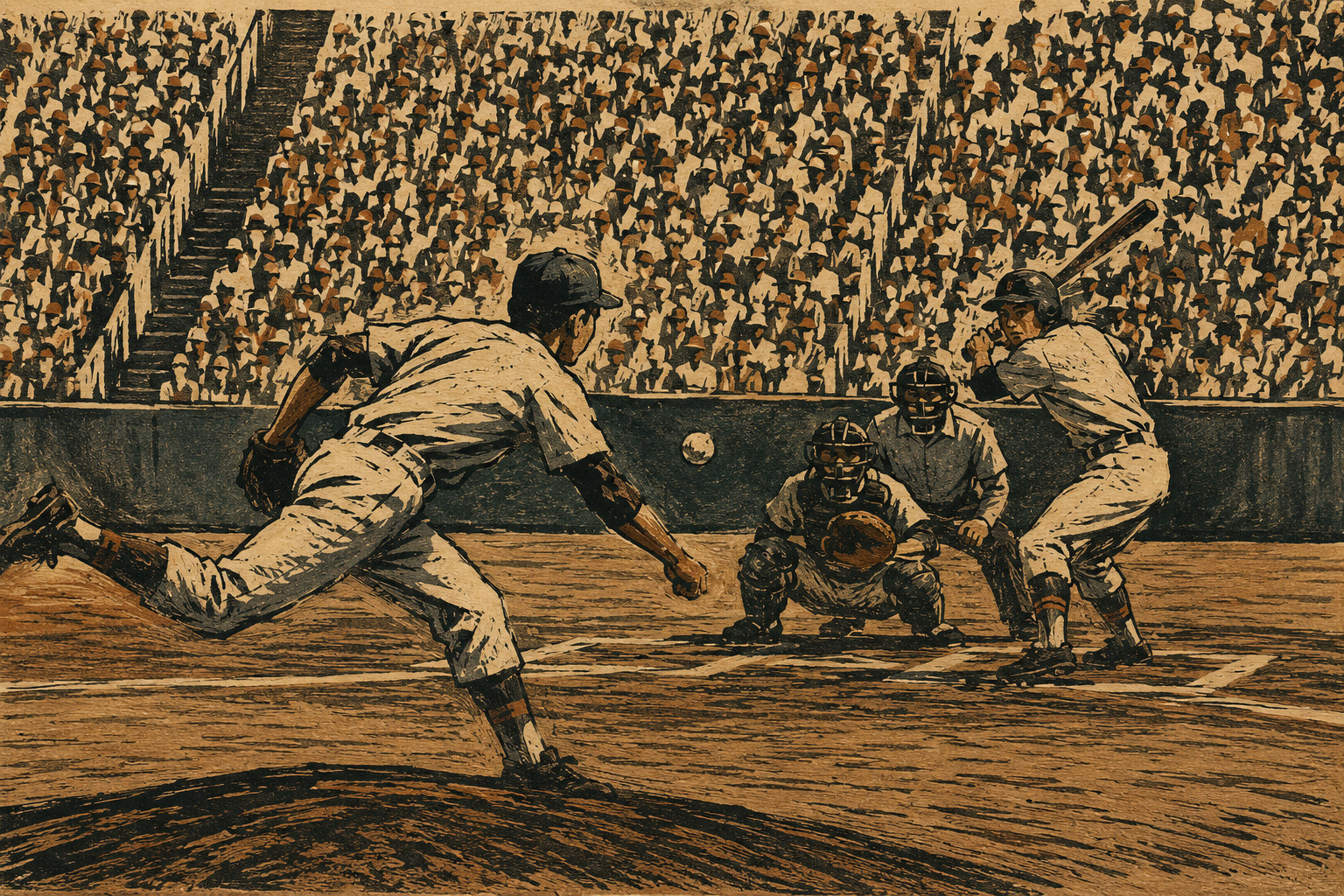
For most of Saturday morning, the 108th National High School Baseball Championship final was a lesson in restraint. Chiben Wakayama had two runs, Kendai Takasaki had one, and two deep pitching staffs kept turning dangerous innings into quiet ones. Then the eighth inning compressed an entire summer into a few minutes: a home run that appeared to make history for Gunma, a hit batter, a ball dropped softly into center, a captain’s sacrifice, a squeeze, and a pitch that escaped a catcher’s reach.
When the last out came at 12:06 p.m. on August 22, Chiben Wakayama had won 4–3. The school’s players carried the deep-crimson championship flag for the fourth time in summer, five years after their 2021 title. Kendai Takasaki, in its first Summer Koshien final, had come within three defensive outs of adding a summer crown to the spring championship it won in 2024.
The official result
| Team | 1 | 2 | 3 | 4 | 5 | 6 | 7 | 8 | 9 | R |
|---|---|---|---|---|---|---|---|---|---|---|
| Kendai Takasaki | 0 | 0 | 0 | 0 | 1 | 0 | 0 | 2 | 0 | 3 |
| Chiben Wakayama | 0 | 2 | 0 | 0 | 0 | 0 | 0 | 2 | X | 4 |
Venue: Hanshin Koshien Stadium, Nishinomiya, Hyogo
First pitch: 10:02 a.m. JST · Final out: 12:06 p.m. JST
Elapsed time: 2 hours, 4 minutes, calculated from the federation’s official start and finish times
Attendance: 44,700 (official)
How the two runs became four
Chiben struck in the second against Kendai starter Satoshi Ishigaki. Kazumasa Kawahara drove a ball into the right-center gap and reached second. Kohei Yamashita followed with a run-scoring triple, and Yusei Nagatomo’s two-out double made it 2–0. It was an early breach in a Kendai staff that had conceded only two runs over five games before the final.
Kendai’s answer came in the fifth. First-year outfielder Renji Kano, batting ninth, doubled home a run. It mattered not only because the margin became one: Kano would also begin the rally that temporarily placed the championship within Kendai’s grasp.
Both managers changed pitchers for the sixth. Chiben’s Kokomi Nagai, a second-year right-hander making his first start of this national tournament, had allowed one run over five innings. Ace Shota Waki took over. Kendai’s Ishigaki, also a second-year right-hander, left after five innings and two runs; left-hander Riku Kitada entered and retired the side in order in the sixth.
The eighth, first half
Kano opened the top of the eighth with a single. After an out advanced the situation, Kendai captain Yusei Ishida turned on Waki’s inside curve and lifted it near the right-field foul pole. The two-run homer—Kendai’s first of the tournament—changed a 2–1 deficit into a 3–2 lead. Ryota Kuba relieved Waki and stopped the inning from growing.
The eighth, second half
Chiben did not answer with a comparable swing. It answered one base at a time. Cleanup catcher Rinto Yamada was hit by a pitch. Ryusei Kusumoto placed a soft single into center. Captain Matsumoto then sacrificed both runners forward, a choice that surrendered an out while making almost any ball in play consequential.
Kawahara’s first squeeze attempt went foul. He put the next one down. Yamada crossed with the tying run, and the fielder’s-choice result left runners at first and third. With Yamashita batting, a low pitch produced a swinging strike but eluded the catcher. Kusumoto sprinted home. The official scoring was a wild pitch; the decisive run was not an error charged to one fielder, but a battery play that broke down at the worst possible instant.
Kuba returned for the ninth and recorded the final three outs. The game had offered a spectacular home run, but it was settled by execution around the plate: a hit-by-pitch, a soft single, a sacrifice bunt, a squeeze, and a pitch not contained.
There is no useful way to reduce the finish to “heart” or fate. Chiben created two chances to score without a clean hit; Kendai had made that kind of thin-margin baseball its route to the final. This time, the margin moved against it.
Two roads to the same last inning
The finalists arrived with contrasting surface identities. Chiben’s offense became more forceful with each round, scoring 11 against Sendai Ikuei and seven against defending spring champion Yokohama. Kendai reached the final through prevention: three 1–0 victories in a single national tournament, a first in spring-or-summer Koshien history, including consecutive shutouts of Ariake and Tenri.
Chiben Wakayama
- Second round: beat Yashiro 2–1
- Third round: beat Tsuruga Kehi 7–3 in 11 innings (tiebreak)
- Quarterfinal: beat Sendai Ikuei 11–3
- Semifinal: beat Yokohama 7–1
- Final: beat Kendai Takasaki 4–3
Kendai Takasaki
- First round: beat Hachiman Commercial 7–1
- Second round: beat Tokai University Kofu 1–0
- Third round: beat Sano Nihon University 4–1
- Quarterfinal: beat Ariake 1–0 in 10 innings (tiebreak)
- Semifinal: beat Tenri 1–0
- Final: lost to Chiben Wakayama 3–4
The final complicated that easy “hitting against pitching” frame. Chiben used three pitchers and scored its winning runs with bunts and running. Kendai used two pitchers in the verified sequence and produced the game’s only home run. Modern high-school baseball is less fixed than its labels: teams carry specialized arms, use a designated hitter under the 2026 rule, and shift between power and precision according to the inning.
What the participants said
Chiben manager Hitoshi Nakatani called himself overwhelmed by emotion and credited the players’ desire and the support from the school section acting as one. His most specific praise went to captain Matsumoto’s eighth-inning sacrifice. Nakatani said that bunt let him see the path not merely to a tie, but to a reversal.
Kendai manager Hirofumi Aoyagi declined to make the ending the definition of the run. He said the players had given everything and praised Ishigaki for pitching like an ace. The remark was consistent with Kendai’s tournament: its roster had reached the final by distributing innings rather than treating endurance by one teenager as the ideal.
Ishida, whose home run briefly put Kendai ahead, acknowledged the pain of the loss while saying the team had made school history. His postgame account held both things at once: disappointment in the final score and gratitude for what he called the best summer of his 18 years. That is a more honest frame than a morality tale in which victory validates effort and defeat erases it.
Kitada and catcher Shoto Oiwa also addressed the deciding pitch rather than hiding from it. Oiwa said there had been a sign mismatch and added that a catcher still aims to block any ball. Kitada credited Chiben’s execution on the squeeze. Their comments describe responsibility without requiring the public to turn one pitch by a high-school athlete into a permanent identity.
Wakayama’s flag, Gunma’s new benchmark
Chiben Wakayama’s fourth summer championship—after 1997, 2000 and 2021—placed the school level with PL Gakuen in a tie for fifth on the all-time summer list. Its five Koshien championships across spring and summer also place it among the competition’s most successful programs. For Wakayama Prefecture, this was a ninth summer championship, moving the prefecture alone into second place nationally.
The first of those Chiben titles is woven directly into the current team. Nakatani captained and caught for the 1997 champion, then managed the 2021 and 2026 winners. Kawahara’s father was also a member of that 1997 team. Japanese reporting identified the Kawaharas as only the second father-son pair to win Summer Koshien, after Kazuhiro and Shoki Kiyohara. The historical detail is striking, but the son’s bunt deserves to stand as his own play—not as an inheritance.
Kendai’s defeat did not restore the school to an old position; it established a new one. The program first became nationally famous for “kidō hakai,” or disruption through aggressive baserunning, and stole a tournament-record eight bases through Kosuke Hirayama in 2014. In 2024 it defeated Hotoku Gakuen 3–2 to win its first Koshien championship and the first spring title for any Gunma school. The 2026 team then made Kendai’s first summer final. Gunma’s earlier summer champions remain Kiryu Daiichi in 1999 and Maebashi Ikuei in 2013. Kendai is now the prefecture’s third distinct program to reach a summer final and the first to do so since 2013.
A tournament older than the stadium
Summer Koshien began before there was a Koshien Stadium. Ten representatives met at Toyonaka in 1915 for the first National Middle School Baseball Championship. The event moved to Naruo, was canceled in 1918 after regional qualifiers because of the rice riots, and arrived at the newly completed Koshien Stadium for the tenth tournament in 1924.
Its continuity has never been absolute. War stopped the 1941 tournament during regional play and interrupted the competition through 1945. It resumed at Nishinomiya in 1946 and returned to Koshien in 1947. Educational reform produced the current National High School Baseball Championship name in 1948. Television arrived in 1953; metal bats in 1974 changed run production; the modern 49-representative structure grew from the nationwide representation introduced for the 60th tournament in 1978.
The tournament has also been forced to revise what it once celebrated. A rest day after the quarterfinals began in 2013. A second, after the semifinals, was added in 2019. The 2020 championship was canceled because of COVID-19, and the 2021 tournament—won by Chiben—was played without general spectators. By 2026, the schedule contained three rest days.
Ten representatives compete at Toyonaka under an 11-point set of playing rules.
The newly completed Hanshin Koshien Stadium hosts the tenth championship.
The 1941 competition is stopped in qualifying; national play resumes in 1946.
A material change reshapes hitting and, over time, the balance between offense and pitching.
Hitoshi Nakatani captains the first winner; a high-scoring 2000 team claims the second.
A quarterfinal rest day is introduced in 2013; a semifinal rest day follows in 2019.
The 2020 championship is canceled; Chiben wins the 2021 tournament without general spectators.
Two-session days, an evening opening, cooling breaks and a three-rest-day calendar become part of the event.
Care is part of competition
The 2026 final should not be used to revive the old idea that a teenager’s worth is measured by how much pain or exhaustion he can disregard. Both finalists used six pitchers on the road to the championship game. The federation has encouraged multi-pitcher staffs for decades, expanded benches from 18 to 20 players in 2023, and cited pitch limits, injury prevention and heat as reasons for the change.
This summer’s tournament ran over 18 days including three rest days. Scheduling at two-session time bands expanded to ten days, and the opening ceremony again took place in the evening. The federation said it was avoiding the hours in which suspected heat illness had occurred most often. After the fifth inning, every player moved to an air-conditioned cooling area for an eight-minute break with thermal checks, changes of clothing, hand and neck cooling, and fluids. Roughly twelve physical therapists were on site each day, supported by physicians and nurses.
Those are meaningful reforms, not proof that the problem is solved. The federation was still holding public discussions in 2026 about seven-inning games and other structural changes. Tradition cannot be the sole answer when heat, workload, shrinking participation and the educational purpose of the sport pull in different directions. Nor should reform be judged only by whether it preserves a familiar television spectacle. The principal question is whether students can compete, learn and recover safely.
What this final says now
The championship game was not a referendum on one style. Chiben’s reputed power gave way to a squeeze; Kendai’s reputation for running and run prevention gave way to a home run. The most useful lesson is that depth and adaptability—not a solitary heroic workload—now define the best teams.
It also showed why Koshien remains unusually powerful in Japanese public life. A crowd of 44,700 watched two schools connect local history to a national stage: Wakayama’s long lineage and Gunma’s newer distribution of baseball power. The tournament drew 802,100 spectators in all, the largest total since the event moved to all-reserved seating at the 104th edition. Yet the athletes at the center were still students playing a two-hour game whose outcome turned on a few ordinary baseball acts.
At 12:22 p.m., the closing ceremony began. Chiben had its flag. Kendai had a runner-up finish no earlier team at the school had achieved in summer. The scoreboard would preserve 4–3; the more lasting record may be the way both teams reached it—with multiple pitchers, tactical flexibility, and a final that was compelling without asking injury or overuse to carry the story.
Sources
- Japan High School Baseball Federation — official August 22 final result, line score, times and attendance
- JHBF — 108th National High School Baseball Championship overview and schedule
- JHBF — 2026 heat and player-health measures
- JHBF — official Summer Championship history
- JHBF — Kendai Takasaki’s 2024 spring championship
- Asahi Shimbun — final game report and decisive squeeze
- Daily Sports, syndicated by Livedoor — Hitoshi Nakatani’s postgame remarks
- Sponichi Annex, syndicated by Livedoor — Hirofumi Aoyagi’s postgame remarks
- Sponichi Annex, syndicated by Livedoor — Yusei Ishida’s postgame remarks
- Daily Sports, syndicated by Livedoor — Riku Kitada and Shoto Oiwa on the eighth-inning pitch