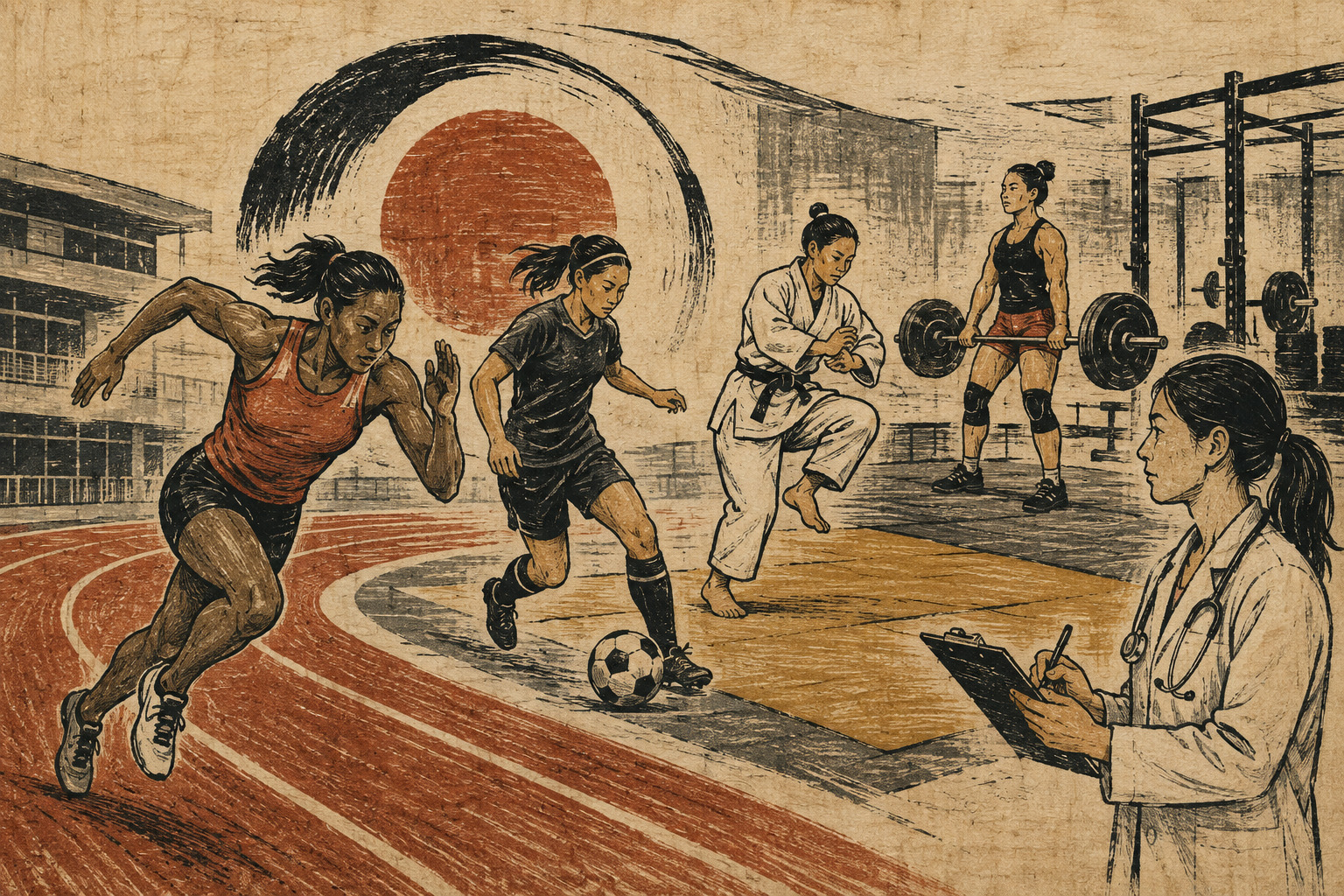
Four questions can quietly shape the career of a female athlete. Are her periods regular? Is she eating enough for the work her training demands? Does pain keep returning in a bone or knee? If she wants to become pregnant, can the sport make room for pregnancy, childbirth and a safe return? Each question can sound private. Each belongs near the center of health and performance. For years, refusing to ask was mistaken for sensitivity, while asking without the ability to help became another form of control.
On August 21, 2026, the Japan High Performance Sport Center and Japan Sport Council joined an international effort to handle those questions across borders. The Global Alliance for Female Athletes, or GAFA, added Japan alongside Canada, France, Germany and Switzerland. They joined the four founders—Australia, the United States, the United Kingdom and New Zealand—bringing the alliance to nine full member nations. Ireland and Belgium are supporting partners.
The announcement promises shared research priorities, expertise and access to webinars, education modules, podcasts, videos and practical resources. Members had already worked online and met at the Women in Sport Congress in Brisbane in March 2026. What the announcement does not provide is a new Japan-specific budget, timetable, numerical target or regional delivery plan. GAFA is not a clinic, a research grant in itself or a regulator that can compel a federation to change.
What nine nations can do at one table
GAFA is more than a collection of university departments. Its members include Olympic and Paralympic committees, high-performance institutes and national sports-science centers. These are organizations that test athletes, educate coaches, conduct applied research and support national teams. They can decide together which questions deserve priority and how quickly useful findings return to the field.
| Role | Countries and organizations | What they bring |
|---|---|---|
| Founding members | Australia (AIS), United States (USOPC), United Kingdom (UKSI), New Zealand (HPSNZ) | Established female-health initiatives, education resources and Olympic-Paralympic performance systems |
| Members added in 2026 | Canada (COC and CPC), France (INSEP), Germany (IAT), Japan (HPSC and JSC), Switzerland (Swiss Olympic) | Different health systems, sporting cultures, languages and research populations for comparison and validation |
| Supporting partners | Ireland and Belgium | Expertise and networks beyond the nine full members |
Scale matters, but diversity matters more. Does an education tool that works in one coaching culture make sense in another? How do nutrition and symptoms differ between cold climates and humid heat? Are Para athletes, adolescents, pregnant and postpartum athletes, and competitors approaching menopause missing from the evidence? A multinational network can assemble larger samples for uncommon questions. It can also expose assumptions one country has mistaken for universal truth.
For now, GAFA has not published a common research protocol, data-sharing agreement or allocation of research funding. More webinar views would not prove that injuries fell or care became faster. The 2026 expansion is best understood as a declaration of capacity and intent. The operating system still has to be built.
The arena changed faster than the laboratory
No women competed at the first modern Olympic Games in Athens in 1896. They entered the program in Paris in 1900, then spent more than a century expanding their events and share of participation. Entry onto the field and entry into the evidence base did not move at the same speed.
A 2022 audit examined 5,261 studies published from 2014 through 2020 in six leading sports and exercise-science journals. Women and girls accounted for 34 percent of more than 12 million participants. Six percent of the studies were exclusively female; 63 percent were exclusively male. The imbalance was particularly strong in research intended to improve performance. Very large database studies can distort the participant total, but the study-by-study pattern remained unmistakable: evidence gathered from men was routinely treated as evidence for everyone.
Researchers often described menstrual variation as noise, cited the expense of verifying hormonal status, worried about pregnancy-related safety or struggled to recruit. Yet excluding complexity does not make it disappear. The menstrual cycle, hormonal contraception, pregnancy, postpartum recovery, lactation and the menopausal transition are not confounders to erase. They are realities a competent study should describe.
Adding more women is necessary, but it is not enough. Evidence becomes transferable only when researchers say which athletes they studied, at what level, during which stage of life and under what hormonal conditions.
From three points to a whole-body energy problem
A defining change began with the Female Athlete Triad in 1992. The original formulation linked disordered eating, amenorrhea and osteoporosis. The American College of Sports Medicine issued a position stand in 1997. Its 2007 revision reframed the three areas as continua: energy availability after exercise, menstrual function and bone mineral density.
That shift matters because an athlete does not have to arrive with three severe diagnoses before anyone acts. Low energy availability is not synonymous with an eating disorder. Long training days, travel, missed meals, limited nutrition knowledge, financial pressure or an environment demanding weight loss can create an unintentional shortfall. A missing period is not automatically normal for an athlete and is not proof that training is working. It is a health signal that deserves an explanation.
In 2014, an International Olympic Committee expert group proposed Relative Energy Deficiency in Sport, commonly RED-S and now also styled REDs. The model expanded beyond women and three domains. Problematic low energy availability can be associated with effects on metabolic, bone, reproductive, immune, cardiovascular, gastrointestinal, hematological, sleep and mental health, as well as performance. Male athletes can be affected too.
The IOC updated its consensus in 2018 and 2023. The 2023 package included a clinical tool moving from screening to risk stratification and then a physician-led diagnosis and treatment plan. It also makes an essential limitation plain: there is no single validated test for REDs, signs and symptoms may have other causes, and a coach cannot diagnose the syndrome from fatigue, body size or a questionnaire. Differential diagnosis and collaboration across medicine, nutrition, psychology and training are necessary.
A menstrual cycle is a vital sign—not a universal training clock
Being able to discuss menstruation can protect health. Placing every athlete on the same cycle-day training calendar is a different scientific claim. A 2020 systematic review and meta-analysis assembled 78 studies and found a possible trivial reduction in performance during the early follicular phase, which includes the start of menstruation. Study quality was low and results varied substantially. The authors recommended individualized responses rather than a general phase-based prescription.
Menstrual pain, premenstrual syndrome, heavy bleeding, migraine, gastrointestinal symptoms and disrupted sleep can make training and daily life genuinely difficult. A 2026 analysis of 9,130 records from 3,693 female athletes assessed by the Japan Institute of Sports Sciences from 2008 through 2021 found that symptoms—particularly PMS—strongly influenced the cycle timing athletes associated with their best performance. Asking what an athlete experiences is more useful than assuming a calendar phase predicts her day.
| Question in the field | What the evidence permits | Responsible action |
|---|---|---|
| Periods are missing or irregular | This is not necessarily “normal for athletes”; low energy availability is one of several possible causes | Remove shame and punishment, then refer for qualified medical assessment |
| Pain or PMS disrupts training | Symptoms and their effects vary; severe symptoms should not simply be endured | Start with the athlete's account and make medical care and individual load adjustment available |
| A team wants a “cycle-synced” plan | Evidence does not support one phase prescription for everyone | Do not impose a team rule; use only the personal information an athlete finds useful |
| An athlete uses hormonal contraception | Hormonal patterns and bleeding differ from a natural cycle and among methods | Coaches should neither interpret nor prescribe; involve qualified medical care when needed |
The pendulum should not swing from refusing to discuss periods to compulsory tracking. A health conversation and a surveillance record available for selection are not the same thing.
Do not blame the knee on “female hormones”
Women and girls experience a higher rate of anterior cruciate ligament injury than men in many comparable sports involving cutting, landing and rapid direction change. Coverage of GAFA's expansion highlighted that disparity. Reducing it to menstrual phase or a single hormone, however, hides causes that sport can change.
Anatomy, neuromuscular control through puberty, strength, landing and deceleration technique, training load, recovery, previous injury, playing surface, footwear, scheduling and access to conditioning and medical staff can interact. If a women's team receives an inferior pitch, smaller support staff or less prevention time, the disparity belongs partly to the system—not simply to the female body.
Neuromuscular prevention programs can reduce risk, but a PDF does not implement itself. Who teaches the movement? How often is it performed? Does the team continue all season? Is adherence measured? An international network becomes useful when it shares implementation failures as readily as a successful trial.
Japan is not starting from zero
Japan's membership is not the first arrival of female-athlete health work from overseas. The Japan Sport Council began strategic support in 2011 through its national multi-support program. The Japan Institute of Sports Sciences launched a development and support project commissioned by the Ministry of Education in fiscal 2013; responsibility moved to the Japan Sports Agency in October 2015. Since fiscal 2024, HPSC has operated a reorganized Female Athlete Research and Support Project.
2011 — JSC begins strategic female-athlete support inside Japan's national performance system.
2013 — The JISS commissioned project begins; a conditioning book and the LiLi support system are developed.
2015 — Commissioning responsibility moves from the ministry to the Japan Sports Agency.
2016–17 — The first and second editions of Health Management for Female Athletes are released.
2018 — A female-sport information portal opens.
2024 — HPSC reorganizes work across research, pregnancy and postpartum support, networks and a digital platform.
2025 — Four countries launch GAFA.
2026 — Five nations including Japan join, bringing full membership to nine.
Japan already has Female Sport Navi, a JISS consultation route and a searchable network of gynecologists who completed training through the Japanese Female Athlete Health Support Committee. HPSC has addressed adolescence, pregnancy, postpartum return, childcare, medicine, nutrition, psychology and professional networks. LiLi, developed in 2013, was an early system through which athletes could record basal body temperature, weight and symptoms and receive expert feedback.
That history gives Japan knowledge to contribute to GAFA. It also sharpens the domestic problem. How does expertise concentrated around a national center reach federations, universities, high schools, middle schools, clubs and Para sport? The distance between HPSC in Tokyo and a 14-year-old in a regional school team is not measured only in kilometers. It is measured in referral routes. Japan needs connections among regional gynecology, orthopedics, pediatrics, nutrition, psychology and coaching—not simply a larger elite center.
Pregnancy and postpartum are not a footnote
Female-athlete health is not a synonym for menstruation. As careers lengthen, athletes may navigate pregnancy, childbirth, breastfeeding, pelvic-floor symptoms, sleep loss, childcare, contracts and travel at the same time. Pregnancy is not an injury and there is no universal return date. Health, delivery, the impact and contact demands of the sport, lactation, psychology, family support and employment all belong in an individual plan.
IOC experts have issued consensus guidance on exercise in pregnancy and postpartum, including elite competition, while emphasizing substantial gaps in evidence. Earlier HPSC programs included training support through pregnancy, before and after birth, and childcare, as well as practical information from athlete mothers. GAFA can make it easier to combine the small populations and applied experience that each nation holds.
A body may be medically ready while a career remains structurally impossible. Sponsorship terms, selection dates, travel with an infant, childcare costs, time and space to express milk, and a coach's support can decide whether an athlete returns. A health-science alliance must not become an excuse to ignore the responsibilities of employers and sport systems.
Period data does not belong to the coach
Digital records can help an athlete recognize a symptom pattern and describe it accurately to a clinician. They can also capture highly sensitive information: menstruation, possible pregnancy, contraception, weight, eating and mental health. When a team asks for those entries, who sees them? Can a selector gain access? When are they deleted? Is an athlete who declines treated differently?
A 2025 UEFA expert consensus on menstrual-cycle tracking in women's football called for a stated purpose, disclosure of who can access data, consent before sharing, compliance with data-protection law and useful feedback to the player. Those principles are a minimum beyond football. Tracking should be voluntary, purpose-limited and revocable, with a wall separating medical information from selection, contract and discipline.
- What specific benefit will the athlete receive?
- Is each field necessary, and must it be collected from everyone?
- Is participation genuinely optional, without penalty for refusal or withdrawal?
- Exactly what can coaches, clinicians, researchers and federations see?
- Where is the record stored, for how long, and who verifies deletion?
- How are consent and privacy protected for minors?
- Will results return to the athlete and lead to care when care is needed?
Tracking that destroys trust also destroys data quality. A system in which athletes cannot answer honestly may appear precise while remaining wrong. If GAFA creates shared datasets, its standards for consent, de-identification, secondary use, cross-border transfer and deletion should be as visible as its scientific protocol.
Move knowledge from the person who has it to the person who needs it
Even an elite athlete surrounded by specialists may be reluctant to report symptoms. A community athlete may not know whom to tell. A male coach may think avoiding menstruation is respectful; a girl may learn that silence proves toughness. The answer is not to turn coaches into doctors. It is to teach them to recognize a concern, avoid making the diagnosis and open a route to qualified care.
Education cannot stop with athletes. Parents, teachers, coaches, team doctors, gynecologists, orthopedic clinicians, dietitians, psychologists and federation executives need to recognize the same warning signs and referral map. Materials should exist in accessible Japanese, captioned video, audio and disability-inclusive formats, with short practical tools beside detailed clinical resources. They should not assume an urban audience with fast connectivity.
The alliance uses the term “female athlete” because sex-related physiology can matter in questions involving menstruation or pregnancy. At the same time, people in women's sport have diverse bodies and gender identities. Research should define its population precisely and respectfully rather than treating categories as self-explanatory. Health support should not become a proxy argument about eligibility or exclusion.
The numbers to ask for in 2027
If the alliance measures success by member countries and resources produced, the easiest activity will look like the greatest achievement. Japan and GAFA should show who received what, whether behavior changed and whether health and access improved. The following are Japan.co.jp recommendations for transparency, not commitments announced by GAFA.
| What to measure | What should be published | Why it matters |
|---|---|---|
| Knowledge transfer | Resources translated and adapted for Japan; completion and comprehension by athletes, coaches and clinicians | A page view cannot show whether knowledge is usable |
| Access | Regional referral points, days to first appointment and use by athletes outside national squads | This exposes gaps between Tokyo and the regions, and elite and school sport |
| Research representation | Reporting completeness across age, sport, Para sport, life stage and hormonal status | A larger female total can still conceal a new exclusion |
| Practice change | Consultation for amenorrhea and severe symptoms, prevention-program adherence and athlete-reported outcomes | This tests whether education changed care and training |
| Data rights | Tracking refusals and withdrawals, complaints, breaches, verified deletion and access audits | Power to collect intimate information needs accountability |
| Failure | Programs athletes abandoned, misunderstood translations and broken referral points | Success stories alone make other systems repeat avoidable mistakes |
GAFA does not need every member to reach the same conclusion. Its advantage may be the ability to define uncertainty together, improve methods and publish differences. In a field such as menstrual-cycle performance, saying “the evidence does not support one prescription for everyone” is itself trusted information.
Getting stronger without being broken
Sport celebrates stories about crossing the body's warnings. Enduring pain, restricting food, losing a period, sacrificing sleep and returning early can be mistaken for devotion. Health and performance are not opposing values. Adequate energy, intact bones, symptoms that can be discussed and a life protected beyond competition are conditions for sustained excellence.
Japan enters the alliance with a history of support dating to 2011, JISS research, consultation resources and experience with digital monitoring. It can learn from different systems in North America, Europe and Oceania. It can also contribute. The outcome, however, will not appear in the group photograph from an international congress.
Success is an athlete able to report a missing period without shame; a coach who refers rather than diagnoses; a researcher who does not exclude women because they are “complicated”; and a competitor who can refuse to surrender intimate data without surrendering her place on the team.
In August 2027, the most useful question will not be whether nine members became ten. It will be how many people used the resources, how many reached appropriate care, which federations changed practice, which holes in the evidence narrowed and which failures were made public. The alliance has placed the world's experts in one circle. The next work is to turn that circle into a place where one athlete in Japan can stand safely.
- Australian Sports Commission / AIS — Five new GAFA nations, full membership and alliance activities, August 21, 2026
- United States Olympic & Paralympic Committee — Four nations launch GAFA, March 7, 2025
- HPSC / JSC — Female-athlete development and support through 2023 and the project from fiscal 2024
- HPSC / JISS — LiLi Female Athlete Support System
- HPSC / JISS — Health Management for Female Athletes
- HPSC — Female Sport Navi
- Japanese Female Athlete Health Support Committee — Education, consultation and trained-gynecologist search
- International Journal of Sport Nutrition and Exercise Metabolism — Audit of female participants in 5,261 studies, 2014–20
- American College of Sports Medicine — History and clinical model of the Female Athlete Triad
- British Journal of Sports Medicine / PubMed — 2023 IOC consensus statement on REDs
- British Journal of Sports Medicine / PubMed — IOC REDs Clinical Assessment Tool version 2
- Sports Medicine — Systematic review and meta-analysis of menstrual-cycle phase and exercise performance
- Women's Health — Menstrual symptoms and perceived performance in 3,693 Japanese female athletes
- Journal of Athletic Training — Review of ACL risk in female athletes and its multiple interacting factors
- BMJ Open Sport & Exercise Medicine — UEFA expert consensus on menstrual-cycle tracking in women's football
- International Olympic Committee — Expert consensus on exercise during pregnancy and postpartum, including elite athletes
Editor's note: This report compares institutional announcements, peer-reviewed studies and clinical consensus documents available through August 21, 2026. Japan.co.jp did not independently interview GAFA, HPSC, JSC or athletes. The announcement does not establish a Japan-specific budget, timetable or performance target. Menstrual, nutritional, pregnancy, postpartum and injury questions require individual medical assessment; this article is not diagnostic or treatment advice. The lead image is a conceptual editorial illustration, not a record of an actual meeting or identifiable athletes.