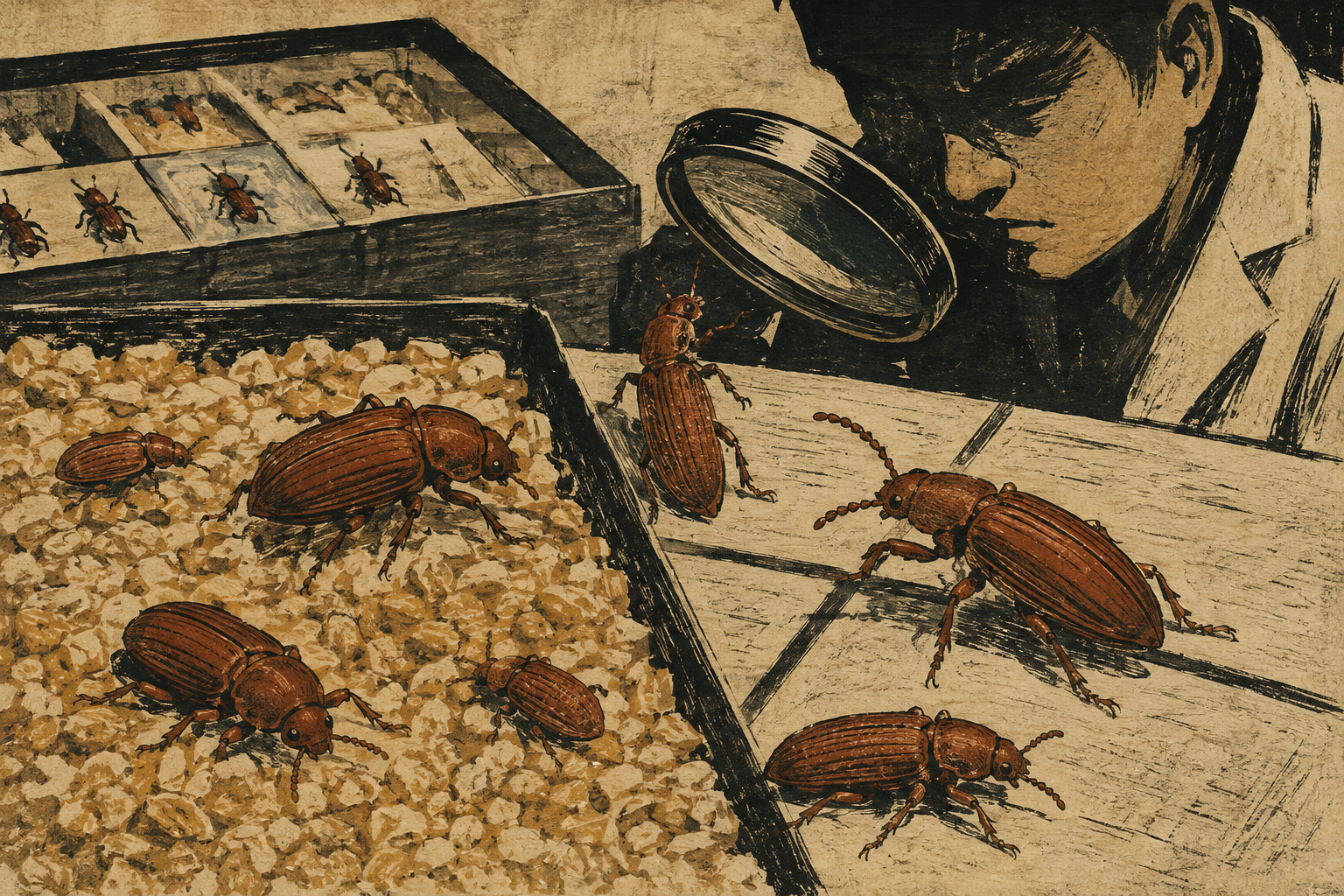
In a quiet laboratory, a beetle walks. It is only a few millimeters long, with a polished, rust-colored back. It leaves the shelter of flour and crosses a narrow infrared beam. The interruption registers as one more mark in a day’s activity record. That step is not a test of exercise or fitness. It is a vote in an experiment about evolution’s budget.
Kentarou Matsumura of the University of Tokyo, Keisuke Tanaka of Tokyo University of Information Sciences, Ken Sasaki of Tamagawa University, Kenji Shimomura of Tokyo University of Agriculture and Takahisa Miyatake of Okayama University selected red flour beetles, Tribolium castaneum, for high or low locomotor activity. They maintained multiple independent replicate lines, compared 24-hour movement, development, body weight, lifespan, egg laying and hatching, then used RNA sequencing to examine genome-wide patterns of gene expression.
The outcome was intuitive, but not simple. High-activity, or H, lines moved more than low-activity, or L, lines in both sexes and lived shorter lives. Females in the two groups laid similar numbers of eggs, but a larger share of eggs from H lines hatched, yielding more offspring. Development time did not clearly differ. The paper was published online by the Proceedings of the National Academy of Sciences on August 11, 2026.
A laboratory animal from an empire of flour
Red flour beetles live wherever people store processed grain: mills, warehouses, feed plants and kitchen cupboards around the world. They are secondary pests, better at exploiting broken kernels, flour, bran and prepared foods than boring into sound grain. Adults are roughly three to four millimeters long. In warm conditions, an egg can become a reproducing adult in about a month, and females can reproduce for several months.
That is bad news for grain managers and excellent news for experimental science. Many beetles fit in a small container. Flour and yeast make a controllable diet. Temperature, humidity and density can be standardized, and generations arrive quickly enough for selection to be observed rather than merely inferred.
In the 1940s, University of Chicago ecologist Thomas Park turned flour jars into miniature worlds. He placed T. castaneum and the related confused flour beetle, T. confusum, into competition and showed that temperature, humidity and parasites could alter which species won. His long-running experiments helped turn ecology from an observational history of nature into a quantitative, repeatable science of mechanisms and probabilities.
By 1975, David Mertz was studying senescent decline in flour-beetle strains selected for fitness early in adult life. In 2008, T. castaneum became the first beetle to have its genome published. It was already valuable for genetics and development; the sequence added a map of genes involved in chemical sensing, detoxification, dry-environment survival and insecticide resistance. Systemic RNA interference made it unusually practical to reduce the activity of genes throughout the animal.
Researchers later recruited the beetle for aging biology. A 2013 study found that adding freeze-dried broccoli to flour extended beetle lifespan and that the effect depended on homologues of the stress-response genes nrf-2, jnk-1 and foxo-1. The pantry pest had become a model for asking how diet, maintenance, reproduction and survival fit together.
Flour is food to us. To this beetle, it is a world—one that researchers can rebuild, replicate and change, generation after generation.
Where “live fast, die young” came from
Every organism faces a finite budget. Energy used to grow now cannot simultaneously repair every molecule for the future. Time spent searching for mates can also expose an animal to predators. Reproducing early may increase the chance of leaving descendants, while investment in maintenance may preserve the body for another season. Life-history theory begins with these trade-offs.
An early twentieth-century idea called the “rate-of-living” theory proposed that intense metabolism used life up more quickly. Raymond Pearl popularized the expression in his 1928 book The Rate of Living. The metaphor was powerful: a creature was imagined to have a fixed store of vital energy, burned fast or slow. But birds and bats can live surprisingly long for their body size and metabolic rate. Repair, membranes, ecology, temperature and evolutionary history all complicate a universal fuel-tank law. Modern pace-of-life research is not simply the old theory with a new name.
In 1957, evolutionary biologist George C. Williams formalized antagonistic pleiotropy: a genetic effect that improves survival or reproduction early can be favored even if it causes harm later, when natural selection is weaker. Thomas Kirkwood’s 1977 disposable-soma theory framed aging as resource allocation. Organisms should maintain the body well enough to reproduce under the mortality risks they face, not invest infinitely in perfect repair.
Those theories do not require a gene whose purpose is death. They predict that aging can be the later cost of traits that were useful earlier, or the consequence of an evolved compromise between making descendants and maintaining the body.
In 2010, Denis Réale and colleagues connected the fast-slow life-history continuum to consistent behavioral differences—activity, exploration, boldness and aggression—within populations. Their pace-of-life syndrome, or POLS, framework predicted that animals on the fast side might take risks, reproduce earlier and die younger, while slower animals might behave cautiously, invest in maintenance and live longer. It was a compelling organizing idea. The authors also emphasized exceptions and alternative causal routes.
1928 — Raymond Pearl publishes The Rate of Living, popularizing the link between intense activity and shorter life.
1948 — Thomas Park reports classic competition experiments with two Tribolium species.
1957 — George C. Williams formalizes antagonistic pleiotropy in the evolution of senescence.
1975 — David Mertz analyzes aging in flour-beetle strains selected for early-adult fitness.
1977 — Thomas Kirkwood proposes an evolutionary allocation theory of somatic maintenance.
2008 — The red flour beetle becomes the first beetle with a published genome.
2010 — POLS links animal personality to life-history strategy within populations.
2015 — Japanese researchers report beetle lines selected over 15 generations for long or short walking distance.
2026 — Activity, lifespan, reproduction and the transcriptome are integrated in one selection experiment.
Instead of watching a correlation, push evolution
Most tests of POLS observe nature and ask whether more-active individuals die sooner. But a correlation does not reveal direction. Young, healthy animals may simply move more. Active animals may be conspicuous to predators. Temperature, food, parasites or population density may independently affect both movement and survival.
Artificial selection narrows that ambiguity. Researchers choose parents by one criterion—in this case activity—then repeat the choice in their offspring. If high- and low-activity lines diverge and unselected traits such as lifespan and hatching diverge with them, it becomes more plausible that shared genetics, regulation or resource allocation connect the traits.
Independent replicate lines are crucial. Without them, one new mutation, one inbred bottle or a chance founder effect could masquerade as the response to selection. Replication asks whether evolution arrives at a similar pattern more than once.
The activity measurement also matters. This was not a sprint or a one-time distance test. Infrared sensors counted movement over 24 hours, closer to the beetle’s daily locomotor tendency. The H lines crossed the sensors more often than the L lines in males and females. Researchers then laid development, body weight, lifespan, egg laying and hatching over that behavioral split.
| Trait measured | H versus L result | Meaning |
|---|---|---|
| 24-hour locomotor activity | Clearly higher in H males and females | The direct response to selection persisted. |
| Lifespan | Shorter in H, longer in L | Activity and longevity evolved together. |
| Egg number | No clear difference | Active females did not simply lay more eggs. |
| Hatching rate | Higher in H | Similar egg numbers produced more offspring. |
| Development time | No clear difference | The whole “fast” suite did not move as one. |
| Gene expression | Distinct functional groups by line | Metabolism, detoxification and maintenance became candidate pathways. |
Not more eggs—more eggs that hatched
A summary such as “higher reproductive output” needs to be unpacked. H-line females did not lay significantly more eggs. The difference was hatching: a larger proportion of their eggs became larvae. The same number laid could therefore produce more descendants. That distinction changes the biological question.
Hatching can reflect nutrients placed in an egg, sperm and fertilization, embryonic development, parental compatibility and the rearing environment. The new result says selection on activity was linked to the chance that the next generation survived the egg stage. It does not identify which of those steps changed.
If highly active lines leave more hatched young but die sooner, the pattern fits a classic life-history exchange between current reproductive success and future survival. Yet the mechanism remains open. Short life could arise from the energetic demands of activity, the physiology that supports higher hatching, genes with multiple effects, or a regulatory program upstream of all three traits.
A trade-off is not necessarily a calorie transferred from one tidy account to another. Hormones, neural signaling, immunity, protein quality control, oxidative stress and behavior can evolve together. The value of the selection experiment is that it reveals a package worth opening—not that it has already labeled every item inside.
The reproductive story is not “more prolific females.” It is “the same number of eggs, with more offspring emerging.” Precision changes the mechanism scientists must now explain.
Reading which genes were used
RNA sequencing does not simply read the DNA blueprint. It measures which genes were being transcribed, and by how much, in the sampled animals. Across thousands of genes, the high- and low-activity lines developed different expression profiles.
H lines showed elevated expression in groups related to energy metabolism, lipid metabolism and detoxification or xenobiotic processing. That is consistent with a body reorganized to support more movement and chemical processing. L lines showed higher expression in groups related to the endoplasmic reticulum, metabolism and the maintenance of cellular functions. The endoplasmic reticulum helps fold proteins, make lipids and regulate calcium, all central to cellular homeostasis.
These are not lists of “short-life genes” and “long-life genes.” Expression can be cause, consequence or both. Greater activity could induce metabolic transcripts; those transcripts could enable activity; or another regulator could alter both. The next step is functional manipulation—for example, reducing selected transcripts with RNA interference and asking whether activity, hatching or survival changes.
- It can show which RNA levels and functional groups differ consistently between selected lines.
- It can nominate metabolism, lipid use, detoxification, the endoplasmic reticulum and cell maintenance for follow-up.
- It cannot show by itself whether an expression difference directly shortened lifespan.
- It cannot establish one master gene controlling activity, reproduction and aging.
- It cannot guarantee that wild beetles or other species use the same molecular route.
The trait that refused to move
If pace of life were one master dial, turning activity up should accelerate development, bring reproduction forward and shorten life. But development time did not clearly differ between H and L lines. The authors call their result partial support for POLS and a decoupling of activity from development.
That is not a failed prediction to hide. It is one of the most informative results. Trait suites have seams. Red flour beetles exploit stored foods where resources can be abundant and predation pressure relatively low. If rapid development offers little advantage there, selection may not have built a strong genetic correlation between development and daily movement. Scarce food, predators, pathogens, temperature swings or competition could assemble a different package.
A 2025 experiment offers a useful parallel. Red flour beetle lines had been selected for more than 40 generations to feign death for long or short periods. Short-feigning lines were more active, but metabolic rate did not differ. Defensive behavior, activity and energy expenditure did not march in lockstep. POLS is most useful not as a law that erases such exceptions, but as a framework for asking which ecology and genetic architecture connect which traits.
A decade of counting the costs of walking
The 2026 paper has a Japanese experimental prehistory. In 2015, Matsumura and Miyatake reported red flour beetle lines selected over 15 generations for long or short walking distance. Long-distance males achieved more matings during a brief encounter, but long-distance beetles also suffered greater predation from an assassin bug. Movement found mates and enemies.
That balance can help preserve variation in a population. An inactive animal may miss opportunity; an active one may be eaten before opportunity pays. Later studies examined how walking distance related to egg size, starvation resistance, sperm competition, death-feigning and brain biogenic amines. The answers differed by sex and context. Mobility was never free, but its price was not a single currency.
The new work extends that program from distance traveled to 24-hour activity, lifespan, hatching and genome-wide expression. Artificial selection’s strength is the ability to push one trait and observe correlated responses. Its weakness is that the pressure in a laboratory is not identical to selection in a warehouse or wild population, where food patches, crowding, insecticides, temperature, predators and opportunities to disperse act at once.
Do not translate this into human exercise advice
“More activity, shorter life” sounds designed to collide with public-health advice. But the activity in this paper is a behavior selected across beetle generations, not the causal effect of starting a workout. Human evidence about the cardiovascular, metabolic, musculoskeletal and psychological benefits of physical activity is a separate body of research. A flour-beetle selection experiment does not overturn it.
The species differences are also profound. T. castaneum is ectothermic, so environmental temperature directly shapes metabolism and development. It reproduces in flour, has a short generation time and experiences risks unlike ours. Its laboratory lifespan is not human life expectancy embedded in medicine, work and society.
The broader evolutionary lesson can still travel. Select strongly on one characteristic and unmeasured characteristics may change. Traits are not isolated knobs. Plant breeders, livestock geneticists, pest managers and conservation biologists must look for hidden correlated responses when favoring growth, docility, dispersal, resistance or reproduction.
Seven experiments that should come next
- Resolve survival curves: identify the age at which mortality begins to diverge.
- Explain hatching: separate egg provisioning, sperm, fertilization and embryonic death.
- Balance the energy books: measure feeding, fat stores, respiration, oxidative stress and repair together.
- Manipulate candidates: use RNA interference to test causal effects on activity, hatching and lifespan.
- Relax selection: maintain H and L lines in a common regime and see which differences persist or regress.
- Change ecology: vary food, predators, temperature, crowding and pathogens.
- Return to populations: test whether wild geographic samples show the same genetic correlations and expression signals.
It is especially important not to assume that H-line beetles simply “used up” more energy. Metabolic rate, oxidative damage, immunity and protein maintenance must be measured alongside survival before wear, antagonistic pleiotropy and reproductive allocation can be separated.
The unmoved development time is testable too. Make food scarce, add predation risk or intensify competition, and the value of developing quickly changes. If development then joins activity and lifespan, pace of life would look less like a fixed personality and more like an evolutionary package assembled for a particular environment.
From one beetle’s footsteps to evolution’s ledger
A red flour beetle’s day becomes a sequence of interrupted infrared beams. Yet behind those marks are the probability of producing descendants, the time available to maintain a body, the processing of lipids and foreign compounds, and the machinery that preserves cellular order.
High-activity lines lived shorter lives and produced more hatched young. That combination gives experimental support to the old intuition of a life lived fast. But egg number and development did not change. That unevenness is evidence against a single master slider. Activity, reproduction, growth and maintenance are partly linked, partly free, and capable of being rewired by ecology.
The answer, then, is not that energetic insects walk until their batteries run out. It is that sustained selection on activity reorganized a population: lifespan and the production of surviving offspring evolved with behavior, while metabolic and maintenance networks settled into different expression states.
The beetle teaches that biology offers few free choices. It also teaches that the cost of a choice depends on species, sex, age and environment. Live fast or live long is not a universal fork in the road. Evolution writes a more complicated ledger—what is connected, when, where and at what price.
- Five-university release — “A thick and short life or a thin and long life depends on locomotor activity” (Japanese, August 21, 2026)
- PNAS — Integrating experimental evolution and transcriptomics reveals the phenotypic and molecular architecture of the pace-of-life syndrome
- Philosophical Transactions B — Personality and the emergence of the pace-of-life syndrome concept at the population level (2010)
- Nature — The genome of the model beetle and pest Tribolium castaneum (2008)
- Heredity — Tribolium beetles as a model system in evolution and ecology (2021)
- PLOS ONE — Predation avoidance and mating success in lines selected for walking distance (2015)
- Journal of Insect Science — Artificial selection for death-feigning, behavior and metabolic rate (2025)
- USDA Agricultural Research Service — Tribolium stock maintenance and developmental rates
- Genes & Nutrition — Broccoli, stress-response genes and longevity in red flour beetles (2013)
- Evolution — Pleiotropy, Natural Selection, and the Evolution of Senescence (Williams, 1957)
- Nature — Evolution of ageing (Kirkwood, 1977)
- PNAS — Experimental evolution of aging, growth, and reproduction in fruitflies (2000)
Editor’s note: This article is based on the university release, peer-reviewed papers and research-agency materials available through August 21, 2026. Japan.co.jp did not independently interview the research team. The new study compared evolved high- and low-activity lines; it was not an exercise intervention in individual insects. H lines did not lay more eggs, but had a higher hatching rate. Development time did not clearly differ, making the result partial rather than universal support for POLS. Gene-expression differences identify candidate mechanisms, not proven causal genes. The main image is a conceptual illustration, not documentary photography of the animals, laboratory or apparatus.