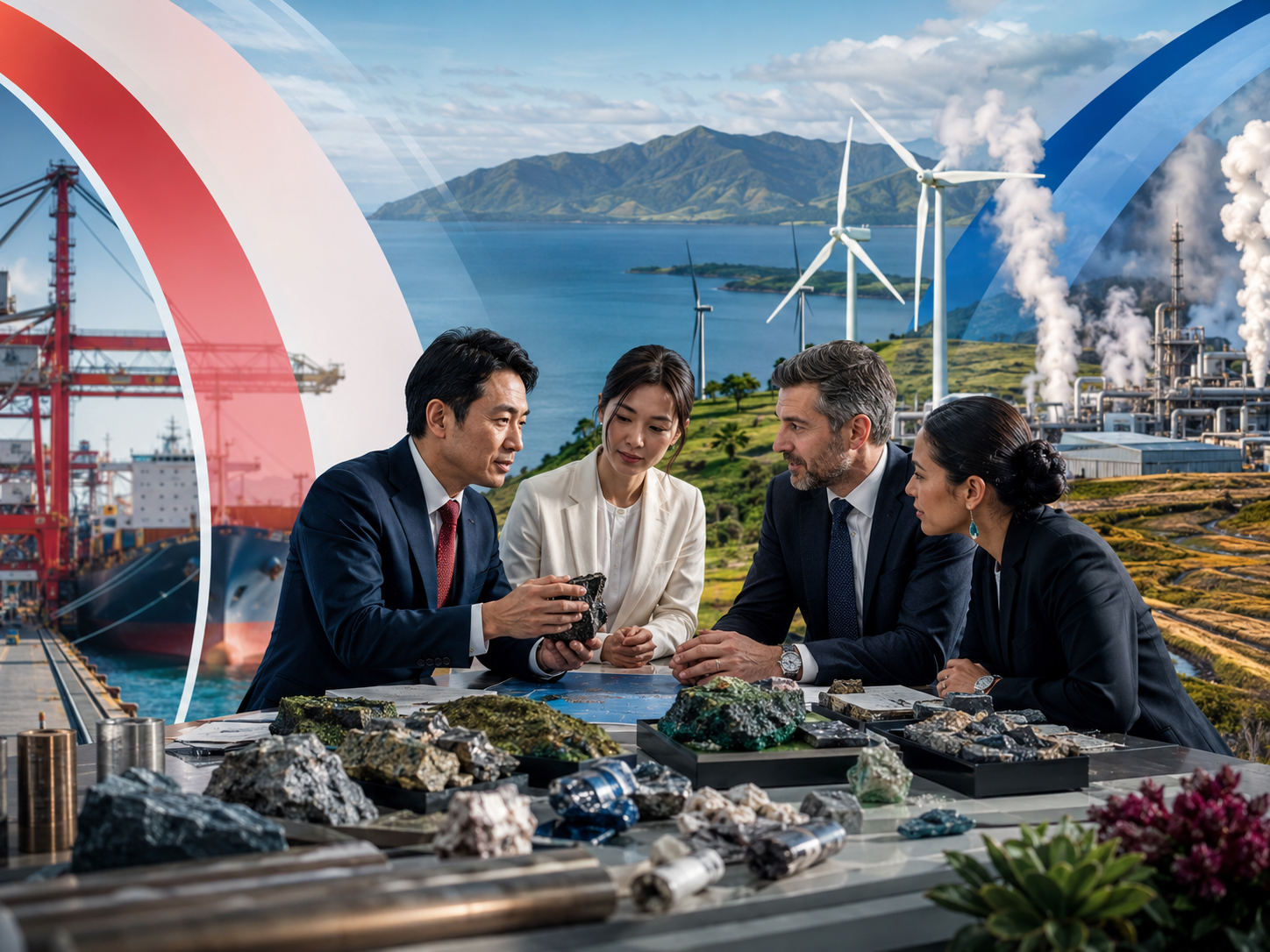
The Japan–New Zealand vice-ministers’ meeting on June 2, 2026, looked modest from the outside: a working lunch in Tokyo between Japanese Vice Minister for Foreign Affairs Funakoshi Takehiro and New Zealand Secretary of Foreign Affairs and Trade Bede Corry. But one line in Japan’s Foreign Ministry readout carried strategic weight. The two sides confirmed that they would strengthen economic-security cooperation, especially the resilience of supply chains for critical minerals, as well as cooperation in energy.
That sentence matters because minerals are no longer just a mining story. Lithium, nickel, cobalt, copper, rare earths, graphite, manganese, tungsten, gallium and germanium are embedded in batteries, motors, wind turbines, grids, semiconductors, AI data centers, defense systems and space technology. Energy security has moved beyond oil tankers and LNG cargoes. It now includes mines, refining, processing, recycling, export controls and trusted partners.
Why New Zealand matters
When Japan talks about critical minerals, the obvious partners are Australia, the United States, Canada, Vietnam, Malaysia, Africa and South America. New Zealand is not Australia. It is not a giant mining power. But that is precisely why the relationship is interesting. Japan is not only searching for one large source of supply. It is building a web of trusted, legally transparent, politically stable and environmentally credible partners.
New Zealand launched a Minerals Strategy to 2040 and its first Critical Minerals List in 2025. The list contains 37 minerals, and New Zealand Petroleum & Minerals says the country has potential to produce 21 of them. That does not mean Wellington will suddenly remake the rare-earths market. It means New Zealand is organizing geological data, permitting, environmental rules and investment signals so that it can be treated as a reliable participant in global supply chains.
Japan already knows mineral risk
Japan’s vulnerability is structural. It is a manufacturing power with limited domestic mineral resources. It learned the lesson of energy dependence through oil shocks, and later learned the danger of rare-earth concentration when high-tech industries became exposed to narrow supply chains. The more Japan electrifies vehicles, builds offshore wind, expands data centers and secures semiconductor capacity, the more mineral exposure changes rather than disappears.
JOGMEC’s rare-metals stockpiling system dates to 1983, when Japan began building a public-private system to manage supply disruption risks. Stockpiled rare metals can be released in response to supply interruptions or domestic shortages. The broader Japanese model combines public finance, information gathering, equity participation, guarantees, private companies and state-backed patience. That model has become newly relevant as Western governments try to reduce dependence on concentrated mineral supply chains.
Energy security and mineral security are now the same conversation
For decades, Japan’s energy security debate centered on LNG, oil, coal, nuclear power, renewable energy and grid reliability. Now the grid itself needs copper and aluminum; wind turbines need rare earths; batteries need lithium, nickel, cobalt, manganese and graphite; semiconductors require specialty materials; AI data centers require electricity, cooling, chips and the minerals behind them. The International Energy Agency identifies critical minerals as essential to technologies from batteries to wind turbines and EV motors.
That is why the Japan–New Zealand meeting put “critical minerals” and “energy” side by side. Clean energy does not eliminate material dependence. It changes its geography. Energy security is becoming a chain that runs from geology to processing to manufacturing to recycling.

New Zealand is a partner in rules, not just rocks
New Zealand’s value cannot be measured only by tonnage. It also offers legal transparency, environmental governance, Pacific diplomacy, English-language regulatory compatibility and a relationship to security networks that Japan trusts. For Tokyo, that is part of the point. Critical-minerals security is not only a question of where the ore is located. It is also a question of whether a country can be relied upon during crisis.
At the same time, New Zealand mining is politically and socially complex. Environmental protection, landscape, tourism, Māori rights, regional consent and climate policy all matter. Any Japanese involvement would have to be framed not merely as extraction but as responsible supply-chain building: exploration data, environmental assessment, processing technology, recycling, finance and community trust.
The Pacific triangle: Australia, the U.S. and New Zealand
Japan’s New Zealand conversation sits inside a broader 2026 push. Tokyo has also deepened critical-minerals and energy cooperation with Australia, one of Japan’s largest resource partners, and has advanced rare-earths and critical-minerals cooperation with the United States. Taken together, Japan is building a Pacific-facing minerals architecture: Australia for scale, the United States for alliance and finance, New Zealand for trusted supply-chain diversification and Pacific rules.
The background is clear: concern about overreliance on China. China remains central to many rare-earth, graphite, magnet and battery-material supply chains. The issue is not trade with China per se. It is dependence without alternatives. Japan’s strategy is to build redundancy before crisis forces improvisation.
What New Zealand gains
For New Zealand, Japan offers more than a customer. Japan brings long-term industrial demand, trading houses, battery and semiconductor companies, machinery makers, public finance, technology standards and a sophisticated approach to resource risk. A partnership with Japan can help New Zealand turn geology into higher-value strategy rather than simply becoming a raw-material exporter.
But the balance will be delicate. Critical minerals are used in clean technologies, but mining is never impact-free. If New Zealand moves too quickly, it could create domestic resistance. If it moves too slowly, it may miss the moment when allies are urgently redesigning supply chains. The policy challenge is to make minerals part of a responsible, high-trust development model rather than a short commodity rush.
- Whether Japanese firms or JOGMEC become involved in New Zealand projects
- Which of New Zealand’s 37 listed minerals become commercially credible
- How minerals cooperation links with LNG, hydrogen, geothermal and renewable energy
- How permitting incorporates environmental standards and Māori rights
- Whether Japan, Australia, New Zealand and the U.S. form a practical Pacific minerals network
Japan’s new resource geography
Japan’s geopolitics begins with geography: an island nation with limited resources, dependent on sea lanes and imported energy. For decades that meant oil and LNG. Now it also means critical minerals, semiconductors, AI, batteries, transmission grids, space systems and seabed resources. The New Zealand meeting was small, but it belongs to this larger map.
Critical minerals are not just stones underground. They are the bloodstream of future industry. If Japan and New Zealand deepen cooperation, the significance will not be merely a new import route. It will be the construction of a Pacific supply chain built on trust, transparency, environmental responsibility and long-term industrial need. Energy security is now decided not only in fuel tanks, but in mines, refineries, laboratories, ports and diplomatic rooms.
Sources and references
This Japan.co.jp report is based on public materials from Japan’s Ministry of Foreign Affairs, the New Zealand Government, JOGMEC, the IEA and Reuters.
- MOFA: Japan-New Zealand Vice Ministers’ Meeting
- New Zealand MBIE: A Critical Minerals List for New Zealand
- New Zealand Petroleum & Minerals: Minerals Strategy and Critical Minerals List launched
- JOGMEC: National rare metals stockpiling project
- IEA: Critical Minerals
- Reuters: Australia and Japan strengthen critical minerals ties