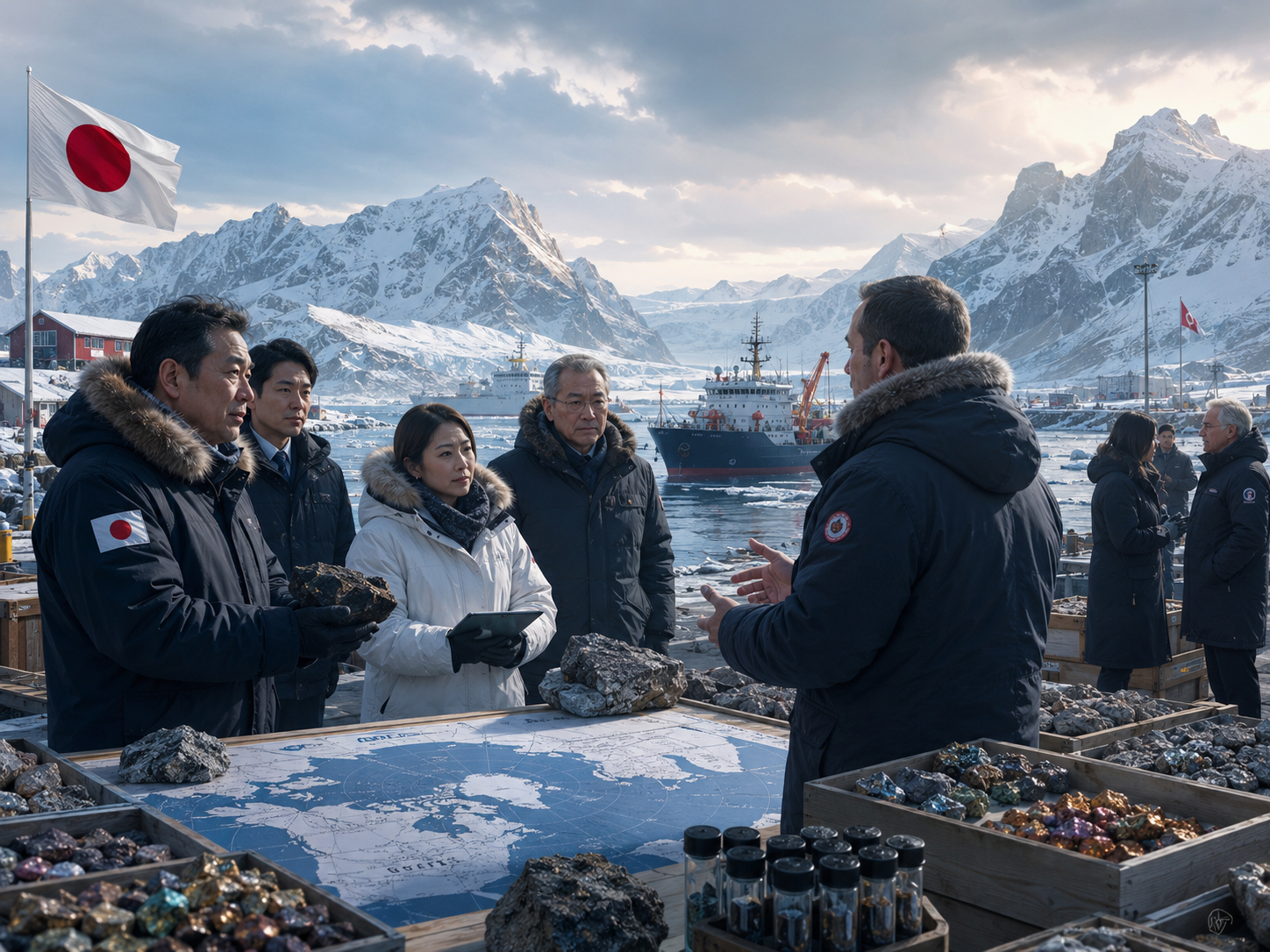
On a conventional map, Greenland is far from Japan. On a rare-earth map, the distance changes. The motors in electric vehicles, the magnets in wind turbines, the guidance systems in weapons, the components inside robotics, the materials used in advanced electronics and defense platforms — all depend on supply chains that begin in the ground and end inside Japanese industry. That is why Tokyo is looking north.
Reuters reported on June 14, citing Nikkei, that Japan plans to send a delegation to Greenland in the summer of 2026 to evaluate possible rare-earth extraction. The reported delegation would include officials from the Ministry of Economy, Trade and Industry, Japanese trading houses and the Japan Organization for Metals and Energy Security, known as JOGMEC. The group is expected to meet Greenlandic government representatives. In other words, this is not a tourist visit to a remote mining prospect. It is the Japanese state, Japanese capital and Japanese industrial demand arriving at the same table.
Greenland is an autonomous territory within the Kingdom of Denmark. Its resource policy sits at the intersection of local self-government, Danish sovereignty, Arctic security, Indigenous and community interests, European strategic anxiety and global demand for critical minerals. It has enormous geological promise, but mining there is never simple. Roads are limited. Ports are few. Energy infrastructure is thin. Winters are severe. Environmental standards are politically sensitive. Local consent matters. A mineral deposit on a map is not the same as a dependable supply chain.
For Japan, Greenland is not a stockroom. It is a long-term insurance policy against concentrated dependence.
Why rare earths are rare in practice
The term “rare earths” is misleading. Many of the elements are not geologically rare in an absolute sense. What is rare is a commercially usable deposit that can be mined, separated, refined and processed without unacceptable environmental, political or financial cost. Neodymium and praseodymium are crucial for high-performance permanent magnets. Dysprosium and terbium help magnets withstand heat. Yttrium, gadolinium and other rare earths matter in electronics, optics, medical technologies and defense systems.
The reason these elements have become strategic is that they sit at the overlap of the green economy and the security economy. Electric vehicles need them. Wind turbines need them. Precision weapons, naval systems, aircraft, satellites, radar, semiconductors and robotics also need them. A government that cannot secure these inputs is not merely short of raw materials; it is exposed across its industrial and defense base.
The hard part is not only mining. Rare-earth elements are chemically similar, making separation difficult and expensive. Some deposits contain uranium or thorium, raising waste and permitting challenges. The politics around Greenland’s Kvanefjeld project show why this matters: an important rare-earth deposit can still become politically blocked if radioactive byproducts and community concerns dominate the debate. Mineral potential is not social permission.
Japan’s 2010 memory
Japan’s rare-earth sensitivity has a date: 2010. After a collision near the Senkaku Islands between a Chinese fishing boat and Japan Coast Guard vessels, Japanese industry experienced severe anxiety over rare-earth supply from China. The episode taught Tokyo that a supply chain can become a diplomatic weapon.
After that shock, Japan moved in several directions at once. It supported non-Chinese supply, including Australia’s Lynas. It invested in overseas mining relationships. It encouraged recycling, substitution and reduced rare-earth use. It strengthened strategic stockpiling. It used JOGMEC as a patient public-sector tool for geological surveys, risk money and supply-chain finance.
That strategy reduced risk, but did not eliminate dependence. A 2026 CSIS analysis says Japan imported more than 5.2 million kilograms of rare-earth metals from China in 2024, equal to 63% of its total rare-earth metal imports. The headline number improved from the pre-2010 era, but the vulnerability remains, especially in heavy rare earths, separation, refining and magnet supply chains.
Why Greenland matters — and why it is hard
Greenland matters because it combines resource potential with geopolitical location. CSIS describes Greenland as ranking eighth globally in rare-earth reserves, with Kvanefjeld and Tanbreez among the island’s most important deposits. Kvanefjeld is known as a large rare-earth and uranium-associated deposit. Tanbreez has attracted attention for heavy rare earths and has received an exploitation license, according to company and regulatory documents.
But Greenland is not a simple substitute for China. CSIS also notes that no rare-earth mining has taken place on the island to date, and that harsh Arctic conditions and weak infrastructure have slowed development. A permitted project is still not a functioning supply chain. A functioning supply chain requires financing, roads or ports, energy, processing, environmental management, workers, community agreements, offtake contracts, political stability and customers willing to pay for resilience.
That is the point Japan must understand well. Greenland cannot be treated as an emergency tap to be opened during the next crisis. It is a long-cycle project environment. The countries and companies that succeed there will be the ones that can stay for years, not weeks.
Japan wants more than ore
The planned Japanese delegation matters because it combines public policy and private capability. Trading houses understand project development, offtake agreements and long-term risk. JOGMEC can provide technical assessment, financing support and risk-sharing. METI brings industrial strategy and economic-security priorities. Together, they represent Japan not as a single mining investor, but as a country trying to assemble a supply chain.
That supply chain begins upstream but does not end there. Ore must become concentrate. Concentrate must be separated. Separated oxides must become metals, alloys, magnets, motors and components. If Japan only shifts mining away from China while leaving separation and processing concentrated in China, much of the risk remains. This is why the United States and Japan released a critical minerals action plan in March 2026, with Reuters reporting themes such as joint financing, responsible mining, geological mapping, stockpiling and rapid response to disruptions.
Greenland could become one upstream node in that wider allied system. But the midstream is decisive. Whoever controls separation, refining and magnet production can still shape the market, even if the ore comes from somewhere else.
The Arctic has become a diplomatic theater
Greenland’s minerals sit inside a larger Arctic story. Climate change is making the region more accessible, but also more fragile. The United States, Denmark, the European Union, NATO, Russia and China all view the Arctic through overlapping lenses: military access, shipping routes, energy, fisheries, data cables, radar, space tracking and minerals. In early 2026, renewed U.S. presidential interest in acquiring Greenland again turned the island into a test of allied diplomacy.
Japan is not an Arctic state, but it is an Arctic stakeholder. It has research interests, shipping interests, climate interests and now mineral-security interests. Tokyo’s usual style is not to plant flags dramatically. It is to study, finance, sign long-term contracts, coordinate with allies and bring technology. That patient style may suit Greenland better than great-power theater — if Japan listens to local priorities.
Greenland does not need another outsider treating the island as a strategic object. It needs durable partnerships that can create jobs, protect water and landscapes, respect local politics, build infrastructure and share value. For Japan, this means diplomacy before extraction.
In mineral diplomacy, the first thing to mine is trust.
China’s shadow remains
Even if new mines open, China’s role will not disappear. China’s dominance is not simply geological. It has deep processing capacity, industrial scale, environmental permitting experience, low-cost production, magnet manufacturing and policy coordination. CSIS has warned that China’s rare-earth separating and processing advantage could give it leverage even over resources outside China, including through offtake and processing arrangements.
That is why Japan’s challenge is not merely to “find rare earths.” It is to build an allied supply chain that survives price pressure, political retaliation and cyclical markets. If China lowers prices, will non-Chinese projects still be financed? If processing costs are higher under stricter environmental standards, will buyers pay the premium? If a new Arctic project needs ten years of patient capital, who carries the risk?
Japan’s other frontier: the deep Pacific
Greenland is not Japan’s only answer. In February 2026, Reuters reported that Japan had recovered rare-earth-rich mud from about 6,000 meters below the sea near Minamitori Island, using the scientific drilling vessel Chikyu. The test involved materials believed to contain elements such as dysprosium, neodymium, gadolinium and terbium. Japan hopes to move toward full-scale seabed mining trials if technical and environmental hurdles can be cleared.
The contrast is important. Minamitori is close to Japan’s jurisdiction but far below the sea. Greenland is on land but far away politically, geographically and logistically. Both are difficult. Both require patience. Neither is a quick fix. Japan’s real answer is not one mine, one seabed, one ally or one technology. It is redundancy: Greenland, Australia, India, the United States, seabed research, recycling, substitution, stockpiles and magnet technology all layered together.
Five ways to read this story
- Greenland has large rare-earth potential, but climate, infrastructure and environmental politics make development slow.
- Japan’s interest is not only mining; it is building an end-to-end supply chain from ore to magnets and final products.
- The 2010 supply shock remains the core memory behind Japan’s rare-earth policy.
- Reducing dependence on China requires midstream processing capacity, not only new mines.
- Greenland will reward patient partners, not extractive headlines.
The Arctic rock is a mirror
Japan has long described itself as a resource-poor nation. But the deeper problem is not simply the lack of domestic resources. It is the question of how a resource-poor industrial state builds reliable relationships with resource-rich places without becoming dependent, extractive or exposed.
The Greenland delegation, if it proceeds, will not mark the start of mining. It will not guarantee a contract. It will not free Japan from China. But it marks a line on the map: from Tokyo to Nuuk, from trading houses to Arctic communities, from JOGMEC’s patient finance to global supply-chain redesign, from industrial anxiety to strategic action.
Rare earths are small elements with large consequences. They are buried in rocks, but they surface in every debate about climate technology, economic coercion and national defense. Greenland’s ore is cold. The politics around it are not.
Japan.co.jp reads this not as an Arctic mining rush, but as Japan designing industrial insurance.
Greenland is far away. Yet the future of Japan’s motors, magnets, semiconductors, satellites, defense platforms and clean-energy systems may run through distant fjords, patient contracts and the slow work of trust.
Sources and background
This Japan.co.jp Long Read draws on Reuters reporting, CSIS analysis, JOGMEC and METI resource-security materials, Greenland mineral-resource information, Tanbreez-related disclosures, and U.S.-Japan critical minerals reporting. Mineral ownership, permits, resource estimates and project economics can change quickly; official filings and government sources should be checked before any investment or policy decision.
- Reuters: Japan to send delegation to Greenland
- CSIS: Greenland, Rare Earths, and Arctic Security
- CSIS: China’s Rare Earth Campaign Against Japan
- JOGMEC
- METI / ANRE: Japan’s international resource strategy
- Reuters: Japan retrieves rare-earth mud from deep seabed
- Reuters: US-Japan rare earths cooperation action plan