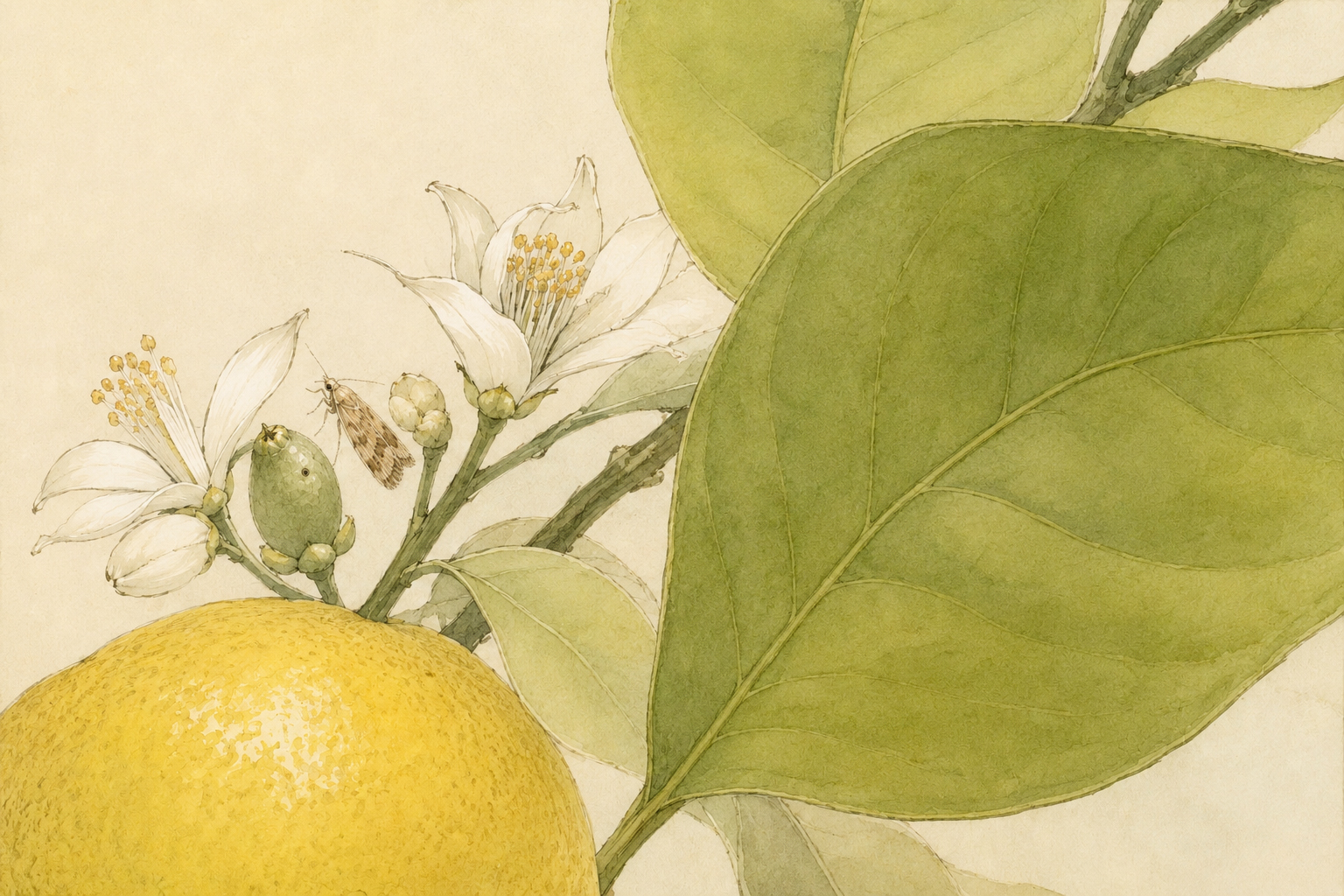
The answer begins with four dots that refuse to form a route. One is Chichijima, almost 1,000 kilometers south of Tokyo in the Pacific. Another is Tsushima, between Kyushu and the Korean Peninsula. The other two are Okinawa and Iriomote in Japan’s southwest. Specimens from all four islands have now been identified as Prays nephelomima, a tiny moth whose larvae feed inside citrus flowers and young fruit.
Kyushu University announced Japan’s first confirmed records on August 20, the day a peer-reviewed paper by doctoral researcher Taiyo Oka and Assistant Professor Sadahisa Yagi appeared in Applied Entomology and Zoology. They proposed the Japanese name remon-nisesuga, レモンニセスガ. In English, the established common name is citrus flower moth.
“First record” describes scientific recognition, not the insect’s passport stamp. Some material had already been collected and left unidentified. The paper resolved what the specimens were. It did not establish that the moth arrived in 2026, that Chichijima was its first landing place, or that the species is absent from Japan’s main islands.
A range nearly 1,900 kilometers wide
Measured between representative island coordinates, Chichijima and Iriomote are about 1,865 kilometers apart in a straight line; Chichijima and Tsushima are about 1,465 kilometers apart. Those are Japan.co.jp geographic calculations, not flight tracks. A moth one centimeter across did not necessarily cross those gaps under its own power, and the order of the records does not reveal the order of invasion.
| Island | Evidence reported | What remains open |
|---|---|---|
| Chichijima Ogasawara Islands, Tokyo | Adults and larvae identified; field damage found in flower buds, young fruit and leaves of Kikuchi lemons. | Whether Ogasawara was Japan’s first entry point or a source for other domestic populations. |
| Tsushima Nagasaki Prefecture | Collected material identified through morphology and DNA comparison. | The local range, route of entry and scale of any damage to cultivated citrus. |
| Okinawa Okinawa Prefecture | Collected specimens establish a confirmed island record. | Population density, seasonal activity, generation count and agricultural impact. |
| Iriomote Okinawa Prefecture | Collected specimens establish a confirmed island record. | Whether it shares one introduction with Okinawa or received the common haplotype separately. |
Every confirmed site is an island. That pattern is a reason to watch the movement of plants and to survey mainland lemon districts; it is not proof that the moth cannot already be present on Honshu, Shikoku or the Kyushu mainland. A blank area on a distribution map can mean genuine absence. It can also mean no sampling, no correct identification or no specimen preserved.
The case was solved in London as well as Japan
Small moths can be taxonomically deceptive. Wing color may vary, museum specimens may fade, and close relatives can look nearly identical to the unaided eye. Oka and Yagi combined adult external characters, male and female genitalia, larvae, feeding evidence and DNA barcodes. They also compared the Japanese material with the name-bearing syntype series held by London’s Natural History Museum.
That museum comparison reaches back to 1907. British entomologist Edward Meyrick described Prays nephelomima from Australian material collected in New South Wales. A type specimen is not merely an old example; it is the physical reference that fixes a scientific name to an organism. Returning to it kept the Japanese identification from resting on photographs or a modern database label alone.
The researchers produced the first detailed illustrated diagnostic treatment of genitalia from both sexes, including the syntypes. They also concluded that Prays semilunata, described from China under a separate name, could not be distinguished and belongs to the same species. That synonymy matters beyond taxonomy: records once filed under different names become part of one biological range.
A barcode can identify a traveler without recovering the itinerary
The molecular evidence came from 658 base pairs of cytochrome c oxidase subunit I, or COI, in mitochondrial DNA. This segment is widely used as an animal DNA barcode. In the study, the Japanese sequences matched the international Barcode of Life cluster assigned to P. nephelomima, reinforcing the morphological diagnosis.
Four COI haplotypes appeared in the worldwide comparison. All Japanese material belonged to the most common one, which also appeared in specimens from Australia, New Zealand and Madagascar. Australia showed the greatest haplotype diversity among the available samples and has records extending back more than a century. The authors therefore identified it as the most plausible geographic origin of the species.
A shared mitochondrial sequence cannot distinguish every plausible pathway. Japan’s moths could descend from a population moved directly from Australia, through another country, from an unsampled Pacific or Asian population, or through more than one introduction of the same common type. Regions represented by few DNA samples can appear artificially uniform. The university’s detailed release explicitly says that more material from Southeast Asia, Oceania and Pacific islands will be needed to identify Japan’s direct source.
The four Japanese populations may also contain differences outside this short maternal marker. Nuclear DNA, genome-scale sampling, older dated specimens and denser surveys could reveal structure invisible to COI. Until then, “Australian origin” should be read as a research-supported hypothesis about the species’ deeper source—not a completed chain of custody.
The moth attacks before a lemon becomes a lemon
The English common name is unusually useful here: citrus flower moth. Larvae bore into flower buds and young fruit, where feeding can potentially affect fruit set and quality. Their concealment also makes a light infestation easy to overlook. By the time damage becomes visible, the feeding stage may already have occupied the plant’s most delicate tissue.
On Chichijima, the researchers confirmed larvae damaging buds, young fruit and leaves of the locally grown Kikuchi lemon. Leaf feeding was not previously known for the species, according to Kyushu University’s technical release. That is a biological discovery, but it should not be inflated into a national crop-loss estimate. The study did not establish Japan-wide yield losses, an economic treatment threshold or a control program.
The distinction from citrus leafminer is practical as well as linguistic. Citrus leafminer, Phyllocnistis citrella, makes conspicuous serpentine trails under the surface of young leaves and is already treated in Ogasawara’s lemon-management manual. P. nephelomima is a different species in a different family. Its characteristic target is reproductive tissue. A winding leaf mine in Japan should not be relabeled as evidence of the newly confirmed moth.
Chichijima’s lemon has its own migration story
The damaged host on Chichijima is not an anonymous orchard variety. Tokyo’s Ogasawara Subtropical Agriculture Center traces the Kikuchi lemon to 1940, when the late Mr. Kikuchi brought a plant known locally as a “Yap lemon” from Tinian to Hachijojima. In 1973, his daughter carried an air-layered plant from the original tree to Chichijima.
The fruit became known locally as shima lemon, or island lemon, and is marketed as Ogasawara lemon. It is commonly sold green, before the peel turns yellow. The official cultivation manual describes a relatively large, juicy fruit with a milder balance of acidity than a standard lemon and notes that it is taxonomically closest to a Meyer lemon.
Ogasawara’s subtropical climate also gives the tree a different rhythm. The manual documents three cycles of budding, flowering and fruit set in a year. Spring bloom remains the main commercial crop, but summer and autumn flowers can also produce fruit. That long flowering window is part of the island fruit’s agricultural identity—and potentially a wider seasonal window in which a flower-feeding insect can be observed.
1907 — Meyrick describes P. nephelomima from Australian specimens.
1940 — Mr. Kikuchi brings the source plant of the Kikuchi lemon from Tinian to Hachijojima.
1973 — His daughter introduces an air-layered plant from Hachijojima to Chichijima.
1970s — The citrus flower moth is recorded in New Zealand.
2013 — Trial handling of “Ogasawara Lemon” begins at Tokyo’s central wholesale market.
August 20, 2026 — The peer-reviewed Japanese records are published.
Those two histories intersect on Chichijima, but the dates do not establish causation. There is no evidence in the new study that the moth accompanied the lemon plants moved in 1940 or 1973. Connecting an old plant transfer to a newly identified insect merely because both appear in the same story would turn chronology into accusation.
Plant movement is a pathway, not a named culprit
Living plants can conceal eggs and very small insects in buds, folded leaves, bark or soil. That makes plants for planting a well-recognized pathway for agricultural and forest pests. Kyushu University warns that movement of nursery trees could carry the moth from islands to mainland lemon regions. The study does not identify a shipment, nursery, grower or trading company responsible for its presence in Japan.
The distribution and DNA are compatible with at least two broad scenarios. A founder population may have entered one location and later moved among Japanese islands with plants. Alternatively, the common global haplotype may have arrived independently at more than one island. A mixture of those paths is also possible. More genetic resolution and older collection dates are needed before one story can be preferred.
- Oldest evidence: whether overlooked specimens in museums or private collections predate the known material.
- Mainland range: whether larvae or adults occur in lemon and lime districts on Honshu, Shikoku or mainland Kyushu.
- Population structure: whether higher-resolution DNA separates the four island records.
- Seasonality: emergence periods, generations per year and overwintering stage under different Japanese climates.
- Crop impact: measured effects on flower survival, fruit set, yield and external quality.
- Management: validated monitoring, pheromone trapping, natural enemies and effective integrated controls.
Taxonomy is part of agricultural early warning
The paper’s achievement is not that it found a spectacular new animal. It made a nearly invisible problem legible. Unidentified specimens in Japanese collections, century-old name-bearing material in London, global barcode records and damaged flowers in an Ogasawara orchard were assembled into one testable account.
That work shows why biological surveillance is more than setting traps at a border. An invasion can remain hidden in plain sight when a species resembles its relatives, lives inside plant tissue or sits in a collection without a secure name. Taxonomy supplies the vocabulary that lets growers, museums and regulators recognize that their separate observations concern the same organism.
So how far has the moth traveled? The confirmed Japanese range stretches across an island gap of roughly 1,900 kilometers. Its deeper geographic origin is most plausibly Australian under the available DNA evidence, putting more than 6,500 kilometers between historical Australian localities and Chichijima. But that is scale, not itinerary. The direct source, intermediate stops, arrival date and number of entries remain blank.
The responsible headline is therefore less dramatic than the map. A lemon-eating moth has reached Japan—at least four parts of it. Science has recovered the moth’s name. Recovering its journey will take more specimens, more seasons and a much finer genetic lens.
- Kyushu University — “A lemon-feeding moth, remon-nisesuga, has invaded Japan,” August 20, 2026 (Japanese)
- Kyushu University — detailed technical press release, August 20, 2026 (Japanese PDF)
- Oka & Yagi — “Invasive citrus flower moth, Prays nephelomima … in Japan,” Applied Entomology and Zoology, 2026
- Tokyo Metropolitan Government, Ogasawara Subtropical Agriculture Center — Ogasawara Lemon Cultivation Management Manual, March 2016 (Japanese PDF)
- Edward Meyrick — “Descriptions of Australasian Micro-Lepidoptera. XIX. Plutellidae,” 1907 (original description)
Attribution note: The four records, feeding sites, taxonomic conclusions, DNA comparison and publication details come from the paper and Kyushu University. Australia is the authors’ most plausible origin candidate, not a proven direct source for Japan. Distances are Japan.co.jp calculations. The alternative invasion scenarios and the description of taxonomy as an early-warning system are Japan.co.jp analysis.