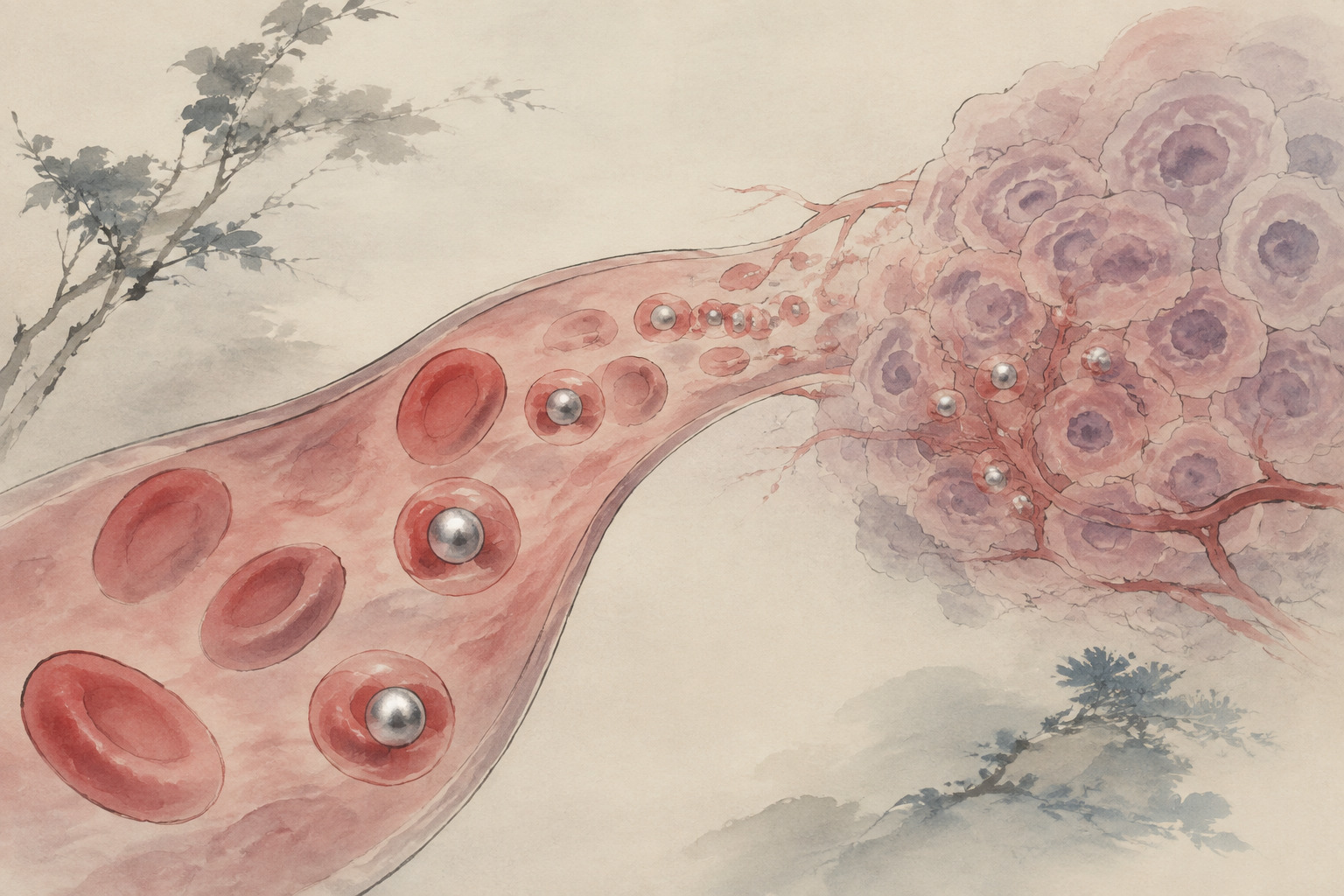
The headline is a useful shorthand, but the chemistry underneath it is more exact. The researchers did not put metal droplets inside blood cells. Nor did they isolate red-cell membranes and wrap each particle in a neat cellular shell. They mixed their nanoparticles with whole blood and used sonication to adsorb a heterogeneous layer of blood-derived proteins, phospholipids and signaling molecules—including CD47—directly onto the surface.
That distinction matters because the coating is supposed to make an artificial object look more like “self” to the immune system. A particle injected into blood is normally covered by proteins and screened by macrophages, often before it reaches a tumor. The new design tries to control that first encounter by arriving pre-coated with a natural blood corona.
Eijiro Miyako, a professor at Tohoku University’s Institute of Multidisciplinary Research for Advanced Materials and a visiting professor at the Japan Advanced Institute of Science and Technology, developed the platform with Nina Sang. Their peer-reviewed paper appeared online in Advanced Science on August 11. Tohoku University and JAIST announced the findings on August 21.
The platform’s name—B–LM–DMX–αCD25—is an inventory. “B” is the blood-derived camouflage. “LM” is a gallium-based liquid-metal alloy core. “DMX” is 5,6-dimethylxanthenone-4-acetic acid, usually known as DMXAA or vadimezan. “αCD25” is an antibody against CD25. Heat, immune suppression and innate immune activation are meant to be tackled in a timed sequence rather than as three unrelated treatments.
A treatment sequence built into one particle
The target was triple-negative breast cancer, or TNBC. These tumors lack estrogen receptors, progesterone receptors and high HER2 expression, so therapies directed at those three biomarkers do not work. The label does not describe one uniform disease; it gathers biologically diverse cancers around three absent treatment targets.
The Tohoku–JAIST strategy begins before light is applied. Its blood coating is meant to reduce clearance by macrophages, allowing more particles to circulate to a tumor. Compared with liquid-metal particles carrying a synthetic DSPE coating, the blood-coated version was taken up more than 50% less by macrophages and accumulated in tumors at roughly five times the level, according to the university release.
Once in the tumor, the surface antibody is intended to find CD25-rich regulatory T cells, or Tregs. These cells normally restrain immune responses and protect the body from autoimmunity. Inside many tumors, however, they also suppress T cells capable of attacking cancer. The team reported nearly complete antibody-coupling efficiency and a reduction of more than 80% in tumor-infiltrating Tregs under the combined treatment.
The external switch is an 808-nanometer near-infrared laser. The gallium-based alloy converts that light to heat, raising the mouse tumor to 58 degrees Celsius within five minutes. Heat kills local tumor cells and can release tumor antigens and danger signals. It also triggers release of the encapsulated DMXAA: loading efficiency exceeded 95.7%, less than 5% leaked without laser exposure, and about 90% was released within 15 minutes under the reported laser condition.
DMXAA supplies the third action. In mice, it activates the cGAS–STING–TBK1–IRF3 axis, encouraging type I interferon signaling and dendritic-cell maturation. The aim is to turn the heated tumor into a source of antigens while simultaneously improving the immune system’s ability to notice and respond to them.
| Component | Intended job | What the study reported |
|---|---|---|
| Whole-blood-derived coating | Present a more self-like surface and reduce rapid immune clearance. | More than 50% less macrophage uptake than DSPE–LM; about fivefold greater tumor accumulation. |
| Anti-CD25 antibody | Reduce immunosuppressive Tregs in the tumor. | Near-100% coupling efficiency; tumor Tregs reduced by more than 80% in the treatment context. |
| Gallium-based liquid metal | Turn 808-nm light into heat and damage tumor cells. | About 54% conversion efficiency; tumor temperature reached 58°C within five minutes. |
| DMXAA | Activate mouse STING after heat-triggered release. | More than 95.7% loading; under 5% leakage without irradiation; about 90% released within 15 minutes after irradiation. |
The tumor tissue carried signs consistent with that chain. Foxp3 and IL-10 expression fell by more than 70%. CD3-positive T cells rose more than thirteenfold and dendritic cells about elevenfold. Granzyme B expression increased 3.07 times and interferon-gamma 3.29 times; STING-associated genes increased as well. Those measurements support the authors’ mechanism inside this model. They do not apportion the survival benefit cleanly among heat, antibody and agonist, and they do not show that the same cascade occurs in people.
Four mice, a separate lung experiment, and a survival cohort
The strongest phrase in the universities’ release is “complete regression.” To interpret it, the experiments must remain separate.
For the primary-tumor study, the team implanted 4T1 mouse mammary-cancer cells in the mammary fat pad of immune-competent BALB/c mice. The 4T1 model is aggressive, metastatic and commonly used to study TNBC-like disease. It preserves a working mouse immune system, which matters for an immunotherapy experiment. It is still a transplanted mouse cancer, not a miniature version of a patient’s evolving, genetically varied tumor.
All four animals given B–LM–DMX–αCD25 plus near-infrared irradiation had complete primary-tumor regression, with tumors no longer detected by day seven and no regrowth during the reported observation. Tumors continued to grow in the comparator groups. The consistency within the full-treatment group is a legitimate signal. A group of four cannot establish a response rate precise enough for clinical prediction, reveal uncommon toxicity or substitute for independent replication.
The lung result came from a separate experimental metastasis model. The joint release reports that visible lung nodules in the combined-treatment group fell by more than 90% against the phosphate-buffered saline control and that lung weight remained near that of normal mice. There were four mice per group and the lungs were assessed on day 24. This does not prove that the treatment prevented the full natural sequence of human metastasis from a primary breast tumor.
Survival was measured in groups of six to eight. Median survival exceeded 70 days for the complete-treatment cohort and was longer than in the other groups. “Seventy days” is an observation window in this mouse experiment, not a conversion formula for years of human survival. A planned tumor-rechallenge experiment—removing or regressing one tumor and later testing whether immune memory rejects another—has not yet been reported.
- Primary tumor: complete regression in four of four mice receiving the whole platform plus laser.
- Experimental lung model: the official release reports a greater-than-90% reduction in nodules, with four mice per group.
- Survival: median beyond 70 days, with six to eight mice per group.
- Not tested in this report: people, human dosing, deep internal tumors, long-term immune memory or GLP repeat-dose toxicology.
- Not established: a cure for TNBC or prevention of human metastatic disease.
The human-STING mismatch is not a footnote
STING has attracted intense drug-development interest because it sits at a junction between sensing misplaced DNA and initiating innate immune signaling. A successful agonist might help expose an immunologically “cold” tumor, improving antigen presentation and recruiting tumor-killing cells.
DMXAA once produced impressive antitumor effects in mice and disappointed in human development. The biological reason became clear: its target is species-specific. A 2013 study in the Journal of Immunology showed that DMXAA directly binds mouse STING but failed to bind or signal through human STING. The new nanoplatform demonstrates a sophisticated way to deliver and release a drug in a mouse whose receptor responds to it. It does not solve the drug’s human receptor mismatch.
A human-active STING agonist could, in principle, replace DMXAA. In practice, that would change the formulation. A substitute may differ in solubility, size, charge, potency, release kinetics and systemic inflammatory effects. The researchers would need to re-establish loading, laser-controlled release, distribution, dose, toxicity and synergy. The complete particle—not merely the new molecule—would have to be tested again in models appropriate to human STING.
This is why the paper’s description of the system as clinically translatable should be read as the authors’ forward-looking assessment, not a demonstrated property. The carrier concept may be adaptable. The exact cargo combination has a known biological barrier between mouse and human.
CD25 removes a brake, but it is not an exclusive Treg address
The second immunological problem is subtler. CD25, the alpha chain of the high-affinity interleukin-2 receptor, is highly expressed on many regulatory T cells. It is also expressed by activated effector T cells. An anti-CD25 strategy can therefore remove suppressive cells that protect a tumor while also disturbing cells needed for a productive immune response.
Tregs themselves are not villains in ordinary physiology. They help maintain self-tolerance; broad depletion can promote autoimmune injury. The tumor accumulation reported here may concentrate the antibody’s effect where it is useful, but “more in tumor” is not the same as “only in tumor.” Measurements of normal tissues, immune-cell subsets over time and repeat dosing will be needed to show that a local immunological reset does not become systemic immune dysregulation.
The blood camouflage raises related questions. CD47 can deliver a “do not eat me” signal to macrophages, but a mixed corona contains many constituents whose abundance, orientation and function may differ from one preparation to the next. Complement activation, clotting, infection control and allergic reactions become manufacturing and safety issues, not just molecular details.
Triple-negative does not mean treatment-free
University news releases sometimes compress the clinical context into a stark problem statement. TNBC is difficult to treat and is more likely than many breast-cancer subtypes to relapse early, but patients do have established options. Surgery, radiation and chemotherapy remain central. Immune-checkpoint treatment is used for defined patients, and antibody–drug conjugates have altered the treatment landscape.
The U.S. Food and Drug Administration added another change on June 24, 2026. It approved sacituzumab govitecan for first-line treatment of unresectable locally advanced or metastatic TNBC as monotherapy for patients who are not candidates for PD-1/PD-L1 inhibitors and in combination with pembrolizumab for tumors with a PD-L1 Combined Positive Score (CPS) of 10 or greater. Approvals and indications vary by country, but the development sets the relevant benchmark.
A future liquid-metal system would therefore need to show value against evolving care—not against no treatment. It might have to identify a population underserved by existing drugs, demonstrate longer survival or durable control, or reduce systemic toxicity enough to justify a laser procedure and a complex biologic-material product.
From red-cell membranes to a whole-blood corona
The idea of borrowing a cell surface to disguise a nanoparticle is at least fifteen years old. In 2011, researchers reported polymeric nanoparticles cloaked in purified erythrocyte membranes. Their top-down method fused red-cell membrane vesicles around synthetic cores, preserving surface proteins associated with long circulation. That PNAS paper helped establish cell-membrane-coated nanoparticles as a field.
Liquid metal followed a different route into biomedicine. Gallium alloys can remain liquid near room temperature, absorb near-infrared light and be reshaped. In 2017, Miyako and colleagues described light-driven liquid-metal “nanotransformers” that generated heat and reactive oxygen species, changed shape and released a drug. The work made the material simultaneously an actuator, imaging aid and delivery vehicle.
In 2021, a JAIST team including Miyako coated gallium–indium liquid-metal particles with biomolecules including gelatin, DNA, lecithin and bovine serum albumin. In a mouse colon-cancer model, the particles accumulated in tumors and supported near-infrared imaging and photothermal treatment. It remained preclinical, but it supplied part of the material history behind the 2026 platform.
The new whole-blood route aims to avoid the isolation and reconstruction required for a purified cell membrane. One mixing-and-sonication step collects a complex surface layer from blood. That economy is attractive. Yet complexity moves rather than disappears: a drug manufacturer must define what is on the surface, how much is present and how variation in donor, disease, collection, storage and processing changes performance.
2011 — A landmark PNAS study reports erythrocyte-membrane-camouflaged polymer nanoparticles.
2017 — Miyako and colleagues publish light-driven gallium-based liquid-metal nanotransformers.
2021 — A JAIST team tests biomolecule-coated liquid metal for near-infrared tumor imaging and heating in mice.
August 2026 — Whole-blood-derived camouflage, anti-CD25, DMXAA and a photothermal core are integrated in a TNBC mouse study.
Light reaches a tumor unevenly; metal must eventually leave the body
The laser makes the therapy externally controllable, but also limits where it can operate. Light at 808 nanometers penetrates tissue better than visible wavelengths, then scatters and is absorbed with depth. Heating a superficial mouse tumor to 58°C in five minutes does not show that an internal lung, liver or bone lesion can be heated uniformly without damaging the tissue above it.
The authors list longer-wavelength NIR-II light and optical fibers as future routes to deeper tumors. Those are proposed engineering solutions, not tested features of the reported system. A fiber can bring light inside the body, but it also adds an invasive procedure and geometry: every target still has to be reached and illuminated.
The in-vitro safety comparison needs equally cautious language. With laser treatment, survival of multidrug-resistant EMT-6/AR1 cancer cells fell below 15%, while survival of normal MRC-5 lung fibroblasts remained above 40%. The difference suggests some selectivity under those conditions. It also means that more than half the normal cells did not survive. The figure information for the animal experiment describes a modest reduction in body weight in treated mice.
A translational program would need pharmacokinetic and toxicology answers that a proof-of-concept efficacy study cannot provide. Where do gallium and indium travel after the particle changes shape or breaks down? How much accumulates in liver and spleen? What happens after repeated doses? Does the blood-derived coat provoke complement or coagulation? Can a standardized product use autologous blood without impractical manufacturing, or an allogeneic source without compatibility and pathogen problems?
The universities say the planned work includes GLP-compliant repeat-dose toxicology, testing other antibodies and immunomodulators, deeper-tumor light delivery and tumor-rechallenge studies for immune memory. That list is valuable because it identifies work not yet completed.
What deserves to survive the mouse result
Small animal studies in oncology are crowded with tumors that shrink or disappear. Most do not become medicines. The filters ahead are severe: reproducibility across laboratories, performance in more representative models, scalable manufacturing, biodistribution, immune safety, chronic toxicity and ultimately phased trials in people.
The durable contribution here may be the sequence rather than the specific formula. First, extend circulation and concentrate a particle. Second, weaken local immune suppression. Third, use light to create tumor damage and release an agonist at the same time. The design tries to place an antigen source, an immune accelerator and a removed brake in one neighborhood.
That logic is scientifically compelling. It also exposes the next experiment with unusual clarity. Replace the mouse-only STING agonist with one that works on human STING; prove that the new cargo still loads and releases on command; test it in a system that carries human STING variants; then establish that blood camouflage and CD25 targeting do more good than harm over repeated doses.
Only after those steps would the cloak become more than an elegant way to win a mouse experiment. For now, the work is a promising preclinical integration of materials science and immunology, paired with a known species barrier that the next version cannot avoid.
- Tohoku University — official Japanese announcement, August 21, 2026
- Tohoku University and JAIST — detailed joint-release PDF with figures, measurements and terminology
- Sang and Miyako, “Blood Cell-Camouflaged Liquid Metal Nanoconjugates…,” Advanced Science (2026)
- PubMed — paper record and abstract
- Conlon et al. — primary 2013 paper showing that DMXAA binds mouse, but not human, STING
- National Cancer Center Japan — breast-cancer treatment information (Japanese)
- U.S. National Cancer Institute — Triple-Negative Breast Cancer
- U.S. FDA — June 24, 2026, first-line TNBC approval for sacituzumab govitecan regimens
- Hu et al. — erythrocyte-membrane-camouflaged nanoparticles, PNAS (2011)
- Chechetka, Yu and Miyako — light-driven liquid-metal nanotransformers, Nature Communications (2017)
- JAIST — 2021 liquid-metal nanoparticle cancer-imaging and treatment study (Japanese)
- Tanaka and Sakaguchi — CD4+CD25+ regulatory T cells in tumor immunity
Attribution note: Particle specifications, cell and animal results, and planned development come from the paper and the universities’ joint release. The greater-than-90% lung-nodule figure is the official release’s characterization; primary-tumor, lung-metastasis and survival cohorts are reported separately. The human-STING limitation, treatment-landscape context and analysis of targeting, manufacturing and light-delivery risks draw on the additional primary and government sources listed above.