“We got up at five in the morning.” At 7 a.m. on February 1, 2026, children from the final year of kindergarten through sixth grade arrived with their parents at a stadium in Marugame, Kagawa Prefecture. Twelve families, 33 people. The 78th Kagawa Marugame International Half Marathon would send 10,264 runners over the course.
The children handed programs to arriving spectators in the morning and finishers’ gifts to runners in the afternoon. Their uncertainty about speaking to strangers receded each time someone said thank you. In a case report released August 14 by the Sasakawa Sports Foundation, children said they wanted to do it again. Parents described seeing initiative and confident greetings they did not usually see at home.
Inside that day is a possible answer to one of Japan’s most stubborn local problems. Asking a working parent to leave the family and volunteer on a weekend creates a collision with the child’s schedule. Make the child a participant, however, and the constraint becomes the invitation. The parent does not need to arrange separate care. The child is no longer merely the spectator or recipient of a service, but one of the people who makes the community work.
Marugame is not proof. There were 12 families and only ten post-event survey respondents. There was no control group or long-term follow-up, and the applicants may have been unusually interested in volunteering before they arrived. A day running from 7 a.m. to 2:20 p.m. is not necessarily repeatable for every family with a kindergarten-age child. Read correctly, this is not a finished national model. It is a promising entry point worth testing.
Why are there too few people to support sport now?
The first reason is that there are fewer children. Japan’s Statistics Bureau estimated 13.29 million people under 15 on April 1, 2026, the smallest total on record and the 45th consecutive annual decline. Children made up 10.8 percent of the population, less than one-third of the 35.4 percent recorded in 1950. There were 3.09 million aged 12–14, with each younger three-year cohort smaller still.
The Sports Agency’s 2026 operating guide projects that the junior-high-age population will fall from about 3.22 million in 2023 to about 2.59 million in 2033—a decline of roughly one-fifth in a decade. In baseball, football and volleyball, one school increasingly cannot supply a complete team. When children playing the same sport are dispersed among several schools, someone must coordinate fields, transport, coaches, schedules and communication.
The second reason is the mismatch between the age of the volunteer base and the calendar of working families. In the 2021 Survey on Time Use and Leisure Activities, 17.8 percent of people had volunteered in the previous year, down 8.2 percentage points from 2016 during a period affected by the pandemic. Participation peaked at 23.4 percent among people aged 65–69. It was 10.1 percent at ages 25–29 and 12.4 percent at 30–34. The generation that long held community activity together is aging; the next one has the narrowest space between paid work and care.
The sports subset is smaller. The Sasakawa Sports Foundation’s adult survey found sports-volunteer participation recovering from 4.2 percent in 2022 to 5.4 percent in 2024, still below 6.7 percent in 2018. Compared with those who play or watch, the people who “support” sport remain a small minority.
A system of communities raising children, begun in 1962
Japanese youth sport did not begin with parents driving children to practice. In 1962, the Japan Sports Association established the Japan Junior Sports Clubs. Local coaches, officers, staff, parents and residents supported children’s activity in schools and public facilities. The movement marked its 60th anniversary in 2022. In fiscal 2025 it included about 24,000 groups and 510,000 children across more than 60 sports.
These clubs were never only about technique. Their stated activities include the outdoors, local service such as cleaning parks, interaction across ages and the development of social responsibility. A child receives a ball, later leads younger members, then may help instruct or organize. What makes the Marugame experiment look new is that it turns “supporting” into an explicit entry route from outside competitive membership.
In fiscal 1995, the government began developing “comprehensive community sports clubs.” The goal was to establish a Japanese version of the multi-sport local club: many ages, many activities, multiple ability levels and voluntary resident management. The number being developed rose from 541 in 2002 to 3,604 in 2019, then plateaued. In July 2025 there were 3,419 established clubs and 122 in preparation, a total of 3,541. The survey identified 178 of the established clubs as inactive.
This is not a system on the verge of disappearance. Established or planned clubs were present in 79.1 percent of municipalities. But the national task has changed from expansion to quality, finance, management and succession. Fewer children can mean less fee revenue. Founding organizers grow older. Nobody volunteers to inherit reservations, insurance, bookkeeping, communications and safeguarding. A sports club’s crisis can begin at the desk before it reaches the field.
1962 Japan Junior Sports Clubs begin, organizing community support for children’s sport and development.
1995 Government development of comprehensive community sports clubs starts.
2019 Developed and developing comprehensive clubs reach 3,604, the high point in the series.
2020–22 The pandemic contracts events and activity; sports volunteering falls to 4.2 percent.
2023–25 Municipalities test regional collaboration and movement of school club activity.
2026 A six-year “reform implementation period” begins; Marugame tests parent–child participation.
A vast unpaid school infrastructure is moving
For roughly 70 years, Japanese school sports clubs have offered adolescents a low-cost route into sport. The school supplies the place, teachers supervise and friends participate along the same daily route. Sasakawa analysis found that only about one-fifth of active children aged 11 and under belonged to a school club, but just under four-fifths of active people aged 12–21 did. Bukatsu has been an important equalizer, lowering dependence on parental income and transport.
It has also depended on teachers’ long hours and the goodwill of advisers who may have no background in the sport. Population decline makes single-school teams harder to maintain. After a 2023–25 trial period, the government has designated fiscal 2026–31 as the reform implementation period for moving school activities into the community. Officials now prefer the term “regional expansion” to “regional transition”: the stated purpose is not simply to remove an activity from school, but to open school and community resources and create something richer.
Family participation appears attractive at exactly this moment. A community club needs much more than a coach: attendance, fees, field reservations, messages, equipment, competition operations, safety and complaints. But handing teachers’ former work to parents without pay is not reform. It merely moves unpaid labor from the faculty room to a mother’s kitchen table.
One event day is not one club year
Sports volunteering operates on two clocks. The first is event time. In a 2018 Sasakawa survey, 39.3 percent of sports volunteers had helped operate a local competition or event, an average of 3.3 times a year. The task is visible, the finish is clear and gratitude returns quickly. Marugame belongs to this clock. It is suited to a newcomer.
The second clock keeps a club open every week. Instruction involved 29.3 percent of volunteers and averaged 20.5 occasions a year. Club administration and assistance involved 25.0 percent and averaged 15.7 occasions. Rain notices, accounts, keys, insurance, rosters, refereeing and repaired equipment recur precisely because nobody applauds them.
For a Marugame-style event to rescue a local club, a joyful day must become a graduated pathway. Begin with 30 minutes at reception; move to four competition days a year; offer monthly communications or equipment checks to those interested; then provide training for assistant coaching, refereeing or board work. Hand a first-time family a year-long duty roster and the entry point closes.
| Participation stage | A parent and child might | The club must provide |
|---|---|---|
| First visit: 30–90 minutes | Set cones, welcome people, retrieve balls, make cheering cards | A short briefing, time choices and age-appropriate work |
| A few times a year | Prepare events, clean, guide new families, organize photographs | Insurance, expenses, a clear finish, thanks and reflection |
| Monthly | Check equipment, help publish news, plan events, assist play for young children | Rotation, paired work, digital tools and freedom to decline |
| Ongoing governance | Assist coaching, referee, keep accounts, serve on a committee | Training, qualifications, payment and conflict-of-interest controls |
“Join with your child” is the opposite of “parents must take a turn”
Parents already support Japanese youth sport deeply. The issue is not the quantity of involvement but whether it is chosen and how it is distributed. In a 2021 Sasakawa survey of 2,400 mothers whose eldest child was in elementary school, 84.4 percent of mothers washed uniforms and practice clothes, compared with 21.2 percent of fathers. Mothers transported their children at a rate of 89.2 percent, compared with 56.4 percent for fathers. Among mothers performing the task, 66.7 percent found transporting coaches and parents burdensome; 64.4 percent said the same of preparing their food and drink, and 62.0 percent of securing spectators’ space.
Eliminating the Japanese label ochatōban—tea duty—does not remove the work if it survives as vague “cooperation.” When unpaid service becomes a test of parental love, a family that says no can appear selfish. Single parents, carers, weekend workers, families with a baby, people managing illness and households without a car may experience nominally voluntary activity as coercion.
The inequality reaches the child. Another Sasakawa analysis found gaps of 20 to 30 percentage points between lower- and higher-income households in citing cost, transport and supervision, assigned duties and parent relationships as reasons a child did not participate in sport. The families with the least spare time and money can disappear before the club ever records them as members.
The same tension is visible in school-club reform. Among parents whose junior-high child belonged to a sports club, 61.3 percent worried about the time required for transport and practice support; 57.5 percent worried about fees and activity costs. Yet 56.8 percent hoped for specialist instruction. Parents are not simply opposed to change. They want something better while knowing a household cannot carry it alone.
A child is not a small source of free labor
What changed the children at Marugame was not the amount of work but its authenticity. Someone accepted the program they offered. A runner crossed the finish and looked at them while expressing gratitude. They were not merely brought along to an adult activity; they were part of the mechanism of an event involving more than 10,000 runners.
This adds a third meaning to sport beyond playing and watching: supporting. A child practices greeting strangers, cooperation, care for public space and contact across generations. A concrete action helps another person. A parent sees a side of the child that home and school may not reveal. A shared family memory can become a sense of belonging to a place.
Educational value cannot excuse excessive hours. Programs need short shifts by age, breaks, water, paired placement with an adult, exclusion from hazardous work and rules for photography and personal data. A child who declines and a child who only wants to play retain the same right to belong. “I want to do it again” matters only if the next occasion is another free choice.
The rescue model: a professional core and a volunteer circle
A sustainable community club does not make everything unpaid. Management, finance, safety, coach coordination, personal information and complaints need a professional core with job descriptions, authority and compensation. Around that core can sit a volunteer circle ranging from micro-tasks to skilled service. Goodwill should enrich activity, not blur who is responsible.
The Sports Agency’s March 2026 operating guide requires recognized community activities to provide appropriate coaching, safety, rest, affordable fees, sound governance and school coordination. It also places registration and training around the prevention of violence, abusive language, harassment, abuse, bullying and neglect. Parents on site add adult eyes. They do not replace screening, insurance, emergency procedures or a reporting system.
Municipal government remains essential: stable access to school facilities, transport connecting several schools, fee assistance for low-income households, funding for club managers, and shared systems for bookings, attendance and payment. When public funding and membership fees provide those foundations, family volunteers can build relationships rather than plug holes in a budget.
- Entirely optional: Nonparticipation must not affect a child’s selection, status or access to information.
- A small first step: Offer 30 minutes, one occasion or one day a year.
- A real role for the child: Make it safe, visible and appropriate to age.
- Remove pointless work: Do not preserve service to coaches merely because it is traditional.
- Reimburse costs: Transport, insurance and required supplies should not come from the family.
- Recruit beyond mothers: Include fathers, students, older residents and adults without children.
- Pay the core: Make responsibility and compensation clear in finance, safety, coaching and data.
- Measure and repair: Track repeat participation, burden, gender, income, departures and children’s views.
Do not turn Marugame’s 33 people into the national answer
Among 447 “parent and child welcome” volunteer listings posted on the activo platform during the 2025 summer vacation, sport, art and culture ranked second by the site’s popularity measure. The company forecasts interest in “contribution leisure”—a nearby activity that creates a memory and social value during a period of high prices. But this is viewing and application data from one recruitment platform, not a representative poll of Japanese families.
The ten responses after Marugame deserve the same discipline. Their enthusiasm matters. The next evidence should ask how many families joined another activity six months later, who could not participate, which parent registered, how families experienced the seven-hour schedule and how many people moved into continuing club roles. A collection of success stories can erase the household that quietly leaves under the weight of duty.
| Measure after one year | What it should reveal |
|---|---|
| Return rate | Did one emotional day lead to another community or club role? |
| Diversity of access | Could fathers, single parents, lower-income families and disabled children join? |
| Distribution of burden | Did invisible communication, preparation and laundry reconcentrate on mothers? |
| Club stability | Did inactivity, vacancies, administrative hours and operating losses decline? |
| The child’s voice | Did the child feel useful, enjoy the role and freely choose whether to return? |
A community begins with the person marking the line
Parent–child participation cannot reverse population decline, supply every qualified coach or finance a club. It is not a policy for increasing the 13.29 million children left in Japan, and it is no substitute for professional work. If “rescue” is the right word, the power lies in remaking the relationship between the family and local sport—not filling a staffing gap with smaller hands.
The old picture placed the parent in the car, at the washing machine, on duty or watching from a distance. The new picture places parent and child beside one another: setting cones, welcoming a first family and talking afterward about what they saw. The child becomes not only someone supported by the community, but a member of it.
With freedom to decline, short roles, fair costs, trained adults and explicit responsibility, the Marugame day can be an opening. Without them, it is merely the old duty roster under a kinder name.
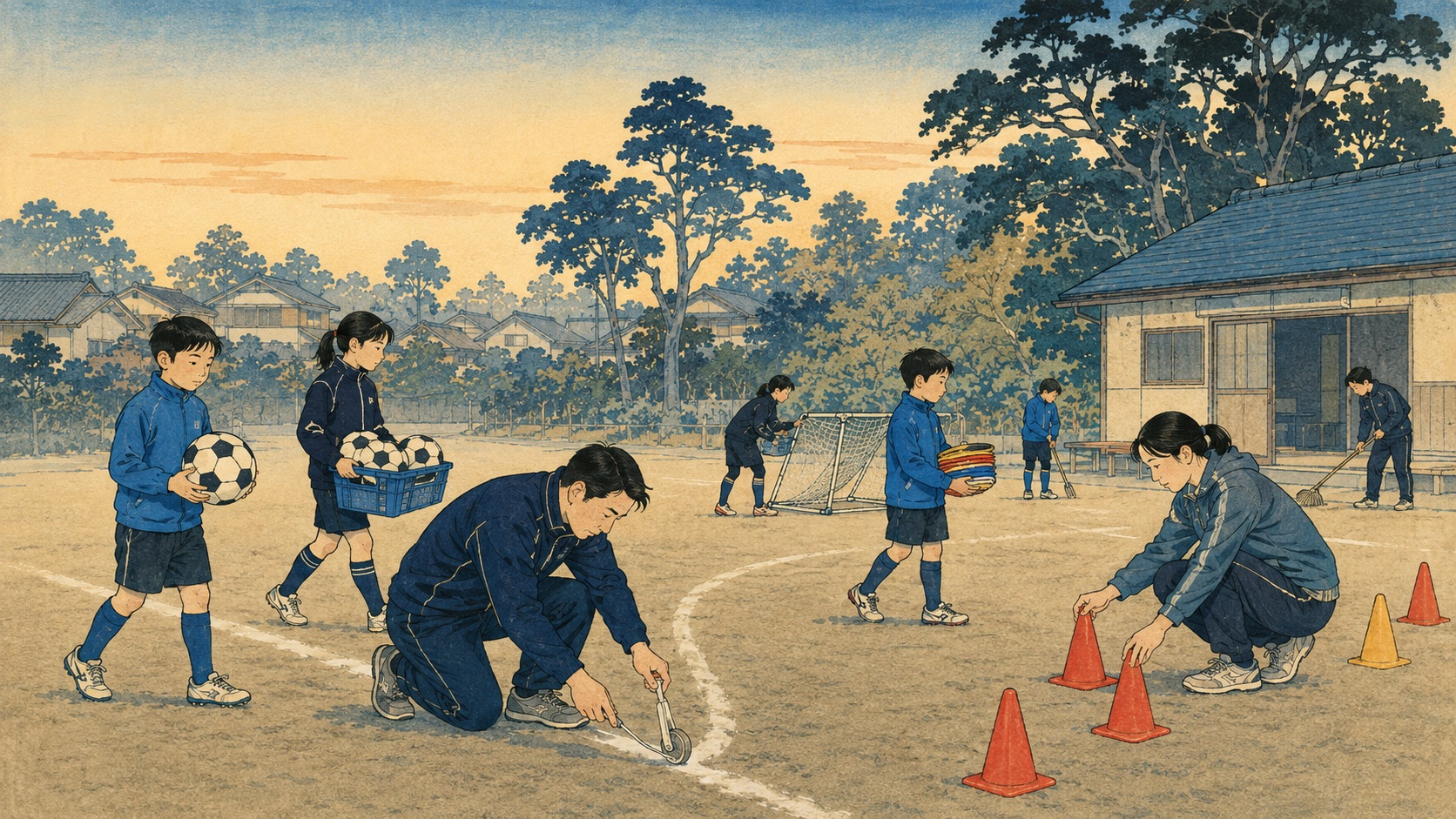
Local sport does not begin when the whistle sounds. Someone opens the equipment room. Someone checks the roster. Someone draws the white line. Beside that person, a child places a cone and starts a hometown game with their own hands. If rescue is possible, it begins in that quiet preparation.
- Sasakawa Sports Foundation: a parent–child option for local volunteering (August 14, 2026). Marugame program, participant comments and survey.
- Statistics Bureau: 2021 Survey on Time Use and Leisure Activities. National and age-group volunteer participation.
- Statistics Bureau: English summary of the 2021 survey. The 17.8 percent rate and change from 2016.
- Sasakawa Sports Foundation: Sports-Life Data 2024. Adult sports-volunteer rate.
- Sasakawa Sports Foundation: sports volunteering. Activity types and annual frequency.
- Sasakawa Sports Foundation: sports volunteers as community mutual aid. Case research across six organizations.
- activo parent–child summer volunteer analysis (July 15, 2026). The 447 listings and topic ranking.
- Japan Sports Association: Japan Junior Sports Clubs overview. Founding year, groups, members and purpose.
- Japan Sports Agency: comprehensive community sports clubs. Definition and development since 1995.
- Japan Sports Agency: fiscal 2025 community-club development. Club totals, inactive clubs and municipal coverage.
- Japan Sports Agency: community-club trend, 2002–2025. Annual development count.
- Statistics Bureau: Japan’s child population (May 4, 2026). Under-15 population and share.
- Japan Sports Agency: guide to creating and operating community club activities (March 2026). Population, governance, safety and recognition.
- Japan Sports Agency: new guidelines for school-club reform (December 2025). The implementation period beginning in 2026.
- Sasakawa Sports Foundation: school-club reform from the parent’s perspective. Expectations and concerns.
- Sasakawa Sports Foundation: parental involvement and burden in elementary sport (2021). Mother–father differences.
- Sasakawa Sports Foundation: who supports children’s sport?. Household income, parental burden and access.
- Sasakawa Sports Foundation: Japan’s parental “tea duty” in perspective. The problem of semi-compulsory labor.
Editor’s note: Marugame’s post-event survey had ten respondents and cannot establish national representativeness, causation or long-term return. activo analyzed listings, views and applications on its own platform; it was not a population survey. The 2021 government volunteer survey covered a pandemic-affected period. “Comprehensive community sports clubs” and “Japan Junior Sports Clubs” use different definitions and registration systems. “Rescue” in this article means combining an optional entry route with sustainable operating infrastructure—not replacing paid work with unpaid family labor. Public information was checked through August 17, 2026 at 4:29 AM JST. The currency display is the editorially supplied value.