Not a huge news day. Good.
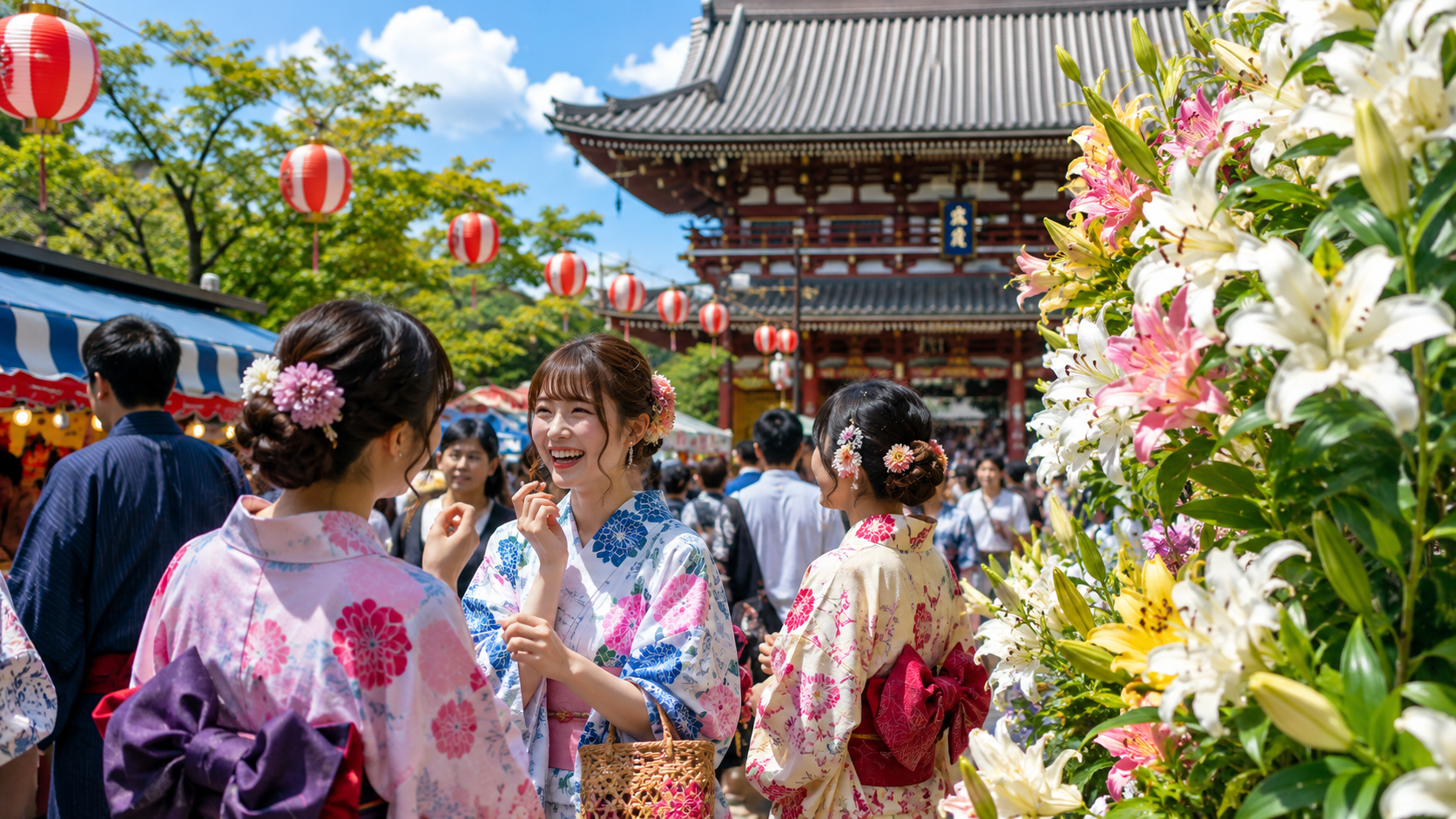
On Sunday, June 21, small pleasures light up the map of Japan. In Himeji, people in yukata walk through the old castle town. In Nagano, lilies of the valley spread across a mountain meadow like tiny white bells. In Kyoto, Tō-ji Temple’s Kōbō market opens again, and somewhere a visitor will stare at an old bowl, decide it has “a feeling,” and carry it home despite having no cabinet space and no plan.
The charm of this day is not its importance. It is almost the opposite. Politics, currency, heat waves and energy security matter. But human beings are also sustained by the smell of festival food, the scent of alpine flowers, the dust of old tools and the strange happiness of walking in a crowd where everyone has decided, for one evening, that sleeves should be decorative.
June 21 is also the summer solstice. The day is long. So are the excuses. “I’m only going to look” can turn into street food, a gondola ride, a second-hand kimono, a plant, and a mysterious ceramic object that appears in your luggage with the moral confidence of a rescued animal.
Himeji Yukata Festival: when the castle town becomes summer
Visit Himeji says the 2026 Himeji Yukata Festival will be held on Saturday, June 20, and Sunday, June 21, from 4:30 PM to 9:30 PM. The venue area includes Osakabe Shrine, Jonan Park and the Nishi-Nikaimachi shopping street, with traffic restrictions planned from 4:00 PM to 10:00 PM. In other words, this is not an event to attack by car. It is an event to approach by train, foot and patience.
The festival’s special appeal is that the yukata itself becomes the star. Many Japanese summer festivals include yukata, but in Himeji the garment is almost a ticket of participation. Himeji’s tourism information notes that visitors wearing yukata can enjoy benefits such as free admission to Himeji Castle and nearby facilities and half-price Shinki Bus fares. A yukata is therefore not only cool and photogenic. Under certain conditions, it becomes transportation policy.
Historically, the festival is tied to Osakabe Shrine and Himeji’s castle-town culture. Walk through the shopping streets, pass the stalls, and glimpse the white castle walls in the distance, and the event begins to feel less like a staged attraction than a town memory reactivated. Himeji Castle is the city’s grand daytime face. The yukata festival is its softer evening face.
The yukata: Japan’s cool formalwear for humid civilization
The yukata began as a simple garment connected with bathing and indoor relaxation, then developed into summer clothing for outings, festivals and hot-spring towns. It is less formal than a kimono, more ceremonial than a T-shirt, and exactly formal enough to make ordinary streets feel like part of the evening’s script.
There are practical complications. Your stride becomes smaller. The obi suddenly matters. Phone use becomes a sleeve-management exercise. If your geta are new, your feet may begin negotiations within 30 minutes. Still, people wear yukata because they transform the same old summer evening into something slightly theatrical.
Himeji understands that transformation. Castle, shrine, shopping street, stalls, families, couples, tourists and locals all enter the same seasonal frame. Add yukata and the city briefly becomes the cover image of summer.
Fujimi Panorama Resort: the flowers are tiny, but they have numbers
On the same Sunday, Fujimi Panorama Resort in Nagano marks the final day of its 1.2 Million Lily-of-the-Valley Festival. The resort lists the 2026 festival period as May 23 through June 21. A gondola carries visitors to the 1,780-meter summit area, where 200,000 European lilies of the valley bloom near the gondola station and another 1 million Japanese lilies of the valley can be found at Nyukasa Marsh, about a 10-minute walk away.
Lilies of the valley are not flamboyant flowers. They do not send the entire country into cherry-blossom logistics mode. They do not face the sun like sunflowers with executive confidence. They are small, white and downward-looking. But in numbers, they are powerful. One flower is modest. 1.2 million flowers is a committee.
JapanGov has highlighted the Fujimi Panorama Resort event as part of the spring beauty of the Chubu region, noting the gondola ride, 1,780-meter elevation and the mountain setting. The experience is the opposite of a humid city afternoon. At that altitude, even the air seems to have gone to school.
Lilies and mountain time
The Nyukasa area is not only about flowers. From the 1,955-meter summit, clear days can bring views of Mt. Fuji, the Yatsugatake Mountains and the Southern Alps. Of course, mountain weather does not read human itineraries. Clouds happen. Wind happens. Wet paths happen. That is part of why flower travel asks for humility.
Lilies of the valley also carry an interesting contradiction: they look delicate but are poisonous plants. They are the floral equivalent of someone who smiles gently in a meeting and then quietly controls the entire budget. Visitors should admire them, not pick them, and stay on protected paths.
The sensible kit is simple: walking shoes, water, a light layer, rain gear and enough time to slow down. Lilies of the valley are not flowers to rush past. They are flowers to crouch for. Your knees may complain; consider it fieldwork.
Tō-ji’s Kōbō market: Kyoto’s most dangerous “just browsing”
In Kyoto, Tō-ji Temple hosts its monthly Kōbō market. Kyoto City’s tourism information notes that Tō-ji was built in 796 to protect the new capital and was entrusted in 823 to Kōbō Daishi, the founder of the Shingon school of Buddhism. Its five-story pagoda is one of Kyoto’s great landmarks, and on the 21st of each month the grounds host a large market drawing vendors from across Japan.
Event listings for the Kōbō market show June 21, 2026 as one of the monthly dates. The market generally runs from about 7:00 AM to 3:30 PM, with some vendors opening earlier. Listings describe more than 1,000 stalls and crowds that can reach around 200,000 visitors. Calling this a flea market is technically correct but emotionally insufficient. It is a large-scale spiritual trial of appetite, curiosity and bag capacity.
The market’s danger is that you do not need anything. Then you see an old plate, a textile, a tool, a plant, a Buddhist object, a kimono, a toy, a mysterious metal fitting. Suddenly it is not shopping. It is destiny. Kyoto’s most dangerous phrase may be ichigo ichie — one time, one meeting — because it is excellent at loosening purse strings.
Kōbō Daishi and the 21st
The market’s monthly date is tied to Kōbō Daishi, also known as Kūkai, one of the most influential figures in Japanese Buddhism, calligraphy, education and religious legend. Tō-ji became a central Shingon temple, and the market grew on the foundation of an ennichi, a monthly holy day connected to a revered figure.
Temple markets preserve an older Japanese rhythm in which faith, commerce, food and local news shared the same ground. People came to pray, buy, eat, talk and gather information. Today, phones deliver information quickly, but markets still offer something algorithms do not: touch, bargaining, expression, texture, hesitation and the possibility of finding something nobody specifically recommended to you.
At antique markets, morning matters. Serious shoppers come early. By early afternoon, plenty remains, but some treasures have already left under the arm of someone who woke up with discipline. Kyoto may look calm in the morning, but in the world of antiques, whole battles can be over before lunch.
Can you do all three in one day?
In theory, with trains, stamina, luck and a flexible relationship with sanity, a person could attempt Himeji, Nagano and Kyoto in one day. In practice, no. Japan’s transportation system is excellent, but it does not make the human skeleton infinite.
For visitors already in Kansai, a morning at Tō-ji’s Kōbō market followed by an evening at the Himeji Yukata Festival is realistic. But carrying antique ceramics through a yukata crowd will make you question your life strategy. Nagano’s lily-of-the-valley festival deserves its own morning or day, especially because the highland setting is the point.
The right way to enjoy June 21 is to choose. Flowers, festival or market. Whichever one you choose, you may regret missing the others. That is fine. Regret is how Japan convinces people to come back.
Japan as weekend culture
Japan’s appeal is not only Mt. Fuji, Kyoto, sushi, anime and hot springs. It is also the density of small Sundays. Local festivals, highland flowers, temple markets, shopping streets, food stalls and seasonal clothing form a cultural layer that is easy to miss if travel is only planned around famous names.
At the Himeji Yukata Festival, clothing and castle-town memory meet. At Fujimi Panorama Resort, flowers and altitude pull visitors away from city humidity. At Tō-ji’s Kōbō market, temple space, commerce and ordinary human acquisitiveness coexist peacefully under the pagoda.
June 21 may not be a headline that shakes the nation. It does not need to be. It is enough that Japan offers a Sunday of sleeves, flowers and old objects; of street food, mountain air and market temptation. Small joys are durable. Even when the big world is noisy, people still return to the evening stall, the morning market and the flower that asks them to bend down.
- Himeji Yukata Festival is an evening event; use public transportation and expect traffic restrictions.
- If wearing yukata, choose footwear you can actually walk in.
- Fujimi Panorama Resort is highland terrain; check weather, gondola operations, paths and layers.
- For Tō-ji’s market, morning is best. Bring cash, coins and a tote bag.
- Late June means both heat and rain. Carry water, shade and rain protection.
Sources and reference
This article is based on public information from Visit Himeji, Kyoto City Tourism Association, To-ji-related market listings, Fujimi Panorama Resort, JapanGov and event calendars. Dates, traffic restrictions, gondola operations, stall numbers and weather-related changes should be checked before travel.