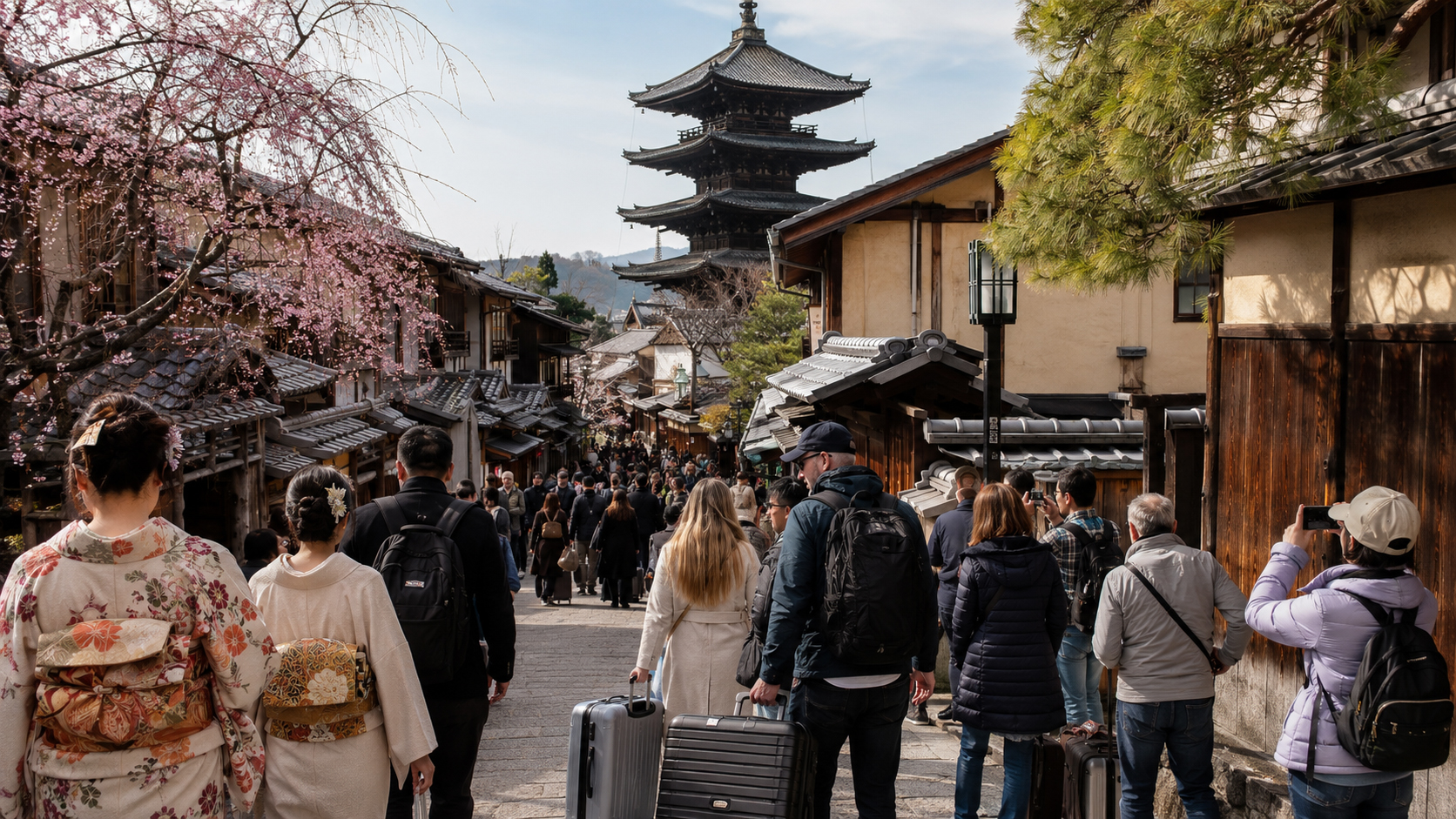
Visitors fell a little. So Japan must feel empty? Please report to Kyoto Station for correction.
Tourism statistics have a sense of humor. Japan received an estimated 3,559,900 foreign visitors in May 2026, down 3.6% from a year earlier, according to the Japan National Tourism Organization. On paper, that sounds like a cooling boom. On the ground, the bus stop in Kyoto, the lanes around Sensoji, the Shibuya crossing, the camera-famous corners around Mount Fuji, and the oversized luggage space on the Shinkansen appear not to have received the memo.
This is Japan’s 2026 visitor paradox. Foreign arrivals are down slightly from last year’s overheated pace, but they remain historically high. More importantly, people do not distribute themselves evenly across the archipelago like polite spreadsheet cells. They gather in a handful of dream images: Tokyo, Kyoto, Osaka, Nara, Mount Fuji, Shirakawa-go, Kanazawa, Hokkaido snow, Okinawa sea. Travelers are free, but many of them are freely choosing the same five sidewalks.
There is another reason the country still feels crowded: the pressure is not only inbound. The weak yen makes Japan look cheaper to foreign visitors, but it makes overseas travel painfully expensive for many Japanese residents. So more Japanese people travel inside Japan. The result is a double booking of the national imagination. Foreign tourists come in because Japan is a bargain; Japanese travelers stay in because abroad looks like a luxury department store with the prices moved upstairs.
Reading the May number: softer, not weak
JNTO says May arrivals reached 3,559,900, down 3.6% year on year. May sits between cherry-blossom season and the summer holiday rush, so some cooling is seasonal. The agency also cited reduced flights in some markets. But the same release noted that 19 markets, including South Korea, Taiwan, the United States and Malaysia, posted record May figures; India and the Middle East reached single-month records.
So this is not a simple “tourism slump” story. The total is down, but several markets remain strong. Weakness in some segments, including China-related demand, can pull down the headline while other regions keep expanding. Japan’s inbound economy is no longer explained by one national market or one style of group tour. Many small rivers from around the world now flow toward the same narrow Kyoto street. From the street’s point of view, the nationality of the shoes matters less than the number of shoes.
| Signal | What the data says | What residents feel |
|---|---|---|
| Down 3.6% | The 2025 peak has cooled somewhat | Popular areas still feel crowded |
| About 3.56 million visitors | Monthly arrivals remain historically high | Stations, hotels, buses and restaurants stay under pressure |
| 19 May records | Demand is becoming more diverse | Multilingual, not just English, support matters |
| Domestic travel pressure | The weak yen discourages some overseas trips | Japanese and foreign travelers compete for the same rooms and trains |
This crowd is also the success of a national project that began two decades ago
Japan’s tourism boom did not happen by accident. In the early 2000s, the country began pushing the idea of becoming a “tourism nation.” Japan had long been better known as a country that exported cars, electronics and capital, while its own citizens traveled abroad. But as population decline, regional stagnation and industrial competition intensified, attracting foreign visitors became a national economic strategy.
In the early years, inbound numbers were modest compared with today. International flights were fewer, multilingual signs were thinner, and cashless payment was not the friendly traveler’s companion it has become. Then came visa easing, low-cost carriers, social media, anime and food culture, a rising Asian middle class and the weak yen. Japan changed from a once-in-a-lifetime destination into a repeat destination.
That is policy success. Tourism created jobs, filled hotels, supported railways and restaurants, and gave some rural areas a reason to restore old houses and promote local food. But success has a tax. Residential streets become photo routes. Fuji viewpoints become queueing machines. Hotel prices move beyond the reach of some locals. Tourism can be economic medicine, but too much in the wrong place gives the town a stomachache.
The weak yen: a bargain for visitors, a warning label for residents
The yen is central to the story. For many foreign visitors, Japan still feels inexpensive relative to their home currencies. Meals, transport, convenience-store food, regional inns and even some city hotels can look like good value. That supports inbound demand.
For Japanese residents, the same currency move is much less fun. Overseas flights, fuel surcharges, foreign hotels and meals abroad all become heavier. A casual trip overseas starts to require a household committee meeting. JTB’s Golden Week forecast pointed to a rise in domestic travel and a preference for shorter, more budget-conscious trips. Japanese households are not simply choosing Japan because they forgot the world exists. Many are choosing Japan because the world has become expensive in yen.
That creates the paradox. Foreigners come because Japan is cheaper. Japanese residents stay because overseas travel is dearer. Kyoto, Hakone, Karuizawa, Sapporo, Fukuoka and Okinawa receive both streams at once. The hotel booking system does not care about macroeconomics. It just says “sold out.”
The Kyoto problem: when a city is too beautiful, the city gets tired
No discussion of overtourism in Japan can avoid Kyoto. Kyoto is not a theme park built for visitors. It is a living city with schools, hospitals, commutes, grocery runs and garbage collection days. But for the world’s travelers, Kyoto is a compressed file of “Japaneseness”: temples, shrines, lanes, maiko, machiya, maple leaves, matcha and bamboo. Everyone wants to unzip it at the same time.
The issue is not simply that travelers behave badly. Many visitors want to respect Japan. But maps, social media and recommendation engines route people to the same locations. Human beings think they are exercising free will, but sometimes they are standing in a line designed by an algorithm. On days when the bamboo grove contains more people than visible bamboo, the smartphone has won.
Kyoto does not need a politics of resentment. It needs better flow design: clearer rules, stronger public transport, taxes and fees that visibly support local life, time-slot reservations where appropriate, and serious promotion of less crowded districts. Kyoto is broad, but first-time tourist routes are narrow.
Regional dispersal is right. It is also hard.
Japan’s government and tourism industry want visitors to spread beyond the famous corridor. They are right. Japan is not only Tokyo, Kyoto and Osaka. It is Yamagata hot springs, Niigata sake towns, Fukui dinosaurs and temples, San’in mythology, Shikoku pilgrimage routes, Kyushu volcanoes, Tohoku festivals and Setouchi islands. Seeing only the Golden Route is like eating only the pickled plum from a bento and declaring that you understand Japanese cuisine.
But dispersal is not magic. It requires transport, hotels, multilingual support, evening food options, cashless systems, medical and disaster information, and trained local staff. A town may want visitors, but not a sudden human wave. Tourism must be channeled like water. In the right amount, it nourishes. In the wrong place, it floods.
And domestic travelers matter here too. If a weak yen keeps more Japanese households traveling inside Japan, regional destinations are not only receiving foreigners pushed away from Kyoto. They are receiving Japanese families, school trips, business travelers and event crowds as well. The rural ryokan owner is becoming less an innkeeper and more an air-traffic controller with tatami rooms.
Manners: often the missing ingredient is not language, but warning
Many tourism conflicts begin with ignorance rather than malice. Trash rules, temple photography, train etiquette, bathing customs, nighttime noise in residential streets, and large luggage on buses all require explanation. Japanese people also make mistakes abroad when they do not know the local rules. Humanity is only partially house-trained when traveling.
The answer is early, specific, multilingual guidance. Airports, hotels, booking sites, railway stations and attraction entrances should explain not only what is forbidden, but why. “Please be quiet” is less useful than “This street is residential; after 9 p.m., please lower your voice.” “Do not litter” is weaker than “There are no trash bins for the next 300 meters; please carry waste with you.”
Most visitors do not want to fail. They want to be told how not to fail. That kind of guidance works better than angry signs, especially when it arrives before the mistake.
Forgetting Japanese travelers distorts the debate
Overtourism debates often focus on foreigners because they are visible: big suitcases, unfamiliar languages, camera queues and group movement. But domestic travelers are a major part of crowding in Japan. Weekend Shinkansen trains, holiday highways, hot springs, theme parks, fireworks festivals, summer events and autumn foliage sites are filled with Japanese travelers too.
In a weak-yen year, domestic travel becomes even more important. This is not bad. Japanese people traveling inside their own country support regional economies and rediscover local culture. But if policy and media talk only about foreigners, the diagnosis becomes wrong. Crowding is produced by timing, place, transport, hotel capacity, prices, social media, school holidays, national holidays and exchange rates. Nationality is only one variable.
The Kyoto bus is not crowded only because of the world. It is crowded because human beings, from everywhere, want to be in the same beautiful place at the same convenient time. This is a tourism problem, but it is also a species problem.
What Japan should do next
Japan has succeeded at increasing visitor numbers. The next stage requires a broader scorecard: local benefit, resident comfort, environmental load, cultural protection and transport capacity. Tourism revenue matters. For some regions, it is a lifeline. But if residents cannot live comfortably, the destination’s charm begins to erode.
There is no single solution. Popular sites need reservations, time-based pricing, local taxes, mountain or site fees, bus expansion and pedestrian flow management. Regional destinations need multilingual signs, secondary transport, trained guides, disaster information and easier payment systems. Travelers need to spread out by season, hour and location; pack lighter; respect residential streets; and carry trash when bins are not available.
Japanese travelers are part of that solution too. If domestic travel rises, Japanese residents are not only victims of crowding; they are participants in it. The weak-yen era makes domestic travel rational. It can support rural Japan. It can also crowd it. Tourism is not just a foreigner problem, not just a government problem, and not just a Kyoto problem. It is a problem created every time all of us choose the same weekend.
Conclusion: the boom has not ended. It has changed shape.
The May 2026 decline in foreign visitors does not mean Japan’s tourism boom is over. It means the boom has entered a more complicated phase. China-related weakness, airline capacity, the weak yen, domestic travel, regional dispersal, resident fatigue, spending quality and hotel prices are all moving at once.
Why does Japan still feel crowded? Because the answer no longer fits in one sentence. Foreigners are still coming. Japanese residents are traveling at home. The yen is weak. Social media pushes everyone toward the same views. Regional Japan has room, but not always infrastructure. Popular places earn money, but residents pay in patience.
Tourism is one of Japan’s great growth industries. It can help regions survive. But tourist sites are not stage sets. They are places where people live. The street a traveler calls “Japan” may be someone else’s route home. Whether those two uses can share the same narrow road is the next test of Japanese tourism.
- May 2026 inbound arrivals fell 3.6% year on year to 3,559,900, but remained historically high.
- JNTO reported record May arrivals from 19 markets, showing that the slowdown is uneven.
- The weak yen makes Japan attractive to foreigners while making overseas travel expensive for many Japanese residents.
- Crowding is caused by foreign arrivals, domestic travel, holidays, social media, transport limits and hotel prices together.
- Japan’s next tourism strategy must focus on quality, dispersal, resident life and infrastructure, not only visitor totals.
Sources and notes
This article is based on JNTO, Japan Tourism Agency, JTB-related travel reporting, travel industry statistics, and 2026 currency and domestic travel trends. Preliminary estimates may be revised.