The solstice is beautiful, but it is also a warning
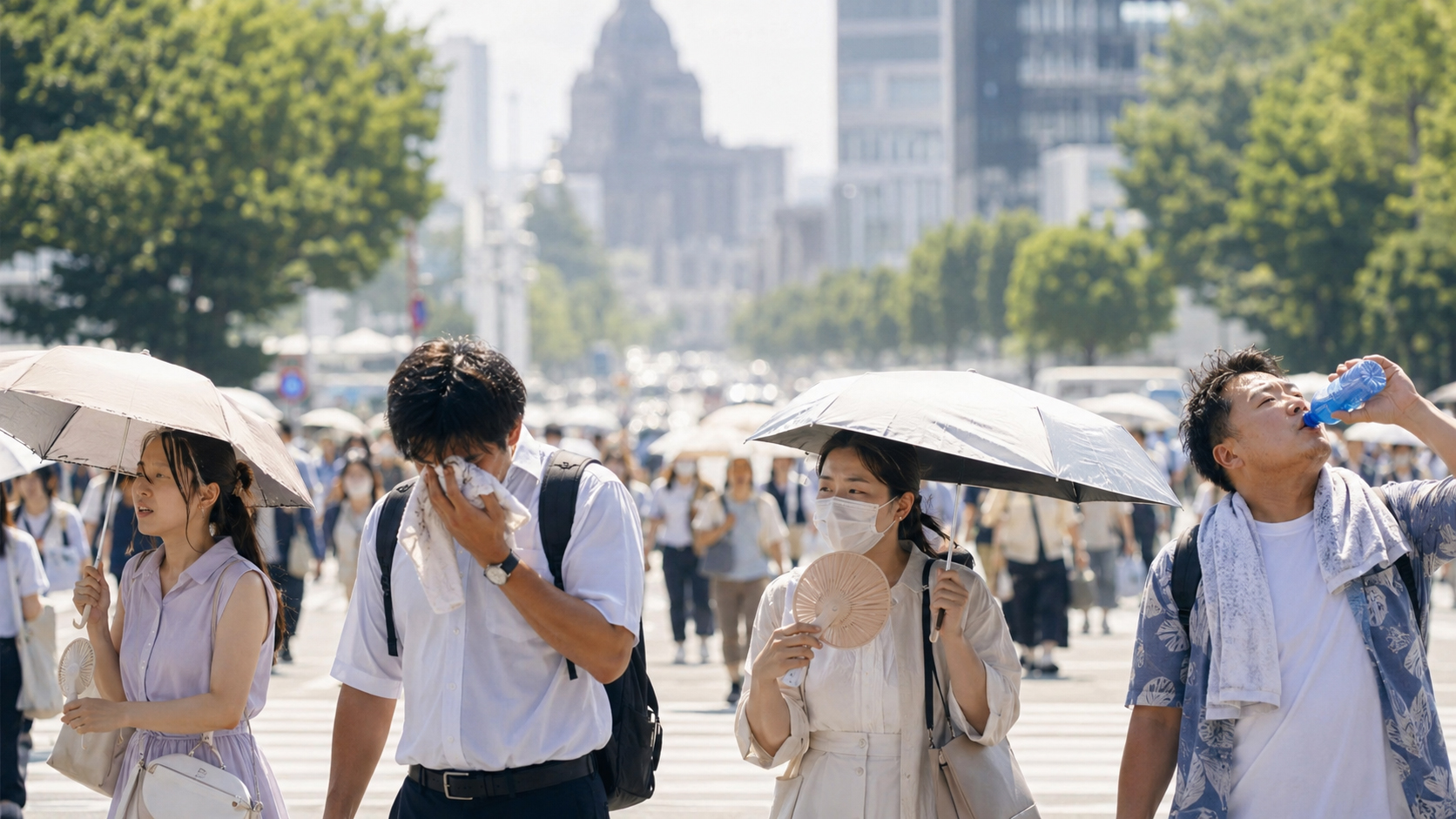
On June 21, Japan reaches the summer solstice. In older language, it is a poetic marker: the longest day, a full measure of light, the turning point into high summer. In modern Japan, it is also a public-health signal. Long daylight, humid air, asphalt streets, crowded trains, outdoor work, older housing and heavy tourism now combine to make summer heat one of the country’s serious seasonal risks.
The summer of 2026 is already carrying warning signs. The Japan Weather Association has said temperatures from June through August are expected to be above normal over a wide area of the country, with a strong Pacific high likely to extend over Honshu. Once the rainy season breaks, Japan may move quickly into the heart of summer heat.
This year’s word is kokushobi, written 酷暑日: a “severe heat day” or “brutally hot day.” In April, the Japan Meteorological Agency decided to use the term for days when the maximum temperature reaches 40°C or higher. Japan already had moshobi, or “extremely hot day,” for 35°C and above. But recent summers have pushed beyond that language. The weather vocabulary had to be updated because the climate reality had already changed.
A new Japanese word for a new level of risk
Kokushobi matters because it is more than a meteorological label. The JMA created the term after public input and expert views, responding to the reality that 40°C temperatures are no longer unimaginable outliers. Naming a danger is one way of making society see it.
Japan’s weather words have always blended science and daily life. Manatsubi, moshobi, nettaiya: hot days, extremely hot days, tropical nights. These are not only numbers. They shape laundry, commuting, school sports, farm work, festivals, home visits and family routines. Now kokushobi joins that list. Forty degrees has entered the calendar.
The change in language shadows a change in climate risk. Japan has always had humid summers, but the new heat is not something that can be handled with nostalgia, stoicism and a glass of barley tea. Traditional habits still matter. Parasols, fans, water, shade and seasonal awareness all help. But today’s summer also requires WBGT monitoring, air-conditioning, labor rules, neighborhood checks on elderly residents, shaded cities and clear public-health communication.
Japan’s heat cannot be measured by temperature alone
The danger of Japan’s summer is not simply the number on the thermometer. Humidity makes it harder for sweat to evaporate, reducing the body’s ability to cool itself. Japan’s Ministry of the Environment uses WBGT, or Wet Bulb Globe Temperature, as a heat-stress index. It combines air temperature, humidity and radiant heat to estimate what the human body is actually experiencing.
A heatstroke alert is issued when WBGT is expected to reach 33 or higher. For exercise, WBGT of 31 or above is categorized as “danger,” where exercise should generally be stopped except in special cases. That means looking only at the forecast high can be misleading. A school field, black pavement, windless station plaza or festival crowd may feel far hotter than a single air-temperature figure suggests.
For travelers, the lesson is direct. A Kyoto temple route, a Tokyo shopping district, a walk through Osaka, a Kamakura slope, or a “cool-looking” mountain town can become draining when queues, stone surfaces, sun exposure and humidity combine. Summer travel in Japan is no longer about how many sights can be packed into a day. It is about how intelligently rest can be built into the day.
Heatstroke is not only an outdoor disaster
When people imagine heatstroke, they often picture a sports field, a construction site or a person collapsing in direct sun. Those settings are indeed dangerous. Outdoor workers, security staff, delivery workers, farmers, school athletes and festival staff all face serious exposure. But medical and public-health experts repeatedly emphasize another risk: heatstroke inside the home, especially among elderly people.
The Health and Global Policy Institute has noted that heatstroke-related deaths in Japan reached a record 2,033 in 2024. Many fatal cases occur indoors, particularly among older people and people living alone. Some do not use air conditioning because they worry about electricity bills. Some do not feel the heat clearly. Some have no one checking on them. Small, ordinary circumstances can become fatal in a hot room.
Heat does not smash windows like a typhoon or shake buildings like an earthquake. It accumulates quietly. It remains at night. It disrupts sleep, speeds dehydration and weakens judgment. That quietness is what makes it dangerous. Invisible disasters are easy to postpone until the ambulance has already been called.
The business of staying cool
Companies are treating heat as a market as well as a hazard. Jiji/Nippon.com has reported that clothes with cooling functions and portable multi-function fans are drawing attention, based on Rakuten Ichiba purchasing data. On June 5, a Tokyo exhibition of products for extreme heat featured 29 companies.
The important point is that cooling products are moving from novelty to infrastructure. Neck coolers, fan jackets, heat-shielding materials, parasols, cooling towels, insulated bottles, monitoring sensors and devices that show heat-stress risk are becoming normal in commuting, outdoor work, school life, tourism and elder care.
But products cannot solve the whole problem. A portable fan is not the same as public shade. A cooling vest is not the same as a safer work schedule. A cold towel is not the same as a city designed for heat. As heat adaptation becomes commercialized, there is a risk that social responsibility will be hidden behind shopping choices.
Summer labor is changing
Some of the hardest summer environments in Japan are construction, delivery, security, agriculture and road work. Outdoor labor must now be managed through work hours, rest intervals, shade, water, salt intake, clothing, health checks and emergency response. Heat is not a test of endurance. It is a workplace risk.
Companies have increasingly adopted fan jackets, cooling helmets, misting systems, air-conditioned rest spaces and earlier work starts. But smaller firms and subcontracted worksites may face uneven protection. Heatstroke is often treated as an individual health event, but it is also a question of workplace design, budget, supervision and training.
For an aging, labor-short Japan, heat adaptation is also economic policy. If workers collapse, construction stops. If delivery workers cannot safely work, logistics slow. If farmers cannot harvest, food supply suffers. Kokushobi is not only a weather word. It is a productivity word.
Heat as a weak point in tourism
Inbound tourism has become a major part of Japan’s economy, but summer heat is a vulnerability. Foreign visitors may not be prepared for Japanese humidity. They climb station stairs with luggage, stand in temple lines, hunt for shade, buy water at convenience stores and quietly abandon half their itinerary by mid-afternoon.
Tourism operators and local governments can do much more: shade, water stations, benches, air-conditioned rest areas, multilingual heatstroke warnings, crowd information, early-morning and evening itinerary suggestions, and better links between outdoor attractions and indoor relief. In places such as Kyoto, Tokyo, Osaka, Nara and Kamakura, heat adaptation is no longer merely hospitality. It is tourism infrastructure.
Summer festivals may also need to change. Hours, emergency services, stall placement, yukata movement routes, elderly participation and child safety all need heat planning. Preserving summer tradition may require changing how summer tradition is staged.
Electricity, household budgets and the air conditioner
Extreme heat raises power demand. Air conditioning saves lives, but electricity costs burden households. When those two facts collide, the weakest residents are often at greatest risk. Some elderly people limit cooling because of cost. Some low-income households rely on old, inefficient units. Some rental homes have poor insulation and do not cool down at night.
Japan cannot leave heat safety to individual caution alone. Options include insulation retrofits, public cooling shelters, targeted electricity support, neighborhood check-ins, school and workplace schedule changes, urban greening and heat-reflective surfaces. All cost money. All require political choices.
Heat is both a weather phenomenon and a mirror of social inequality. The same 40°C day does not mean the same thing to everyone. It feels different in a shaded house than in a poorly insulated apartment, in a flexible job than in outdoor shift work, with money for cooling than without it.
Updating Japan’s summer common sense
Japan’s summer has long been described through wind chimes, shaved ice, fireworks, yukata, cold noodles, cicadas and evening festivals. Those images still matter. They are part of the country’s seasonal beauty. But the 21st-century summer also includes WBGT, heatstroke alerts, cooling shelters, fan jackets, school activity limits and heat-aware tourism planning.
“We survived without air conditioning in the old days” is no longer safe advice. Cities are hotter, the population is older, nights cool down less reliably and humidity remains punishing. The old summer and the new summer may share a name, but they are no longer the same creature.
On the solstice, the sun is high. Japan’s summer is still beautiful: sea, mountains, festivals, fireworks, yukata, cold tea, cold noodles and cicadas. But enjoying it now requires taking heat seriously. Kokushobi is not only a word to fear. It is a word to prepare by.
- Check WBGT and official heatstroke alerts, not just the maximum temperature.
- Plan sightseeing for morning and evening; do not overload the hottest part of the day.
- Older people, children, people with health conditions, outdoor workers and travelers need special caution.
- Indoor heat can be dangerous; monitor nighttime room temperature, humidity, hydration and air-conditioner use.
- Cooling gadgets help, but they are backup. The real protections are rest, shade, cooling, water and schedule changes.
Sources and reference
This article is based on public information from the Japan Meteorological Agency, Ministry of the Environment, heat-illness prevention authorities, Jiji/Nippon.com, the Japan Weather Association, the World Economic Forum and health-policy sources. Heat alerts, product availability and forecasts change quickly; readers should check official information before travel or outdoor work.
- Japan Meteorological Agency: new name for days of 40°C or above
- Japan Weather Association: Summer 2026 Weather Forecast for Japan
- Nippon.com/Jiji: Japanese Firms Launch New Items to Address Heat Wave
- Ministry of the Environment: WBGT Guideline
- Ministry of the Environment: Heat Stroke Alert
- Health and Global Policy Institute: Heatstroke mortality and public health
- World Economic Forum: How Japan is preparing for extreme heat in summer 2026