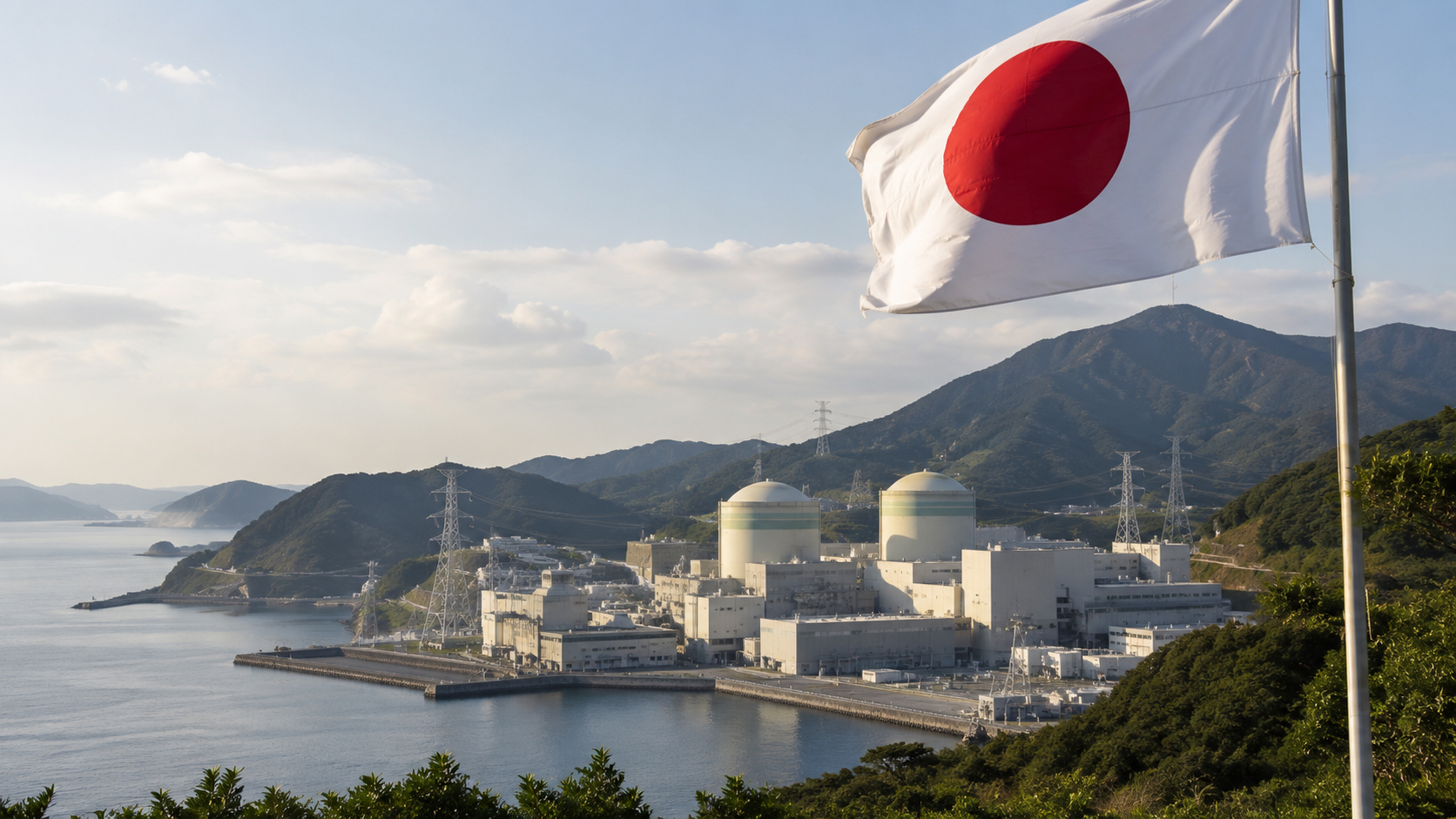
Japan’s nuclear debate has moved beyond restart
For more than a decade after Fukushima, the central word in Japan’s nuclear debate was “restart.” Existing reactors had been shut down after the 2011 disaster. Each plant then had to pass new safety reviews, build new counter-terrorism and emergency facilities, secure local support and survive a politics of deep public distrust.
Now the word is changing. The Ministry of Economy, Trade and Industry has outlined a roadmap for replacing aging reactors: two to five by the 2040s and as many as 11 to 14 by the 2050s. Reuters reported that Japan’s power industry welcomed the proposal as necessary to preserve nuclear workforces and supply chains, while also calling for stronger policy support to make investment possible.
This is not merely another restart story. It is a decision about whether post-Fukushima Japan will once again plan to be a country that builds nuclear reactors. That makes the roadmap both an energy document and a social contract.
Why now: the clock on aging reactors
Nuclear plants carry clocks inside them. Equipment ages. Components become harder to source. Workforces retire. Emergency standards change. Seismic and tsunami assumptions are updated. Anti-terrorism facilities must be added. Even with policy that can extend operating lifetimes from 40 to 60 years, time cannot be bought forever.
Energy-policy analyses have warned that a significant amount of Japan’s existing nuclear capacity will approach lifetime limits before mid-century. Reuters has reported that ministry materials point to large amounts of nuclear capacity reaching operational limits by 2050, while the new roadmap says replacement will be needed to preserve stable supply.
So the replacement debate is not only a pro-nuclear wish list. It is also the mathematics of aging infrastructure. If old reactors leave the system, Japan must fill the gap with renewables, storage, fossil fuels, demand reduction, new nuclear reactors or some combination of all five. The longer the country waits, the fewer realistic options it has.
Fukushima is not a footnote
The March 11, 2011 earthquake, tsunami and Fukushima Daiichi nuclear disaster remade Japanese energy policy. Before the accident, nuclear power was a pillar of electricity supply. After it, reactors across the country were shut down, the regulatory system was rebuilt, and public trust collapsed.
Fukushima is not just an event in the past. It remains a living policy fact: evacuation, decommissioning, contaminated water, decontamination, compensation, reputational damage to farms and fisheries, community division, and the question of who is allowed to say “safe.” Any serious discussion of new reactors must begin there.
When the government or utilities describe next-generation reactors as safer, residents do not hear only technical specifications. They ask who evacuates, who decides, who loses land, who pays, who bears responsibility, and what happens when the improbable becomes real. Without answers to those questions, a nuclear rebuild can advance on spreadsheets while failing in society.
Energy security: Hormuz and nuclear power share the same map
Japan’s renewed nuclear push is inseparable from energy security. The war in Ukraine, LNG price shocks, the weak yen, Middle East tension and shipping risk through the Strait of Hormuz all point toward the same vulnerability: Japan buys most of its energy from abroad.
Thermal power is flexible, familiar and essential, but it is tied to fuel imports, global commodity prices and maritime routes. If Middle Eastern shipping is disrupted, insurance costs, fuel prices and power-generation costs can all move. Electricity appears to come from a wall socket. Behind it are tankers, foreign exchange markets and geopolitics.
Nuclear power offers a different proposition. Uranium is imported, but in small volumes. Fuel can be stored more easily than oil or LNG. Nuclear plants emit little carbon while generating electricity. That is why the government and utilities see nuclear as serving both energy security and decarbonization. But those advantages do not erase the problems of safety, waste, cost and consent.
Decarbonization: can renewables do it alone?
Japan’s latest energy plan points toward a 2040 electricity mix in which renewables supply 40% to 50% and nuclear around 20%. Reuters has reported that the plan reflects rising power demand from semiconductor factories, data centers and electrification, as well as the need to cut emissions.
Expanding renewables is essential. Solar, offshore wind, onshore wind, hydro, geothermal, biomass, grid reinforcement, batteries and demand response all matter. But Japan has limited flat land, complicated grid constraints and a power system built around regional utilities. Solar produces most during the day; wind varies; storage is improving quickly but requires vast investment to manage national and seasonal variability.
Supporters of nuclear power see it as stable, low-carbon baseload electricity. Opponents point to long construction times, cost overruns, waste, accident risk and the danger of diverting investment away from renewables and efficiency. Neither side can win with slogans. Japan’s electricity demand may rise sharply, and a low-carbon grid must be reliable in summer heat, winter cold, typhoons and industrial peaks.
Why utilities welcome the roadmap: skills and supply chains
Utilities are not welcoming the roadmap only because they want more generation. Nuclear power is a large ecosystem of skills: welding, forging, pressure vessels, pumps, control systems, radiation management, fuel, maintenance, emergency planning, regulation, decommissioning and public communication.
If there is no credible future for new nuclear construction, workers leave, suppliers exit, factories repurpose equipment and expertise fades. Nuclear is not an industry that can be restarted casually after a long pause. It is built over decades.
That is why the industry wants clear policy signals. A replacement roadmap tells manufacturers, engineers and financiers that there may be work beyond maintenance and decommissioning. Without that signal, investment dries up. Without investment, the supply chain that Japan says it needs may not exist when it is needed.
The money question: who carries the risk?
Replacing nuclear reactors means confronting cost. Next-generation reactors may have stronger safety systems, but construction is expensive and slow. Regulation, local consent, legal risk, decommissioning costs and spent-fuel management add further uncertainty. A private utility balance sheet cannot easily absorb all of that risk alone.
That is why the industry is asking for stronger policy support. Support can mean more than subsidies. It can include long-term contracts, capacity-market design, government guarantees, financing frameworks, regulated returns, risk-sharing mechanisms and predictable rules.
The political question is where the risk ultimately lands. On utilities? Investors? The government? Consumers through bills? Future generations through waste and decommissioning obligations? A reactor replacement plan is therefore also a national financial design.
Local consent is the hardest politics
In Japan, nuclear policy is not decided only in Tokyo conference rooms. It is decided in host towns, prefectural assemblies, fishing communities, emergency-planning zones, courtrooms and sometimes local elections. A reactor is not a dot on a national map. It is part of a lived region.
Replacing reactors at existing nuclear sites is more realistic than building on entirely new sites. Transmission lines, ports, industrial workforces and local tax arrangements already exist. But realistic does not mean easy. Decommissioning an old reactor, building a next-generation unit on the same site, updating evacuation plans and persuading residents all take time.
After Fukushima, Japan cannot assume that communities will accept national necessity as sufficient justification. Benefits and risks are unevenly distributed. The country may receive low-carbon electricity, but the host region carries the proximity risk. How Japan handles that asymmetry will determine whether the roadmap remains policy paper or becomes construction.
Spent fuel and final disposal: the back end cannot be postponed
Nuclear debates often focus on restarting or building reactors. But nuclear power has a back end: spent fuel, reprocessing, plutonium management, interim storage, final disposal and decommissioning. If those are left vague, opposition will grow stronger.
Japan has long pursued a nuclear fuel-cycle policy, but reprocessing and final repository selection have been difficult. Storage pools, dry cask storage, transport routes and geological disposal may sound technical, but they are central to public trust. A country cannot credibly promise a nuclear future while leaving the waste future unresolved.
The waste timeline is longer than elections, longer than corporate planning cycles and longer than most market forecasts. That is precisely why it must be treated as part of the main policy, not a separate problem for later.
Next-generation reactors are not magic
Government materials point toward next-generation advanced reactors at sites where operators have decided to decommission existing units. Such reactors may offer improved passive safety, better accident response, more efficient operations, lower waste profiles or more flexible output. Technologically, they matter.
But “next-generation” is not a magic phrase. Demonstration, regulation, standardization, supply chains, construction experience, insurance, financing and local consent are still required. A safer design still needs a credible evacuation plan, transparent oversight, public information and a clear answer about responsibility.
The quality of Japan’s nuclear reset will be decided not by the elegance of the concept but by the discipline of the details. Nuclear policy fails when it becomes allergic to details. Details are safety.
What Japan is really choosing
Japan is not choosing a future made only of nuclear power. It still needs a rapid expansion of renewables, stronger grids, more storage, deep efficiency, a narrower role for fossil fuels, industrial electrification and demand flexibility. The nuclear question is how much nuclear remains in that system, under what safety conditions, and with what social consent.
The replacement roadmap shows that Japan can no longer avoid the choice. Fukushima caution, climate urgency, fuel-import vulnerability, industrial competitiveness and regional trust must fit into one policy. That is difficult. But difficulty is not an excuse for pretending the choice does not exist.
Utilities may welcome the roadmap because it gives their industry a future. Whether society welcomes it will depend on something else: verifiable safety, honest accounting, credible waste policy, real local consent and a government willing to say not only what nuclear power can do, but what it will cost and who will carry the risk.
- Japan’s roadmap points to 2–5 reactor replacements in the 2040s and as many as 11–14 by the 2050s.
- The drivers are aging reactors, rising electricity demand, fuel-import risk and decarbonization targets.
- Fukushima’s legacy and local consent remain the biggest political challenges.
- Utilities want the roadmap because nuclear skills and supply chains cannot survive without future work.
- Spent fuel, final disposal and cost-sharing must be addressed directly for the reset to gain public trust.
Sources and reference
This article is based on Reuters reporting, Japan's Ministry of Economy, Trade and Industry / Agency for Natural Resources and Energy, World Nuclear Association materials, and energy-policy documentation. Reactor status, policy targets, costs and local consent may change.
- Reuters: Japan utilities welcome nuclear replacement targets
- Reuters: Japan proposes rebuilding ageing nuclear plants
- METI/ANRE: Outline of the Seventh Strategic Energy Plan
- METI/ANRE: Detailed outline of the latest Strategic Energy Plan
- METI/ANRE: The restart of nuclear power plants
- World Nuclear Association: Nuclear Power in Japan
- Reuters: Japan targets 40-50% renewable energy and 20% nuclear by 2040