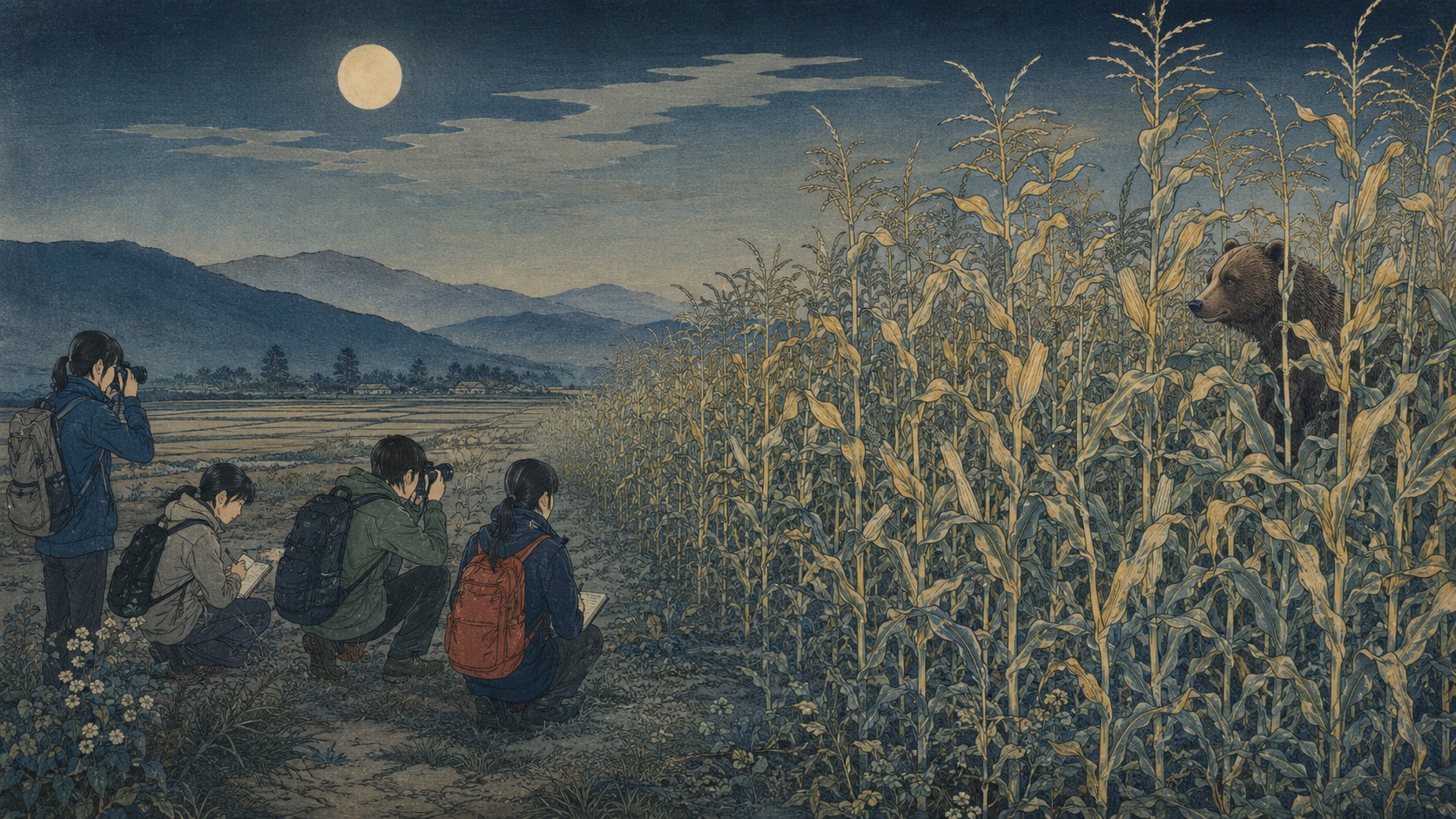
“Poi-poi!” The call carries through the brush at Hokkaido University’s Teshio Experimental Forest near Horonobe, not far from the island’s northern tip. It is not meant to summon a bear. Passed down through generations of the Brown Bear Research Group of Hokkaido University, it warns animals that people are present so that an encounter can be avoided. The students do not enter the forest to close in on bears for photographs. They walk fixed routes and look for tracks, claw marks, feeding signs and scat.
A new finding emerged from that unglamorous evidence. Naoki Kanasugi, a third-year doctoral student in Hokkaido University’s Graduate School of Science and a member of the student group, joined former veterinary professor Toshio Tsubota and nine other authors to analyze autumn diet data gathered from 2016 through 2021. Their paper appeared in the peer-reviewed journal Wildlife Biology on July 20.
The question sounds simple: Why does a Hokkaido brown bear enter a field of dent corn grown for livestock feed? Is it pushed out of the forest because the mizunara oak produced too few acorns? Or is it pulled toward farmland because an enormous quantity of concentrated food is available there? The study’s answer is both. Corn in the bears’ diet decreased as mizunara mast increased, and it increased when a larger area of corn remained unharvested.
A poor forest harvest—or a rich farm harvest?
Research into wildlife crop use often looks at only one side of the food landscape. One line of inquiry measures the “push” from nature: when nuts or berries fail, animals search for substitutes closer to people. Another measures the “pull” of agriculture: farms place dense, nutritious and predictable food within reach.
Earlier Hokkaido research had already shown that brown bears used more dent corn in poor mizunara years. But that pattern could not by itself separate scarcity in the forest from opportunity in the field. If a poor acorn year also happened to be a year in which harvest ran late and corn remained standing longer, either process—or both—could produce the same scat record.
Kanasugi’s team put the forest and farm on the same weekly calendar. Students measured the availability of mizunara acorns, hardy kiwi, crimson glory vine and Japanese rowan, then reconstructed the diet from scat. They also interviewed the enterprise growing corn near the study landscape and obtained harvest timing for 2018 through 2021. The area not yet harvested each week became an index of crop availability.
| Hypothesis | Prediction | What the data showed |
|---|---|---|
| Wild-food shortage alone | Crop use rises in poor mast years, but standing crop area adds no information | Mizunara mattered, but it did not explain the pattern alone |
| Crop abundance alone | Use rises with unharvested area, regardless of acorn production | Crop area mattered, but the rate of decline changed with mast |
| Push and pull together | Crop use is greatest when acorns are scarce and accessible corn is abundant | The best-supported account: the two food systems interacted |
Washing scat to reconstruct an autumn menu
Scat does not preserve a meal in its original proportions. Leaves, fruit, animal tissue and corn differ in digestibility. Researchers washed the collected samples, identified visible seeds, plant fragments, hair and bone, estimated their proportions with a point-frame method and applied correction factors so that conspicuous remains would not automatically be mistaken for most of the food consumed.
In the Teshio landscape, the leading autumn foods were dent corn, mizunara acorns, hardy kiwi and sika deer, in that order. Fish, crimson glory vine and Japanese rowan also formed principal categories. The menu changed with the week. “Autumn diet” was not a fixed property of the population but a sequence shaped by fruiting and harvest.
In the strong mizunara years of 2019 and 2021, acorns took a larger share as autumn progressed and corn use fell rapidly. In the poor mast years of 2016, 2017, 2018 and 2020, corn persisted longer. Bears ate corn before harvest even in good acorn years, while in poor years corn could continue to appear after harvest. The authors suggest that missed cobs, broken ears or spilled kernels may keep a commercially finished field ecologically open.
Nor did a poor acorn crop turn the bears into corn specialists. Hardy kiwi and sika deer tended to serve as alternative foods. That flexibility is one of the brown bear’s evolutionary strengths. It is also why a single explanation—and a single management tool—rarely solves conflict.
Dent corn is more than an accidental snack
Dent corn is not the sweet corn served at a summer table. It is grown largely for livestock feed, often across substantial fields. By autumn, energy-rich ears stand in a dense and predictable block. For a large omnivore trying to accumulate fat before hibernation, that can be more efficient than searching tree by tree. Tall stalks may also conceal an animal while it feeds.
Previous work showed the scale of that attraction. A 2005 examination of 556 bears killed in three Hokkaido regions between 1991 and 1998 found that crops represented 32% to 46% of late-summer stomach volume, depending on the region, with dent corn the leading crop. A 2006 study in Furano found crop remains in scat for longer from September into November during the exceptionally poor 1995 mizunara year.
The new paper does not overturn the shortage hypothesis. It completes it by adding what the farm offered and when. A bear responds not only to what is missing but to what is easy. If it receives a large reward without a serious cost, it can remember the route and repeat the behavior in another season.
That makes crop loss more than a balance-sheet problem. Successful feeding near farms can teach an animal to approach human-used space. But crop consumption is not itself a diagnosis of dangerous behavior. Managers still need separate evidence about the individual, its wariness, its approach to people and the immediate setting.
A 55-year-old student circle became a research instrument
“Bear Lab” is a convenient English nickname, but Hokudai Kumaken is not a formal university laboratory. It is a student circle founded voluntarily by Hokkaido University graduate and undergraduate students in 1970. At the time, brown bears attracted public attention but remained poorly studied, while policy aimed aggressively at reducing their numbers. The founders began with a youthful desire to see wild bears and soon expanded into sign surveys, interviews and translation of scientific literature.
Continuous work at Teshio began in 1975. Students spend one to two weeks walking across an experimental forest of roughly 225 square kilometers. Membership changes; the routes, notebooks, maps, definitions and safety practice pass forward. Bears live and reproduce on a time scale longer than a research grant or a doctoral enrollment. The organization graduates people every year without graduating the observation.
This is citizen science in a demanding form, not casual photo crowdsourcing. Teams move through brush, streams and forest roads, apply comparable definitions to field signs and carry samples back for analysis. Paper records were later digitized; university and research-institute scientists supplied statistical methods. The system depends on student autonomy as well as experimental-forest staff, local residents, alumni and faculty.
Safety is part of the protocol. Hokkaido University’s profile of the group says new members read the safety manual and learn to use bear spray before fieldwork. Nobody works alone. Teams enter after sunrise, avoid low visibility and turn back at a large fresh scat or sharply defined track. “Know the bear properly and fear it correctly” is not a slogan of intimacy. It is a rule for maintaining distance.
1966 Hokkaido begins a spring culling program, encouraging capture when tracks are visible on snow
1970 Graduate and undergraduate students form the Brown Bear Research Group
1975 Repeated field-sign monitoring begins at Teshio
1987–1989 Teshio monitoring pauses after signs become exceptionally scarce
1990 The old spring program ends amid concern about population decline
2021 Forty years of student records reveal decline during culling and recovery afterward
March 2026 A data paper preserves field signs recorded from 1976 through 2015
July 2026 Six years of diet data reveal the relative roles of natural food and crops
Footprints recorded the biological effect of policy
The student archive produced its first major scientific answer in 2021. Researchers applied a state-space model to scats and tracks recorded from 1975 through 2015. Detection rates fell by an average of 15% a year during the period of spring culling and had nearly vanished by the late 1980s. After the program ended, they rose by an average of 7% a year, indicating population recovery.
The original policy, launched by Hokkaido in 1966, encouraged capture in early spring when snow made tracks easier to follow. It was built to reduce the population and set no limits on total removals, area or females with cubs. Concern about decline led to its abolition in 1990. Modern early-spring capture is not the same system: it uses monitoring, regional and sex-specific limits, restrictions around family groups and a stated goal of maintaining skilled personnel.
Hokkaido’s model-based estimate rose from about 5,200 bears in 1990 to about 12,200 at the end of 2022. The exact number is uncertain, but distribution and overlap with human-used land expanded. In fiscal 2024, agricultural damage caused by brown bears reached a record of roughly ¥350 million, and dent corn accounted for about half. Recovery was a conservation achievement. It also created a new management era.
The power of the student record is that it observed policy before and after with comparable methods. Nobody designed a new survey after the outcome became visible. The footprints and scats came first; decades later, their pattern became legible. In March 2026, field signs from 1976 through 2015 were documented as a data paper in Ecological Research, making the architecture itself available to future researchers.
What “manage crop availability” means on a farm
Availability in ecology is not identical to planted acreage. In the statistical model, weekly unharvested area was the primary crop index. On an actual farm, two equally sized fields can present different opportunities. A functioning electric fence, a visible boundary and a clean post-harvest field can make food harder to reach even while the crop is physically present.
Hokkaido’s bear-response handbook places attractant removal, vegetation cutting, correctly maintained electric fencing, monitoring and shared reporting among the foundations of prevention. The new study sharpens the timing. Early September, before mizunara acorns fully mature, can make corn attractive whether the eventual mast year is rich or poor. In a poor year, protection may need to remain after the harvester leaves because residue can extend the reward.
| Management lever | How it changes a bear’s choice | Operational question |
|---|---|---|
| Electric fencing | Raises the cost and discomfort of reaching a high reward | Are voltage, vegetation contact and ground gaps checked through the post-harvest period? |
| Harvest and residue removal | Reduces both standing food and the reward left behind | Are edge rows, missed ears and spilled kernels removed quickly in poor mast years? |
| Edge clearing | Removes concealment on the approach | Does the forest–field boundary provide enough visibility for detection and deterrence? |
| Mast monitoring | Warns when pressure to substitute crops may be high | Can acorn forecasts trigger an earlier start and later end to protection? |
| Regional reporting | Prevents rewards simply shifting to the next unprotected field | Do farms, municipalities and researchers use the same incident and damage map? |
Prevention and capture answer different questions. Securing fields can reduce the recruitment of new crop-feeding animals. It does not determine the population a region can sustain or the emergency response to an animal that has lost fear of people. Capture alone leaves the next bear an unsecured reward. In 2024, Japan added most bear populations, including Hokkaido brown bears, to the category of Designated Wildlife Species for Control. Environment Ministry planning guidance was revised in 2026. Effective policy must operate at the field, the individual animal and the regional population simultaneously.
- Measure mizunara mast with the same method every year and share the forecast regionally
- Track crop maturity, residue, fence voltage and edge vegetation—not unharvested area alone
- Use DNA in scat to separate repeat visits by one bear from a population-wide shift
- Combine cameras and GPS with diet data to identify first-entry routes and timing
- Compare protected and unprotected fields before and after fencing or residue removal
What the study still cannot explain
This was an observational study. Researchers did not randomly assign bears to accessible and inaccessible fields. An association between unharvested area and corn in scat cannot reveal the exact percentage reduction produced by a particular fence design. Area also did not directly measure crop energy, ripeness, residue or bear-by-bear access.
The survey routes lay near an agricultural boundary and may capture stronger crop use than would be found among bears deeper in the forest. The scat analysis did not identify every individual, so repeated feeding by a few bears cannot be completely separated from a behavior spread across many animals. Scat identifies food, not the location of consumption or aggression toward people.
Statistical association also does not reduce causation to one arrow. Harvest timing depends on weather, crop maturity and working conditions, which may change alongside bear behavior. Six years spanning rich and poor mast is stronger than a single season, but longer records and additional regions will be needed to identify climate and land-use effects.
| What the evidence supports | What it does not establish |
|---|---|
| Corn use was related to both mizunara mast and unharvested crop area | Every entry can be predicted from those two variables alone |
| Use persisted after harvest in poor years, consistent with residue feeding | Which residue was eaten by which individual and in what quantity |
| The case for preventive access management became stronger | The exact effect of a fence, mowing schedule or harvest date |
| Repeated student monitoring produced data suitable for peer-reviewed science | Student monitoring automatically guarantees accuracy or continuity |
| Crop feeding can increase contact with human-used landscapes | Every crop-feeding bear is dangerous or should be removed |
A bear enters a field one choice at a time
The most important image in this study is not a brown bear standing among corn. It is a line walked by students: forest road, stream bank, oak plot, field edge—and then the same line again one or two weeks later. Repetition placed the irregular harvest of the forest and the scheduled harvest of the farm on one graph.
Half a century of repetition recorded something larger. Hokkaido reduced bears until field signs nearly disappeared, changed direction and saw the population recover. It is now trying to manage a recovered large carnivore amid rural depopulation, aging hunters and extensive agriculture.
The answer is neither to feed bears in the forest nor remove every animal found near a crop. It is to count the acorns, power the fence, clear the approach, remove residue, share reports and continue monitoring the animal and the population. People cannot stop a poor mast year, but they can reduce the reward they place across the boundary.
A bear enters a cornfield one decision at a time. Coexistence is built the same way: one survey, one preventive measure and one proportionate judgment after another. Hokkaido University’s students have passed that accumulation to the next class for 55 years.
- Hokkaido University, “Student monitoring reveals factors in brown bears’ crop use”, July 24, 2026. Overview, methods, results and paper information.
- Kanasugi et al., “The relative abundance of crop and natural food influences crop consumption by brown bears”, Wildlife Biology, 2026, DOI: 10.1002/wlb3.01693.
- Hokkaido University, “Following brown-bear signs for half a century”. Kumaken fieldwork, safety, sample processing and student research.
- Higuma-no-Kai, history of brown-bear research in Hokkaido. The group’s 1970 founding and development of Teshio fieldwork.
- National Institute for Environmental Studies, “Student monitoring reveals brown-bear population dynamics”, 2021. Forty-year record, decline under spring culling and recovery after abolition.
- Furumaki et al., 40-year brown-bear field-sign dataset, Ecological Research, 2026, DOI: 10.1111/1440-1703.70054.
- Hokkaido Government, wildlife damage survey. Fiscal 2024 agricultural and brown-bear crop losses.
- Hokkaido Government, brown-bear response handbook. Attractants, farm prevention, electric fencing and incident response.
- Environment Ministry, bear information and policy resources. Designated-species status, conflict measures and mast information.
- Environment Ministry, revision of bear management-planning guidance, 2026.
- Hokkaido University and Bears: Researching Bears. University bear science, student fieldwork and social application.
- Sato, Mano & Takatsuki, stomach contents of 556 Hokkaido brown bears, Wildlife Biology, 2005.
- Sato et al., crop use and mizunara production in Furano, Mammal Study, 2006.
Editor’s note: “Bear Lab” is an informal headline translation; Hokudai Kumaken is a student circle, not a formal university laboratory. The 2026 paper is a peer-reviewed observational study. Electric fencing and residue removal are management implications supported by the university release and official guidance, but this study did not randomize or directly compare specific prevention methods. Crop feeding and aggression toward people are separate outcomes. The hero image is symbolic and does not depict the group’s real practice of avoiding close contact with wild bears. The exchange-rate timestamp supplied by the publisher was converted from UTC to Japan time.