First, understand what this advisory is not
The name is long: the Off the Coast of Hokkaido and Sanriku Subsequent Earthquake Advisory. The phrase is also frightening. When people hear it after a strong quake, the natural reaction is to ask whether an even larger earthquake is about to happen. The first answer must be clear: this is not earthquake prediction.
The advisory does not tell people that a specific earthquake will strike at a specific time, in a specific place, with a specific magnitude. Japan cannot do that. No modern earthquake agency can. What the advisory does is different. It says that, after a large earthquake in or around a known offshore megathrust region, the possibility of a further large earthquake is considered relatively higher than usual. That is not certainty. It is not prophecy. It is a preparedness message.
On June 25, 2026, a M6.9 earthquake struck off Iwate at about 7:30 a.m. Japan time. Strong shaking was recorded across parts of northern Japan, including Shindo 6 Upper in Aomori. There was no damaging tsunami expected. But because the quake occurred near the Hokkaido–Sanriku offshore hazard zone and close to the threshold described in the advisory framework, JMA began evaluating whether the criteria for the advisory were met. That evaluation matters because preliminary magnitude and source details can be revised, and because the advisory depends on both size and location.
Where is the advisory aimed?
The advisory concerns the region around the Japan Trench and the Chishima, or Kuril, Trench. These offshore trenches mark the zone where the Pacific Plate subducts beneath northern Japan. The Japan Trench runs off the Pacific side of Honshu, from the Boso Peninsula area toward Tohoku and Aomori. The Chishima Trench continues off the Pacific side of Hokkaido toward the Kuril island arc.
That geography matters. “Hokkaido–Sanriku” is not a small local label. It points to a broad offshore system capable of producing severe shaking and tsunamis along the Pacific coast. Depending on the source area and tsunami generation, communities from Hokkaido through Tohoku and farther south may need to pay attention. Coastal risk does not stop at a prefectural border.
Cabinet Office and JMA materials explain that if a massive earthquake occurs along the Japan and Chishima trench areas, a wide region from Hokkaido to Chiba could face strong shaking and high tsunami impacts. The Sendai Regional Headquarters of JMA explains that a modeled Sanriku offshore megaquake could produce tsunami heights of around 30 meters in parts of Tohoku and shaking up to Shindo 6 Upper. Those numbers are not there to create fear. They are there to make evacuation planning concrete.
Why watch for a “subsequent earthquake”?
Large earthquakes are not always isolated single events. After a strong quake, aftershocks are expected. But in some cases, an earthquake can be followed by an even larger event nearby or on a connected section of the same subduction-zone system. Disaster officials call attention to this possibility because the first event may be the moment when people still have time to prepare.
The historical example almost everyone in Japan remembers is March 2011. A M7.3 earthquake occurred off Sanriku roughly two days before the M9.0 Great East Japan Earthquake and tsunami. That does not mean that every M7-class quake is a foreshock. Most are not. It does mean that Japan learned, painfully, that a large offshore quake can sometimes be followed by something still larger.
The Hokkaido–Sanriku advisory system began operation on December 16, 2022. Its purpose is to create a formal, public, calm mechanism for the moment after a large offshore quake. Instead of either silence or panic, the system gives people a middle path: recognize elevated risk, confirm preparations, be ready to evacuate quickly, and keep life moving as safely as possible.
The probability is low. The consequence may not be.
The Sendai JMA explanation is unusually direct. Based on worldwide records, the probability that a subsequent earthquake will actually occur after such an advisory is about 1 in 100. In other words, in most cases, an advisory will not be followed by a catastrophic quake. That is important. It is why the advisory should not be read as a prediction.
But low probability is not the same as no risk. If the possible event is a giant offshore earthquake and tsunami, the rational response is not to panic; it is to prepare. A short delay can matter in a tsunami. A pair of shoes can matter if glass breaks during the night. A charged phone can matter if evacuation information changes. A secured bookcase can matter if another strong shaking event occurs.
JMA’s regional explanation uses a memorable idea: if a subsequent earthquake does not happen, do not treat the advisory as a “false alarm.” Treat it as practice. That is exactly the right way to think about it. Preparedness is not wasted just because the worst case does not occur. It becomes rehearsal, and rehearsal saves lives.
| Common misunderstanding | Better reading | Practical action |
|---|---|---|
| “Officials predicted a megaquake.” | No. The advisory says the possibility is relatively higher than usual, not that a quake is certain. | Follow official updates and raise your preparedness level. |
| “A tsunami is guaranteed.” | No. Tsunami warnings and advisories are separate, event-specific information. | Coastal residents should confirm evacuation routes, high ground, and tsunami evacuation buildings. |
| “One percent is too low to matter.” | The probability is low, but the potential consequence is severe. | Secure furniture, charge devices, prepare a go-bag, and keep shoes and a flashlight near your bed. |
| “If no advisory is issued, we are safe.” | No. A giant earthquake can occur without a recognized preceding event. | Keep everyday earthquake and tsunami preparedness in place. |
What should people do if it is issued?
The actions are simple, practical, and familiar. First, look inside the home. Secure furniture. Move heavy objects down from high shelves. Check the path from the bed to the door. Make sure the front door can open. Keep shoes nearby. If glass breaks in a nighttime quake, bare feet can turn a survivable evacuation into an emergency.
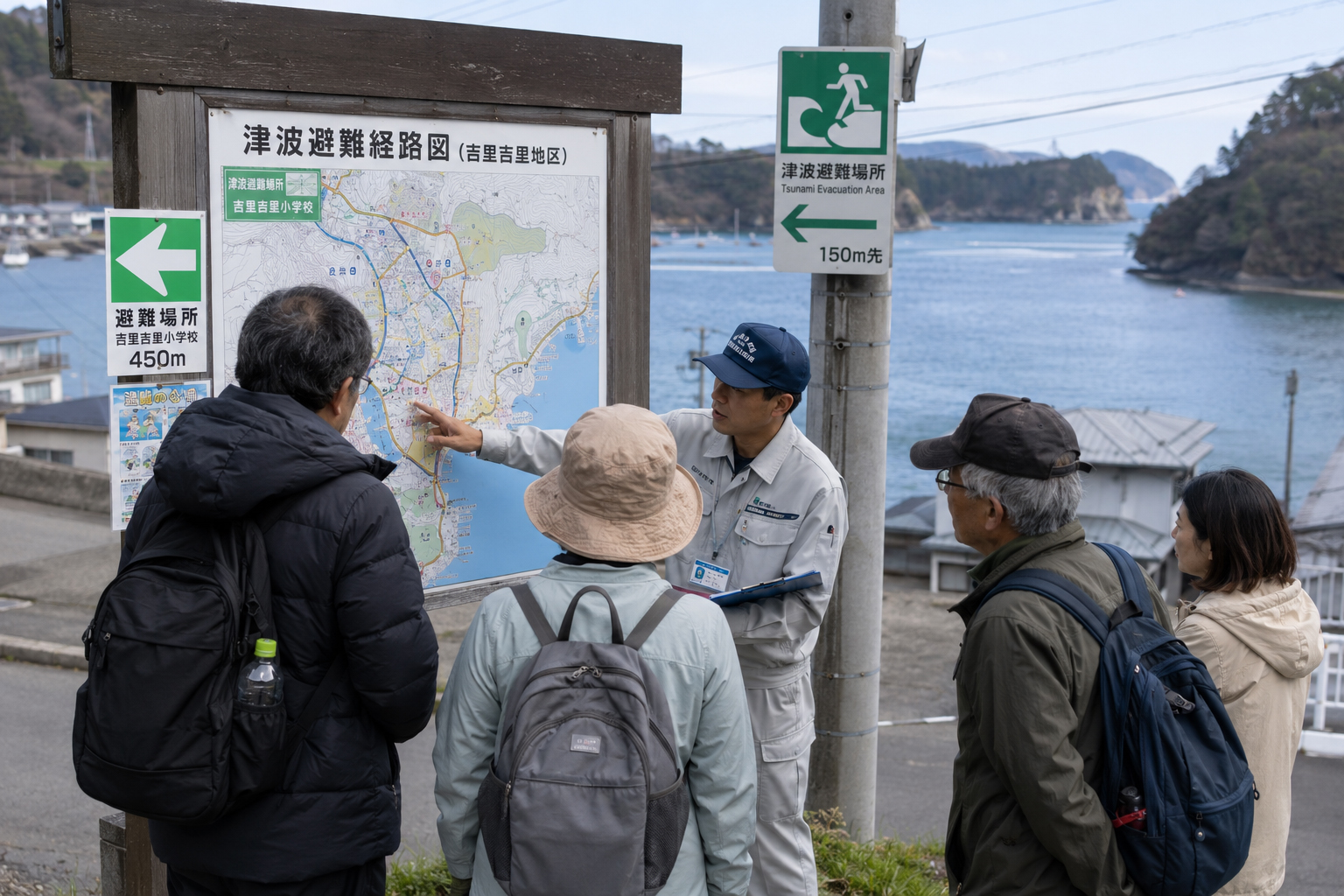
Second, check evacuation routes. If you live, work, or are traveling near the coast, know how to reach high ground or a designated tsunami evacuation building. Think about night, rain, power outage, injury, elderly relatives, children, and pets. A route that seems easy in daylight may be much harder after shaking or during heavy weather.
Third, prepare communications and supplies. Charge smartphones and portable batteries. Confirm how your family will contact each other. Keep a small bag ready with water, medication, glasses, cash, ID, a flashlight, a radio, rain gear, and basic food. None of this requires panic buying. It requires calm organization.
Stay away from the coast, rivers, cliffs, and old walls
After a strong earthquake, danger is not limited to the inside of a building. Coastal areas may be affected by tsunami risk, sea-level changes, damaged seawalls, unstable docks, and broken harbor infrastructure. Rivers can carry tsunami waves inland. Cliffs and steep slopes may be weakened by shaking. Old block walls, stone walls, roof tiles, signs, and exterior facades may look normal and still be dangerous.
If the advisory is issued, do not go to the shore to look. Do not go to the harbor to check a boat in person. Do not walk under cliffs or beside old walls just because that is the normal shortcut. Disaster safety is often not heroic. It is the ordinary decision to stay away from places that could fail.
The Sanriku coast is beautiful, but it is also one of Japan’s most serious tsunami landscapes. Ria coastlines bring mountains and sea close together. In some places, high ground is near; in others, bays can amplify waves. That is why local signs, evacuation stairs, school routes, shrines on high ground, and tsunami evacuation towers matter so much.
The history behind the system
Sanriku’s tsunami history is one of the foundations of modern Japanese disaster culture. The 1896 Meiji Sanriku tsunami, the 1933 Showa Sanriku tsunami, the 1960 Chile tsunami, and the 2011 Great East Japan Earthquake and tsunami all shaped how communities think about shaking, warning, evacuation, memory, and rebuilding.
One of the hardest lessons is that shaking alone does not always tell the whole story. Some tsunami earthquakes produce relatively modest shaking near shore but dangerous waves. Other offshore earthquakes produce strong shaking but limited tsunami effects. That is why coastal residents are taught to respond to both felt shaking and official tsunami information — and, when in doubt, to move to safety early.
The advisory is part of that long history. It is not a perfect instrument. It cannot see the future. But it gives government and residents a disciplined way to behave after a large offshore event: not denial, not panic, but heightened readiness.
Schools, companies, hotels, and visitors
Schools should confirm student safety, assembly points, tsunami evacuation routes, and handoff procedures. Parents rushing by car to schools can create congestion, especially in coastal areas where roads may be needed for evacuation. The safest plan is the one the school and local government have already communicated.
Companies should not assume that immediately sending everyone home is always safest. If rail service is disrupted or roads are damaged, staying in place may be safer. Workplaces should check stockpiles, contact systems, facility hazards, data protection, and arrangements for stranded employees. Ports, factories, warehouses, and construction sites should check fuel, gas, chemicals, cranes, heavy equipment, and waterfront hazards.
Hotels and tourism businesses have a special responsibility. Visitors may not know the local geography, the meaning of sirens, or the difference between earthquake information and tsunami information. Clear instructions in English, Chinese, Korean, and simple Japanese can make a real difference. The first disaster guide for a traveler is often the hotel front desk.
Do not let information fatigue win
One challenge with advisories is that, most of the time, nothing catastrophic follows. People then begin to ignore the next alert. That is understandable, but dangerous. The right response is to narrow the information sources: JMA, local governments, NHK, police, fire authorities, transport operators, power companies, and other official channels. Avoid unverified social media claims, recycled tsunami videos, and dramatic posts without sources.
Families can also assign roles. One person checks official updates. Another prepares supplies. Another contacts relatives. Everyone does not need to doom-scroll. The point of information is action, not anxiety.
When the week ends, preparedness should remain
If the advisory is issued, the special heightened period is roughly a week. But the end of that period does not mean the earth has become safe. It means the particular elevated-watch window has passed. A major quake can occur without a preceding event and without an advisory.
The value of the week is that it gives people a deadline to improve ordinary readiness. Anchor the bookcase. Move heavy objects. Walk the evacuation route. Put shoes near the bed. Write down family contact numbers. Prepare medication. Think about pets. Check on an older neighbor. These are small actions, but earthquakes turn small actions into major differences.
How to read the June 25 Iwate quake in this context
The June 25 M6.9 off-Iwate earthquake was not followed by a damaging tsunami warning, according to early reporting. But it produced serious shaking, and it occurred in a region where people know the history of offshore earthquakes too well. The report that JMA began evaluating the advisory criteria should be read as a sign of disciplined emergency management, not a reason for rumor.
The facts should be separated carefully: M6.9 magnitude, off Iwate, about 50 kilometers deep, Shindo 6 Upper in Aomori, no damaging tsunami expected, and an advisory-criteria evaluation. Each fact answers a different question. How big was the earthquake? Where was it? How deep was it? How strong was the local shaking? Is there tsunami danger? Are officials asking people to raise readiness?
That last question is the purpose of this explainer. The advisory is not there to frighten Japan. It is there to give Japan time to act. Review the route. Stay away from unstable coastlines and cliffs. Secure the furniture. Charge the phone. Keep shoes and a flashlight nearby. Confirm the official sources. Those actions are not dramatic, but they are exactly what saves lives.
- Review tsunami evacuation routes and high-ground destinations, including night and rain scenarios.
- Avoid beaches, ports, river mouths, cliffs, old block walls, and damaged buildings.
- Secure bedroom furniture and keep the path to the door clear.
- Charge phones, portable batteries, radios, and flashlights.
- Keep shoes, glasses, medication, and a flashlight beside the bed.
- Confirm family meeting points, contact methods, and support for older relatives, children, and pets.
Sources and references
This article draws on public information from JMA, the Sendai Regional Headquarters of JMA, Japan's Cabinet Office disaster prevention materials, TBS NEWS DIG, AP, and the Geological Survey of Japan/AIST to explain the advisory and its practical meaning.
- Japan Meteorological Agency: Monitoring of Earthquakes, Tsunamis and Volcanic Activity
- Sendai Regional Headquarters, JMA: Hokkaido–Sanriku Subsequent Earthquake Advisory
- Cabinet Office: Hokkaido–Sanriku Subsequent Earthquake Advisory explainer
- TBS NEWS DIG: JMA evaluates criteria after off-Iwate M6.9 quake
- AP: Powerful 6.9-magnitude earthquake strikes off northern Japan
- Geological Survey of Japan: April 2026 Sanriku offshore earthquake information