- An island that cannot be understood from Sapporo alone
- Before modern Japan: ancient settlements and northern trade
- Indigenous history is not a museum exhibit
- The making of a modern northern economy
- The population challenge: preserving access, not simply numbers
- The food system behind the famous Hokkaido label
- Three seas, one uncertain fishing future
- Chitose and the next industrial experiment
- People who connect Hokkaido to the wider world
- Western and southern Hokkaido: cities with distinct characters
- Mountains, flowers, farms and volcanic lakes
- The east and far north: wildlife, wetlands and island journeys
- A practical four-season guide — and a question about the future
An island that cannot be understood from Sapporo alone
Look at a map of northern Japan and the first thing that stands out is distance. Hokkaido is large enough that a journey from its southern harbor cities to the Okhotsk coast can cross entirely different agricultural districts, weather systems and ecosystems. Sapporo is a substantial metropolitan center, but it is only one part of this remarkable region.
The prefecture's official area is about 83,422 square kilometers, roughly 22 percent of Japan's total. That statistical convention includes the Russian-administered islands claimed by Japan as the Northern Territories. The main island itself lies between the Sea of Japan, the Pacific and the Sea of Okhotsk. Mount Asahi reaches 2,291 meters, while the elegant volcanic cone of Mount Yotei rises to 1,898 meters. The Ishikari and Tokachi plains provide extensive agricultural land, and the mountain ranges separate communities and climate zones.
Winter is not uniform: western districts receive heavy snow, parts of the Pacific coast are drier, and eastern coastal areas can experience cool summer fog. Geography explains much about the island's housing, transportation, food production and the cost of living. It is also the starting point for understanding why public services become difficult to maintain when the population falls.
Before modern Japan: ancient settlements and northern trade
The archaeological record overturns the impression that Hokkaido was an empty frontier awaiting modern settlement. Communities lived from fishing, hunting and gathering for millennia, developing pottery, settlements and elaborate burial practices. The Jomon Prehistoric Sites in Northern Japan became a UNESCO World Heritage property in 2021. Hokkaido components include Ofune and Kakinoshima in Hakodate and the Kiusu earthwork burial circles in Chitose.
Later archaeological periods include the Epi-Jomon, Okhotsk and Satsumon cultures. Their material remains reveal different ways of making a living and contacts across the northern seas. The transition between archaeological cultures and the histories of living peoples is complex; it should not be reduced to a single date or an unbroken, simplistic genealogy.
Ainu communities developed extensive relationships with neighboring peoples, exchanging goods with mainland Japanese traders and peoples of northeast Asia. Salmon, marine products and forest resources were important to livelihoods, alongside cultivation in some areas. The northern ocean was a network of exchange rather than a barrier separating Hokkaido from the world.
Indigenous history is not a museum exhibit
Ainu people are Indigenous to northern Japan and neighboring areas, including Hokkaido, Sakhalin and the Kuril Islands. Their languages, oral literature, forms of craftsmanship and social practices have developed through centuries of adaptation and exchange. They are also contemporary people with diverse professions, interests and views.
From the seventeenth century, the Matsumae domain increasingly controlled trade with Ainu communities. Conflicts including Shakushain's uprising in 1669 and the Kunashiri-Menashi uprising in 1789 illustrate the pressures created by unequal trade and expanding control. The Meiji state's land and resource policies later disrupted access to traditional livelihoods, including salmon fishing and hunting. Assimilation policies and discrimination made intergenerational transmission of language and knowledge particularly difficult.
The 1899 Hokkaido Former Aborigines Protection Act was repealed in 1997. Parliamentary resolutions in 2008 and legislation in 2019 marked important changes in official recognition of the Ainu as Indigenous people. They did not erase the consequences of earlier policies. Upopoy, the National Ainu Museum and Park in Shiraoi, opened in 2020; Nibutani and Lake Akan offer other opportunities to learn from regional cultural institutions and practitioners. Visitors should respect photography rules and the decisions of communities about what knowledge they choose to share.
The making of a modern northern economy
Hakodate entered the international trading system in 1859, after the 1854 Convention of Kanagawa opened the way for foreign ships. Its churches, former consulates and warehouses reflect commercial relationships that preceded the development of Sapporo as the administrative center of the island.
In 1869 the Meiji government renamed Ezochi Hokkaido and established the Kaitakushi, or Development Commission. State-led migration, imported farming methods, transport construction and resource extraction transformed the island. For Ainu residents this transformation also involved dispossession and restrictions on traditional ways of life. These two aspects of modernization belong in the same historical account.
Sapporo Agricultural College opened in 1876. Its successor, Hokkaido University, became a center for scientific research. The railway between Temiya and Sapporo opened in 1880, linking industrial development to maritime transport. Coal, steel, paper and food processing supported communities across the island. Later mine closures demonstrated how quickly a town's economic foundations could change. The 1972 Sapporo Winter Olympics helped establish the city's international winter-sports identity, while the island's economy continued to diversify.
The population challenge: preserving access, not simply numbers
Hokkaido's final 2025 census counted 4,980,272 residents, compared with 5,224,614 in 2020. Sapporo alone had 1,961,996 residents, nearly two in five of the prefecture's inhabitants. The concentration of people and institutions in its capital is an important counterpart to the decline of many smaller communities.
Population loss has a particularly concrete meaning on a large cold island. A town with fewer taxpayers may still have the same roads to clear, pipes to repair, schoolchildren to transport and elderly residents to serve. Hospitals need skilled staff, not just buildings. Regional transport must remain usable even when individual routes have few passengers.
Recruiting newcomers can help, but it is only one tool. Housing, family services, reliable employment and accessible transport affect whether residents choose to remain. Foreign workers increasingly contribute to food production, hospitality and other services; integration requires fair employment and practical language support. Remote medicine, shared municipal services and automated vehicles may reduce some barriers, but their effectiveness depends on staffing, connectivity, winter reliability and funding.
The food system behind the famous Hokkaido label
Hokkaido's agricultural output reached ¥1.4817 trillion in 2024. Its farms occupy approximately 1.138 million hectares of cultivated land, more than a quarter of the Japanese total. The scale of farming distinguishes much of Hokkaido from the smaller fields commonly encountered elsewhere in Japan.
Tokachi's broad fields produce crops including potatoes, wheat and sugar beet, while the grasslands of eastern Hokkaido are closely associated with dairy production. Rice is also important in suitable parts of the island. Milk, butter, cheese, flour, confectionery and processed vegetables connect these rural economies to factories, logistics facilities and urban consumers.
Mechanization and precision agriculture can help manage scarce labor and improve consistency, but equipment purchases require capital, training and maintenance. Feed, fertilizer and fuel costs influence profitability. Crop rotation, soil protection and adaptation to changing weather are equally important. Hokkaido's food industry is therefore not simply a matter of fertile land: it is a sophisticated system of farms, processors, cooperatives, transport and scientific knowledge.
Three seas, one uncertain fishing future
Scallops, kelp, pollock and salmon are among the products that make Hokkaido central to Japanese seafood supply. In 2024 marine fisheries and aquaculture produced roughly 1.11 million tonnes, with a value of ¥285.6 billion. Behind those figures are coastal towns that depend on boats, processing facilities, cold storage and distribution networks.
The latest challenges are visible on a dinner table. When salmon catches fall, roe becomes harder to secure and processors have less raw material. As this special edition explores in its Urahoro report, even a municipal gift program can become exposed to a change in seafood supply. Changes in marine temperature, food availability, migration and survival are active areas of investigation; their importance varies among stocks and locations.
Sustainable fisheries require monitoring, resource management and economically viable communities. Diversifying products and markets may make processors more resilient, while conservation safeguards the resource base on which their business ultimately depends.
Chitose and the next industrial experiment
In Chitose a new manufacturing ambition is taking shape. Rapidus is developing its IIM-1 facility for advanced logic semiconductors. According to the company, its pilot line began operation in April 2025, with mass production targeted for 2027. The proposed two-nanometer-class technology would bring a different kind of supply chain to Hokkaido: ultrapure materials, precision maintenance, dependable power, water management and highly trained engineers.
A pilot line is not proof of profitable mass production. Commercial success will depend on manufacturing yields, customers, financing and the ability to develop supporting industries. Nevertheless, the project illustrates how Hokkaido is trying to broaden its industrial base beyond food, tourism and traditional manufacturing.
Wind, geothermal, hydroelectric, solar and biomass resources offer opportunities to supply some of the region's energy needs. Transmission capacity, environmental effects, winter maintenance and community acceptance constrain what can actually be built. Geothermal projects must consider existing hot-spring uses. Universities and research institutes are another long-term asset: discoveries in genetics, immunology and soil-derived engineering featured elsewhere in this edition illustrate the range of expertise that exists on the island.
People who connect Hokkaido to the wider world
Chiri Yukie (1903–1922) preserved Ainu oral narratives in writing and Japanese translation. Her Ainu Shin'yoshu, published after her death, remains a vital example of Indigenous intellectual authorship. Her memorial museum in Noboribetsu offers a place to learn about that achievement.
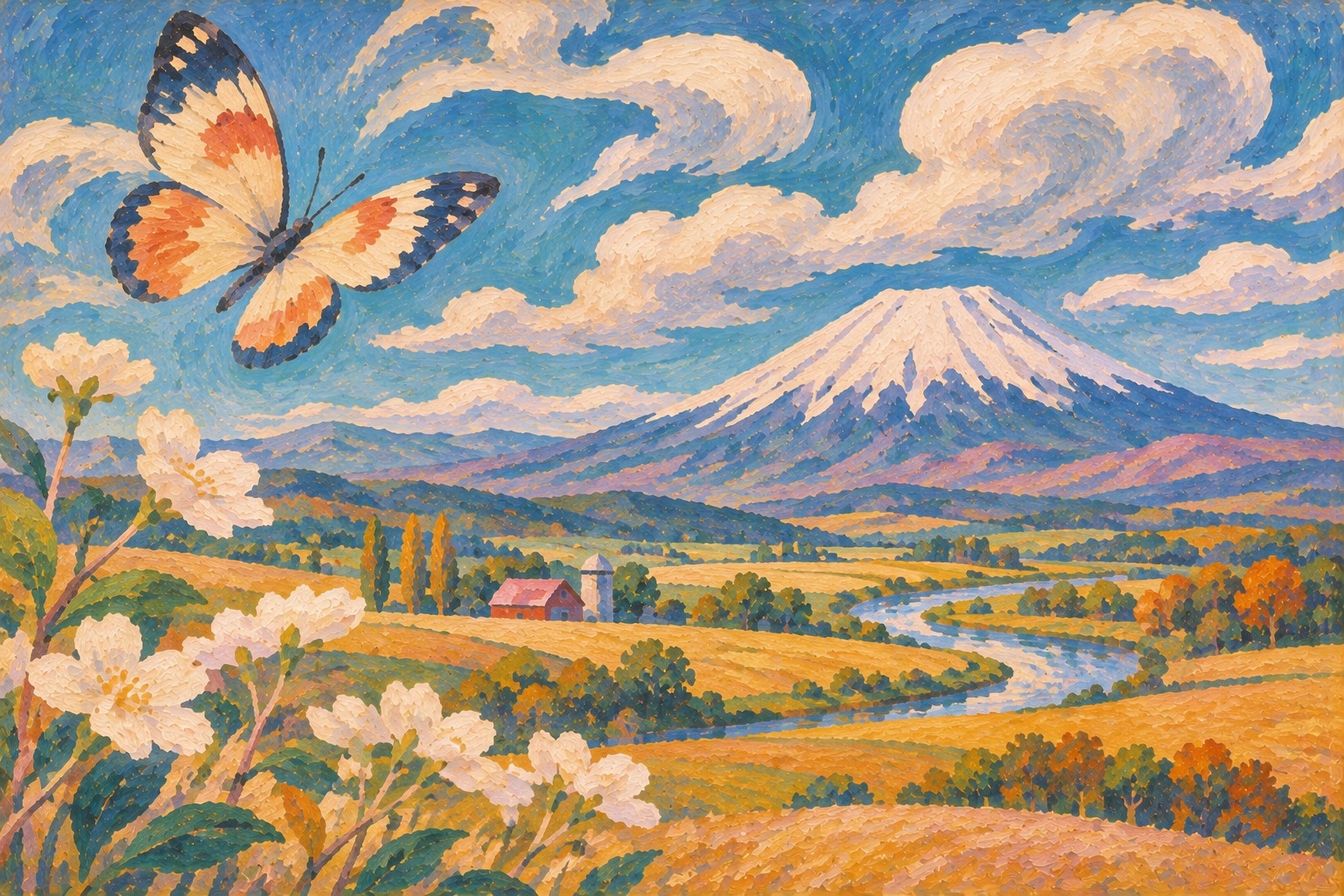
Sapporo-born painter Kotaro Migishi (1903–1934), whose artistic vocabulary inspired this edition's illustrations, pursued modernist approaches to painting, including imaginative treatments of butterflies and shells. Novelist Ayako Miura, associated with Asahikawa, explored moral and religious questions in works including Hyoten (Freezing Point). Composer Akira Ifukube drew on experiences in Hokkaido and became internationally known for film music.
The island's scientific and business achievements are equally varied. Akira Suzuki, associated with Hokkaido University, shared the 2010 Nobel Prize in Chemistry for work that transformed organic synthesis. Akio Nitori built a furniture business founded in Sapporo into an international retailer. Ski jumper Noriaki Kasai, from Shimokawa, and speed skater Miho Takagi, from Makubetsu, exemplify the island's winter-sports connections. These figures illustrate different relationships with Hokkaido: birth, education, creative inspiration and enterprise.
Western and southern Hokkaido: cities with distinct characters
Sapporo is the most practical starting point for many first-time visitors. Odori Park, the Clock Tower, the Hokkaido University campus and the Hokkaido Museum provide complementary views of the city. The winter snow festival showcases the season rather than trying to escape it. Jozankei is a nearby hot-spring district for travelers who want a quieter mountain setting.
Otaru offers a different urban history. Its canal, former commercial buildings and warehouses recall the island's maritime trade and financial development. Glassmaking, seafood restaurants and historic architecture make a walk through the city rewarding. Hakodate, farther south, combines the star-shaped Goryokaku fort, Motomachi's churches, the morning market, the Kanemori Red Brick Warehouses and views from Mount Hakodate. Its December floating Christmas tree is a reminder of its friendship with Halifax, Canada.
For visitors interested in earlier Japanese settlement and trade, Matsumae and Esashi offer historical sites beyond the major urban centers. Allow enough time for travel rather than treating southern Hokkaido as a quick excursion from every other region.
Mountains, flowers, farms and volcanic lakes
Asahikawa offers Asahiyama Zoo, woodworking traditions and access toward the Daisetsuzan mountains. Furano's summer lavender fields and Biei's rolling farmland make a rewarding combination, especially for travelers interested in landscape and agriculture. Respect farm boundaries: the fields are workplaces, not unrestricted photographic sets. The Blue Pond near Biei adds a distinctive geological and visual attraction.
Niseko and the area around Mount Yotei offer ski terrain, hot springs and summer outdoor activities. Snow conditions and operating dates vary. Backcountry travel requires appropriate knowledge and equipment, and resort rules should be respected. Lake Toya offers a volcanic caldera landscape and views toward Mount Usu. Noboribetsu's Jigokudani, or Hell Valley, reveals the geothermal processes that supply its hot springs. Lake Shikotsu is another striking destination within the Shikotsu-Toya National Park.
Daisetsuzan National Park is a vast alpine environment, not simply a scenic extension of a city park. Weather can change rapidly. Check trail conditions and official volcanic or weather advisories before mountain excursions.
The east and far north: wildlife, wetlands and island journeys
Shiretoko was inscribed as a natural World Heritage site in 2005. Its importance lies in the interaction of marine and terrestrial ecosystems, including seasonal sea ice, salmon and wildlife. Utoro and Rausu provide different perspectives on the peninsula. Observe wildlife at safe distances and follow access rules; the presence of brown bears makes unsupervised encounters dangerous.
Kushiro offers broad wetland vistas and opportunities to understand the habitat of red-crowned cranes. Lake Akan is known for marimo algae and Ainu cultural institutions, while Lakes Mashu and Kussharo reveal the volcanic landscape of eastern Hokkaido. Obihiro and Tokachi connect food to farming through dairy products, confectionery, pork rice bowls and the region's agricultural horse traditions.
Wakkanai is a gateway to the far north and Cape Soya, the northernmost point in territory presently administered by Japan. Rishiri's mountain and Rebun's alpine flowers reward visitors who have time for ferry journeys and walking. Weather may disrupt boats, so build flexibility into island itineraries. Hokkaido's distances make a focused regional trip more satisfying than a hurried checklist of every major attraction.
A practical four-season guide — and a question about the future
Food is an excellent way to connect a journey to local livelihoods: Sapporo miso ramen and soup curry, Asahikawa shoyu ramen, Hakodate shio ramen, jingisukan grilled lamb, Tokachi pork bowls, seafood and dairy products each tell part of the story. Ainu cuisine should be approached through cultural institutions and businesses that choose to share it, rather than assuming it is identical to the wider region's food traditions.
Spring brings thaw and flowers; summer suits walking and farm landscapes; autumn brings harvests and color; winter is associated with skiing, festivals and sea ice. Flowering and drift-ice conditions are not guaranteed. Winter driving requires real experience of snow and ice, and severe weather can interrupt rail, road and ferry services. Check official timetables, park restrictions and weather forecasts close to departure.
Hokkaido's future is not a choice between protecting nature and building industry, nor between tourism and agriculture. The harder question is how to make those activities compatible with each other and with the lives of people who call the island home. New factories need power, water and workers; farms need healthy soils and viable markets; tourism needs landscapes and communities that have not been exhausted by its success. Indigenous rights and cultural agency must remain part of that conversation. Understanding these relationships is the best way to discover Hokkaido — and to appreciate why its future matters to Japan.
Explore this Hokkaido special edition
- Population decline and regional communities
- Salmon fisheries and roe supply
- The Shinkansen extension
- Living Ainu dance traditions
- Hakodate’s floating Christmas tree
- Geoceramics research
- Koji Yuki’s contemporary art
Primary sources and references
- Hokkaido government: final 2025 census
- Hokkaido Databook: geography
- Hokkaido Databook: historical chronology
- Official Jomon heritage site
- Upopoy: Ainu history and culture
- Hokkaido archives: Development Commission records
- Hokkaido University: agricultural faculty history
- Hokkaido Databook: agriculture
- Hokkaido Databook: fisheries
- Hokkaido Databook: manufacturing
- Rapidus: Chitose manufacturing facility
- METI Hokkaido: geothermal development
- Hokkaido Databook: tourism
- Official Hokkaido tourism guide
- Ministry of the Environment: national parks
- Ministry of the Environment: Shiretoko
- Chiri Yukie memorial museum
- Migishi Kotaro Museum of Art
- Nitori Holdings: corporate history
- Upopoy: institutional history
- Hokkaido Databook 2026
- Official tourism guide: Mount Yotei