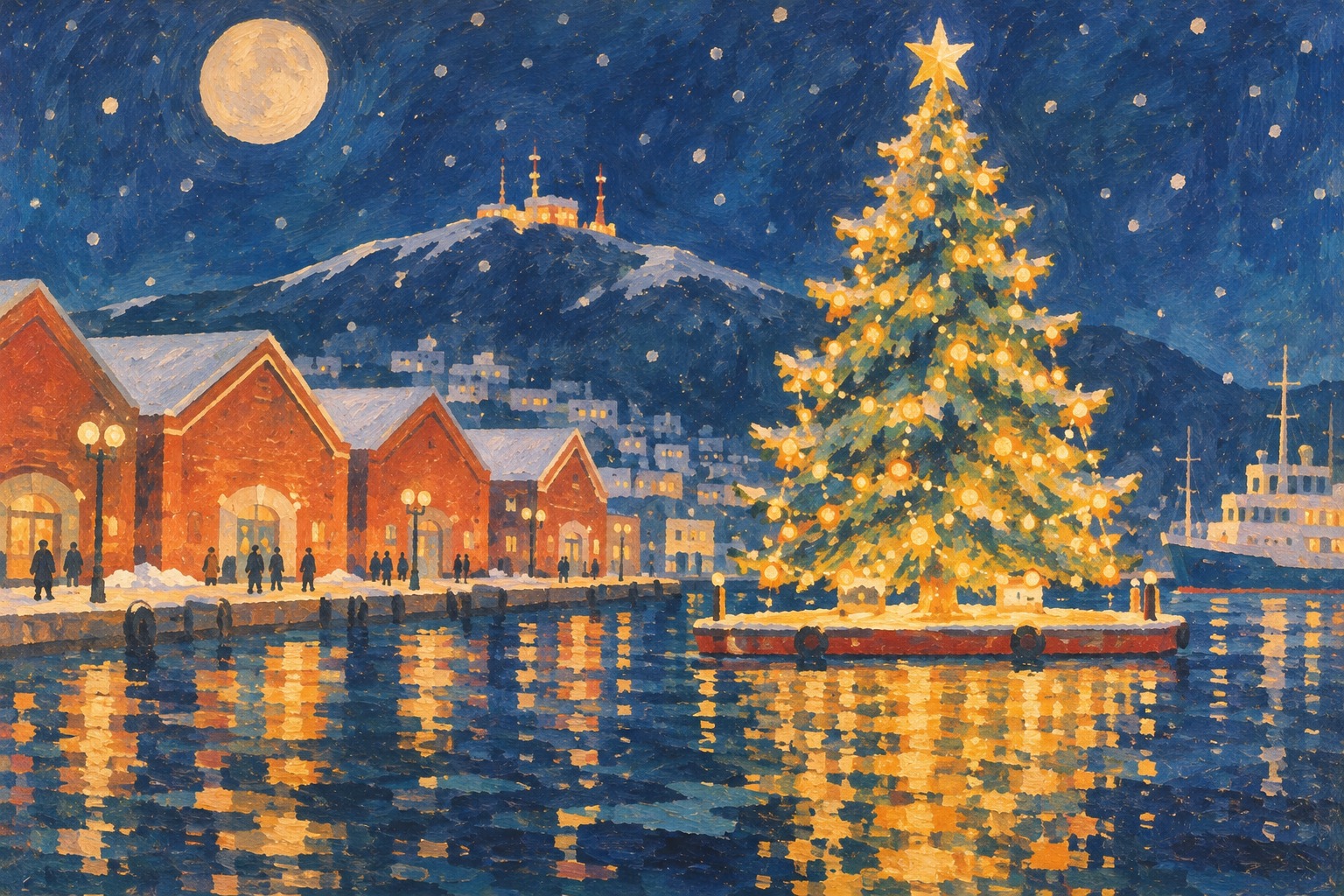
A tree arrives by sea
A Christmas tree does not usually arrive at its destination under tow. On November 27, however, HTB reported that a roughly 20-meter fir grown in Hokkaido had been brought by boat to the waters off Hakodate’s Kanemori warehouses. It is the centerpiece of a festival scheduled to begin on December 1. Around 150,000 LED lights are planned for the display. The installation has taken place; the illumination itself is still ahead.
The unusual setting makes the harbor an integral part of the artwork. Water doubles the lights, the brick buildings frame the spectacle, and the approaching winter darkness supplies a stage that a conventional town square cannot reproduce. Yet the tree is also a reminder that Hakodate’s international identity predates the festival by more than a century.
A port with several beginnings
Hakodate, historically written Hakodate with the characters 箱館, developed as a maritime trading center before Japan’s nineteenth-century treaty system. Coastal trade connected southern Hokkaido with the rest of the archipelago. Its harbor later became a point of contact between Japanese authorities and foreign ships.
The distinction between opening a port for provisions and opening it to commercial trade matters. The 1854 agreement with the United States led to the provisioning opening in 1855. In 1859, commercial treaties brought Hakodate into the first group of Japanese international trading ports alongside Yokohama and Nagasaki. Foreign merchants, diplomatic missions and new commercial relationships helped shape the built environment, while Japanese merchants adapted to opportunities and risks. The city’s history is therefore not simply a story of Western influence; it is a story of local adaptation to a changing world.
When a warehouse becomes a destination
The Kanemori buildings once served a very practical purpose: storing goods moving through the port. The company traces its origins to a shop opened in 1869 by founder Watanabe, followed by a commercial warehouse business in 1887. Fire destroyed the earlier warehouses in 1907, and replacement buildings were completed in 1909. Their brick construction embodies the commercial demands and fire risks of a growing port.
By the late twentieth century, warehousing activity was shifting elsewhere. The operator chose to repurpose its buildings, opening shopping and event facilities in 1988, the year the Seikan Tunnel opened. Further conversions followed. This is adaptive reuse: the historic fabric survives because the structure can perform a new function. The festival benefits from a waterfront that remains economically active rather than being preserved solely as a static exhibit.
The streets behind the waterfront
The most revealing part of Hakodate is not confined to the harbor. The western district rises toward Mount Hakodate through streets where Japanese, Western and hybrid architectural forms coexist. Municipal preservation policy began protecting the historic landscape in 1988. The Motomachi-Suehirocho preservation district encompasses buildings and streets whose relationship to the mountain and sea gives the area much of its character.
The city’s inventory identifies BAY Hakodate, a brick warehouse dating from 1909, as retaining a water channel recalling the district’s former trading function. Such details show how infrastructure shaped architectural form. A visitor who comes for the evening lights can spend the daylight hours reading the buildings as evidence of changing commercial and residential life. Preservation also requires maintenance, compatible new uses and attention to the people who live and work in the district.
A Canadian friendship, a Hokkaido tree
In 1982 Hakodate entered a sister-city relationship with Halifax, Nova Scotia. Both are maritime cities with historic star-shaped fortifications. Their relationship has encompassed educational, civic and commercial exchange. The Christmas festival grew out of an effort to make Hakodate’s winter streets a destination in their own right.
According to the Hakodate Chamber of Commerce and Industry’s retrospective, the first festival took place in 1998, with a tree from Halifax as its defining feature. The organizers have used Hokkaido-grown Sakhalin firs since 2019. This change is worth emphasizing because descriptions of the festival sometimes still suggest the current tree comes from Canada. The friendship is the origin of the tradition, not the current source of the timber. Residents and volunteers have helped turn the exchange into a continuing local celebration.
Can winter festivals strengthen a local economy?
Hakodate’s municipal tourism estimate for fiscal 2025 recorded about 6.058 million visits, up 0.6% from the preceding year. The October–March half of the year accounted for approximately 2.631 million, up 2.4%. The city also estimated about 579,000 overseas overnight visitors. These are citywide measures, not festival attendance counts or an estimate of the event’s economic contribution.
A winter celebration can help diversify demand across the year. Hotels may gain a reason for travelers to stay overnight, restaurants can offer warm regional food, and a walkable historic district gives visitors opportunities to spend time at independent shops. The festival’s soup stands explicitly connect the evening spectacle with food businesses. But a sound assessment must consider costs as well: installation, energy, weather contingencies, crowd management and winter maintenance. The strongest case for seasonal tourism is not simply more arrivals; it is sustained local benefit without diminishing the character of the place.
Seeing the lights in December
The city’s tourism information schedules the festival from December 1 through Christmas Day. The first evening’s illumination begins at 6 p.m.; regular days have an earlier lighting period from 4:30 to 5:45 p.m., followed by lights from 6 to 10 p.m. Fireworks are planned for the evening relighting. Three brief red-light displays are scheduled at 6:30, 7:30 and 8:30 p.m. Weather can alter the program.
Visitors should check the current notice before setting out, dress for the cold harbor wind and respect waterfront safety restrictions. The event offers more than a photograph: it brings together a nineteenth-century port, twentieth-century urban renewal and a friendship across the Pacific and North America. A locally grown tree standing on the water is a contemporary expression of that accumulated history.
Sources and references
- HTB Hokkaido, November 27 report
- Hakodate official tourism information
- Hakodate City, sister cities
- Hakodate Chamber of Commerce, November 2022 bulletin
- MLIT Hokkaido Regional Development Bureau, port history
- Kanemori, corporate history
- Kanemori, warehouse history and reuse
- Hakodate City, preservation districts
- Hakodate City, traditional buildings inventory
- Hakodate City, visitor statistics
- Hakodate City, FY2025 tourism estimates (PDF)