- A road material hiding in plain sight
- What makes volcanic soil interesting?
- An old relationship with earth, a different technology
- Why the first target is the road base
- The carbon question cannot be answered at the kiln alone
- From laboratory sample to regional supply chain
- Beyond asphalt: a culture of making with local earth
A road material hiding in plain sight
A road in northern Japan has to survive more than traffic. Water enters its structure, winter temperatures fall below freezing, and spring brings a thaw. Repeated over years, this combination can undermine the very surface that connects a village to its hospital, school or market. A new Hokkaido research partnership proposes looking beneath the road for part of the solution: soil itself.
On November 10, the Japan Science and Technology Agency (JST) selected Hokkaido University’s geoceramics initiative for Phase 1 of the Future Co-Creation category of COI-NEXT. The university announced the award on November 26, followed by industry partner Nichireki Group on November 27. Assistant Professor Shiori Suzuki of the university’s Research Faculty of Agriculture leads the project, with Tomakomai as its municipal partner. Three of 39 applications were selected in this funding round. The Hokkaido project runs through March 31, 2028. This is a research and partnership award, not a procurement contract for a proven commercial pavement.
What makes volcanic soil interesting?
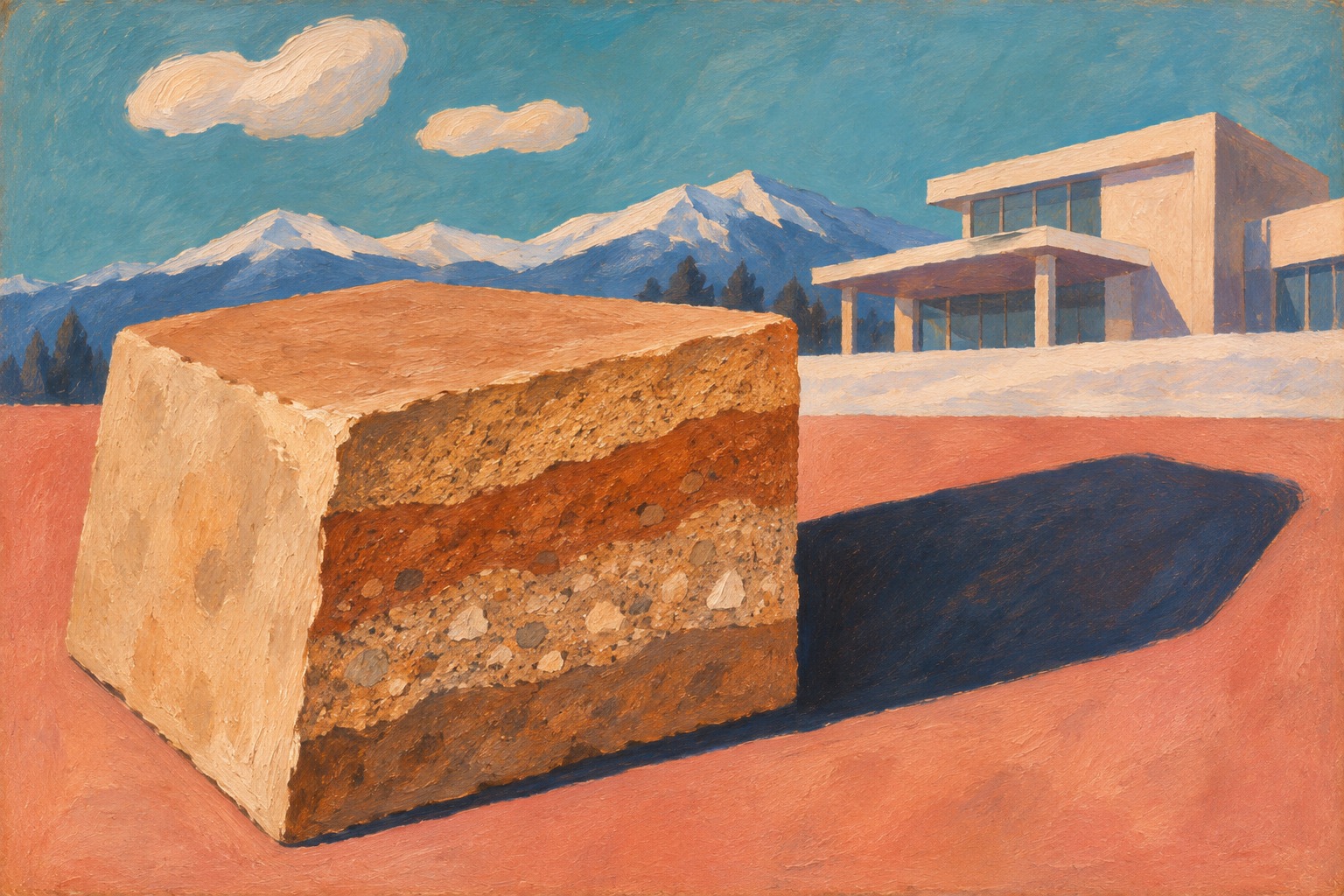
The proposed feedstock includes kuroboku, dark soils formed in volcanic landscapes. Some contain allophane, a poorly crystalline aluminosilicate mineral. Soil is not a standardized industrial powder: organic matter, water content, particle size and mineralogy can vary dramatically. A successful manufacturing process must accommodate or control these differences rather than assume every excavation yields equivalent ingredients.
Geopolymers are a family of materials in which chemically activated mineral feedstocks form a binding network. The Hokkaido proposal illustrates crushing and classification followed by an alkaline activator and a room-temperature reaction. Unlike traditional fired ceramics, the intended process does not require a kiln to consolidate the material. The absence of firing is an attractive engineering feature, but the energy and chemical inputs of the entire production chain still matter.
An old relationship with earth, a different technology
Japan offers a useful historical comparison. Traditional plasterers built earthen walls on bamboo or similar latticework, mixing soil with straw fibers and applying successive layers. Such techniques demanded intimate knowledge of local ingredients, shrinkage and drying. The Agency for Cultural Affairs designated traditional Japanese wall plastering as a selected preservation technique in 2002. It is also part of the traditional architectural craftsmanship inscribed on UNESCO’s intangible heritage list in 2020.
The new research does not simply revive an old recipe. Chemical activation and engineered pore structures belong to a different materials-science tradition. The connection is instead a philosophy of material selection: understand what the local earth contains, adapt it to a particular function, and make the finished object useful rather than treating soil as an interchangeable waste stream. That idea links laboratory science with craftsmanship without claiming the two technologies are identical.
Why the first target is the road base
Roads are layered structures. The surface receives tires and weather, while the base spreads loads into the underlying ground. A material that succeeds as a base is not automatically suitable as a wearing surface. Freeze-thaw cycling introduces additional problems: trapped water expands when it freezes, and thawed ground can lose bearing capacity. Drainage, compaction, traffic loading and the frost susceptibility of surrounding layers all influence performance.
Hokkaido University says an experimental kuroboku-derived road-base material satisfied a pavement strength specification. It also identifies freeze-thaw resistance as a development objective and describes work on natural-polymer additives to improve construction handling. The announcement does not disclose the detailed strength results or a multiwinter field record. Engineers will need evidence of repeated-load behavior, moisture sensitivity, frost durability and consistent installation before widespread adoption can be considered.
The carbon question cannot be answered at the kiln alone
A local feedstock could reduce hauling and the need to purchase virgin material. Avoiding high-temperature firing could also lower process energy. Neither advantage establishes a specific carbon saving. Grinding, drying, activator manufacture, machinery, transport and end-of-life processing all belong in the assessment. A soil-based binder that needs expensive or emissions-intensive chemical inputs may offer less benefit than its name suggests.
The appropriate comparison is a functional one: for instance, the emissions and costs of maintaining a kilometer of road to equivalent service standards over a defined period. A longer-lasting material may justify higher initial cost; a cheaper material requiring frequent replacement may not. This is why field monitoring and life-cycle assessment should proceed together. No verified project-specific carbon reduction percentage or commercial unit price has been established in the announcement.
From laboratory sample to regional supply chain
Tomakomai gives the researchers a municipal setting in which practical requirements can inform material design. The industrial partner brings pavement experience. Other participants span engineering, chemistry and design. This combination matters because a laboratory specimen can be successful while its supply chain fails: feedstock may vary by season, processing equipment may be incompatible, or a material may be difficult to place and compact at scale.
Responsible sourcing also requires boundaries. Excavated material needs screening for contamination and suitability; productive topsoil and sensitive habitats should not be treated as unlimited industrial reserves. Alkali handling and leaching must be assessed. A regionally sourced product is most valuable if it meets safety and quality requirements consistently, can be maintained by local contractors, and competes on total service cost. These are proposed evaluation criteria, not claims of completed project tests.
Beyond asphalt: a culture of making with local earth
The project name uses tsuchidō, a phrase suggesting a way of working with earth. Its ambitions extend from infrastructure to walking paths, household objects and craft. Architects might eventually explore related nonstructural components, finishes or landscape elements. Load-bearing building systems, however, would need their own evidence on structural behavior, seismic performance, fire and moisture exposure. A road-base test is not a building approval.
For sparsely populated cold regions, the larger opportunity is not merely a new binder. It is the possibility of connecting municipal maintenance, local businesses and material design around an accessible resource. The decisive test will be whether the partnership can publish transparent performance and cost data and demonstrate a practical improvement over existing alternatives. If that happens, Hokkaido’s soil could become a source of industrial knowledge as well as a foundation for its roads.
Primary sources and references
- Hokkaido University release, November 26
- JST selection announcement, November 10
- Hokkaido University researcher directory: Shiori Suzuki
- Nichireki Group news, November 27
- Agency for Cultural Affairs: Japanese wall plastering
- Traditional wall preservation association: plastering techniques
- JST COI-NEXT project directory