- A missing delicacy, and a promise a town could not keep
- The numbers behind the empty delivery box
- How a fish became a source of municipal revenue
- Before ikura became a luxury, salmon sustained a region
- A journey across an ocean before a return to Japan
- Climate, food and the limits of a single explanation
- A financial problem for the next generation of fish
A missing delicacy, and a promise a town could not keep
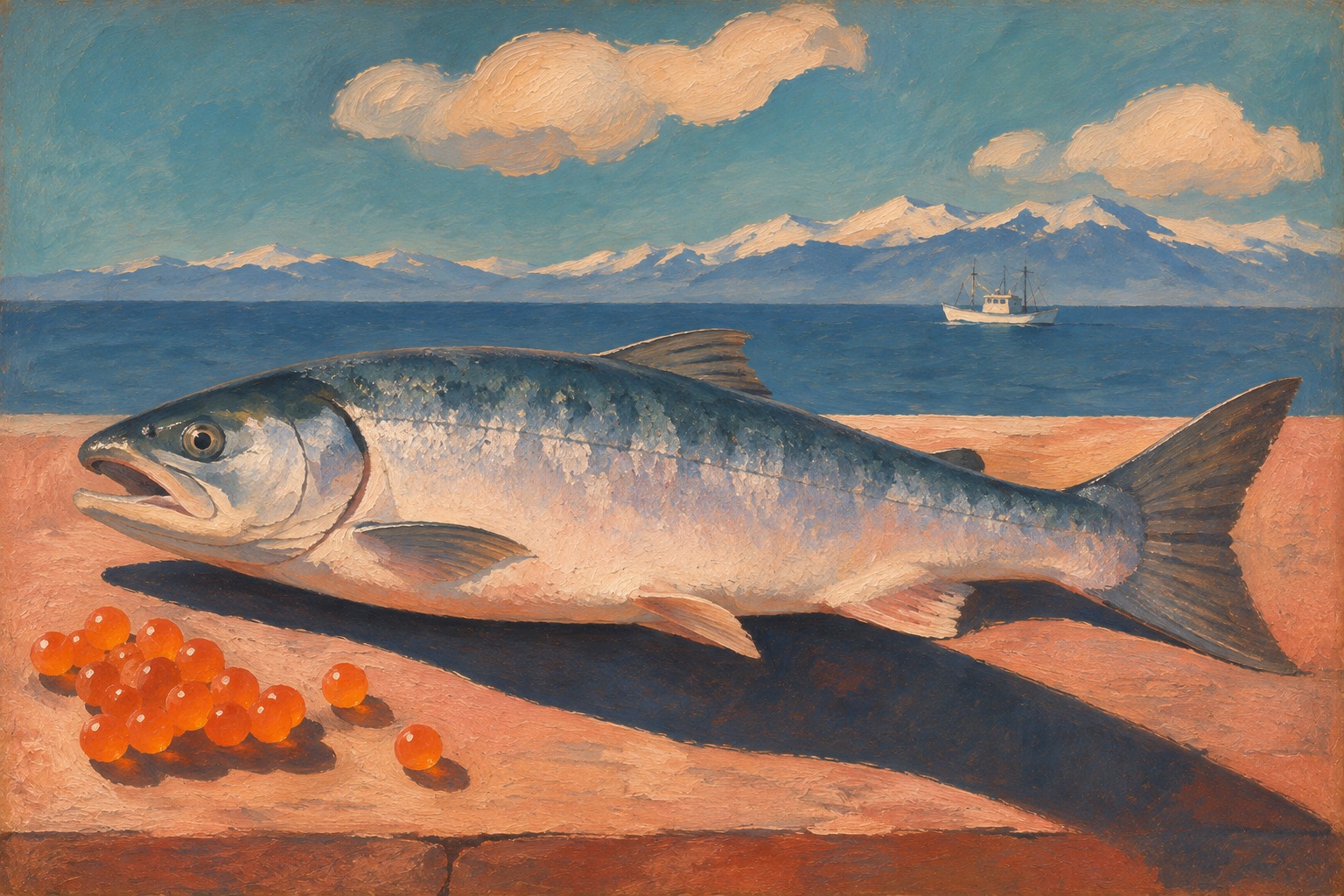
For many Japanese families, a bowl of rice covered in translucent orange salmon eggs is a reminder of autumn in Hokkaido. This year, hundreds of people who expected a delivery of locally produced ikura from Urahoro will have to choose something else.
On November 25, local broadcasters HTB and UHB reported that the town in eastern Hokkaido had abandoned shipments of its large-grain salmon roe reward under Japan's hometown donation scheme. The decision affected 630 applications involving ¥14.98 million. According to HTB, a supplier had warned the municipality in October that the raw material could not be secured. UHB reported that even closing applications earlier than usual had not protected the town from the shortage and rising prices.
The municipality is offering substitute rewards or refunds, with HTB reporting a response deadline at the end of November. This is not a recall or a food safety incident. It is a supply failure, and an unusually visible example of how changes in the North Pacific can eventually reach a local government's administrative office.
The numbers behind the empty delivery box
The latest preliminary statistics published by Hokkaido on November 26 cover coastal autumn salmon catches through November 20. The island's fisheries had landed about 3.13 million fish, compared with 5.61 million in the corresponding period of 2025. The 44.2 percent reduction in numbers was accompanied by a 27.4 percent decline in aggregate catch value, to ¥18.18 billion.
Dividing these totals by the fish counts produces an indicative average catch value of about ¥5,810 per fish, against ¥4,466 a year earlier. This is an aggregate calculation, not a wholesale quote or a retail price for roe. Fish sizes, maturity, sex and quality can all affect the value obtained. Even a higher average value cannot necessarily compensate a business for lower throughput or fixed operating costs.
The regional figures are also uneven. The Japan Sea coast recorded less than one-quarter of the previous year's count, while the broad area east of Cape Erimo was much closer to its earlier level. The statistics describe coastal landings, not all fish returning to rivers, and do not identify the supplier's specific procurement sources. The fishing season's final total may differ.
| Region | Fish caught | % of previous year |
|---|---|---|
| Sea of Okhotsk | 2,078,463 | 57.5% |
| Nemuro | 363,272 | 65.0% |
| East of Cape Erimo | 457,194 | 90.1% |
| West of Cape Erimo | 103,192 | 27.5% |
| Sea of Japan | 127,267 | 23.2% |
How a fish became a source of municipal revenue
Japan introduced furusato nozei, often rendered as hometown tax donations, in 2008. Eligible taxpayers can direct donations to municipalities they wish to support and claim tax relief under applicable limits and procedures. Many municipalities offer local products in recognition of contributions. The system is not simply an online marketplace: its fiscal and administrative consequences extend beyond the value of a parcel.
Urahoro's own published accounts show ¥123.20 million in donations in fiscal 2024 and ¥84.843 million in fiscal 2025. HTB reported that salmon roe had been the most popular reward in the latter year, associated with approximately three-tenths of donations. The ¥14.98 million now affected is equivalent to almost 18 percent of that previous year's total, a comparison that illustrates the scale of the exposure rather than measuring a realized loss.
If a donor accepts a substitute, the financial outcome is different from a refund. The cost of procuring replacements, shipping, administration and existing supplier commitments also matters. A municipality receives less usable revenue than the gross donation total. For processors, the risk is different again: purchasing expensive fish may be necessary to retain customers, yet the available quantities may be too small to run facilities efficiently. Diversifying rewards and matching commitments to verified inventory could reduce these risks.
Before ikura became a luxury, salmon sustained a region
Salmon has a place in Hokkaido's history that predates the modern commercial fishery. For Ainu communities, it was an important source of food, with preservation techniques helping make seasonal catches available during winter. The Ministry of Agriculture, Forestry and Fisheries describes ruibe, thinly sliced frozen fish, as a regional food with Ainu origins.
The ministry also records soy-marinated ikura as a culinary tradition across Hokkaido. Unlike sujiko, in which the eggs remain together in the ovarian membrane, ikura is separated into individual grains before seasoning. The autumn appearance of fresh roe in shops allows households to prepare their own. Its cultural significance is therefore not limited to restaurants, premium sushi or gifts shipped to other parts of Japan.
The industrial foundations changed in the late nineteenth century. Hokkaido's research organization dates Japan's full-scale salmon propagation effort to the establishment of the Chitose Central Hatchery in 1888. After the Second World War, more scientific approaches to rearing, feeding and release improved hatchery methods. Favorable ocean conditions also contributed to higher return rates. That history matters today: successful propagation always depended on conditions beyond the hatchery itself.
A journey across an ocean before a return to Japan
The principal autumn salmon species in Hokkaido is chum salmon, Oncorhynchus keta. Juveniles move from rivers into coastal waters in spring. Japanese-origin fish travel through northern Pacific waters, including the Sea of Okhotsk and the Bering Sea, before returning as adults. Four-year-old fish make up the largest age group, though other ages occur.
A study announced by the Japan Fisheries Research and Education Agency on August 25, 2026, offers a useful new perspective on where losses might occur. Researchers used long-running surveys in the Bering Sea and genetic identification of fish origin to examine Japanese salmon abundance. More Japanese-origin fish in the survey were associated with more returns to Japan roughly two years later. The agency says the results appeared online in Fisheries Research on July 2.
The implication is that survival before reaching those northern feeding grounds can strongly influence subsequent returns. Monitoring fish offshore may improve forecasting before the adult fish reach Japanese waters. That would give hatcheries, fisheries and processors more time to make decisions. The relationship is not a guarantee that a forecast will be correct, nor does it establish why any particular group of juveniles disappeared.
Climate, food and the limits of a single explanation
A fish spending years at sea encounters a changing combination of currents, temperatures and food availability. Japan's Fisheries Agency has identified plausible contributors to falling chum salmon return rates, including changes in the southward influence of the Oyashio current, shorter periods of favorable coastal temperatures for young salmon, difficulties during migration and deteriorating feeding conditions. Competition for prey with other salmon in the Bering Sea is another possibility discussed in the agency's white paper.
The effects are not necessarily the same at each life stage. A juvenile leaving a river faces different constraints from an adult returning to spawn. Catch counts also depend on fishing conditions and management, and cannot by themselves measure every component of population change. Temperature observations, age-specific returns, genetic sampling and food-web research need to be considered together.
The direct explanation reported for Urahoro's cancellation is a shortage of salmon roe amid poor catches and higher prices. It would be tempting to describe every missing package as a direct consequence of climate change, but that would go beyond the available evidence. The larger environmental questions are important precisely because researchers are still working to resolve them.
A financial problem for the next generation of fish
On November 24, Hokkaido published a medium-term policy for sustaining salmon propagation. Its significance is not merely biological. Fishing businesses contribute to hatchery operations through payments linked to catch value. When fish become scarce, funding for capturing broodstock, collecting eggs, rearing juveniles and releasing them comes under pressure.
The policy document records approximately ¥1.9 billion in fishery contributions in 2025, compared with average annual costs of about ¥2.7 billion for the preceding three-year period. These are different time bases, not a formal audited deficit calculation. Nevertheless, the figures demonstrate why maintaining the historical scale of hatchery operations has become difficult.
Hokkaido proposes adjusting release programs to local resource conditions, examining consolidation of facilities, improving research on marine conditions and protecting returning adults and naturally reproducing stocks. More releases are not automatically a better outcome; survival, habitat, genetic diversity and costs must also be considered. Results will take years to assess because salmon do not return in the same season in which they are released.
For Urahoro and other fishing communities, the immediate task is to fulfill commitments fairly. The longer-term challenge is to build a regional economy that can endure uncertain harvests without losing the people and expertise needed when conditions improve. An autumn bowl of ikura is not merely a luxury. It connects a household to an ocean, a fishing port and a system of stewardship that must continue even in years of scarcity.
Primary sources and references
- HTB Hokkaido, November 25
- UHB Hokkaido, November 25
- Urahoro: historical donation totals
- Urahoro: official hometown donation portal
- Hokkaido: preliminary coastal catch statistics through November 20
- Hokkaido: medium-term salmon propagation policy, November 24
- Hokkaido Research Organization: artificial salmon seed production
- MAFF: Hokkaido soy-marinated salmon roe
- MAFF: ruibe and Ainu food heritage
- Japan Fisheries Research and Education Agency: salmon species
- Fisheries Agency: FY2024 white paper on marine environmental change
- FRA: survival before arrival in the Bering Sea, August 25
- Fisheries Research, online July 2, 2026 (per FRA)
- FRA: releases, returns and return rates