- A Sunday performance with a much longer story
- A tradition sustained before international recognition
- What movement and voice can communicate
- Why the history of assimilation matters
- What a UNESCO inscription does — and does not — mean
- A national institution, many local centers
- Preservation as the right to shape the future
A Sunday performance with a much longer story
At Upopoy in Shiraoi, Hokkaido, the Obihiro Kamuito Upopo Preservation Association is scheduled to take the stage on November 29. The noon session combines performance with cultural participation; a second performance is planned for 2 p.m. Each lasts half an hour at the cultural exchange hall, Uekari Chise. The organizer asks visitors to collect a numbered ticket at the hall on the day.
The association is one of five groups included in the November program, alongside organizations from Akan, Shiranuka, Sapporo and Chitose. Upopoy has invited regional practitioners since fiscal 2021, and the current annual program is scheduled to continue through February 14, 2027. These are announced arrangements, not a firsthand account of Sunday’s event.
For visitors accustomed to seeing Indigenous heritage through objects in museum cases, a live performance offers another perspective. The people who hold the knowledge are present, making decisions about how to share it. The story of the weekend is therefore also a story about the work that takes place between performances.
A tradition sustained before international recognition
The history of the Obihiro association begins not with an international award, but with concern among elders in Fushiko Kotan in the 1950s. The Riwka Ainu cultural information center at Obihiro Centennial Museum records the formation of a local song group and its evolution into the present association in 1964. Its origins illustrate the importance of community initiative.
Obihiro City’s profile, updated in March 2026, records 26 members as of February, with younger people actively involved and a repertoire exceeding 30 songs and dances. The museum’s account describes pieces associated with sowing millet, cranes, bows and other elements of life, as well as lullabies. These are examples of the group’s repertoire, not a verified set list for Sunday.
A festival audience may encounter a dance for a few minutes. A practitioner needs repeated opportunities to learn, remember and teach it. The continuity of the group over six decades offers a more meaningful measure of preservation than any single performance. The municipal membership figure is a dated snapshot, not a count of this weekend’s performers.
What movement and voice can communicate
Traditional Ainu dance encompasses many kinds of performance. Some are connected to ceremony, some evoke the movements of animals, and others are associated with recreation or improvisation. The cultural museum at Nibutani emphasizes the distinctive traditions of different communities, including the importance of family and village settings in passing them on.
The concept of kamuy, often explained in English as spiritual beings or deities, helps readers understand why relationships with the natural world appear in cultural expression. Yet a dance seen at a public venue cannot automatically be identified as a sacred rite. The meaning depends on the piece and its context, and practitioners are the appropriate authorities on those distinctions.
Voice matters as much as movement. UNESCO’s heritage description notes that collective dance can be accompanied by singing without instruments. Ainu oral literature, including yukar, also carries knowledge through spoken or sung expression. These practices are distinct, but each illustrates why language education matters to cultural continuity. A recording may preserve a sound; it cannot by itself sustain the community that knows how and when to use it.
Why the history of assimilation matters
Ainu history is not a chapter that begins with Japan’s nineteenth-century development of Hokkaido. Communities across northern Japan and neighboring regions maintained their own livelihoods and networks of exchange. Restrictions on trade under the Matsumae domain and the subsequent organization of fisheries altered those relationships, as Upopoy’s historical account explains.
The Ainu Association of Hokkaido describes a long period of imposed assimilation and the failure of postwar institutions to give adequate recognition to Ainu ethnic identity. The 1899 Hokkaido Former Aborigines Protection Act was repealed in 1997 when new cultural promotion legislation was introduced. Parliamentary recognition of the Ainu as an Indigenous people was sought through unanimous resolutions in 2008; a new Ainu policy law followed in 2019.
These changes provide historical context for the work of preservation groups. A decline in the use of an Indigenous language cannot be understood merely as a change in consumer preference or fashion. Opportunities to transmit knowledge were affected by institutions, discrimination and the conditions under which families lived. Recognizing that history makes the achievements of community practitioners more intelligible.
What a UNESCO inscription does — and does not — mean
Japan designated traditional Ainu dance an Important Intangible Folk Cultural Property on January 21, 1984. In 2009, UNESCO inscribed it on the Representative List of the Intangible Cultural Heritage of Humanity. The distinction from the World Heritage List is important: the subject is a living practice, not a monument or geographical site.
Japan’s cultural property register identifies preservation organizations across Hokkaido. The recognition is not a declaration that there is a single definitive choreography shared by every community. Nor does inscription make recordings, designs or performances automatically available for unrestricted commercial reuse.
Recognition can help attract attention and resources, but it is not a substitute for teachers, rehearsal spaces, funding and the willingness of younger people to participate. A useful question for cultural institutions is whether recognition translates into sustainable opportunities for the people who carry the tradition.
A national institution, many local centers
Upopoy opened beside Lake Poroto on July 12, 2020. Its name refers to collective singing. It brings together the National Ainu Museum and National Ainu Park, among other facilities, with responsibilities that encompass research, education, cultural transmission and public exchange. Its museum’s permanent exhibition is organized around six themes, offering visitors perspectives on language, history and contemporary life.
An institution with national visibility can connect audiences with regional groups, but it cannot replace their work. Nibutani in Biratori offers a complementary example. The National Museum of Ethnology describes how Shigeru Kayano founded an Ainu-language school for local children in 1983, and how the Biratori preservation association pursues cultural practices extending beyond dance.
The relationship between regional organizations and national museums is therefore central. A performance can lead a visitor to a museum exhibition, a language-learning resource or a deeper exploration of a particular community. The strongest educational experiences connect those settings instead of presenting all Ainu traditions as interchangeable.
Preservation as the right to shape the future
Article 31 of the United Nations Declaration on the Rights of Indigenous Peoples recognizes Indigenous peoples’ rights over the maintenance, protection, development and control of their heritage and cultural expressions. Applied to a public cultural event, that principle raises practical questions about consent, recording, compensation and how performances are described.
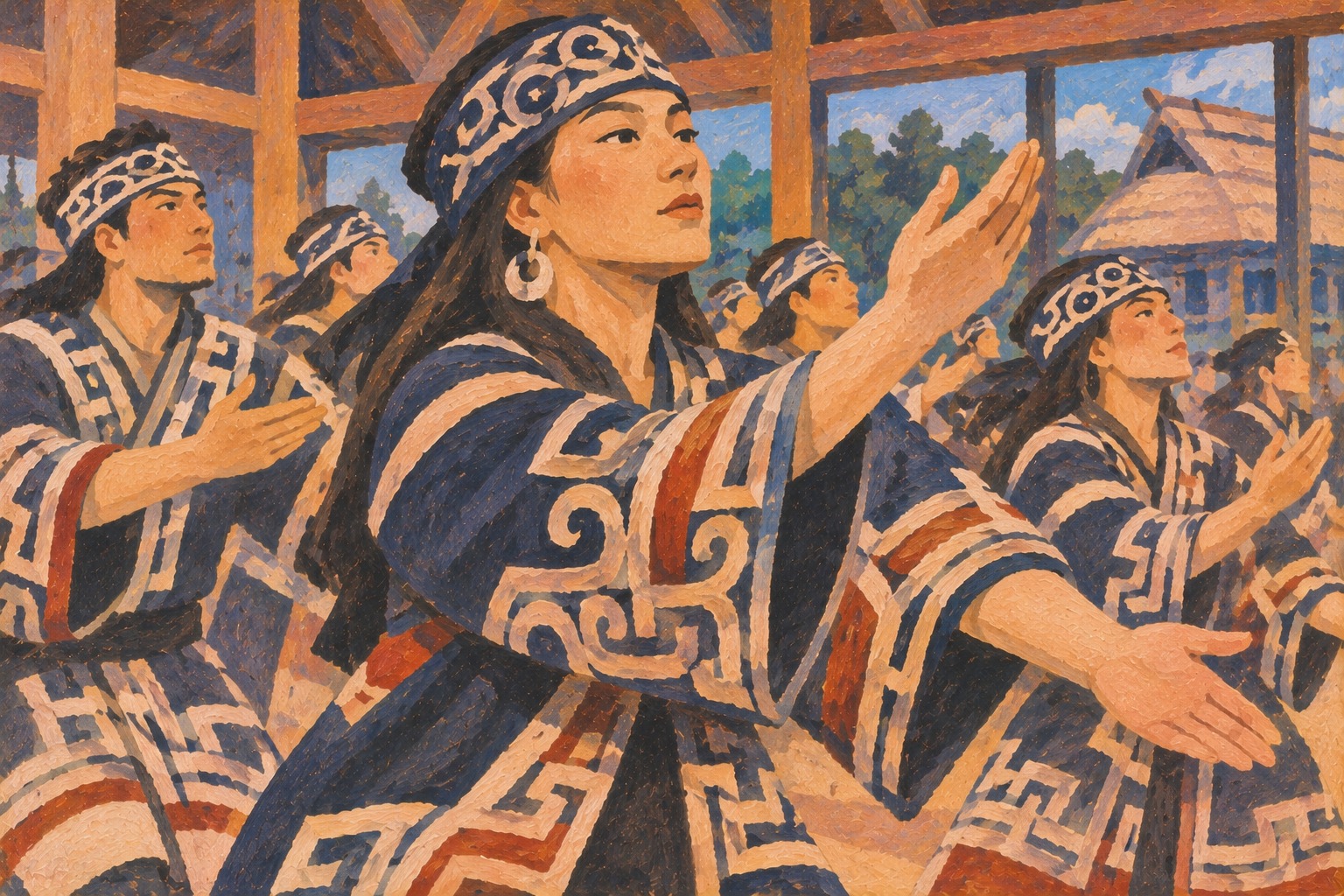
For journalists, it means distinguishing a public demonstration from a ceremony, avoiding invented explanations of symbolism, and not assuming that a museum’s presentation speaks for every Ainu person. Visitors should follow the venue’s and performers’ rules for photography and recording. An editorial illustration is not evidence of a particular dance or costume.
Ultimately, the health of a living tradition is not measured solely by how faithfully it resembles an image from a century ago. It also depends on whether its practitioners have the freedom and resources to decide what to teach, what to share and how to create. Sunday’s program in Shiraoi is a small window onto that much larger work.
Primary sources and references
- Upopoy — November preservation association program
- Obihiro City — Traditional Ainu dance (updated March 3, 2026)
- Obihiro Centennial Museum, Riwka — cultural transmission groups
- Agency for Cultural Affairs — national cultural property register
- UNESCO — Traditional Ainu dance
- Agency for Cultural Affairs — promotion of Ainu culture
- Ainu Association of Hokkaido — history
- Upopoy — history, culture and education FAQ
- Upopoy — institutional history and functions
- Upopoy — facilities and meaning of its name
- Nibutani Ainu Culture Museum — regional dance traditions
- National Museum of Ethnology — Saru River dance and oral literature
- United Nations — Declaration on the Rights of Indigenous Peoples, Article 31
- Upopoy — FY2026 regional association program