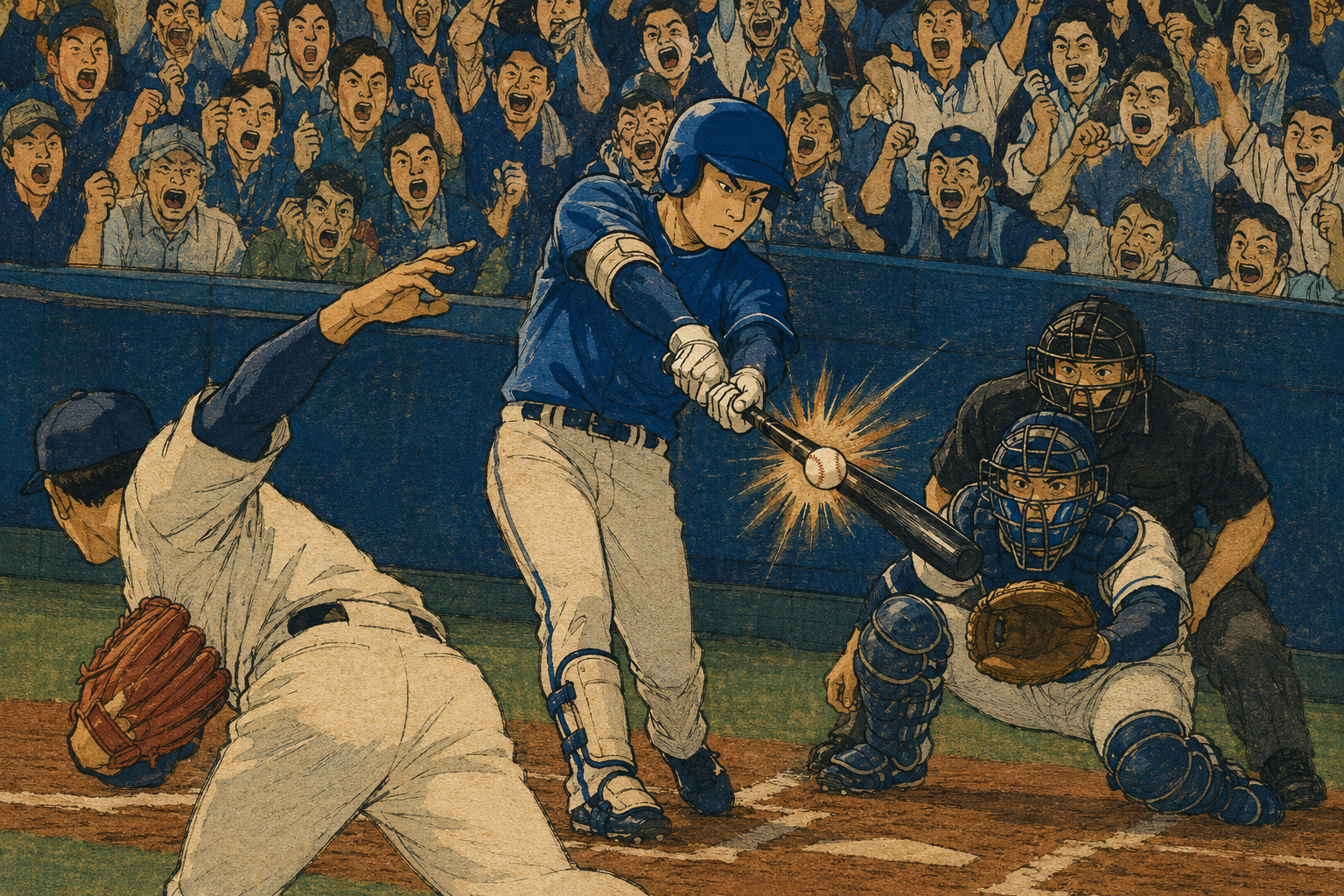
Hiroki Tokoda. Shota Suzuki. Kotaro Ohtake. Kazuyuki Takemaru. Haruto Takahashi. Yudai Ono. Easton Lucas. Seven pitchers from five opposing clubs, separated by age, repertoire and role. They share two facts in Asahi Miyashita’s rookie record: each throws left-handed, and each surrendered exactly one of his first seven Nippon Professional Baseball home runs.
NPB’s player page had already absorbed one game beyond the requested Aug. 24 cutoff: Miyashita went 4-for-5 with a double on Aug. 25. Subtracting that official game log restores the earlier snapshot to 56 games, 168 at-bats, 39 hits, six doubles, seven homers and 21 RBIs. His cutoff slash line was .232/.279/.393. The league page confirms the cumulative season total but does not divide it by pitcher handedness.
To test the 7–0 claim, Japan.co.jp matched each home run on DeNA’s official play-by-play against NPB’s official pitcher rosters. All seven were left-handed. There was no repeat victim: seven pitchers for seven home runs. Six were starters. The only relief pitcher was Chiba Lotte’s Suzuki.
That makes the pattern real. It does not make every conclusion drawn from it real. A right-handed batter holding a platoon advantage over a left-handed pitcher is conventional baseball, not a reverse split. The extreme feature is that Miyashita’s home-run column is entirely concentrated on that conventional side of the matchup.
The seven swings in game context
The sequence began at Yokohama Stadium on April 12. Miyashita drove a seventh-inning Tokoda pitch into the right-field seats for his first professional homer, bringing DeNA within one run of Hiroshima. The BayStars scored four in the eighth and won 6–5.
Two months passed before No. 2. On June 14 at ZOZO Marine Stadium, Miyashita pulled a two-run shot off reliever Suzuki into left field in the eighth inning of a 6–4 loss. The third, at Koshien on July 20, opened the scoring against Ohtake and traveled to right; DeNA won 7–0.
Then came four in 21 days. Miyashita hit a second-inning grand slam to left off Takemaru at Tokyo Dome on Aug. 1, supplying the first runs of an 8–7 win over the Giants. On Aug. 5, his two-run shot to right off Takahashi broke a 2–2 tie in an 11–7 win over Hanshin. Ono allowed a solo homer to right-center in a 5–2 Chunichi win on Aug. 11. Lucas yielded another right-center solo on Aug. 21; it was DeNA’s only run in a 4–1 loss to Hanshin.
| No. / date | Left-handed pitcher | Ballpark / direction | Situation | Final |
|---|---|---|---|---|
| 1 / Apr. 12 | Hiroki Tokoda, Hiroshima | Yokohama / right | 7th-inning solo, cut deficit to 3–4 | DeNA 6–5 |
| 2 / June 14 | Shota Suzuki, Lotte | ZOZO Marine / left | 8th-inning two-run, cut deficit to 4–6 | DeNA 4–6 |
| 3 / July 20 | Kotaro Ohtake, Hanshin | Koshien / right | 5th-inning solo, opened scoring | DeNA 7–0 |
| 4 / Aug. 1 | Kazuyuki Takemaru, Yomiuri | Tokyo Dome / left | 2nd-inning grand slam, opened scoring | DeNA 8–7 |
| 5 / Aug. 5 | Haruto Takahashi, Hanshin | Yokohama / right | 2nd-inning two-run, broke 2–2 tie | DeNA 11–7 |
| 6 / Aug. 11 | Yudai Ono, Chunichi | Vantelin Dome / right-center | 6th-inning solo, cut deficit to 2–4 | DeNA 2–5 |
| 7 / Aug. 21 | Easton Lucas, Hanshin | Yokohama / right-center | 2nd-inning solo, opened scoring | DeNA 1–4 |
The home runs produced 12 RBIs—more than half of Miyashita’s 21—and DeNA went 4–3 in the seven games. Four were solo shots, two came with one runner aboard, and one was a grand slam. Three opened the scoring; one broke a tie. These were not seven interchangeable additions to a total.
The spray chart hidden inside the handedness story
Calling Miyashita a “lefty killer” compresses the data into the pitcher’s arm. The batted-ball directions point back toward the hitter. A right-handed batter pulled only two of the seven home runs to left. Three went to right and two to right-center.
That distribution echoes the BayStars’ own pre-draft assessment. In the club’s 2025 draft guide, the scouting department called him a big right-handed infielder capable of extra-base power “to all fields.” A scouting comment is an employer’s projection, not independent proof. The official game log now supplies a concrete early result compatible with it.
Tokoda, Ohtake and Takahashi saw balls leave to right. Ono and Lucas saw them leave to right-center. The two pulled homers came against Suzuki and Takemaru. This is not evidence that every pitch was outside or that every swing followed the same mechanical plan; DeNA’s text logs do not disclose complete pitch location, velocity, movement, exit velocity or launch angle. It is evidence that Miyashita’s power against left-handers has not required a single landing zone.
Power inside an unfinished offensive line
Seven home runs can make the rest of a rookie line disappear. It should not. At the cutoff, Miyashita had 39 hits in 168 at-bats. Thirteen were extra-base hits: six doubles and seven homers, with no triples. He had 66 total bases, two steals and only two grounded double plays.
The same line contains 43 strikeouts and 11 walks. His .279 on-base percentage trailed his .393 slugging percentage by 114 points. His isolated slugging—the difference between slugging average and batting average—was .161. That is useful early power, but it sits beside a still-developing ability to extend plate appearances and reach base without a hit.
Those facts create two honest readings at once. Miyashita has already shown enough impact for one swing to alter a game: a grand slam, a go-ahead two-run homer, three opening runs. He also has a small major-league sample in which pitchers are collecting evidence as quickly as he is.
- Every home run through Aug. 24 came against a left-handed pitcher.
- The seven homers came against seven pitchers from five clubs.
- Five were driven to right or right-center; two were pulled to left.
- The Aug. 24 line was .232/.279/.393 in 180 plate appearances.
- It does not supply handedness-specific plate appearances, batting average, on-base percentage, strikeouts or walks.
Hokkaido, Toyo and an early national-team selection
Miyashita was born Jan. 26, 2004, in Hokkaido. He played at Hokkai High School, then Toyo University. Samurai Japan’s official archive places him on the collegiate national team for the 44th Japan–USA University Baseball Championship in 2023, wearing No. 4 as an infielder. He was 19 and in his second university year.
DeNA selected him in the third round of the 2025 draft. The club described more than a bat: an infielder with the versatility to play across the dirt, soft glove work and stable throwing. Its 2026 profile lists him at 182 centimeters and 88 kilograms, right-handed throwing and batting, uniform No. 34. He started at shortstop and hit sixth in DeNA’s most recent game before the cutoff, an Aug. 23 loss to Hanshin.
At the December 2025 presentation for new players, Miyashita reduced his declaration to one word: dorokusaku—“gritty” or “willing to do the dirty work.” He said becoming a professional was not the end of the dream. The phrase matters because the home-run split is exactly the kind of novelty that can obscure the less visible demands of a rookie season: daily defensive repetitions, video review, travel, recovery and the next adjustment after opponents learn the first one.
2004 Born Jan. 26 in Hokkaido.
Hokkai High Plays high-school baseball in Hokkaido.
2023 Selected for Japan’s collegiate national team while at Toyo University.
October 2025 DeNA takes him in the third round of the NPB draft.
April 12, 2026 First professional homer, off Tokoda to right field.
Aug. 21, 2026 Seventh homer, off Lucas to right-center.
A franchise that remembers rookie power
The BayStars’ franchise line extends back through the Yokohama and Taiyo names. In his first season listed by NPB, Taiyo Whales infielder Takeshi Kuwata hit 31 home runs and drove in 84 runs over 125 games in 1959. The total remains an imposing historical marker for any rookie in the organization’s lineage.
A more immediate comparison occupies the same DeNA infield. Shugo Maki hit .314 with 22 homers and 71 RBIs in his 2021 rookie season. His 35 doubles set a Central League rookie record at the time, according to NPB, and he became the first rookie in Japanese professional baseball to hit for the cycle.
Miyashita’s seven should not be projected mechanically toward 22 or 31. Kuwata and Maki’s numbers are completed seasons of 125 and 137 games. Miyashita’s total covers 57 appearances through late August. Run environments, roles and opportunities differ. The history offers scale, not destiny.
It also offers a more demanding standard than novelty. A 7–0 handedness split can define a week of coverage. A durable rookie season requires enough offensive and defensive value to stay in the lineup after every club updates its plan.
How the next chapter could erase the headline
The next home run against a right-hander would end the perfect 7–0 ratio. That would not weaken Miyashita’s season; it would widen it. The next left-handed opponent can also approach him differently—harder inside, softer farther away, fewer pitches in the zones his opposite-field swing has punished. Managers can summon a right-handed reliever earlier. These are normal tactical possibilities, not reported plans from any opponent.
The most valuable future evidence will arrive in several columns: whether he earns more walks, reduces empty two-strike swings, sustains extra-base impact and remains playable across the infield. A home-run split is a discovery. A complete player is an accumulation.
DeNA’s official cheer song for Miyashita already asks for home runs “to right and to left.” Through Aug. 24, the actual sequence ran right, left, right, left, right, right-center, right-center. The song had the geography correct. The surprise was on the mound every time.
Seven left-handers made the pattern. Five opposite-field drives made it interesting. What Miyashita does after opponents know both facts will determine whether this is remembered as a statistical curiosity or as the first visible shape of his power.
- Nippon Professional Baseball — Asahi Miyashita individual season statistics, current Aug. 25
- Yokohama DeNA BayStars — official Asahi Miyashita profile
- Yokohama DeNA BayStars — 2025 draft guide and scouting assessment
- Yokohama DeNA BayStars — 2025 draft rights announcement
- Yokohama DeNA BayStars — 2026 new-player presentation
- Samurai Japan — Asahi Miyashita collegiate national-team profile
- Yokohama DeNA official game records: Apr. 12 vs. Hiroshima, June 14 vs. Lotte, July 20 vs. Hanshin, Aug. 1 vs. Yomiuri, Aug. 5 vs. Hanshin, Aug. 11 vs. Chunichi, Aug. 21 vs. Hanshin, Aug. 25 vs. Hiroshima, used to restore cutoff
- NPB 2026 official rosters used to verify throwing hand: Hiroshima, Chiba Lotte, Hanshin, Yomiuri, Chunichi
- Nippon Professional Baseball — Takeshi Kuwata career statistics
- Nippon Professional Baseball — Shugo Maki career statistics
- Nippon Professional Baseball — review of 2021 batting records
- Yokohama DeNA BayStars — August 2026 schedule and results
Editorial note: The names, readings, club affiliations and throwing hands of Miyashita and all seven pitchers were checked against NPB and club records. Dates, home-run directions, scoring situations and final scores were reconstructed from DeNA’s official game logs. Aug. 24 was an off day; to restore that cutoff, we subtracted Miyashita’s official Aug. 25 line—4-for-5, one double and one strikeout—from NPB’s Aug. 25 cumulative totals. Public official totals do not provide handedness-specific plate appearances, averages, pitch data or exit velocities, so none is inferred. The scouting description is identified as the club’s assessment. The illustration is conceptual. The supplied exchange-rate update of Aug. 25 at 7:48 p.m. UTC converts to Aug. 26 at 4:48 a.m. JST.