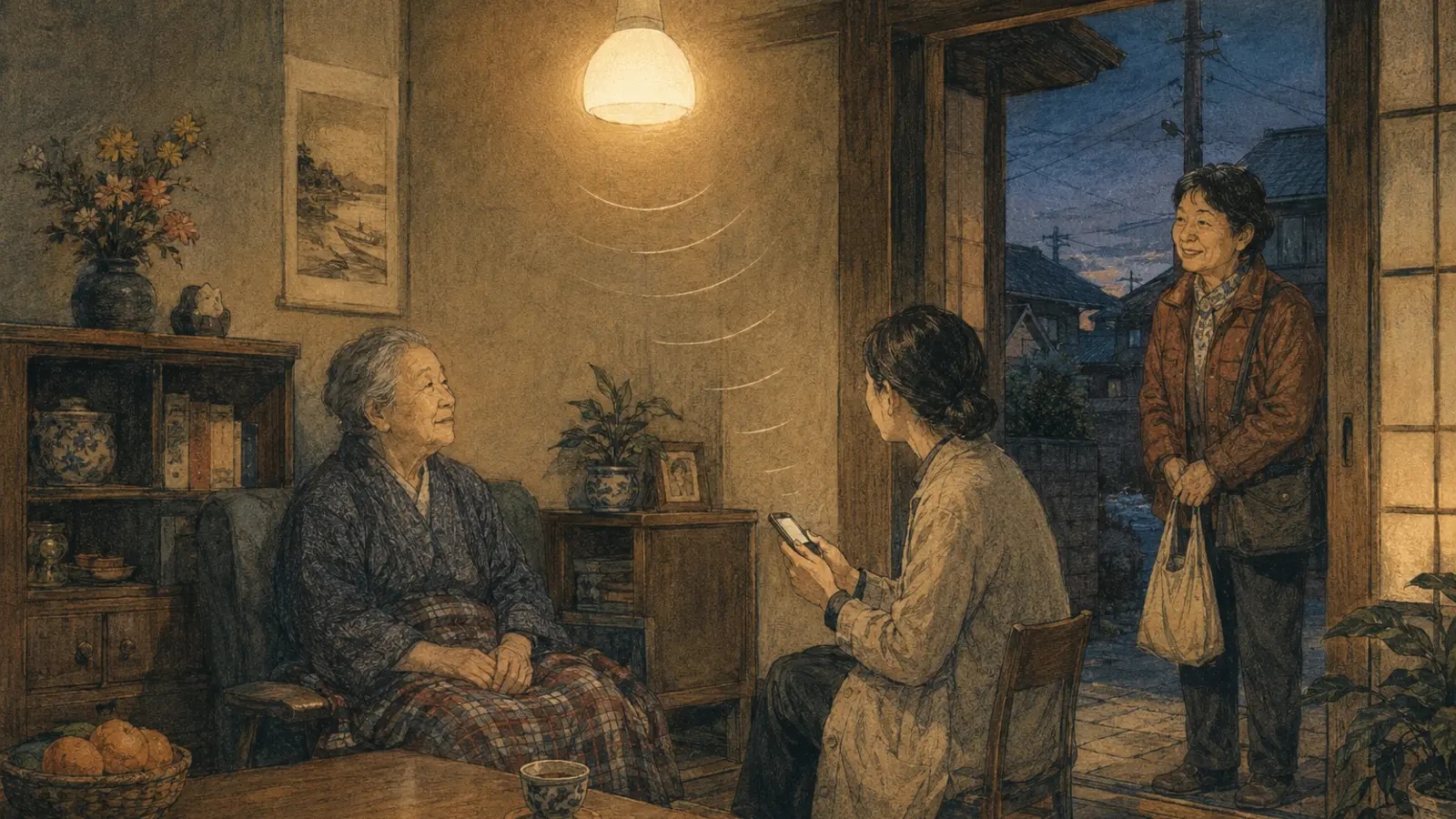
At 2 a.m., the hallway light goes dark. The person who lives there may simply have returned to bed. Morning arrives and it does not come on. Noon passes without an on or an off. The bulb cannot know why. Its resident may be traveling, spending the day in another room, avoiding that switch—or lying somewhere in need of help.
It knows only this: the expected change did not happen. Hello Technologies’ Hello Light sends that small absence beyond the home over a mobile network. On August 6, 2026, the company and regional-marketing specialist Mindshare announced a partnership intended to build a nationwide monitoring network around that signal.
The ambition is striking. Within three years: 100 municipalities and 50,000 households. Over the medium to long term: 1,000 municipalities and one million households. Community-development companies, regional trading companies, destination-management organizations and welfare groups would become local operators. People who know the area would work as paid “community monitoring partners.”
Communicating that “nothing happened”
Hello Light integrates an LED, antenna and SIM into a bulb designed for the common E26 socket. It does not require a household Wi-Fi router or a separate communications hub. Installed in a hallway, toilet or on stairs—somewhere the resident ordinarily uses a light every day—it transmits changes in the switch state over low-power wide-area mobile communications.
In “period detection” mode, the service treats the absence of a change during a specified day, or a light remaining continuously on, as a possible abnormality and notifies registered contacts by email or another channel. One standard direct-sale setting examines midnight through 11:59 p.m. and sends an alert at 10 the following morning if no change occurred. Detection windows, recipients and visiting services vary by seller and municipal plan.
The bulb is not “watching” the person in the conventional sense. It records no video, conversation, pulse or room-by-room movement trail. It knows one extremely narrow piece of household behavior: when a particular light changed state.
| Signal | Ordinary explanation | Responsible next step |
|---|---|---|
| No on/off change | Travel, an overnight stay, use of another room or a changed schedule | Contact the resident or family before drawing a conclusion |
| Light remains on | Forgetfulness, a different habit, reading or nighttime activity | Compare with the person’s routine; do not label it an emergency automatically |
| No communication | Failure, outage, removal of the bulb or network disruption | Treat equipment and welfare checks as part of one defined procedure |
| Normal light activity | Ordinary use, another person or an automatic control | Remember that a normal signal is not proof of health |
Why a bulb instead of a camera?
The monitoring market offers wearable emergency buttons, room-motion sensors, smart power and water meters, speakers, conversational robots, watches and fall-detection cameras. Each can provide valuable information. Many also require the resident to wear, charge, speak to or configure something—or to accept multiple sensors inside the home.
A bulb’s advantage is that it asks for almost no new ritual. The old switch becomes the check-in action. Because there is no image, it can be easier to discuss installation near a toilet or bedroom corridor. Founder Akira Torii recalls early users saying that the approach did not make them worry, while service providers found it easier to explain because it preserved privacy.
Data minimization is also functional limitation. A person could fall while a timer or housemate continues operating the light, producing no alert. A healthy person away for the night could produce one. Cognitive decline, a failed lamp and a power cut can look identical. This is neither a fall detector nor a medical device. It is a delayed sensor for the absence of a familiar household response.
Before Hello Light, a connected light needed a second box
The idea did not appear in 2026. According to Torii’s product history, the first connected monitoring lamp was announced in June 2015. It needed both a bulb and a separate internet gateway. Installation cost tens of thousands of yen, service cost several thousand yen a month, a spare outlet was required and residents sometimes unplugged the gateway. The concept attracted interest but did not spread.
Low-power wide-area communications changed the design. After more than three years of development and trials, the company announced Hello Light in December 2018, integrating the LED, antenna and IoT SIM. Shipments began in May 2019. Because each bulb carries its own connection, the monitored household does not need a smartphone or broadband subscription.
In 2020, Yamato Transport began a trial in Tama, western Tokyo. In 2021 it expanded its Kuroneko Monitoring Service Hello Light Visit Plan nationwide. If no light change is recorded for 24 hours, a family contact is alerted. When that person cannot visit, Yamato staff can be asked to conduct a proxy welfare check during business hours. Daito, Osaka, has subsidized the plan’s ¥1,870 monthly charge since fiscal 2023.
The Yamato plan received a Good Design Award in 2023. In September 2025, Hello Technologies said the bulbs had recorded 100 million switching events and had been used to monitor more than 16,000 people. The hardware has moved beyond a tiny prototype. The new question is institutional: who explains it, installs it and assumes responsibility after the message arrives?
1917 · Okayama’s Saisei Komon system begins the lineage of Japan’s welfare commissioners.
1946 · The modern name minsei-iin is adopted.
2015 · The first connected monitoring light is announced with a separate gateway.
2018 · Hello Light integrates the LPWA SIM and LED.
2019 · First shipments.
2020 · Yamato begins a monitoring trial in Tama.
2021 · Yamato expands its visit plan nationwide.
2025 · The company reports 100 million switching events and 16,000+ users.
2026 · Mindshare and Hello Technologies announce the million-home vision.
More than eight million older people living alone
The pressure comes not only from population aging but from the transformation of family structure. A Cabinet Office projection put the number of people 65 and older living alone at 8.155 million in 2025 and 8.87 million in 2030. In 1980, living alone accounted for 4.3 percent of older men and 11.2 percent of older women. By 2020, the shares were 15.0 and 22.1 percent.
Living alone is not itself isolation or danger. Many people choose independence and retain work, friendships and community roles. Reducing “older adults living alone” to one vulnerable stereotype turns monitoring from assistance into surveillance. The more meaningful questions are whether an unexpected silence reaches someone, and how quickly a real person can respond.
Delayed discovery is nevertheless real. Final National Police Agency data for 2025 show that, among 204,562 bodies handled by police, 76,941 were people living alone who died at home. Of those, 58,919 were 65 or older. This is not a count of deaths caused by social isolation; it is an administrative category of police-handled deaths and cannot describe every cause or relationship. Yet 24,096 of the older people fell into intervals of four days or more before discovery, exposing gaps in contact.
The human network is not growing at the same pace. Japan’s system of volunteer welfare commissioners began with Okayama’s Saisei Komon program in 1917. For more than a century, commissioners have visited residents, heard concerns and connected households with public welfare. In the December 2025 nationwide appointment, 220,880 people filled 240,971 authorized positions—a 91.7 percent fill rate, down from 93.7 percent three years earlier. About 20,000 seats remained vacant.
From unpaid goodwill to paid local infrastructure
The most consequential part of the partnership is its response to that labor shortage. Mindshare is to lead coordination with municipalities and local groups, service operations, enrollment and support for local personnel. Hello Technologies supplies the bulb and related system.
Community monitoring partners would explain the service, assist applications and confirm installation, creating a regular point of contact with residents. Community-development companies, regional trading companies, DMOs and welfare organizations could combine that work with shopping assistance, local delivery, transportation or other services. The proposition is to return legitimate compensation to the community instead of continually adding unpaid duties to volunteers.
That fits Japan’s integrated community care ideal: allowing a person to maintain an independent life in familiar surroundings through coordinated housing, medicine, nursing care, prevention and everyday support. If a bulb opens a relationship that also reaches food, transport and care counseling, its value could extend beyond the rare alert day.
But the announcement is still a blueprint. It does not say whether community partners will make post-alert calls or visits, who covers nights and holidays, who decides when to call emergency services, what a false alarm costs, how residents will pay, or how workers will be trained and audited. One million households do not mean merely one million bulbs. They mean one million sets of consent, contacts, routines and local resources that must remain current.
Less surveillance does not mean no privacy risk
Collecting less than a camera is a genuine strength. It does not make the remaining data harmless. Repeated switching times can suggest waking, sleeping, absence or changes in nighttime activity. Connected to a bulb identifier, address, subscriber and emergency contacts, those signals become protected behavioral information.
A 2024 review of how adults 50 and older perceive smart-home surveillance found that 13 of the 15 included studies discussed privacy concerns involving collection and access. Nine also reported enthusiasm for improved safety. The desire for protection and unease about observation coexist.
- Resident consent: Can the person who lives there understand, choose and later withdraw—not merely the family or landlord?
- Recipients: Which details go to relatives, the local operator and government, and at what stage?
- Retention: How long are switching histories stored, and how are they deleted after cancellation?
- False and missed signals: What happens during travel, outage, device failure—or an accident hidden behind normal activity?
- Response: What are the defined times and thresholds for a call, visit or emergency referral?
- Equity: Who pays, and what happens when the home lacks a compatible fixture, connectivity or a digitally capable relative?
- Human contact: Does installation complement conversation and visits, or quietly replace them?
The best monitoring exists on days without an alert
Saving human effort is not the same as removing relationships. A bulb can poll one million households every day, but it cannot measure loneliness. A person may switch on a light while having no one to talk to, may preserve daily motions while becoming ill, or may hesitate to ask for help. The dashboard can remain normal.
Nor can people perform every check unaided as the working-age population contracts. An unlimited dependence on welfare commissioners, relatives, drivers and care managers exhausts the very people providing support. If a sensor reduces routine checking and lets people spend more time on conversation, judgment and urgent response, machine and neighbor stop being rivals.
Success therefore needs measures beyond bulbs shipped. Operators should publish median alert-to-contact time, false-alert and unreachable rates, local-partner turnover, privacy complaints, referrals that actually reached health or welfare support, and whether residents feel more independent rather than more watched.
The future: can a bulb become the beginning of a relationship?
Hello Light’s history is one of removing technology from the resident’s path: eliminate the separate router, reduce setup, avoid the camera and use an existing switch. The social system should pursue the same principle—do not burden the resident with a complicated institution; arrange for a trusted person to appear when needed.
Behind that simple surface, however, the operation must be rigorous: trained responders, recorded consent, backup contacts, night coverage, data protection, device-failure detection, safe visiting procedures and municipal coordination. Scale without those details could produce a glowing bulb and no meaningful help.
Since 1917, Japanese neighborhood welfare has depended on the eyes and ears of people who know the area. The new proposal does not replace them with a light bulb. It asks the bulb to notice one easily missed silence, then passes the relationship to a local person whose work is recognized and paid.
The following morning, a notification appears. It is not a diagnosis. It is a question: “The usual light did not change.” The future of a million-home network will be decided by what happens next—who makes the call, who walks to the door and who addresses the person inside by name.
- Mindshare and Hello Technologies partnership announcement — three-year and long-term targets, division of roles and local-partner model.
- Hello Technologies, Hello Light product and development history — communications, detection modes, 2015–19 development and deployments.
- Yamato Transport’s nationwide monitoring-service launch and Daito’s Hello Light subsidy program — an existing notification-and-visit model.
- National Police Agency, 2025 data on people living alone who died at home.
- Cabinet Office aging-society white paper, families and households — trends and projections for older people living alone.
- Ministry of Health, Labour and Welfare, history of welfare commissioners, and 2025 nationwide appointment results.
- Ministry of Health, Labour and Welfare, integrated community care.
- JMIR review of smart-home surveillance perceptions among adults 50+ — safety, privacy and user agency.
Editor’s note: One million households is a company’s medium- to long-term target, not an installed base. Hello Light is an auxiliary monitoring product that reports changes in a light; it is not a medical device, fall detector or emergency alarm. This article does not equate the police category “people living alone who died at home” with every definition of lonely or isolated death.