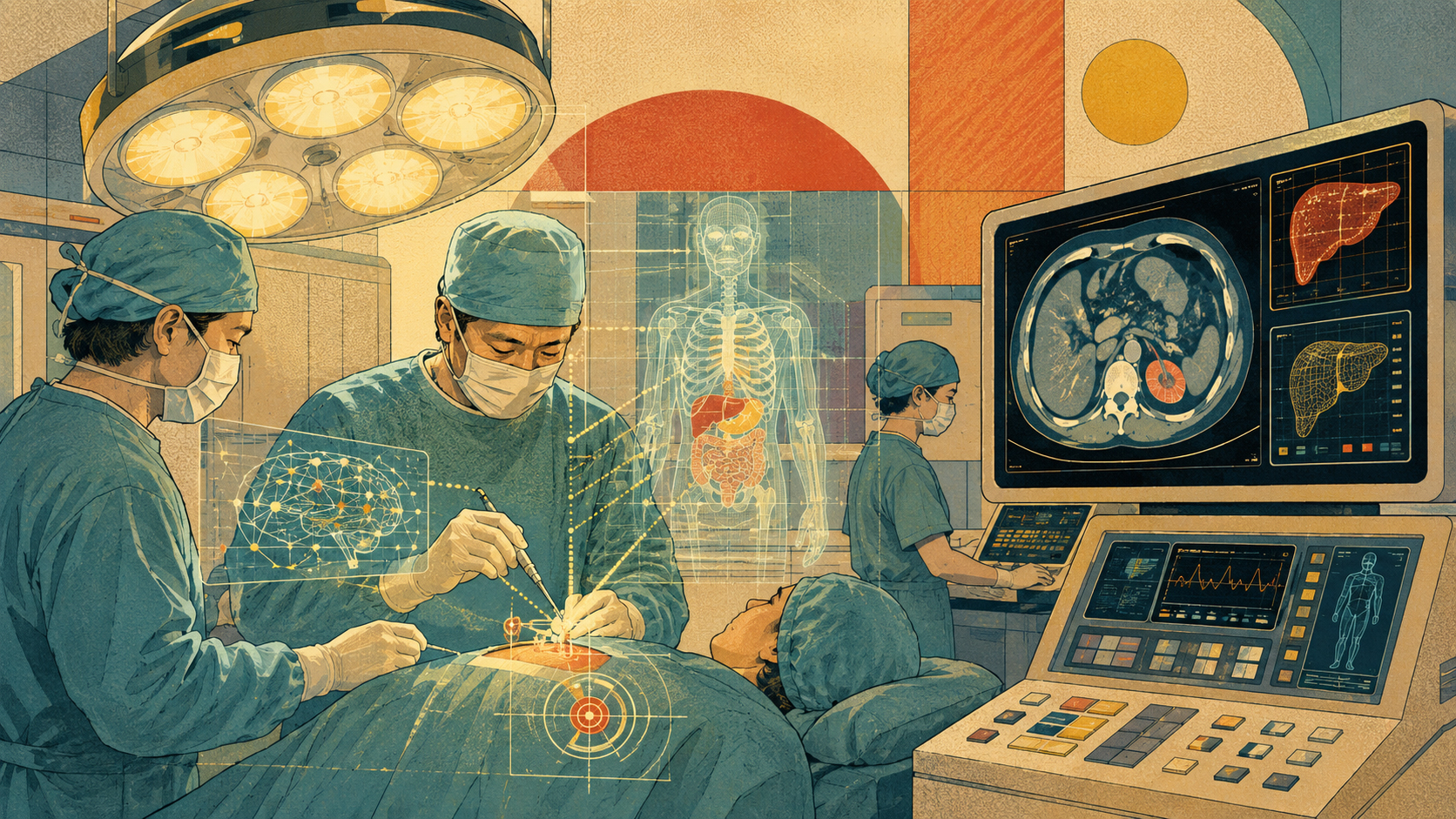
In an operating room, artificial intelligence is not a slogan. It is not a shiny dashboard, a productivity demo, or a pitch-deck promise. A wrong highlight, a missed nerve, a misplaced confidence cue, or a poorly timed instruction can change the life of a patient. That is why the story of Direava, a Tokyo medical-AI startup, is more serious than most AI stories in Japan’s 2026 boom. It is about whether the knowledge of expert surgeons can be captured, taught, checked, and carried forward before Japan’s surgical workforce thins too far.
Direava’s own language is direct: “Smarter surgery, Deeper insight.” The company says it wants to give AI the power to see, think, and communicate, redefining surgery itself. That does not mean replacing the surgeon. It means building another intelligence beside the surgeon — one that can read the field, flag danger, preserve expert technique, and help younger doctors learn what a senior surgeon sees almost instinctively.
In June 2026, Direava became one of the most interesting small-company AI stories in Japan. A Jiji Press report said the company was developing a generative-AI surgical support system with government backing. The system analyzes images of organs and blood vessels, then produces written, step-by-step procedural guidance and cautions. In a February trial, medical students asked questions while watching footage of a gastric cancer operation; medical experts later judged the AI’s responses to be roughly 85% to 90% accurate. Direava is expected to begin with an instructional tool rather than full clinical decision automation. Even so, the direction is clear: Japan is trying to turn surgical expertise into software before the apprenticeship chain breaks.
Why surgical AI now?
Japan’s surgical workforce problem is no longer theoretical. According to a Nippon.com summary of a Ministry of Health, Labor, and Welfare expert panel, the number of cancer surgeries is expected to fall slightly, from 465,000 in 2025 to 440,000 in 2040. That sounds like relief. It is not. The number of surgeons capable of performing those operations is expected to fall faster than the surgical workload.
The pressure is especially acute in gastrointestinal surgery. Between 2012 and 2022, the number of surgical gastroenterologists fell by about 10% to around 19,000. The number under age 40 fell by 15%. If current trends continue, physicians under 65 who are eligible for membership in the Japanese Society of Gastroenterological Surgery are projected to decline from 15,200 in 2025 to 9,200 in 2040, creating an estimated shortage of 5,200 surgeons.
That is the backdrop for Direava. Japan’s aging population increases the complexity of care. Work-style reform limits the long hours that used to hold the system together. Emergency operations at night and on holidays remain demanding. Young doctors see the intensity, the responsibility, and the lifestyle costs of surgery and choose other paths. A system that once relied on heroic overwork now needs new tools.
What Direava is trying to build
Direava describes its work as an AI surgical platform. Its website says the company is not stopping at anatomical recognition. It is working on intraoperative situational awareness, detection of dangerous actions, decision-support software, safer and more precise surgery, and the reduction of complication risk.
That sequence matters. First, the system must see: organs, vessels, nerves, instruments, field changes, and movement. Then it must think: what stage is this operation in, what hazard is near, what action resembles an expert maneuver, what motion could become dangerous? Finally, it must communicate: through highlights, alerts, written steps, teaching comments, structured video review, or postoperative analysis.
Surgical AI is hard because surgery is not a still image. Organs move. Blood appears. Smoke clouds the view. Camera angles change. Tissue is pulled, cut, lifted, and hidden. Anatomy differs from patient to patient. A model that merely labels an organ is not enough. The more valuable system is the one that can tell a surgeon, a trainee, or an educator: this is the dangerous moment; this is the structure you should not lose; this is the maneuver an expert would slow down before attempting.
Kinosura: the practical first step
In January 2026, Rokken announced that “Kinosura,” an AI-powered surgical video recognition program developed by Direava with Rokken’s support, had received regulatory approval. The product is used in robot-assisted resection of malignant esophageal tumors. During surgery, AI analyzes video and detects and highlights the left and right recurrent laryngeal nerves, supporting surgeon recognition.
That sounds narrow. It is actually important. The recurrent laryngeal nerves are small but critical structures involved in vocal cord movement. In esophageal cancer surgery, injury can lead to hoarseness, swallowing difficulty, aspiration risk, and other complications. Experienced surgeons learn to read the subtle visual cues in a crowded field. Younger surgeons need that knowledge transferred without waiting decades.
Kinosura shows that Direava’s vision is not merely speculative. Before autonomous surgery, before grand claims about AI replacing human judgment, there is a practical and medically meaningful task: make the structure that must not be missed easier to see. In medicine, that kind of incremental precision matters.
Direava and Japan’s surgical numbers
The importance of being surgeon-founded
Direava’s chief executive, Yushi Takeuchi, is an assistant professor in surgery at Keio University School of Medicine with a background in gastrointestinal surgery. Direava’s website says he graduated from Keio University School of Medicine in 2012, completed graduate medical studies in 2019, worked as a research fellow at IRCAD in Strasbourg in 2020, and continued in clinical and academic surgery in Japan.
That matters. A medical-AI company can build an impressive demo while still missing the operating room. Surgeons do not need noisy alerts. They do not need a system that explains the obvious. They do not need a black box that shifts responsibility. They need software that understands when silence is best, when a warning is justified, when an educational comment belongs after the operation rather than during it, and when a visual highlight will help instead of distract.
Direava calls itself surgeon-perspective technology created by an active surgeon. In a regulated medical-device context, that is not a marketing flourish. It is one of the preconditions for trust. Surgical AI must fit the human factors of the operating room, not merely the benchmark table.
GENIAC and the national industrial frame
Direava announced in June 2026 that it had been selected for the fourth public call of GENIAC, a Ministry of Economy, Trade and Industry and NEDO project to strengthen Japan’s domestic generative-AI development capacity. The company also announced a third-party allotment of new shares to investors including SPARX, Nissay Capital, and SBI Investment.
That places surgical AI inside a larger industrial-policy question. Japan may not win the global large-language-model scale race by brute force alone. But Japan has strengths in robotics, precision equipment, hospitals, clinical expertise, manufacturing discipline, and high-quality specialty data. Surgical AI sits at the intersection of those strengths.
If expert surgical video, annotation, medical-device development, clinical validation, and global education can be tied together, Japan could build exportable medical knowledge infrastructure rather than merely import foreign AI products. The operating room, in that sense, becomes both a medical site and a national technology frontier.
The global promise — and the safety warning
The American College of Surgeons wrote in January 2026 that AI can help integrate preoperative diagnostics, intraoperative guidance, and postoperative monitoring into a more coordinated system. In the OR, advanced imaging and AI analytics can support better assessment of technique and performance; beyond the OR, simulation can help trainees practice and benchmark their progress.
But the same article emphasized that a surgeon’s responsibility remains to the patient, not the algorithm, not speed, and not financial margin. AI is not a replacement for clinical judgment. Surgeons must lead the governance, data standards, transparency, and ethical use of these systems.
Reuters delivered a sharper warning in February 2026, reporting on adverse-event claims and lawsuits involving AI-enabled medical devices in operating rooms. The details are contested, and device reports do not establish causation by themselves. But the lesson is clear: AI in surgery can create new categories of risk. A confident-looking navigation cue may be wrong. A system trained for one context may mislead in another. A feature added for marketing can enter a safety-critical environment before the evidence base is mature enough.
That is why Direava’s path should be judged not by how loudly it talks about autonomy, but by how carefully it validates limited use cases, logs performance, handles responsibility, educates surgeons, and works with regulators. The safer future of AI surgery will likely arrive through narrow, validated assistance before broader autonomy.
AI as apprenticeship infrastructure
Surgery has long been taught by observation, repetition, supervision, and reflection. Young doctors watch experts. They assist. They make mistakes under supervision. They review. They slowly acquire a sense of danger that is difficult to put into words. But work-hour limits, staffing shortages, and uneven case distribution make that apprenticeship harder to sustain.
AI can become a new layer of apprenticeship infrastructure. It can structure surgical video, mark key moments, compare trainee motion with expert motion, explain why a senior surgeon paused, and make rare or difficult cases reviewable outside the operating room. Direava’s educational work and its Surgo surgical education platform point in this direction.
A video cannot make someone a surgeon. An AI answer cannot replace years of supervised practice. But the ability to preserve expert judgment, annotate it, search it, and teach it repeatedly is powerful. In the near term, the most important surgical AI may not be a robot that cuts. It may be the system that helps the next generation understand why the master surgeon did not cut yet.
Japan.co.jp view
Direava is compelling because it is entering one of AI’s hardest rooms. Back-office automation, sales agents, search, advertising, and enterprise chat matter. But surgical AI carries a different moral weight. If it fails, the damage is not a typo or a lost lead. It may be a complication.
That makes the company’s success conditions unusually strict. The technology must be accurate, but accuracy is not enough. It must be explainable enough for clinical use, modest enough not to overclaim, useful enough for surgeons to keep using, and safe enough for regulators and hospitals to trust. It must support the surgeon rather than blur the surgeon’s responsibility.
Japan’s AI industry is often measured against American and Chinese foundation-model giants. That comparison misses Japan’s quieter opportunity. In fields where expert practice, field data, precision equipment, and safety culture matter, Japan can still build world-class AI companies. Direava is one of the small firms showing what that path might look like — not from the chat window, but from the operating room.
Reader takeaways
| Item | Meaning |
|---|---|
| What happened | Direava is gaining attention for surgical AI aimed at Japan’s surgeon shortage and training gap. |
| Technology direction | The company is working on AI that recognizes anatomy, detects risky actions, supports decision-making, and reduces complication risk. |
| First implementation signal | Kinosura, a Direava-developed AI video recognition program for robot-assisted esophageal cancer surgery, received regulatory approval. |
| Social backdrop | Japan may face a shortage of roughly 5,200 gastrointestinal surgeons by 2040. |
| Main challenge | Surgical AI requires not only accuracy, but trust, regulation, responsibility, explainability, and careful clinical validation. |
Sources and references
This article draws on Direava’s official website, a Jiji Press report carried by Nation Thailand, Rokken’s Kinosura development-support note, Nippon.com’s summary of MHLW cancer-care workforce projections, the American College of Surgeons, and Reuters reporting on AI safety in operating rooms.
- Direava official website: mission, services, company profile, and news items.
- Jiji Press / Nation Thailand: Direava surgical AI report, June 10, 2026.
- Rokken: AI-powered Surgical Video Recognition Program “Kinosura” regulatory approval, January 7, 2026.
- Nippon.com: Health Ministry panel predicts surgeon shortage in Japan, September 9, 2025.
- American College of Surgeons: AI Avalanche Is Forcing Healthcare to Reimagine Future of Surgery, January 2026.
- Reuters: AI enters the operating room and safety reports arise, February 2026.