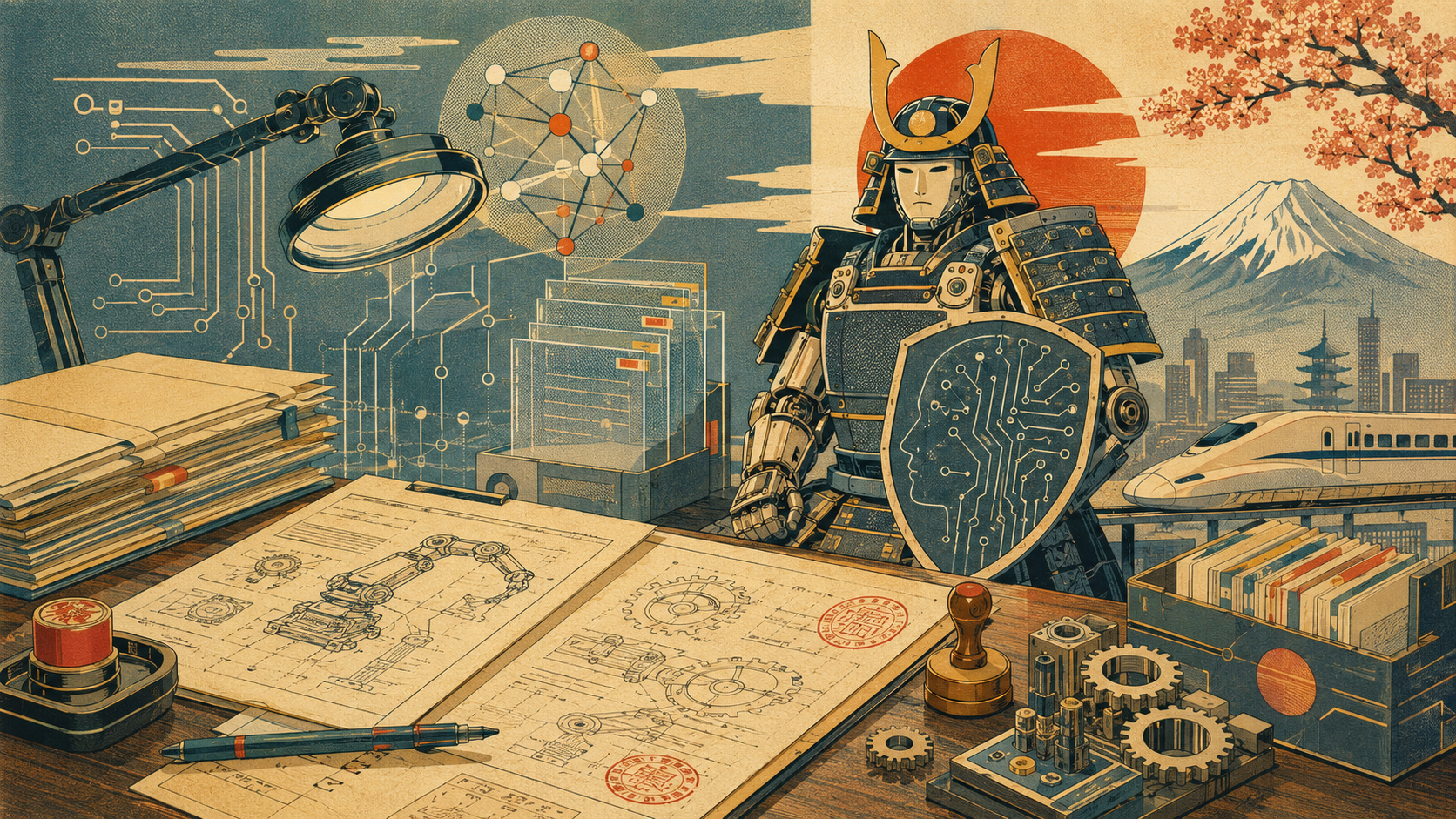
An invention is not protected by inspiration alone. It has to be translated into claims, compared with prior art, reviewed for weak language, positioned against competitors, and turned into a map of where a company will defend, license, disclose, or stay silent. The idea born in a lab, factory, university office, or startup meeting becomes a business weapon only when it is converted into the language of intellectual property.
On June 26, 2026, AI Samurai announced that it would hold its “AI Samurai New Function Announcement 2026” event on July 22 in Nihonbashi, Tokyo, where it plans to unveil a new IP strategy support feature called “Patent Wars®.” The program includes Patent Wars, a patent MCP server using AI Samurai’s proprietary patent database, AI-agent-era patent search, new generative-AI research with Osaka University, and corporate AI use cases.
The interesting part is not that patent search may become faster. That has been happening for years. The interesting part is that AI Samurai is trying to move the work from search to strategy. In the old model, a person looked for documents. In the new model, a person may work with an agent that reads the patent landscape, checks the draft, compares competitors, and helps frame the next move. The name is theatrical. Patent Wars. But beneath the drama is a real industrial problem.
From search to strategy
AI Samurai describes the generative-AI shift as a move from an era of searching to an era of working with AI agents to plan IP strategy. Patent Wars® and the patent MCP are positioned as part of a next-generation IP platform covering invention creation, prior-art search, competitor analysis, and IP strategy planning.
The key term is MCP. Model Context Protocol is commonly discussed as a connection layer that allows AI agents to use external databases and business systems. In AI Samurai’s case, the point is to connect the agent to patent data, not just general language-model knowledge. That means the product is trying to move closer to grounded patent work: patent publications, technical similarities, application records, and the logic of rights.
AI Samurai by the numbers
The old dream of an IP nation
Japan has long described itself as a manufacturing nation. Cars, cameras, semiconductor equipment, materials, machine tools, precision components, medical devices, and robotics all helped define the country’s industrial identity. But behind the visible products was an invisible struggle over intellectual property.
During the postwar growth years, Japanese companies learned, improved, mass-produced, and then created original technologies of their own. By the 1980s and 1990s, large manufacturers had built huge patent portfolios. Patents became both technical records and bargaining chips: tools for cross-licensing, defense, negotiation, and market control.
In the twenty-first century, the contest changed. The unit of competition is no longer just a product. It is software, data, standards, platforms, AI models, supply chains, and ecosystems. Inventions now arise not only inside factories, but also in universities, startups, joint research projects, open-source environments, and even conversations with generative AI.
That makes traditional patent work harder. The search space is larger, technologies overlap, and competitors are global. If Japan wants to talk again about being an IP-powered economy, the IP department itself has to become more intelligent.
Why Hajime Shirasaka matters
AI Samurai’s representative director, Hajime Shirasaka, is a patent attorney, a Ph.D. in knowledge science, and a visiting professor at the Japan Advanced Institute of Science and Technology. AI Samurai’s executive profile says he graduated from the National Defense Academy, studied machine-learning-based image processing at Yokohama National University, and later completed doctoral work on collaboration between AI and humans in inventive step. He also has experience in the intellectual property division of Fujifilm.
That biography explains the company. AI Samurai is not simply a legal-tech firm. It is not just another AI startup. It sits at the intersection of patent practice, machine learning, university research, and industrial technology strategy.
The company began in September 2015 as Gold IP. In 2016 it launched IP Search and IP Direct. In 2017 it began developing the IP Samurai® patent examination simulation system. In 2018 it expanded into free and beta services connected to Japanese patent publications. In January 2019 the company changed its name to AI Samurai, and in August 2019 it released the formal version of its AI patent similar-document evaluation system.
AI Samurai ONE and the integration of patent work
AI Samurai’s recent product direction centers on AI Samurai ONE, an all-in-one package that integrates patent search, evaluation, and drafting. In December 2025, the company announced an update that allows invention memos, proposals, internal disclosure forms, academic papers, and product catalogs in Word format to be converted into patent-application-style claims and specifications.
On June 9, 2026, the company added a generative-AI-powered “AI Review” feature to AI Samurai ONE. The function reviews application documents such as specifications, claims, drawings, and abstracts, and points out problems and improvements from the perspective of rights acquisition. It includes overall review, reference-symbol consistency checks, antecedent-basis checks in claims, field-specific review for areas such as software/AI, chemistry/materials, bio/pharma, optics/lenses, machinery/electrical/control, and user-defined review items.
This is not glamorous, but it matters. Patent documents are long, precise, and unforgiving. A mismatch between a drawing symbol and the specification can waste time later. A weak claim phrase can create a narrow right. AI review does not replace a patent attorney; it gives the attorney, engineer, and IP manager a finer net for catching issues early.
Why “Patent Wars” is not just a name
Patents look like quiet paperwork. In reality, they draw market boundaries. Who owns the invention? Where can a competitor enter? Which product can be blocked? Which technology generates licensing revenue? Which startup can tell investors that its core technology is defensible?
Generative AI makes the battle more complicated. AI can write code, propose molecules, suggest materials, design circuits, and generate documents. That raises questions about inventorship, inventive step, disclosure, and how to explain an AI-assisted invention. The Japan Patent Office has been surveying AI-related patent filings since July 2019, and its 2026 update notes the rapid growth of generative-AI technologies and services since 2022 across business, education, healthcare, government administration, and other sectors.
So the phrase Patent Wars is not only marketing. As invention becomes more AI-assisted and more global, IP strategy becomes a battlefield. The question is no longer “Did we file a patent?” The question is “What does our patent position let us do?”
What patent AI could mean for smaller companies
AI Samurai matters not only to corporate IP departments. It may matter even more to startups, SMEs, and university researchers. They often have promising technology but no full-scale IP department. They may have limited budgets for outside counsel, little time to search prior art, and no clear view of competitor filings.
If patent AI works, a small team can ask earlier questions: Is this invention worth filing? What prior art is close? Which technical feature should be emphasized? Which country or product area matters first? Which competitor is building around the same space?
That does not eliminate the need for specialists. Claim design, prosecution strategy, international filing, litigation risk, and licensing still require human judgment. But a better first draft, better search, and better issue list can make every expert conversation more valuable.
The Toyota connection
AI Samurai disclosed that in June 2025 it became a wholly owned subsidiary of Toyota Technical Development. That connection gives the company a new industrial context. Toyota Technical Development sits close to the engineering, development, and IP needs of one of Japan’s most important manufacturing ecosystems.
This makes the story more than legal tech. Japanese manufacturing now faces patent competition in electrification, batteries, materials, autonomous driving, robotics, software-defined vehicles, AI chips, and supply chains. If patent AI becomes practical, it will not merely improve back-office paperwork. It may shape how manufacturing companies see the technological battlefield around them.
That is why AI Samurai’s position is unusually Japanese: university-linked research, patent-attorney knowledge, generative AI, and the industrial gravity of the Toyota ecosystem. It is not a flashy chatbot. It is AI for the hidden machinery of invention.
The risk: oversimplifying IP judgment
Patent AI also carries risks. A company could see a similarity score and wrongly decide not to file. It could trust a draft claim too quickly. It could mistake a model’s confident summary for legal advice. Patent value is not only about patentability. It is about claim scope, ease of design-around, connection to revenue, future standards, licensing leverage, and business timing.
The strength of AI is exploration and organization. The strength of humans is judgment and responsibility. As AI becomes more capable in IP work, that division becomes more important. AI Samurai will succeed if it helps patent attorneys and IP managers see more, earlier, and more clearly — not if it pretends that patent strategy can be reduced to an automatic answer.
Japan.co.jp view
AI Samurai’s Patent Wars® may sound playful, but it is one of the most Japanese AI stories in this issue. Japan still has deep invention capacity inside laboratories, factories, universities, materials companies, parts makers, medical-device firms, robotics teams, and precision manufacturers. If those inventions are not found, written, compared, and protected, technical strength can disappear in the market.
Generative AI writes text. IP AI draws boundaries around the future. Who can enter a market? Who receives royalties? Who controls a standard? Who turns research into a business? The heart of patent AI is not document automation. It is the strategic conversion of invention into defensible opportunity.
The next stage for AI Samurai is not a world where inventors merely ask an AI to draft a patent. It is a world where companies and AI agents read the invention map together, watch competitors, and choose where to invest next. Patent Wars is a fight to protect invention — and perhaps a new map for Japan to compete again through intellectual property.
Timeline: from Gold IP to Patent Wars
| Year | Event |
|---|---|
| 2015 | Founded in Tokyo as Gold IP. |
| 2016 | Launched IP Search and IP Direct for IP research and overseas filing support. |
| 2017 | Began developing the IP Samurai® patent examination simulation system. |
| 2019 | Changed name to AI Samurai, won the JEITA Venture Award, and released the formal AI Samurai® similar-document evaluation system. |
| 2021 | Repositioned as an invention-creation AI company linked with Osaka University and JAIST. |
| 2025 | Became a wholly owned subsidiary of Toyota Technical Development. |
| 2026 | Added AI Review to AI Samurai ONE and prepared to unveil Patent Wars®. |
Reader takeaway
| Question | Answer |
|---|---|
| What happened? | AI Samurai announced a July 22, 2026 event to unveil Patent Wars® and a patent MCP server for AI-agent-era IP work. |
| Why does it matter? | It shows patent work moving from search, drafting, and review toward AI-assisted IP strategy. |
| Company background | Founded in 2015, renamed AI Samurai in 2019, and positioned as an invention-creation AI company linked with Osaka University and JAIST. |
| Recent product moves | AI Samurai ONE has added AI review, patent drafting from invention materials, and field-specific document checks. |
| Main issue | Can AI support better human IP strategy without oversimplifying legal and business judgment? |
Sources and references
This article draws on AI Samurai official announcements, PR TIMES releases, Japan Patent Office materials, and AI Samurai’s company history and executive profiles.
- PR TIMES: AI Samurai new function announcement event 2026, “Patent Wars®,” June 26, 2026.
- PR TIMES: AI Samurai ONE adds generative-AI patent document review, June 9, 2026.
- AI Samurai: sixth-anniversary company timeline.
- AI Samurai: transition into an invention-creation AI company linked with Osaka University and JAIST.
- Japan Patent Office: Recent Trends in AI-related Inventions, March 30, 2026.
- AI Samurai: executive profile of Hajime Shirasaka.