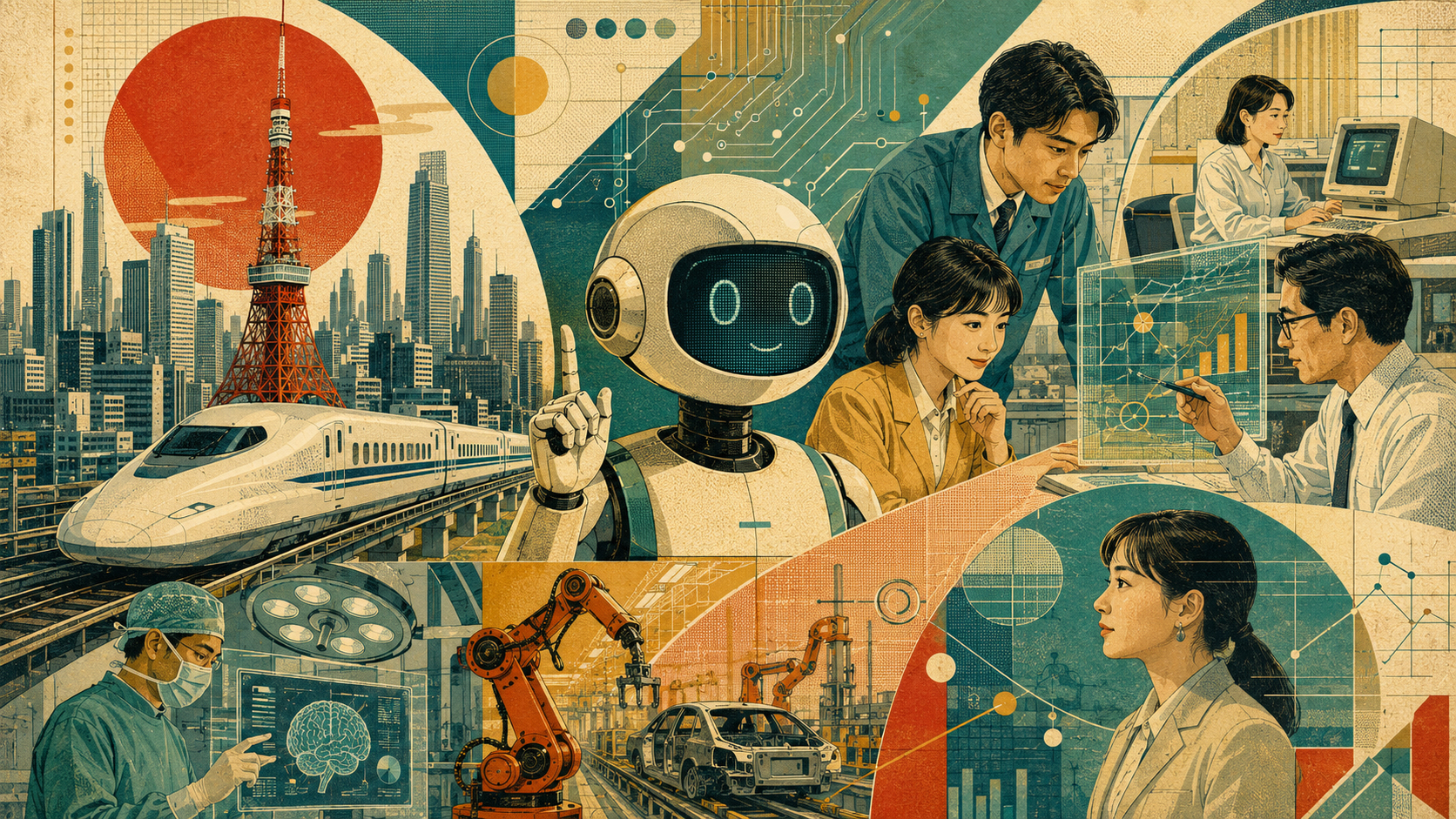
For today’s Japan.co.jp AI issue, the visual language is “Showa Tech Magazine”: a deliberately nostalgic, late-1970s to early-1980s Japanese science-and-business magazine style. Cream paper, halftone dots, geometric panels, orange suns, teal circuits, office workers studying diagrams, friendly robots, control rooms, surgical monitors, factory arms, city skylines, and trains. It is the opposite of the usual generic AI image — black background, glowing blue brain, chrome humanoid, cold infinity grid.
That choice matters. Today’s 12 AI stories are not about some abstract superintelligence floating above society. They are about AI entering work: the operating room, patent office, insurance agency, sales desk, remodeling estimate, back office, serverless cloud stack, and brand strategy meeting. The future in this issue is not a dark server room. It is a practical Japanese workplace with documents, terminals, diagrams, and people trying to understand what the machine is recommending.
Showa Tech Magazine is our name for that feeling: a future that looks engineered, explained, printed, and human. It borrows from science magazines, electronics catalogs, Expo displays, corporate technology brochures, manga robots, school diagrams, and the optimistic industrial graphic design of Japan’s high-growth and post-high-growth decades.
What “Showa Tech Magazine” means
“Showa Tech” is not a formal art movement. It is an editorial visual framework. It combines four memories: first, the diagrammatic clarity of Japanese science and electronics magazines; second, the hopeful corporate technology advertising of the 1970s and 1980s; third, the approachable robot culture shaped by manga and anime; and fourth, the Expo-era belief that cities, transport, communication, medicine, and industry could be shown as one connected system.
The key word is explanation. This style does not hide technology behind mystery. It shows flows, arrows, panels, cutaways, dashboards, users, and decision points. Who uses the system? Where does the data go? What does the AI recommend? Where does human judgment remain? Those are exactly the questions today’s AI coverage should ask.
Astro Boy and the friendly machine
Japan’s visual culture of intelligent machines cannot be separated from Osamu Tezuka’s Mighty Atom, known globally as Astro Boy. Tezuka’s official site describes Atom as a robot boy with 100,000 horsepower and seven special abilities, created in the image of Dr. Tenma’s lost son. But the deeper cultural point is not horsepower. It is emotion. Atom was not simply a machine. He was a bridge between human grief, technology, responsibility, and hope.
That made a difference. In much Western robot fiction, the machine often becomes the rebel, invader, or judgment on humanity. Japan has its own anxieties about technology, of course. But postwar popular culture also left room for a different machine: companion, assistant, colleague, rescuer, teacher, tool. From Astro Boy to Doraemon, from factory robots to caregiving devices, Japan repeatedly imagined technology as something that could live beside people.
That is why the AI in today’s art is not a monster and not a god. It is a helper on the edge of the frame. It appears beside surgeons, sales teams, insurance agents, patent researchers, architects, and office workers. It assists, maps, warns, sorts, highlights, and suggests. The human remains in the picture.
Expo culture: the future as a public display
Expo 1970 in Osaka gave Japan a national stage for future-making. It displayed technology not only as product, but as society: pavilions, screens, robots, transportation, crowds, energy, telecommunications, cities, and images of life to come. Expo-style design had a distinct grammar — huge circles, flowing paths, models, diagrams, crowds moving through systems, and the feeling that tomorrow could be explained on a wall panel.
That grammar is useful for AI because AI is often invisible. It lives in software, prompts, APIs, logs, training data, cloud infrastructure, and interface design. If we do not visualize its flows, it becomes either magic or marketing. The Showa Tech approach forces the invisible to become legible: input, processing, recommendation, audit, approval, output.
In today’s hero image, we brought together Tokyo-like infrastructure, a tower, a Shinkansen, a robot, surgeons, engineers, factory arms, and business teams. The image is not saying that AI controls everything. It is saying that AI is entering many practical places at once.
The Fifth Generation Computer project: Japan’s earlier AI dream
In 1982, Japan’s Ministry of International Trade and Industry launched the Fifth Generation Computer Systems project, one of the most ambitious state-backed computing programs of its era. Built around ideas such as massively parallel computing, logic programming, and knowledge processing, it imagined computers that could handle reasoning and information in a way conventional systems could not.
The project did not produce the commercial transformation its advocates hoped for, and it is often remembered as a grand but imperfect bet. Yet its historical value is enormous. It shows that Japan once treated intelligent computing as a national industrial project. It connected government, major electronics firms, researchers, and the idea that knowledge itself could become a computational field.
Today’s generative AI is technically different. But the dream has a family resemblance: machines that can work with language, knowledge, rules, decisions, and human tasks. The Showa Tech style lets us place 2026 generative AI inside that longer Japanese story, rather than treating it as a fad that arrived from nowhere.
Why paper texture matters in the age of AI images
Most contemporary AI visuals are too frictionless. They glow. They shine. They look global, anonymous, and interchangeable. Paper texture does the opposite. It makes the future local, printed, handled, saved, folded, and read. A yellowed magazine page has memory. A diagram has pedagogy. A halftone dot has human manufacture in it.
For an AI issue about small and mid-sized Japanese firms, this matters. These stories are not about the far-off singularity. They are about how ordinary organizations absorb new tools. A hospital, a remodeling firm, an insurance agency, a patent platform, a sales consultancy, a back-office marketplace. These are not places that need myth. They need explanation.
How the style unifies today’s 12 AI stories
| Field | Visual interpretation |
|---|---|
| Surgical AI | Operating rooms become learning rooms, with monitors, overlays, and human focus. |
| Patent AI | Invention appears as papers, diagrams, seals, guardians, and structured knowledge. |
| Shadow AI governance | Orderly systems are contrasted with chaotic tool clouds and uncontrolled data paths. |
| Insurance AI | The client, agent, and AI assistant share the same practical desk. |
| Sales AI | Funnels, customer paths, and agent modules become a giant strategy board. |
| Remodeling AI | Floor plans, color samples, and estimates show AI close to daily life. |
By giving these stories one visual system, the issue becomes more than a list of startup announcements. It becomes a map of where Japanese AI is actually going: into specialized tasks, professional workflows, and the parts of business that still run on forms, follow-ups, and judgment calls.
From abstract AI to workplace tool
“AI” is too large a word. It can make readers feel that the subject belongs to scientists, cloud giants, or investors. But “estimate,” “policy,” “patent,” “handover,” “proposal,” “audit,” and “follow-up” are close to everyday work. Today’s art choice narrows the distance.
Old technology magazines did this well. They translated difficult systems into images that a reader could study. Cutaway drawings explained buildings. Circuit diagrams explained devices. Factory illustrations explained automation. Today’s AI coverage needs the same discipline.
Japan’s 2026 AI moment
Japan’s current AI moment is not only cultural. It is also policy-driven. Japan passed its first AI-focused law in 2025, emphasizing promotion, research, development, and utilization more than heavy prohibition. Japan’s AI Basic Plan, adopted by Cabinet decision in late 2025, sets a national framework for encouraging AI-related technology development and use.
That policy atmosphere fits the art. Japan is not only asking what AI might do in theory. It is asking where AI can be used: in companies, hospitals, local industries, infrastructure, education, manufacturing, and services. The practical question — how does AI fit inside existing institutions? — is exactly the question that a diagrammatic Showa Tech style can help visualize.
Japan.co.jp’s view
Showa Tech Magazine is not nostalgia for nostalgia’s sake. It is a way of giving the newest technology a deeper cultural memory. AI in Japan did not begin with the latest chatbot. It follows a long line: postwar manga robots, Expo futures, electronics manufacturing, computing policy, factory automation, personal computers, mobile internet, cloud systems, and now generative AI agents.
Today’s art choice brings that line back onto the page. AI is the future. But for Japan, it is also a strangely familiar future — one that has been drawn, diagrammed, serialized, exhibited, and imagined for generations.
Sources and references
This article draws on Tezuka Osamu official materials, Expo and robotics references, research on Japan’s Fifth Generation Computer project, 2025–2026 Japanese AI policy sources, and Japan.co.jp’s July 7, 2026 AI issue lineup.
- TEZUKA OSAMU OFFICIAL: Mighty Atom / Astro Boy profile.
- Edward Feigenbaum: Japanese National Fifth Generation Project.
- OECD AI Policy Observatory: Japan AI Basic Plan.
- White & Case: Japan’s first AI legislation becomes law.
- BIE: Robots and Expo 2025 Osaka Kansai.