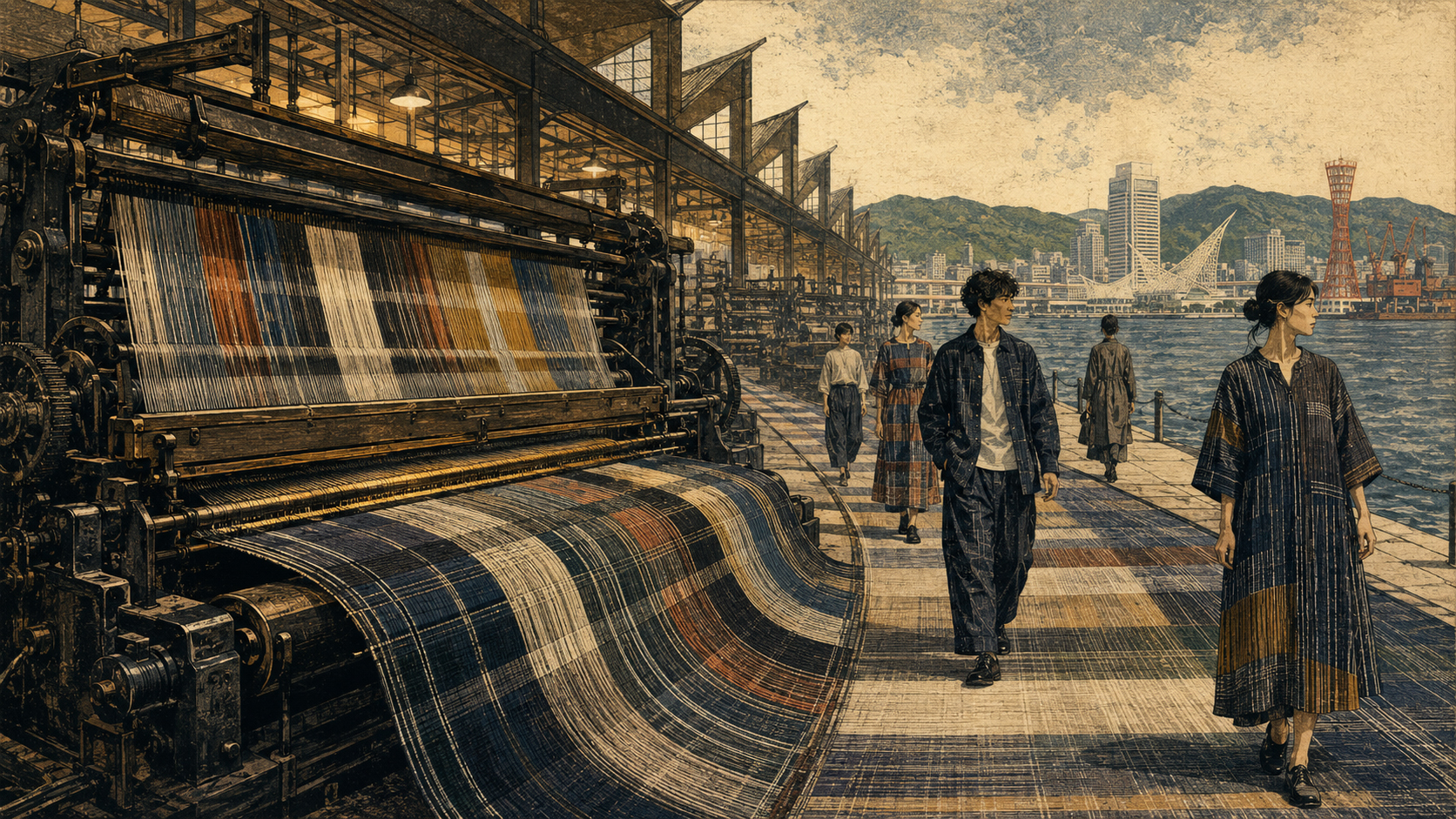
On Sunday afternoon, a bolt of cloth will leave the kind of place where Banshu-ori has usually been understood—a mill, a dye house, a sample room—and enter a very different room on Kobe’s waterfront.
Models will walk through the food hall at Kobe Port Museum. Shoppers will be able to touch fabric, compare bags and garments, and ask the people behind the labels what they have made. Two younger company presidents will speak before the show. The event is called the Banshu-ori Collection 2026: The Region’s Path Continuing into the Future.
The title is celebratory. The setting is designed to be inviting. Yet the collection’s importance comes from a tension that a runway cannot conceal: Banshu-ori is a famous cloth whose production region has often remained invisible to the person wearing it.
For generations, North Harima’s companies excelled at supplying fabric to other businesses. Color was put into yarn; yarn was organized into warp and weft; patterns were constructed thread by thread; unfinished cloth passed onward for washing and finishing. A shirt might reach a department store under another company’s name, with no obvious sign that its feel and color began around Nishiwaki.
Now some firms are asking to be recognized not only as capable suppliers but as authors. They are designing finished products, running shops, staging open factories, building labels and speaking directly to consumers. The August 23 event is a compact view of that change.
A public show for an industrial system
The Banshu-ori Collection will take place at TOOTH TOOTH MART FOOD HALL & NIGHT FES on the first floor of Kobe Port Museum. The market runs from 11 a.m. to 4 p.m.; the main program runs from 1 to 4 p.m. Admission is free, although ordinary seating is reserved for food-hall customers. A ¥2,000 priority-seat package includes an equivalent food ticket and an original Banshu-ori item.
At 1 p.m., Koshiro Saito, president of Saito Shoten, and Junpei Maruyama, president of Maruman, are scheduled to open with a discussion of the cloth’s appeal. Around 1:25 p.m., four labels—Boon Life Base, hatsutoki, jisetsu and POLS—will present garments and talk about their brands.
A six-brand market will add POLS, Re:BANSHUORI, WOVE MELT, Boon Life Base, Okido Weaving and ENMAGO. The organizer is the Public Interest Incorporated Foundation Kita-Harima Industrial Development Organization, with the venue cooperating and Sonomano.inc handling stage production. It is the second collection at the venue after the 2025 event.
Seen simply as a calendar listing, it is a three-hour fashion program attached to a five-hour market. Seen as industrial policy, it performs three jobs at once.
First, a runway makes fabric move. A swatch can show color and construction, but a garment reveals drape, weight and the way a surface changes under light. Second, a market closes the distance between a maker and the person who may pay for that value. Third, the talks attach people, decisions and place to material that has often traveled anonymously through a long supply chain.
The color comes before the cloth
Banshu-ori is commonly described as a yarn-dyed woven textile. That compact phrase explains both its beauty and the structure of its industry.
In piece dyeing, a fabric can be woven first and colored afterward. In Banshu-ori’s characteristic process, the yarn is dyed before weaving. Colored warp threads run lengthwise; weft threads pass across them. Checks, stripes and more complex designs are created by the physical crossing of color rather than printed onto a finished white surface.
The approach can produce fine color relationships, clear patterns and a soft hand. The municipal account of the industry credits the region’s rivers—the Kakogawa, Sugihara and Noma—and their abundant water with helping dyeing develop. Cotton cultivation in the warmer Banshu area supplied the early material base.
But no single romantic workshop makes the cloth from beginning to end. Banshu-ori grew as a division-of-labor cluster. A production coordinator, or sanmoto, develops and manages an order. Dye specialists color yarn. Other businesses prepare and align the warp. Weavers set looms and monitor a process in which tension, humidity, yarn character and machine condition can all change the result. Finishers wash and treat the woven fabric to establish its final feel and dimensions.
That interdependence is an advantage when the network is dense: each shop becomes very good at a particular problem, and a coordinator can combine expertise for varied small-lot work. It is also a vulnerability. Losing one firm does not merely subtract one competitor. It may remove a process that several brands require.
| Production group | Member firms | Employees | Why it matters |
|---|---|---|---|
| Production coordinators | 11 | 215 | Translate design and orders into a sequence of regional processes |
| Yarn dyeing | 6 | 159 | Establish color before the yarn reaches a loom |
| Weaving | 87 | 400 | Construct the fabric and its pattern from prepared yarn |
| Finishing | 2 | 110 | Wash, stabilize and give the cloth its final hand |
The figures are from the Kitaharima foundation’s March 2026 member-company snapshot, not a census of every person or independent business connected to Banshu-ori. Even so, they show why succession cannot be solved by producing more designers alone. Two member finishing companies sit at the end of a chain used by scores of weaving firms.
A carpenter brings home a loom
The traditional origin story begins in 1792. Hida Yasubei, a shrine carpenter from Hienosho village, had worked on the reconstruction of Kandaijin Shrine in Kyoto. He returned with knowledge of Nishijin textile equipment and used his woodworking skill to build a loom.
The earliest cloth was associated with Kandaiji-jima, a name linked to the Kyoto shrine, and later became known as Banshu-jima. It spread as side work among farm households. In that form, weaving was not yet a singular industrial identity; it was a way to turn locally available cotton, winter time and family labor into income.
By the early Meiji period, the area around what would become Tsuma village had an estimated 60 to 70 cotton-cloth businesses. The late-Meiji spread of power looms shifted output from household rooms toward factories. The term Banshu-ori was reportedly used in an official address at a joint textile exhibition in 1906.
Railways changed the scale of possibility during the Taisho era. Cloth could move more efficiently to cities, and the regional name circulated nationally. After World War I, the industry pivoted toward overseas sales, particularly Southeast Asia.
Before the outbreak of the Second Sino-Japanese War, Nishiwaki’s account says the region reached 100 million square yards a year and 270 businesses. Its labor history extended beyond the postcard image of a prosperous weaving town: employers recruited female workers from elsewhere in Japan and from the Korean Peninsula. Later, during the high-growth decades, young women again arrived through group-employment programs from across western Japan.
These workers were not peripheral to the industrial story. Their labor made the volume possible. Any serious account of Banshu-ori’s heritage has to remember the hands and migrations inside the machinery.
1792 · Hida Yasubei is said to build a loom after returning from Kyoto.
Late 1800s · Power looms move production from farm households toward factories.
1906 · “Banshu-ori” is reportedly used in a prefectural governor’s exhibition address.
1920s–30s · Rail and export markets turn the region into a major textile center.
Post-1945 · U.S. sales and rapid growth create the “gatchaman” boom.
1985 onward · Yen appreciation, imports and changing markets accelerate contraction.
2006–08 · A fashion-zone initiative begins; Banshu-ori gains a regional collective trademark.
2026 · Direct-sale events, open factories and brand collections push the region outward again.
When every clatter sounded like money
After World War II, new products and access to the U.S. market drove another expansion. The period acquired a famous nickname: the gatchaman boom. In the local telling, one gacha—the clatter of a loom—meant ¥10,000 in profit.
The phrase compressed an entire economy into a sound. A loom running meant an order, wages, shipping, maintenance and money circulating through town. Nishiwaki became a city in 1952, the first municipality to attain city status in inland Harima, as production expanded.
That prosperity also trained the industry to think in volume and export channels. The shocks came in layers: the dollar and oil crises of the 1970s; improving textile capacity in lower-wage countries; the sharp appreciation of the yen after the 1985 Plaza Accord; the collapse of the asset bubble; domestic deflation; and the spread of inexpensive imported fabric and clothing.
Municipal figures put Banshu-ori’s production peak at approximately 388 million square meters in 1987. By 2016 it was about 34.22 million square meters, or 8.8 percent of that peak. The export share fell from more than 60 percent to 14.8 percent over the same comparison.
The latest foundation snapshot should not be spliced mechanically into that historical series because reporting coverage and definitions may differ. It nevertheless shows a much smaller, domestically oriented system: 8.954 million square meters of output, 1,010 looms and 89.2 percent of shipments destined for Japan.
This is not simply a story of decline. Smaller volume can support more variation, shorter runs and higher-value work. In 2004, Katayama Shoten and partners developed the Arrange Winder, a system that connects yarns of differing materials and thicknesses for continuous production. It made complex, small-lot textile development more practical and won the Prime Minister’s Prize in the first Monodzukuri Nippon Grand Awards in 2005.
But flexibility is not the same as security. A smaller order can be creative and profitable; thousands of smaller orders do not automatically arrive on time to keep every specialized process busy.
Why the labels matter
The brands in Kobe represent different ways of moving up and outward from contract fabric.
POLS began in 2015 as a collaboration between Maruman, a yarn-dyed textile company founded in 1901, and textile designer Kanako Kajihara. It turns Maruman’s electronic jacquard work into clothing, stoles, bags and interior objects. The label highlights a 144-threads-per-inch density used in Nishiwaki jacquard—a technical choice presented not as hidden specification but as part of the product’s identity.
hatsutoki emerged inside Shimada Seishoku, a coordinator founded in 1948. The company says it launched the label to test and demonstrate the value of fabrics it developed with regional craftspeople. The move is revealing: a finished garment is a research instrument as well as a retail product. It tells a mill how fabric feels after cutting, sewing, wearing and washing.
jisetsu, launched by Tohban Dyeing for spring–summer 2025, carries the perspective of a company rooted in yarn-dyed fabric production into apparel. At a Tokyo event this spring, it displayed the process of making cloth alongside garments—a deliberate attempt to make process part of fashion rather than backstage information.
Boon Life Base, opened in 2024 by the local company behind the label, combines regional fabric with in-house sewing and offers made-to-order shirts. Its model addresses an important gap. If the region sells only cloth, much of the final product’s price and customer knowledge remains elsewhere. Sewing and retail keep more of both close to production.
The market broadens the experiment. Re:BANSHUORI turns production offcuts into goods. WOVE MELT combines cotton and polylactic-acid material in a fabric that can be heat-formed and laser-cut, extending weaving into products that do not rely on ordinary sewing. Okido Weaving and ENMAGO keep the actual weaving business visible beside the consumer labels.
No one model needs to win. The region is stronger if a jacquard fashion label, a custom-shirt shop, a material experiment, an upcycler and a specialist weaving company create different reasons to place orders through the same ecosystem.
Kobe is a bridge—and a risk
Holding the collection in Kobe is more than a search for foot traffic. North Harima is inland; Kobe is Hyogo’s port city, a place historically associated with trade, foreign influence, apparel and modern consumption. The event moves the regional industry into a room where tourists, diners and urban shoppers may meet it without planning a factory visit.
That distance can make Banshu-ori legible. It can also detach the attractive surface from the place that created it. If visitors leave remembering only a pleasing checked shirt, the fabric has gained a customer but the region may remain anonymous.
The solution is not to overload every garment with a history lesson. It is to make provenance verifiable and easy to follow: who designed the cloth, where the yarn was dyed, who wove and finished it, what the regional trademark guarantees, and where a buyer can return for another product or visit the place itself.
Banshu-ori has had a regional collective trademark since 2008. Nishiwaki says qualifying fabric must be planned, yarn-dyed, woven and processed in the production region and meet set quality standards. That mark provides a foundation for a fuller chain-of-custody story. The opportunity is to make it useful to a shopper rather than merely protective to an industry.
The factory becomes a place to visit
North Harima is already experimenting with visibility at home. Nishiwaki’s Banshu-ori Industry Expo, known as Banpaku, began in 2018 with the call, “A famous textile market for the textile town!” This May, 36 exhibitors filled a route between the civic complex and the historic Kishi residence area. The city reported about 18,000 visitors, up from roughly 12,000 the previous year.
The 2026 program combined fabric sales with a fashion show by Nishiwaki High School students. An evening program paired talks by manufacturers with product displays. Separately, Hyogo’s Field Pavilion program offers open-factory and regional-history experiences that treat the working landscape itself as an exhibit.
This is not tourism pasted onto manufacturing. A factory visit can perform industrial work. It can recruit a future employee who had never imagined textile production as a career. It can show a designer what a loom can and cannot do. It can help a buyer understand why a small lot costs more. It can return names and faces to the production chain.
The work is not linear. The Banshu-ori Workshop Museum, opened in a converted sawtooth-roof factory in 2007, closed on March 15, 2026. The closure does not erase the wider movement toward public access, but it is a reminder that heritage venues need durable operations too.
Nishiwaki’s demographic setting sharpens the need. The city counted 36,770 residents on July 1, 2026. A production region can attract occasional crowds while still losing the everyday population, machine technicians and successors needed to make cloth on Monday morning.
What the runway cannot repair
A well-attended collection can create attention. Attention is not the same as industrial renewal.
Brands require working capital, inventory decisions, photography, e-commerce, customer service and returns—skills that differ from producing fabric to specification. Direct sales can bring better margins and better information, but they also transfer risk from an apparel customer back to the mill. Small firms can exhaust themselves trying to operate as manufacturers, media companies and retailers at once.
There is also a danger in treating every company as a separate lifestyle story. Banshu-ori’s competitive advantage is collective. The region benefits when labels are distinct to consumers but still cooperate on dyeing capacity, finishing, machine repair, training, environmental investment and provenance.
Success should therefore be measured beyond attendance and social-media reach. Did the Kobe collection produce repeat customers, wholesale inquiries and orders at sustainable prices? Did those orders travel through several North Harima firms? Did a younger worker apply for a job? Did a company invest in a loom or help train a finisher? Did visitors later go to Nishiwaki?
Those questions are less photogenic than the show. They determine whether the show matters.
- Orders: not only event sales, but repeat and wholesale business.
- Regional value: how much work stays with North Harima’s dyeing, weaving, sewing and finishing firms.
- People: apprentices, mid-career recruits and transfer of machine knowledge.
- Shared infrastructure: investment in bottleneck processes, maintenance and environmental performance.
- Place: whether Kobe visibility leads consumers and designers back to the production region.
Beyond the mill, with the mill
Banshu-ori has survived by changing its scale and its route to market. It moved from farm households to factories, from domestic cloth to export power, and from mass volume toward varied, smaller runs. Its latest transition is from anonymous competence toward visible authorship.
That does not require every weaver to become a fashion designer or every dye house to open a shop. It requires enough paths for the value created in the region to be recognized and returned to it. A label can carry a name. A market can reveal demand. A school show can make the industry imaginable to a teenager. An open factory can turn production knowledge into a public asset. A collective mark can connect the finished product back to the network.
On August 23, the fabric will look furthest from the mill when it passes under Kobe’s lights. In reality, every color and fold will carry the mill with it: the carpenter’s first loom, the river water, the recruited workers, the export years, the shocks, the specialist workshops and the people now deciding whether to stay.
The future of Banshu-ori is not a choice between heritage and fashion, or between the factory and the runway. It is whether North Harima can weave them into the same piece of cloth.
- Event: Banshu-ori Collection 2026 — The Region’s Path Continuing into the Future
- Date: Sunday, August 23, 2026
- Market: 11 a.m.–4 p.m.; talk and fashion program: 1–4 p.m.
- Venue: TOOTH TOOTH MART FOOD HALL & NIGHT FES, Kobe Port Museum 1F, 7-2 Shinkocho, Chuo Ward, Kobe
- Admission: Free; food-hall purchase required for ordinary seating. Priority package: ¥2,000, including a ¥2,000 food ticket and original Banshu-ori item.
- Kita-Harima Industrial Development Organization: Banshu-ori Collection 2026 — organizer’s notice and participants.
- Potomak / TOOTH TOOTH MART event announcement, August 7, 2026 — schedule, venue and admission.
- Kitaharima Foundation: Banshu-ori statistics, March 2026 — member firms, employees, looms, output and destinations.
- Nishiwaki City: Banshu-ori history and industry overview — traditional origin, industrialization, labor, exports, peak production and structural change.
- Nishiwaki City: Banshu-ori revitalization — fashion-zone work, regional trademark and industry-academic programs.
- Nishiwaki City: 2026 Banshu-ori Industry Expo — exhibitors, program and earlier attendance.
- Nishiwaki mayor’s activity record, May 2026 — reported attendance of about 18,000.
- Nishiwaki City: Hyogo Field Pavilion programs — open-factory and regional-industry visits.
- Nishiwaki City: Banshu-ori Workshop Museum closure.
- Nishiwaki City: population on July 1, 2026.
- POLS / Maruman: brand and jacquard background; Shimada Seishoku: hatsutoki and regional production; Boon Life Base: sewing, stores and made-to-order shirts; Kairi Eguchi Studio: WOVE MELT material project.
- FASHIONSNAP: jisetsu’s 2026 process exhibition; Kiss PRESS: Re:BANSHUORI offcut products.
Editorial note: The organizer’s current figures cover member companies and should not be read as a complete census of every independent maker. Historical and present output figures are reported separately because coverage and definitions may differ. Japan.co.jp’s assessment of the event’s industrial significance is analysis based on those published records; the event has not yet taken place.