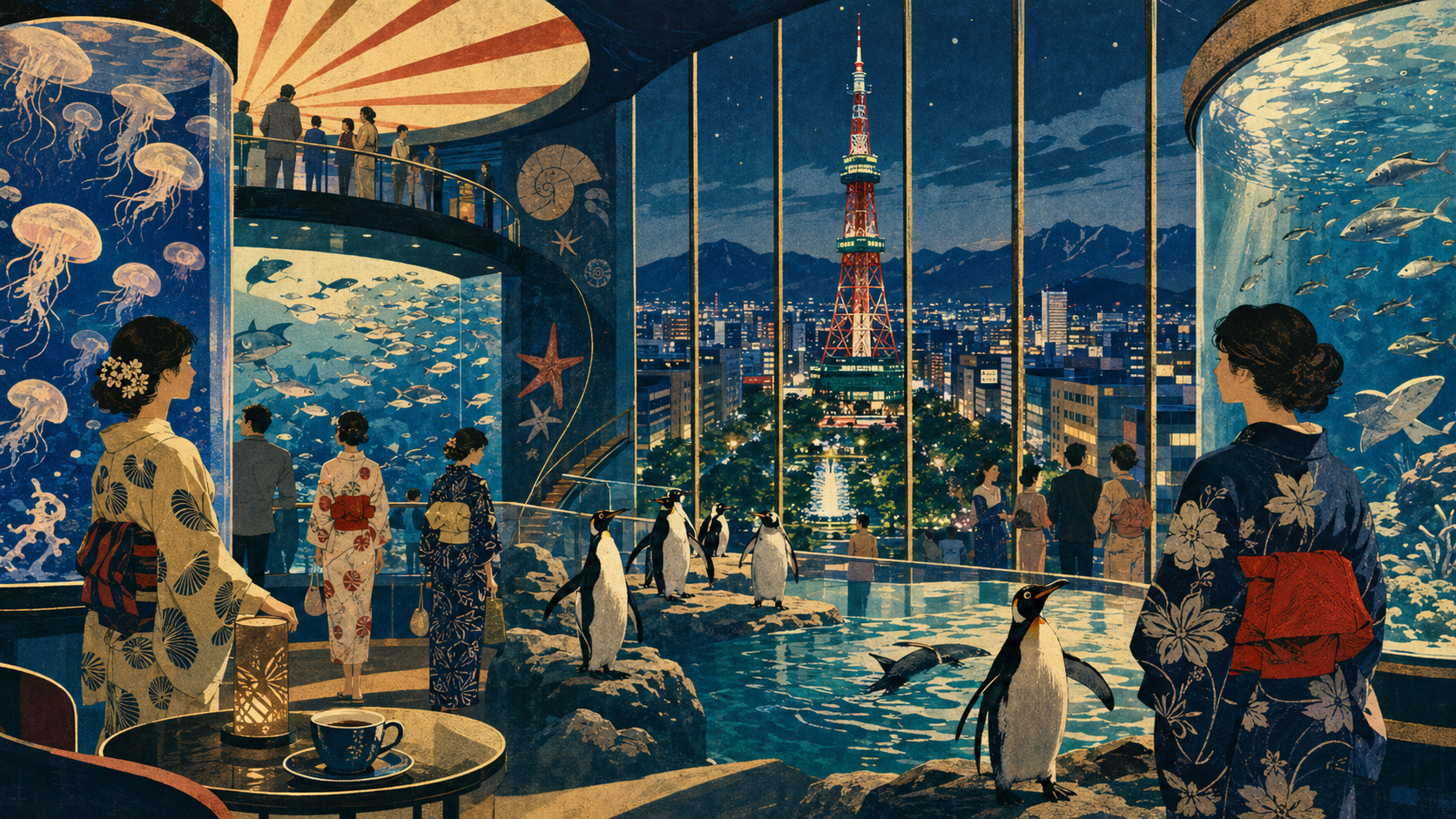
At 10 p.m., the aquarium is still part of the city
On the fifth floor of moyuk SAPPORO, coffee and jelly can travel into a darkened gallery where planted waterscapes glow like miniature worlds. One floor higher, fairy penguins cross a terrain of movable hexagons. Below, visitors watch aquarists at work instead of passing a closed staff door. This is how AOAO SAPPORO has tried to distinguish itself since opening on July 20, 2023: not as an excursion outside daily life, but as a room within it.
Its third birthday makes that proposition unusually visible. The official title, “Great Evolution! AOAO SAPPORO Summer Late-Night Festival 8 DAYS,” covers July 18 through 25. Each day pairs aquarium observation with another part of Sapporo culture—classical music, chocolate, coffee, wine, staff storytelling, dinosaurs or the newly coined study of fins.
“Eight late nights” needs one important qualification. AOAO is not announcing eight exceptional extensions. Its ordinary hours are already 10 a.m. to 10 p.m., with final admission at 9 p.m. The anniversary program uses that established night schedule for eight consecutive days. Night is not an add-on here; it is part of the operating idea.
The eight-day program, night by night
The sequence is a compact statement of what AOAO means by a “city aquarium.” Some sessions require a separate purchase from participating shops, but most observation programs are included after ordinary admission. Capacity, service hours and conditions vary; the aquarium’s event notice should be checked on the day.
| Day | Date and program | What happens |
|---|---|---|
| 1 | July 18 — Aquarium × classical music 17:00 and 19:00 | PMF Blue Night Classical brings Pacific Music Festival academy musicians into the aquarium. |
| 2 | July 19 — Aquarium × gastronomy 14:25 and 18:55 | SOIL CHOCOLATE pâtissier Nozomi Hiroshima explores chocolate in the afternoon; HOURS BEER’s Hikaru Goto leads an evening drinks gathering. |
| 3 | July 20 — Aquarium × MORIHICO. 10:00–22:00 | “3Q Day” makes the Nature Aquarium a one-day tea room; collaboration sweets are sold until 20:00. |
| 4 | July 21 — Aquarium × wine 18:55 | A Summer Wine Cruise with Interlink Japan’s Saori Abe. |
| 5 | July 22 — Aquarium × secrets 18:55 | The director and aquarium staff explain the things visitors normally do not see. |
| 6 | July 23 — Aquarium × dinosaurs 18:55 | A staff preview tour of the new birds, lizards and dinosaurs exhibition before its July 24 opening. |
| 7 | July 24 — Director’s night tour 19:00 | A night walk through AOAO’s stories on the opening day of the two new evolution zones. |
| 8 | July 25 — Aquarium × “Hireology” 13:30, 15:30, 17:30 and 19:00 | An AOAO “Hireologist” introduces five fish and the different work performed by their fins. |
There is also a yukata campaign throughout the eight days. After 5 p.m., a visitor in yukata can buy a Sapporo Classic beer, AOAO cream soda or mango milk for ¥100, once per person per day, at Shirokuma Bakery &. On July 24 and 25, the craft aquarium continues until 10 p.m.; children of junior-high age or younger wearing yukata can make a fin fan without the ordinary ¥300 craft charge.
July 20: one aquarium, one coffee city
The anniversary day belongs to a collaboration between a three-year-old aquarium and a thirty-year-old Sapporo coffee institution. MORIHICO. began in Chūō Ward in 1996. In 2026, AOAO calls itself the “Sapporo beginner” and MORIHICO. the “Sapporo master”; “3Q” reads as both third-anniversary shorthand and a spoken “thank you.”
At the first-floor moyuk square, MORIHICO.’s Estafette coffee truck is scheduled from 10 a.m. to 8 p.m., offering limited collaboration sweets and drinks: coffee-jelly au lait, blue-jelly soda and shaved-ice versions of both visual worlds. Upstairs, the Nature Aquarium Tea Room runs through the aquarium day, with sweets until 8 p.m. A ¥2,500 set combines aquarium admission with one collaboration sweet, which can be carried into the planted-gallery space. The fourth-floor Wonder Books shop begins selling MORIHICO.’s 30th-anniversary coffee and goods at 10 a.m.
The partnership is larger than one day. A MORIHICO. exhibition runs in the Nature Aquarium and Library Aquarium area through August 31, using furniture and fittings from the original café, books selected by president and art director Sōsuke Ichikawa, and panels on Sapporo coffee culture. The current notice dates the display from July 7, an update to an earlier announcement that had listed July 20.
Three exhibits, three different meanings of evolution
AOAO’s anniversary campaign uses “evolution” in two ways: as biology and as institutional change. The biological side arrives in three installations, but not all on the birthday. The northern salamander observation tank began July 2. “Co-Creation and Play” and the redesigned Green Room open July 24. A July 20 visitor can see the first, but must return later for the other two.
| Exhibit | Opening and location | Question it asks |
|---|---|---|
| Northern salamander growth observation | July 2, 4F Laboratory | How does an egg sac become a larva and then an adult—and how can a city aquarium support conservation in eastern Hokkaido? |
| Co-Creation and Play | July 24, 5F Co-Working Aquarium | What do fins reveal about how a fish swims, rests, signals and lives in its environment? |
| Birds, Lizards and Dinosaurs | July 24, 6F Green Room | How can living birds and reptiles help a visitor read deep evolutionary time? |
The fourth-floor salamander tank grows out of conservation work begun with Shibecha Town in April 2025. AOAO displayed egg sacs in May 2026 and now plans a continuous view from egg through larval development to the adult form. The northern salamander is listed as Endangered Class IB on Japan’s national Red List and is protected as a natural monument in Shibecha. The tank therefore turns a growth sequence into a local conservation relationship rather than presenting “evolution” merely as change within one animal’s lifetime.
“Hireology”: a playful word for serious looking
On the fifth floor, visitors will be able to step onto a raised platform and look into five tanks from above. The animals were selected for visually distinctive fins: sea goldie, black-saddled toby, mudskipper, spotfin lionfish and freshwater butterflyfish. AOAO calls the method Hireology—its own “finology”—a house-made term for asking what fins disclose about habitat, behavior and the relationships between people and the living world.
The word is lighthearted, but the observation is sound. A fin is not a generic paddle. Different fins supply thrust, braking, steering, balance, hovering and display in different combinations. A mudskipper’s body and fins support movement at the shifting edge of water and land; a spotfin lionfish’s spreading fin rays shape both its silhouette and how it maneuvers around prey. The installation’s strength will depend less on naming every structure than on slowing visitors long enough to see those differences.
Its physical design matters. The tanks are not simply at eye level behind a wall. The platform changes the viewing angle, making body plans legible from above. That is consistent with AOAO’s Library Aquarium, where the exhibition unit joins tank, observation prompt, caption and book rather than treating the label as an afterthought.
Birds are dinosaurs; not everything on the wall is
The sixth-floor Green Room adds a roughly three-meter bird enclosure with a green-cheeked conure, an updated evolutionary tree and a “Dinosaur Wall” supervised by the Mukawa Town Hobetsu Museum. Ten scale models are listed: Mosasaurus, Plesiosaurus, Pteranodon, Ankylosaurus, Stegosaurus, Kamuysaurus, Triceratops, Brachiosaurus, Therizinosaurus and Tyrannosaurus.
There is a useful scientific distinction inside that popular grouping. Mosasaurus and Plesiosaurus were marine reptiles, not dinosaurs; Pteranodon was a flying reptile, not a dinosaur. The remaining named animals are dinosaurs. Modern birds are also dinosaurs—the living descendants of theropod dinosaurs—not merely “related to” dinosaurs in a loose sense. The American Museum of Natural History summarizes the evidence in shared structures such as the wishbone and other skeletal features.
That correction does not diminish the wall. It improves its question. The display brings several branches of reptile evolution into one sightline, then lets a living parrot interrupt the idea that dinosaurs belong only to the past. Kamuysaurus adds a distinctly Hokkaido link: the hadrosaur known from Mukawa makes the deep-time story local.
Why an aquarium opened above Tanukikoji
AOAO SAPPORO opened across the fourth through sixth floors of moyuk SAPPORO on July 20, 2023. Its name comes from the Japanese expression aoao—life growing vividly green or blue. The founding theme, “Wonder of Life—what was invisible becomes visible,” became a design brief for an aquarium without a suburban campus or waterfront.
The location is part of a central-Sapporo redevelopment linked to Tanukikoji and the underground pedestrian network. Sapporo City described the project as the first urban redevelopment in Japan to introduce an urban aquarium. The facility occupies about 5,100 square meters including back-of-house areas. At its first anniversary, AOAO’s official profile listed about 250 species and 4,000 individual animals; those are historical 2024 figures, not a claim about today’s exact collection.
A downtown aquarium also has to make its infrastructure visible. AOAO prepares artificial seawater in two systems, one for fish and one for penguins, each capable of making roughly 3,000 liters at a time. Visitors on the fourth-floor Laboratory can see husbandry work that conventional aquariums often hide. The absence of an ocean outside the window becomes a lesson in water chemistry, life-support systems and daily labor.
A vertical aquarium built as three verbs
The original visitor journey was organized around three ideas: connect, scope and commons. On the fourth floor, the Laboratory connects visitors with aquarists and systems. On the fifth, the Library Aquarium and Nature Aquarium train the scope of observation. On the sixth, penguins, plankton, plants, sound and food form a shared commons.
| Floor | Founding experience | How the third anniversary changes it |
|---|---|---|
| 4F | Open laboratory, water-making equipment, small life and Wonder Books. | Salamander development links visible husbandry to Shibecha conservation. |
| 5F | Library Aquarium, planted Nature Aquarium and work-friendly viewing spaces. | Five fin-focused tanks add an elevated, participatory way of looking. |
| 6F | Fairy penguins, plankton, Blue Room, Green Room and bakery/bar. | A live bird, evolutionary tree and model wall connect present life with deep time. |
The fifth-floor Nature Aquarium was described at opening as the third permanent installation of its kind after Tokyo and Lisbon. Four planted waterscapes use the aesthetics of wabi-sabi and Zen to make ecological time perceptible. Nearby, the Library Aquarium arranges 43 tanks like a collection of readable volumes, pairing animals with prompts and books. AOAO reported that this exhibition method won a 2025 Good Design Award—the institution’s first major external recognition for a way of seeing, rather than for a spectacular single tank.
On the sixth floor, movable hexagonal land units allow the fairy-penguin environment to be reconfigured. Sixteen plankton tanks magnify the small and translucent. The Blue Room uses a screen about 20 meters wide and a projected floor of roughly 120 square meters to surround visitors with an oceanic image space. More than twenty kinds of plants soften the Green Room. Food and drink can travel through the building, a deliberate refusal of the usual museum division between gallery and café.
How the night became a program, not just an hour
Staying open until 10 p.m. was there from the beginning, but AOAO gradually gave those hours a stronger cultural identity. In 2025 it adopted the “happy late night” idea associated with the former OMO3 Sapporo Susukino and developed AQUARIUM JAM as a recurring Friday-night framework. Music, performance, learning, beer and Sapporo’s late-night “shime parfait” culture could coexist with animal observation.
The third-anniversary eight-day run is the clearest version yet. PMF musicians do not merely provide background music; wine, chocolate and coffee specialists become interpreters of the city; staff tours turn institutional knowledge into performance. The aquarium collaboration is not interchangeable entertainment pasted onto tanks. At its best, it makes the city outside more legible through the life inside.
This strategy also changes who can visit. Families remain central during the day, but a worker can arrive after dinner, an adult can attend a wine talk, and a couple can enter without treating the aquarium as an all-day expedition. In a climate where winter makes indoor public life especially important, AOAO’s late hours function as urban infrastructure.
Conservation and breeding behind the celebration
The public-facing anniversary rests on less visible work. AOAO and Shibecha Town signed a comprehensive partnership agreement in September 2025 after beginning northern-salamander conservation that April. The arrangement connects research and environmental education with tourism and local revitalization. The new growth tank is its most accessible public result so far.
In another milestone, the Japanese Association of Zoos and Aquariums certified AOAO’s breeding of the carpet eel-blenny Congrogadus subducens as the first recorded breeding in Japan. The animals reproduced in May 2024; AOAO began showing juveniles alongside adults in March 2026. That history matters to the word “evolution”: an aquarium’s progress is measured not only by new galleries, but by accumulated husbandry knowledge and whether it can reproduce and share what it learns.
Partnerships have been structural from the start. Otaru Aquarium supported animal husbandry at opening. Mukawa’s Hobetsu Museum supervises the new prehistoric wall. Shibecha anchors species conservation. PMF and MORIHICO. bring music and coffee into the interpretive program. AOAO’s model is less a sealed attraction than a platform where other Hokkaido institutions can meet a downtown audience.
A practical anniversary guide
AOAO SAPPORO is on floors 4–6 of moyuk SAPPORO, about three minutes on foot from Odori Station and about one minute from the Tanukikoji streetcar stop. There is no dedicated parking. Regular hours are 10 a.m.–10 p.m., with final admission at 9 p.m.; the facility operates year-round, but events and animal conditions can change without notice.
| Item | Published information | Anniversary caution |
|---|---|---|
| Admission | Adult ¥2,200; elementary/junior-high student ¥1,100; age 3 and over ¥200; under 3 free. | Online purchase is recommended; same-day sales may be limited on crowded dates. |
| July 20 tea-room set | ¥2,500 including aquarium admission and one collaboration sweet. | Sweets are sold until 20:00; quantities may be limited. |
| New zones | Salamander display from July 2; fin room and bird–dinosaur gallery from July 24. | Do not expect all three new exhibits on July 20. |
| Kids WONDER SHEET | From July 18, ¥300, with questions about water, animals, the building and staff. | Separate from admission. |
| Fin-fan craft | From July 24, normally 11:00–16:00, ¥300 cash; members free. | Extended to 22:00 on July 24–25; last reception 21:30. |
| Anniversary food | Penguin-cookie croissant ¥480; AOAO cream soda and mango milk ¥790, July 18–August 31. | Food counter last order is 21:30. |
Three years of making the invisible visible
| Date | Development | Why it matters |
|---|---|---|
| July 20, 2023 | AOAO SAPPORO opens in moyuk SAPPORO. | A large aquarium becomes an anchor of a downtown redevelopment rather than a waterfront destination. |
| April–May 2024 | A fairy-penguin chick and carpet eel-blenny offspring are born. | Early husbandry results begin to match the public-facing design ambition. |
| 2025 | “Happy late night” and AQUARIUM JAM expand night culture; Library Aquarium receives a Good Design Award; Shibecha partnership is signed. | AOAO develops culture, design and conservation as parallel identities. |
| March–July 2026 | First-breeding recognition, salamander growth display and two evolution galleries. | Institutional knowledge is translated into exhibits visitors can read and question. |
| July 18–25, 2026 | Eight-day third-anniversary program. | The aquarium presents its mature idea of itself: science, city culture and night life under one roof. |
AOAO’s most persuasive achievement after three years is not that it has imitated a coastal aquarium in an office-and-residential tower. It is that it has used the constraints of the tower to invent a different public rhythm. The sea is made on the fourth floor. Observation is edited like a library on the fifth. Penguins, projections, plants and conversation share the sixth. At 10 p.m., visitors step back into Tanukikoji carrying the aquarium’s question into the city: what living connections become visible when we learn how to look?
Principal sources and further reading
- AOAO SAPPORO, third-anniversary “Summer Late-Night Festival 8 DAYS”: July 18–25 schedule, program times, yukata offer and craft extension.
- AOAO SAPPORO, AOAO × MORIHICO. “3Q” project: July 20 tea room, coffee truck, collaboration menu and exhibition details.
- AOAO SAPPORO, “Great Evolution” exhibitions: opening dates, locations, animals, activities and anniversary food.
- AOAO SAPPORO, July 2023 opening announcement: opening date, name, philosophy and operating model.
- AOAO SAPPORO, complete opening profile: approximately 5,100-square-meter footprint, floors and original partners.
- AOAO SAPPORO floor guide: Laboratory, artificial seawater, Library Aquarium, Nature Aquarium, penguins, plankton, Blue Room and Green Room.
- AOAO SAPPORO tickets: current standard admission and sales conditions.
- AOAO SAPPORO access: station walking times, address, hours and parking notice.
- AOAO SAPPORO, first-anniversary profile: historical 2024 species and individual counts.
- AOAO SAPPORO, AQUARIUM JAM: “happy late night” history and the recurring night-culture program.
- AOAO SAPPORO, 2025 Good Design Award: the Library Aquarium’s observation-and-reading system.
- AOAO SAPPORO, Shibecha Town partnership: northern-salamander conservation and the September 2025 agreement.
- AOAO SAPPORO, first-breeding recognition: carpet eel-blenny breeding, certification and display.
- City of Sapporo, moyuk SAPPORO redevelopment: urban connections and the aquarium’s place in the redevelopment project.
- American Museum of Natural History, dinosaur facts: modern birds as living dinosaurs and the extinction of non-avian dinosaurs.
Editor’s note: Program details were checked on July 18, 2026, Japan time. This is a pre-event guide: it describes scheduled activities and does not report that they have already occurred. AOAO’s latest notices distinguish the July 2 salamander exhibit from the two zones opening July 24. Hours, capacity, animal displays and food service may change; check the aquarium’s same-day notice. The hero is an editorial illustration, not a photograph.