A two-hour safety campaign, built around a ten-minute ceremony
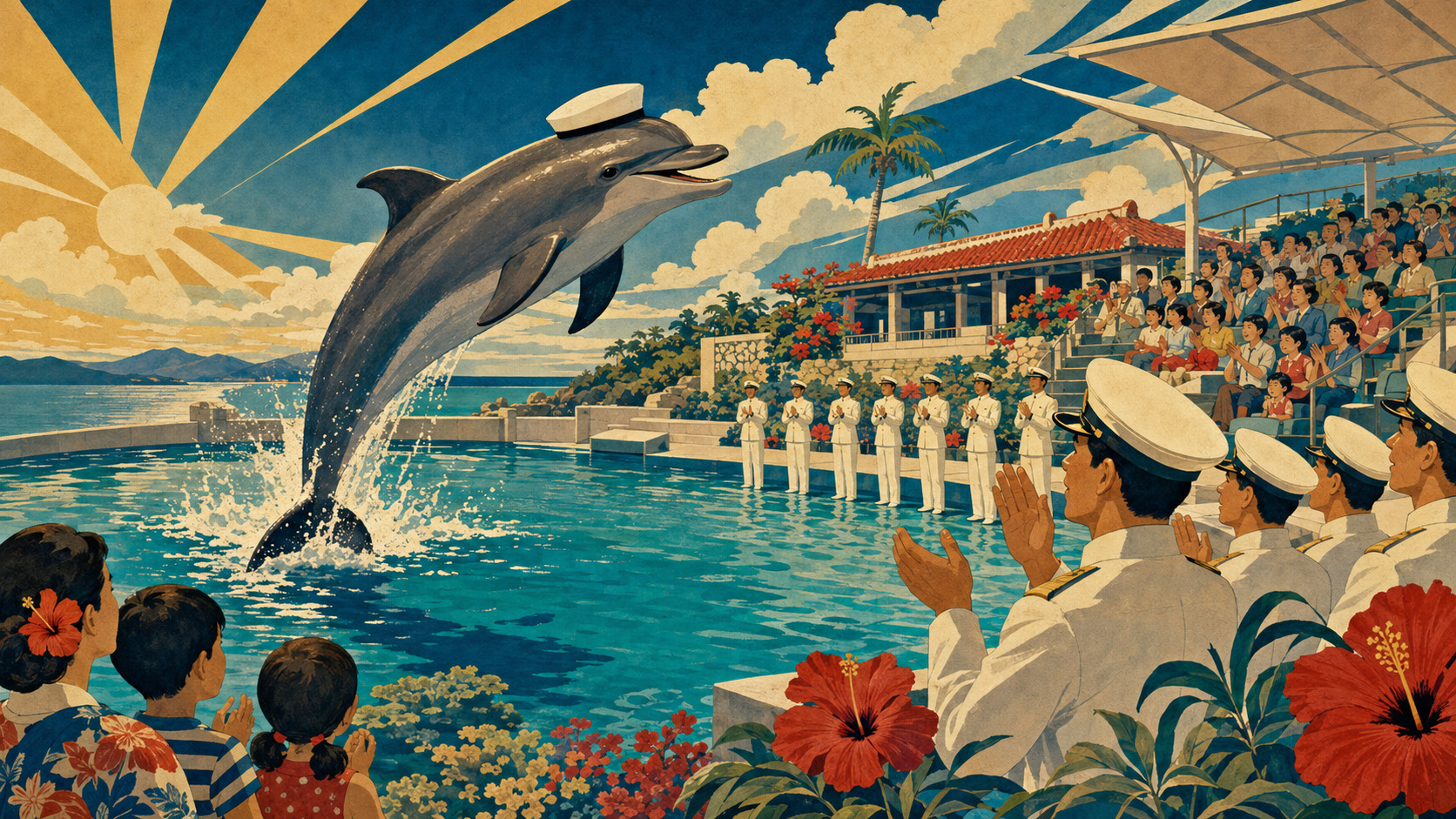
The afternoon begins before the appointment. From 1:30 to 3:30 p.m., the dolphin-facility area at Okinawa Churaumi Aquarium is scheduled to host Coast Guard uniform try-ons, instruction in safer ways to enjoy the sea and souvenir photographs with Umimaru, the uniformed seal who serves as the agency’s image character. At 2 p.m., Muku is to receive the one-day title from the Nago Coast Guard Station. At 2:10, an approximately seven- to eight-minute Coast Guard collaboration dolphin show follows.
The sequence is easy to misread, so the aquarium’s official July 16 event notice makes the distinction explicit: Muku is not appearing in that collaboration show. The appointment and performance are adjacent program items, not one Muku performance. Weather or an animal’s condition may force postponement; the notice names August 8 as the planned alternate date.
| Time | What is announced | What visitors should know |
|---|---|---|
| 1:30–3:30 p.m. | Uniform try-ons, water-safety outreach and photographs with Umimaru around the dolphin facilities | The notice does not promise every activity continuously or guarantee participation capacity. |
| 2:00 p.m. | Muku’s appointment as one-day chief of the Nago Coast Guard Station | This is an honorary public-awareness role, not operational command. |
| 2:10 p.m. | One-day Coast Guard collaboration dolphin show, about 7–8 minutes | Muku is not scheduled to appear in the show. |
| If postponed | August 8 is the planned alternate date | Weather and animal condition govern; check the aquarium notice before traveling. |
Why the Nago Coast Guard Station is speaking at a dolphin theater
The ceremony is local in a precise administrative sense. The Nago Coast Guard Station’s jurisdiction includes Motobu, the town containing Ocean Expo Park, as well as most of Nago, Nakijin, Ōgimi, Ie, Izena and Iheya. It is part of the Naha Coast Guard Office and the 11th Regional Coast Guard Headquarters, whose officers combine search and rescue, maritime law enforcement, navigation safety, environmental protection, disaster work and public education across Okinawa’s waters.
Official 2026 planning material explains why a visitor attraction is useful territory. The 11th Regional Headquarters says marine-leisure casualties in 2025 tied the record high, the share involving tourists has been rising, accidents involving Okinawa-resident stand-up paddleboard users continue, and incidents among people 50 and older carry a high fatality rate. Its four 2026 priorities are life-jacket use; stronger information for tourists, including overseas visitors; risk awareness among the 50-plus population; and precautions for snorkeling, swimming, diving and SUP.
The prior full-year figures show the scale. In 2024, the regional headquarters recorded 109 marine-leisure casualties in Okinawa, including 26 dead or missing. Snorkeling and swimming together made up close to three-fifths of cases. Tourists accounted for roughly seven in ten casualties; of the 26 dead or missing, about six in ten were at least 50 years old. Among non-diving marine-leisure casualties for whom flotation status was counted, three-quarters were not wearing a life jacket.
The risk is not abstract in Motobu. Reporting on Muku and Okichan’s 2025 appointment, the Ryukyu Shimpo cited the Nago station as recording 20 marine-leisure accidents and eight deaths in its jurisdiction in 2024. From January to the 2025 ceremony, seven incidents and one death had already been recorded. Those station-level numbers are a news report’s account of Coast Guard data, not a fresh 2026 tally, but they show why the safety message is placed where northern Okinawa families and tourists already gather.
What the uniform experience is meant to make memorable
A child-sized uniform and a photograph with Umimaru create an easy entry point. The more durable lesson is preparation. The Coast Guard’s Water Safety Guide organizes advice by activity—swimming, snorkeling, canoeing, SUP, fishing, motorboats, personal watercraft and mini-boats—because the same sea presents different failure modes to each user.
The 11th Region’s recent case studies emphasize how quickly conditions outrun experience. In April 2026, three SUP guests were rescued about 500 meters offshore at Ishigaki’s Yoshihara coast after the wind strengthened; two days earlier, seven people, including operators, were rescued roughly a kilometer offshore near Miyakojima’s Yonaha Maehama after another wind shift. All the guest participants in both examples were beginners. The agency’s lesson is direct: match the activity to skill and physical condition, obtain current weather information and return before strengthening wind closes the route home.
| Before entering the water | Why it matters |
|---|---|
| Check forecasts, warnings, wind direction, waves, currents and local rules. | Conditions can change the safe return route even when the beach still looks inviting. |
| Choose the right life jacket, inspect it and fasten it to fit. | The Coast Guard warns that waiting for rescue without flotation is extremely difficult; loose straps can defeat the equipment. |
| Match the activity to your experience, stamina and health; do not enter when unwell. | Tour schedules and holiday plans do not override physical limits. |
| Keep a waterproof means of communication and tell someone the plan. | A rescue cannot begin until responders know that help is needed and where to search. |
| For a marine incident or accident in Japan, call 118. | The Coast Guard introduced the three-digit emergency number on May 1, 2000. Give what happened, when and where, calmly and concisely. |
Muku is not a common bottlenose dolphin
The user-friendly English shorthand “bottlenose dolphin” needs a taxonomic qualifier. Muku is an Indo-Pacific bottlenose dolphin, Tursiops aduncus, called minami bandō iruka in Japanese. The aquarium distinguishes the species from the common bottlenose dolphin by its narrower, longer beak and the dark spots that develop on the underside. It says Okinawa Churaumi is the only facility in Japan currently keeping this species.
The aquarium’s annual report lists Muku as male, an estimated 54 years old and in care since May 1, 1975, as of March 31, 2026. Because his exact birth date is not known, “estimated age” and “more than 50 years in human care” are more accurate than treating 1975 as a birth year. The aquarium says Muku is extending Japan’s longevity record for the species; its 2025–26 report describes the 50-year milestone reached by Muku and Okichan as the longest captive-care record for any cetaceans in Japan and the world record for an Indo-Pacific bottlenose dolphin.
From Amami Ōshima to the 1975 Ocean Expo
Muku’s biography is inseparable from a national exposition. The aquarium’s 2025–26 annual report says he and Okichan were brought from Amami Ōshima to Motobu in 1975 to perform at “Dolphin Nation / Okichan Theater” during the Okinawa International Ocean Exposition. The expo was staged only three years after Okinawa’s 1972 reversion to Japan and placed the ocean at the center of a large national development and tourism project.
When the exposition ended, the relationship did not. Ocean Expo Park opened in 1976, and the dolphins remained part of the post-expo site. The modern Okinawa Churaumi Aquarium opened in November 2002, but Okichan Theater’s lineage is older: the dolphin facilities carry the memory of the 1975 fair across the boundary between the original aquarium era and the present complex.
The annual report describes distinct public roles. Okichan became known for dynamic athletic performances. Muku’s underwater “Dolphin Studio” presentations explained echolocation, behavior and the biological abilities that are difficult to see from stadium seating alone. In this sense, the 2026 appointment continues a long pattern: an individual animal acts as the point of contact through which a large institution explains something invisible—sonar in one program, risk and rescue readiness in another.
A half-century shared with Okichan
The 2025 Marine Day ceremony was a joint appointment. Both Okichan and Muku were named one-day Nago Coast Guard Station chiefs after reaching 50 years in care that May. According to the Ryukyu Shimpo’s report from the theater, Muku appeared with staff to urge visitors to wear life jackets and stay out of the water when feeling unwell. Their recognition that year went further: the prefecture presented a special tourism award, Motobu named them tourism ambassadors and issued special resident certificates, and they also took honorary police roles in a separate event.
Okichan died on December 2, 2025, after a period of declining health. The aquarium estimated her age at 52. Her official chronology reaches from the 1975 expo to the birth of her daughter Sami in 1999, the anniversary honors of 2025 and the joint Coast Guard appointment that July. Sami’s birth was the first successful breeding of an Indo-Pacific bottlenose dolphin in Japan and received a breeding award from the Japanese Association of Zoos and Aquariums.
The announced 2026 Marine Day program is therefore the first in this sequence to appoint Muku alone. That does not justify inventing an animal’s feelings or turning Okichan’s death into spectacle. It does give the ceremony historical weight. Muku is the remaining half of a pair that linked the 1975 expo, the growth of Okinawa tourism, cetacean education and the local public-safety campaigns of 2025.
Beyond performance: Muku as teacher and research animal
The public record is broader than shows. In 2025, a temporary revival of the aquarium’s diver program paired Muku with a diver to present underwater behavior. The anniversary project also opened back-of-house tours explaining long-term care and animal welfare, brought lessons about cetacean biology and training into northern Okinawa schools, and used the two dolphins’ history as a way to discuss the social role of an aquarium.
Muku has contributed to reproductive research as well. A Foundation research report describes work begun in 2017 on cryopreserving dolphin semen for future artificial insemination. In the reported year, staff could collect from five animals representing four species, but Muku was the only individual who consistently cleared all of the team’s quality thresholds and whose thawed samples remained suitable for artificial insemination. About five insemination doses were shipped abroad in a liquid-nitrogen dry shipper and retained suitable quality after transport.
That research is not a detail of today’s family event, and it should not be confused with wild-population conservation. It does show why “in care for 50 years” means more than a longevity number. Long records can yield knowledge about health, reproduction and aging—but they also create a continuing obligation to evaluate welfare, adjust activity and let animal condition override the program. The 2026 notice’s postponement clause, and the explicit decision that Muku will not perform in the show, should be read in that responsible frame.
The Coast Guard’s Okinawa history begins with reversion
The Japan Coast Guard itself was established on May 1, 1948. The organization now divides the country into 11 regions and carries out law enforcement, rescue, environmental protection, disaster response, hydrographic work and maritime-traffic safety. Okinawa’s regional story begins later: the 11th Regional Coast Guard Headquarters opened on May 15, 1972, the day Okinawa reverted to Japan.
Its official overview counts 160 islands in the jurisdiction, including 47 inhabited islands. That geography makes a simple word such as “local” unusually expansive. The Nago station’s territory includes islands as well as the Motobu Peninsula; a rescue problem can involve a beach, reef, fishing ground, ferry route, SUP board or dive site. The station’s public education is thus not secondary to its patrol work. Preventing a callout is one form of saving a life.
The honorific “chief for a day” turns that institutional map into a memorable scene. Muku does not acquire law-enforcement powers. Instead, the station borrows a familiar face—or, more accurately, a familiar dorsal fin and beak—to make its instructions travel further than an ordinary leaflet might.
Marine Day came from a voyage; safety belongs inside the celebration
Japan’s Marine Day asks people to give thanks for the sea’s benefits and wish for the prosperity of maritime Japan. Its historical line begins with July 20, 1876, when Emperor Meiji returned to Yokohama aboard the lighthouse-service steamer Meiji Maru after a northern tour. July 20 became Marine Memorial Day in 1941. Legislation enacted in 1995 created the national holiday from 1996, originally on that fixed date; from 2003, the holiday moved to the third Monday in July. In 2026, the movable holiday lands on its old calendar date, July 20.
The Churaumi program gives the holiday’s formal language a practical Okinawa translation. Gratitude for the sea cannot be separated from knowledge of wind, current, health and equipment. Prosperity in a maritime country depends not only on ports and ships, but on people returning safely from beaches and reefs.
| Year | Milestone | Connection to today |
|---|---|---|
| 1876 | Meiji Maru returns to Yokohama on July 20. | The voyage supplies the date behind Marine Memorial Day and later Marine Day. |
| 1941 | July 20 designated Marine Memorial Day. | A commemorative observance precedes the national holiday. |
| 1948 | Japan Coast Guard established. | The modern national maritime-safety institution begins. |
| 1972 | 11th Regional Coast Guard Headquarters opens on Okinawa’s reversion day. | Okinawa gains the regional organization serving its island waters. |
| 1975 | Muku and Okichan arrive from Amami Ōshima for the Okinawa Ocean Expo. | Okichan Theater’s half-century history begins. |
| 1976 | Ocean Expo Park opens after the exposition. | The dolphin program continues at the post-expo park. |
| 1996 | Marine Day first observed as a national holiday. | The sea’s benefits and maritime prosperity receive a statutory day. |
| 1999 | Okichan gives birth to Sami. | Japan records its first successful Indo-Pacific bottlenose dolphin breeding. |
| 2000 | Coast Guard launches emergency number 118. | A three-digit call connects marine incidents to national responders. |
| 2002 | The modern Okinawa Churaumi Aquarium opens. | The older theater becomes part of a new-generation marine complex. |
| 2025 | Muku and Okichan reach 50 years in care and become joint one-day chiefs. | The safety partnership begins with the celebrated pair. |
| 2026 | Muku receives the Marine Day appointment alone. | A 1975 legacy carries a current warning about life jackets and preparation. |
How to read the moment at 2 p.m.
The ceremony can be enjoyed at face value: a veteran aquarium dolphin receives a title, Coast Guard uniforms come out for photographs, and a mascot meets families. It is also a carefully designed piece of public communication. Muku supplies recognition. The Coast Guard supplies the action verbs—check, wear, fasten, decide, return, call. The aquarium supplies a place where visitors are already thinking about marine life and their own next encounter with Okinawa’s water.
The most respectful reading also keeps three boundaries visible. Muku is an Indo-Pacific bottlenose dolphin, not the more commonly held bottlenose species. The one-day title is symbolic, not an operational office. And the 2:10 collaboration show is not a Muku performance. Accuracy does not diminish the delight of the event; it protects the animal, the visitor and the public-safety message from being blurred into a single cute image.
At the end of the afternoon, the title expires. The advice does not. Marine Day lasts one day; Okinawa’s water, weather and rescue geography do not observe the calendar.
Principal sources and further reading
- Okinawa Churaumi Aquarium, official 2026 event notice: appointment, program times, Muku’s non-appearance in the show, alternate date, uniform activities, species notes and longevity claim.
- Okinawa Churaumi Aquarium Annual Report No. 22, April 2025–March 2026: Muku’s register entry, arrival from Amami Ōshima, Ocean Expo history, Okichan Theater roles, Sami’s birth, anniversary project and care legacy.
- Okinawa Churaumi Aquarium, 50th-anniversary record: 2025 joint Coast Guard appointment, police appointment, tourism honors, diver show and anniversary programs.
- Okinawa Churaumi Aquarium, official report on Okichan: death, estimated age and life chronology.
- 11th Regional Coast Guard Headquarters, 2026 marine-leisure casualty-prevention plan: current priorities, risk trends and April 2026 SUP examples.
- 11th Regional Coast Guard Headquarters, 2024 casualty summary: 109 marine-leisure casualties, 26 dead or missing, activity, age, tourism and flotation patterns.
- 11th Regional Coast Guard Headquarters, official overview: establishment on May 15, 1972, island jurisdiction and missions.
- Naha Coast Guard Office, jurisdictions: municipalities assigned to the Nago Coast Guard Station, including Motobu.
- Japan Coast Guard Water Safety Guide and life-jacket guidance: preparation by activity, inspection, fit and flotation advice.
- Japan Coast Guard, emergency number 118: purpose, reporting guidance and May 1, 2000 launch.
- Okinawa Churashima Foundation research report: cetacean health, semen cryopreservation, Muku’s samples and international transport.
- Ryukyu Shimpo, July 22, 2025: eyewitness report on the joint appointment and station-level 2024–25 accident figures.
- Japan Coast Guard, organization and history: national establishment in 1948 and modern missions.
- Japan Maritime Public Relations Center, Marine Day history and Kyushu District Transport Bureau, holiday origins: 1876 voyage, 1941 observance, 1996 holiday and 2003 date change.
Editor’s note: Research closed on July 18, 2026, Japan time. Event plans may change for weather or animal condition; the aquarium names August 8 as the planned alternate date. The 2025 Nago-area accident totals are attributed to the Ryukyu Shimpo’s report of station data. “World record” and “only Japanese facility” reproduce the aquarium’s official descriptions. Longevity is not, by itself, a complete welfare assessment. The hero image is an editorial illustration, not a record photograph.