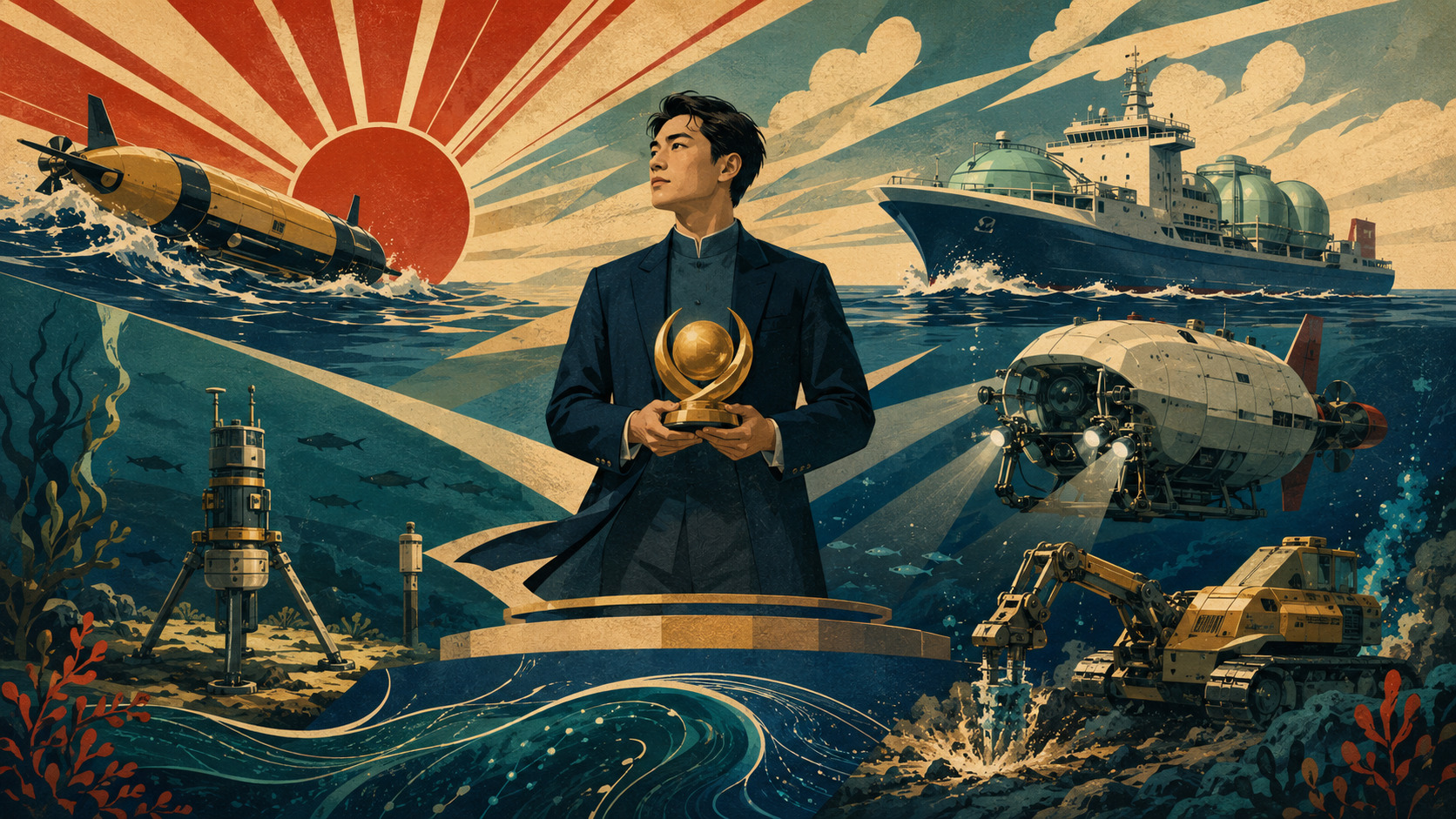
The ceremony is official; the names require a second release
At 10:30 a.m., after a half-hour opening ceremony, the national presentation begins on the third floor of Tokyo International Cruise Terminal. The Ministry of Land, Infrastructure, Transport and Tourism says the 19th awards recognize people and organizations with conspicuous achievements in public understanding, scholarship and research, industrial promotion and other ocean fields. The ceremony is scheduled to finish at 11, while the public Marine Day program continues until 5 p.m.
That much is fixed in MLIT’s July 13 announcement. The announcement does not list the 19th recipients. Nor does its attached event outline. The distinction matters because the exhibitors are not automatically the award winners, and an award’s category cannot be inferred from a booth or a research program.
The previous year shows how the publication sequence works. MLIT announced the six recipients of the 18th awards in a separate release dated July 21, 2025—the day of the ceremony. It gave each name, affiliation, category and official achievement summary. This article was researched to a July 18, 2026 lock, before an equivalent 19th-award release was available.
| Question | Verified status at the research lock | Editorial action |
|---|---|---|
| Is the 19th ceremony confirmed? | Yes: July 20, 10:30–11:00, Tokyo International Cruise Terminal. | Report the time, place, purpose and award history. |
| Are the 19th recipients named in the July 13 notice? | No. The notice describes the award but publishes no roster. | Do not guess from exhibitors, past recipients or program participants. |
| What release completes the story? | MLIT’s official 19th-award recipient announcement, including achievement summaries. | Add names, affiliations and citations verbatim in substance; then test each claimed technology link. |
| Can the exhibits still be explained now? | Yes. The official booth page and research agencies document them independently. | Describe their state of development without calling them prizewinning work. |
An honor created to make a maritime nation visible
The award’s Japanese name, Kaiyō Rikkoku Suishin Kōrōsha Hyōshō, is often rendered as the Awards for Distinguished Contributors to a Maritime Nation. It is a Prime Minister’s commendation, not a technology prize alone. Five ministries—education and science; agriculture, forestry and fisheries; economy, trade and industry; land, infrastructure, transport and tourism; and the environment—administer it with the cooperation of the Cabinet Office’s ocean-policy secretariat.
The system was created in 2008, immediately after a foundational change in Japanese ocean governance. The Basic Act on Ocean Policy was promulgated in April 2007 and established principles including the balance between ocean development and environmental protection, marine safety, scientific knowledge and integrated policy. The first Basic Plan on Ocean Policy followed in March 2008. The new award gave that policy architecture human faces.
Two broad fields have remained. “Special contributions to the promotion of Japan as a maritime nation” can encompass public education, science and technology, industry, regional development and policy. “Outstanding achievements concerning the ocean” recognizes marked achievement within fields such as marine science, fisheries, maritime affairs and environmental conservation. That breadth is deliberate: the sea cannot be governed, understood or used by a single profession.
The first class already pointed toward today’s ocean drones
The inaugural eight recipients demonstrate why the award should not be reduced to machinery. They included a maritime high school, a scholar who helped shape the Basic Act, a writer whose work brought maritime rescue to a mass audience, a proponent of marine industrial policy, a fisheries group that helped restore sandfish, a shipbuilding engineer and a sea-turtle conservation pioneer.
But one first-year citation speaks directly to the 2026 exhibit. JAMSTEC engineer Taro Aoki was honored for developing Japan’s large unmanned underwater vehicles: the 3,000-meter-class Dolphin-3K, the 11,000-meter-class remotely operated Kaikō and the 3,500-meter-class autonomous cruising vehicle Urashima. The official citation noted Urashima’s 317-kilometer continuous run in 2005.
That is a genuine historical connection, not a claim about the still-unpublished 19th roster. The language has changed from “unmanned underwater vehicle” to the friendlier “ocean drone”; the hard problem remains. A robot must navigate where satellite signals do not penetrate, conserve energy, communicate through water and return useful observations from a high-pressure environment.
What the 18th recipients reveal about the award’s range
The 2025 class is the nearest verified guide to the institution’s priorities. Shuichi Kodaira was recognized for large-scale subseafloor survey methods that advanced understanding of megathrust earthquakes. Toshio Suga’s citation concerned the global ocean-observation network and climate research. Kuninao Tada was honored for coastal environmental research, conservation and public understanding. The Japan Ship Technology Research Association was recognized for strengthening international maritime rules and standards.
In the second field, Ichiro Yasuda’s work revealed how vertical turbulent mixing shapes ocean and ecosystem variability. Masaru Tsujimoto developed a common “yardstick” for evaluating ships’ performance in real seas, supporting reductions in greenhouse-gas emissions from shipping.
Those six citations form a useful map: observation, hazard science, coastal ecology, standardization, fundamental ocean physics and practical decarbonization. They also demonstrate why a responsible connection must start with each official citation. A winner can be related to a technology theme by method, public benefit, governance or environmental verification—not merely because both use the word “ocean.”
| 18th recipient, 2025 | Official achievement in brief | Theme it illustrates |
|---|---|---|
| Shuichi Kodaira | Large-scale subseafloor surveys and megathrust-earthquake mechanisms | Mapping beneath the seabed; disaster resilience |
| Toshio Suga | Global ocean-observation networks and climate-change research | Persistent, comparable observations |
| Kuninao Tada | Coastal environmental research, protection and ocean literacy | Science joined to stewardship and public understanding |
| Japan Ship Technology Research Association | International maritime rules and standards | Turning technical knowledge into shared operating frameworks |
| Ichiro Yasuda | Vertical turbulent mixing and ocean–ecosystem variability | The physical processes that monitoring systems must resolve |
| Masaru Tsujimoto | Real-sea ship-performance metric supporting GHG reductions | Measured, verifiable maritime decarbonization |
Booth 1 is a research system, not five unrelated attractions
The official Marine Day booth list gives the Cabinet Office’s third-phase Strategic Innovation Promotion Program, or SIP, the first position. Its “Building a Platform for Ocean Security” display includes models of ocean drones and a long-term seabed monitor, plus panels on wide-area environmental monitoring, the Minamitorishima rare-earth-mud mining test and basic research into marine-basalt carbon capture and storage.
To a casual visitor, that can look like a cabinet of futuristic objects. The program plan shows a single logic. Japan wants to understand and manage a maritime jurisdiction far larger than its land area. Mineral-resource work requires precise mapping. Any intervention requires a defensible environmental baseline and monitoring during and after operations. Carbon storage requires geological characterization and verification. Robots, fixed instruments, docking stations and data links are the observational infrastructure shared by all three missions.
SIP itself was created to cross ministerial and disciplinary boundaries. Its marine program has developed in stages: the first phase, from fiscal 2014 through 2018, concentrated mainly on surveying seafloor hydrothermal deposits shallower than 2,000 meters; the second, from 2018 through 2022, moved into deep-sea resources, rare-earth mud, multiple-AUV operations and recovery technology; the third, from 2023 through 2027, combines a potential rare-earth supply chain, wide-area environmental monitoring and basic marine-basalt CCS research.
“Ocean drone” means an autonomous underwater vehicle
The popular label is helpful, provided it does not conjure a flying camera. An autonomous underwater vehicle, or AUV, operates below the surface without a pilot aboard and without a continuous control cable. It follows a programmed mission, using onboard navigation and sensors to map terrain or measure the water and seabed. A hovering AUV can stop and maneuver around an object; a cruising type efficiently covers a larger tract.
The SIP plan names the hovering vehicle Hobarin. It also describes cooperative control for multiple cruising AUVs. Two-vehicle trials preceded a fiscal-2026 goal of demonstrating three vehicles coordinating a seabed survey in shallow water. The point of a swarm is not spectacle: several vehicles, kept in useful formation and communicating acoustically, can cover a wide area faster than one.
Endurance and data are the limiting currencies. The program is developing a general-purpose deep-sea terminal that a hovering AUV can dock with for charging and communication. It is also pursuing a smaller, cheaper AUV optimized for roughly 100–200-meter water, portable by a small team and designed with domestic production and commercial transfer in mind. The technology story therefore stretches from exceptional research robots to a possible service industry.
A long-term seabed monitor supplies the missing dimension: time
An AUV is good at spatial coverage; a fixed observatory is good at watching one place change. The SIP architecture joins both. The “Edokko No. 1” seabed environmental-impact assessment system can serve as a stationary observer and an acoustic lighthouse—a reference point that helps robots find and revisit the same area. Optical links let an AUV collect large datasets at short range, while acoustic communication carries smaller messages through water.
The research plan envisages Hobarin, Edokko No. 1 and the deep-sea terminal exchanging position, observations and data. A robot can retrieve measurements without hauling the fixed station to the surface; a dock can extend missions; several moving vehicles can place the point record in a wider map. Fiscal 2026 targets include testing the integrated wide-area system deeper than 1,000 meters and identifying what still fails. Social-implementation trials are scheduled for fiscal 2027.
This is why “monitoring” is not a decorative environmental word. A baseline must exist before disturbance. Sensors must work during an operation. Observations must continue long enough to distinguish a project effect from natural variation. And the record must be accurate enough for scientists, regulators, communities and operators to interrogate.
At Minamitorishima, the six-kilometer test recovered its first mud
The rare-earth panel is not merely a future proposal. In January and February 2026, JAMSTEC’s deep-sea scientific drilling vessel Chikyu tested the connection and operation of a rare-earth-mud recovery system inside Japan’s exclusive economic zone around Minamitorishima. The site is about 6,000 meters deep.
The system adapts mud-circulation methods associated with offshore drilling. Pipes and machinery are connected and lowered toward the seabed; a mining tool penetrates the deposit, loosens and gathers sediment, and lifts the mud to the ship. JAMSTEC describes it as a closed-circulation design intended to suppress leakage and dispersion of suspended material during recovery.
Chikyu reached the operating area on January 17. Recovery began on January 30. In the early hours of February 1, the team confirmed that the first rare-earth mud had reached the vessel. That result followed a 2022 test that lifted seabed sediment from 2,470 meters off Ibaraki. The 2026 operation was a system-connection test and an initial recovery step at far greater depth; JAMSTEC identifies February 2027 as the target for a full-scale mining test.
Recovery is not yet a commercial mine
The wording matters. A world-first engineering operation at roughly 6,000 meters does not by itself establish an economically viable, environmentally acceptable supply chain. Exploration must characterize the deposit. Recovery equipment must operate reliably at useful throughput. The mud must be classified, separated, refined and smelted. Costs, energy use, logistics, law and market conditions all remain part of the industrial equation.
Ecological proof is equally central. The 2026 test placed an Edokko No. 1 COEDO system, an automated environmental-DNA sampler and a hydrophone on the seabed; surface instruments included a pollution-monitoring system using biological photosynthetic response. JAMSTEC says the monitoring applies international standards developed through the program. The closed system is designed to limit suspended plumes, but design intent must still be checked against measurements.
The broader history counsels restraint around headline resource figures. JAMSTEC notes that an often-cited early estimate of 16 million tonnes of rare-earth oxides around Minamitorishima was based on initial, coarsely spaced sampling and is not included in the U.S. Geological Survey’s world resource list. Later program work identified and modeled a different promising area more precisely. “Resource,” “reserve,” “recoverable material” and “commercial production” are not synonyms.
Marine-basalt CCS asks whether rock can lock carbon away
The fourth thread looks not for material to bring up, but for a way to put carbon dioxide down. Conventional CCS captures CO₂ from an industrial source or the atmosphere, transports it and injects it into suitable geology for long-term storage. Basalt adds the possibility of mineral fixation: dissolved CO₂ can react with calcium-, magnesium- and iron-bearing minerals to form solid carbonates.
Japan’s SIP project is studying Takuyo-Daigo Seamount, a large flat-topped underwater volcano inside the Minamitorishima EEZ. Its plan has three parts: survey the seamount’s geological structure for a possible marine-basalt storage system; experiment on CO₂ behavior and optimize injection; and develop a concept that includes transport and offshore injection, with international research cooperation.
The Marine Day wording is appropriately cautious: basic research. The program aims by the end of SIP’s third phase to describe the geology, estimate storage and mineral-fixation potential, evaluate CO₂ behavior, develop elemental injection technology and present a system concept. It does not say that Tokyo is opening a commercial repository or conducting public injection at the festival.
The environmental-monitoring connection is again direct. A credible storage project would have to establish where the carbon goes, how pressure and fluids behave, whether leakage pathways exist and what happens to the surrounding ecosystem. The same deep-sea capacity that makes an intervention possible must also make it observable.
At Booth 22, Tokyo asks the public to rename a working experiment
The Tokyo Port and Harbor Bureau’s booth moves from the abyss to a vessel people can board. It is collecting a public nickname for Mahoroba, the hydrogen fuel-cell passenger ship that carried paying passengers during the 2025 Osaka–Kansai Expo and is scheduled to begin operating in Tokyo Port this winter.
Mahoroba combines electricity produced in fuel cells from hydrogen and oxygen with plug-in electrical power stored in batteries. At the vessel, the fuel-cell reaction produces electricity and water without emitting carbon dioxide; electric motors also avoid the engine vibration and fuel odor associated with a diesel boat. Those are operational advantages, not a complete life-cycle carbon calculation. The climate result depends on how the hydrogen and shore electricity are produced, compressed or transported.
The contest opened June 19 and closes at 11:59 p.m. on August 31. Anyone may enter, with parental consent for minors. Tokyo will select finalists and put them to a residents’ vote, with the result due around late November. Up to 600 entrants who register an email address are to be selected for priority booking, and creators of finalist names can receive a wheelhouse visit when they sail. The chosen name will be a public nickname; the registered ship name Mahoroba will not change.
Tokyo’s hydrogen fleet is already plural. In April, the metropolitan government completed Tokyo Mirai Maru, a 14.4-meter Port and Harbor Bureau workboat, and Tsukiji ZERO, an 11.7-meter river-works boat. Each combines a fuel cell and lithium-ion battery, carries two crew and 12 passengers, and travels at about 19 kilometers per hour. Tokyo describes them as the first fuel-cell vessels completed for a Japanese government body. Their routine assignments—staff transport, port inspection and river-works supervision—may be more important to adoption than a one-day demonstration.
Five exhibits, five different maturity levels
Marine Day compresses decades of work into models and panels. That creates excitement, but it also flattens the distance between prototype, field test and public service. The following reading keeps the verbs honest.
| Technology thread | What is verified in 2026 | What remains | 19th-award link |
|---|---|---|---|
| Ocean drones / AUVs | Multiple-vehicle control, Hobarin, docking, communications and lower-cost AUV development are active SIP work; three-AUV and deep-water system tests are fiscal-2026 targets. | Robust long-duration operation, commercialization, scale and reliable field service. | Do not assign to a 19th recipient until MLIT publishes the citation. |
| Long-term seabed monitoring | Edokko No. 1, optical/acoustic data links and AUV integration form the planned wide-area system. | Demonstration below 1,000 meters, validation and fiscal-2027 implementation trials. | Recipient-specific connection pending official roster. |
| Rare-earth mud | First mud reached Chikyu from the roughly 6,000-meter Minamitorishima test in February. | Full-scale 2027 test, environmental proof and a viable end-to-end supply chain. | Recipient-specific connection pending official roster. |
| Marine-basalt CCS | Geological, laboratory and system-concept research at Takuyo-Daigo Seamount. | Storage estimate, injection design, monitoring, regulation, environmental assessment and any deployment decision. | Recipient-specific connection pending official roster. |
| Hydrogen fuel-cell vessels | Mahoroba completed commercial Expo service and is due in Tokyo this winter; two Tokyo government workboats are complete. | Public operating record, fueling scale, cost and low-carbon hydrogen/electricity supply. | Recipient-specific connection pending official roster. |
A 20-year line from ocean law to deep-sea systems
| Year | Milestone | Why it matters to today’s story |
|---|---|---|
| 2007 | Basic Act on Ocean Policy promulgated; integrated national framework established. | Places development, conservation, safety, science and coordination in one policy structure. |
| 2008 | First Basic Plan; first Maritime Nation awards. | Turns the new policy into a plan and recognizes eight people or organizations behind ocean work. |
| 2014–2018 | SIP phase one marine-resource survey technology. | Builds efficient survey systems, multiple-AUV operations and industry transfer. |
| 2018–2022 | SIP phase two innovative deep-sea resource survey technology. | Advances deep-water rare-earth assessment, AUV formations, environmental standards and lifting technology. |
| 2022 | Sediment lifted from 2,470 meters off Ibaraki. | Proves a recovery approach before the six-kilometer step. |
| 2023–2027 | SIP phase three Ocean Security Platform. | Integrates rare earths, persistent environmental observation, robotics and basalt CCS. |
| 2025 | Mahoroba operates commercially for the Osaka–Kansai Expo. | Moves a hydrogen fuel-cell passenger ship from demonstration program to public transport. |
| 2026 | First mud recovered in the Minamitorishima system test; Tokyo fuel-cell workboats completed; 19th awards and Marine Day exhibit. | Several long research lines become visible to the public at once. |
| 2027 target | Full-scale rare-earth-mud mining test and SIP social-implementation trials. | The next evidence point—not a guaranteed commercial launch. |
What a visitor sees—and what the display cannot prove
The main Marine Day event runs from 10 a.m. to 5 p.m. and admission is free. The ocean-security booth promises models of ocean drones and the long-term seabed monitor, panels about the wide-area monitoring system, Minamitorishima test and marine-basalt CCS, and printed material. It does not promise a live six-kilometer dive, a working mine or a carbon injection. The hydrogen booth is a naming campaign; the official list does not advertise Mahoroba as an open ship at the terminal.
That does not make the exhibit less valuable. A model can reveal how an AUV docks. A system diagram can show why fixed and moving sensors need each other. A cross-section can make six kilometers comprehensible. A naming form can convert an energy project into a relationship with a future passenger.
The fair-minded questions are therefore specific. What was demonstrated, at what depth and for how long? What is a target rather than a result? How is an environmental baseline established? Does “zero emission” mean at the vessel or across fuel production? What data will be public? And, once the official honors release appears, precisely what did each recipient do?
The award’s deepest subject is not technology
AUVs, lift pipes, acoustic links, fuel cells and carbonate-forming basalt are the visible nouns. The award is about the verbs performed by people: observe repeatedly, invent patiently, standardize collectively, teach clearly, conserve responsibly and operate safely.
Japan’s first award class included both the engineer behind pathbreaking undersea vehicles and the educators and storytellers who helped society understand the ocean. The 18th class ranged from deep-earth imaging to coastal stewardship and ship-efficiency metrics. That history warns against treating “innovation” as a row of machines detached from institutions, rules or environmental evidence.
When MLIT publishes the 19th recipient citations, the proper connection to today’s exhibits will be exact and limited: which achievement supplies a sensor, a method, a standard, a body of knowledge, a public institution or a decarbonization pathway that the displayed future depends upon? Until then, the responsible celebration is to honor the system’s history, explain the work now visible and leave the unnamed honors unnamed.
Sources and official links
- MLIT, July 13, 2026: Marine Day event and 19th awards ceremony: time, place, award purpose and event structure. The notice contains no recipient roster.
- MLIT: official Marine Day 2026 event outline: opening, awards, exhibitions and public program.
- C to Sea / Umi Coco: official Marine Day 2026 site: hours, venue, admission and program notices.
- C to Sea: official booth guide: ocean drones, long-term seabed monitor, rare-earth test, basalt CCS and Tokyo hydrogen-vessel naming booth.
- MLIT: 18th awards, July 21, 2025: six recipients, affiliations, categories and official achievement summaries.
- Cabinet Secretariat: first awards, 2008: inaugural recipients and detailed citations, including Taro Aoki’s underwater-vehicle work.
- MLIT, 2008 Maritime Report: award creation, two fields, five-ministry structure and first class.
- Cabinet Office: Basic Act on Ocean Policy: official law resources.
- Cabinet Office: Fourth Basic Plan on Ocean Policy: history of the 2008, 2013 and 2018 plans and the current policy setting.
- Cabinet Office: SIP phase-three Ocean Security Platform research plan: AUVs, Edokko No. 1, deep-sea terminal, rare-earth program, monitoring milestones and marine-basalt CCS objectives.
- JAMSTEC: history of the SIP ocean programs: phase-one and phase-two targets and results.
- JAMSTEC, December 23, 2025: Minamitorishima test plan: six-kilometer system, closed circulation, monitoring equipment and 2027 target.
- JAMSTEC, February 2, 2026: rare-earth-mud recovery速報: first mud confirmed aboard Chikyu on February 1.
- JAMSTEC: 2022 lifting test: successful recovery of seabed sediment from 2,470 meters.
- JAMSTEC: how Minamitorishima rare-earth resources are assessed: research history and caution concerning the early 16-million-tonne estimate.
- Tokyo Metropolitan Government: Mahoroba nickname contest: entry period, selection, passenger invitation and registered-name distinction.
- Tokyo Port and Harbor Bureau: hydrogen fuel-cell vessel: hybrid system and operational characteristics.
- Tokyo and Iwatani: agreement to operate Mahoroba: Osaka Expo history, Tokyo service plan and public-education purpose.
- NEDO: unveiling of Mahoroba: fuel cell, hydrogen tanks, battery and bunkering-system development.
- Tokyo Metropolitan Government: Tokyo Mirai Maru and Tsukiji ZERO: completion, dimensions, capacity, power systems and duties.
Editor’s note: Research was locked on July 18, 2026, Japan time. MLIT’s advance ceremony announcement did not publish the 19th recipient names; this edition therefore makes no recipient-specific claim and should be updated only from the official award release. “Ocean drone” is used as the program’s public term for an autonomous underwater vehicle. “Zero emission” for fuel-cell vessels refers here to operation aboard the vessel, not necessarily production and delivery of hydrogen or electricity. The hero artwork is an editorial illustration, not a documentary photograph.