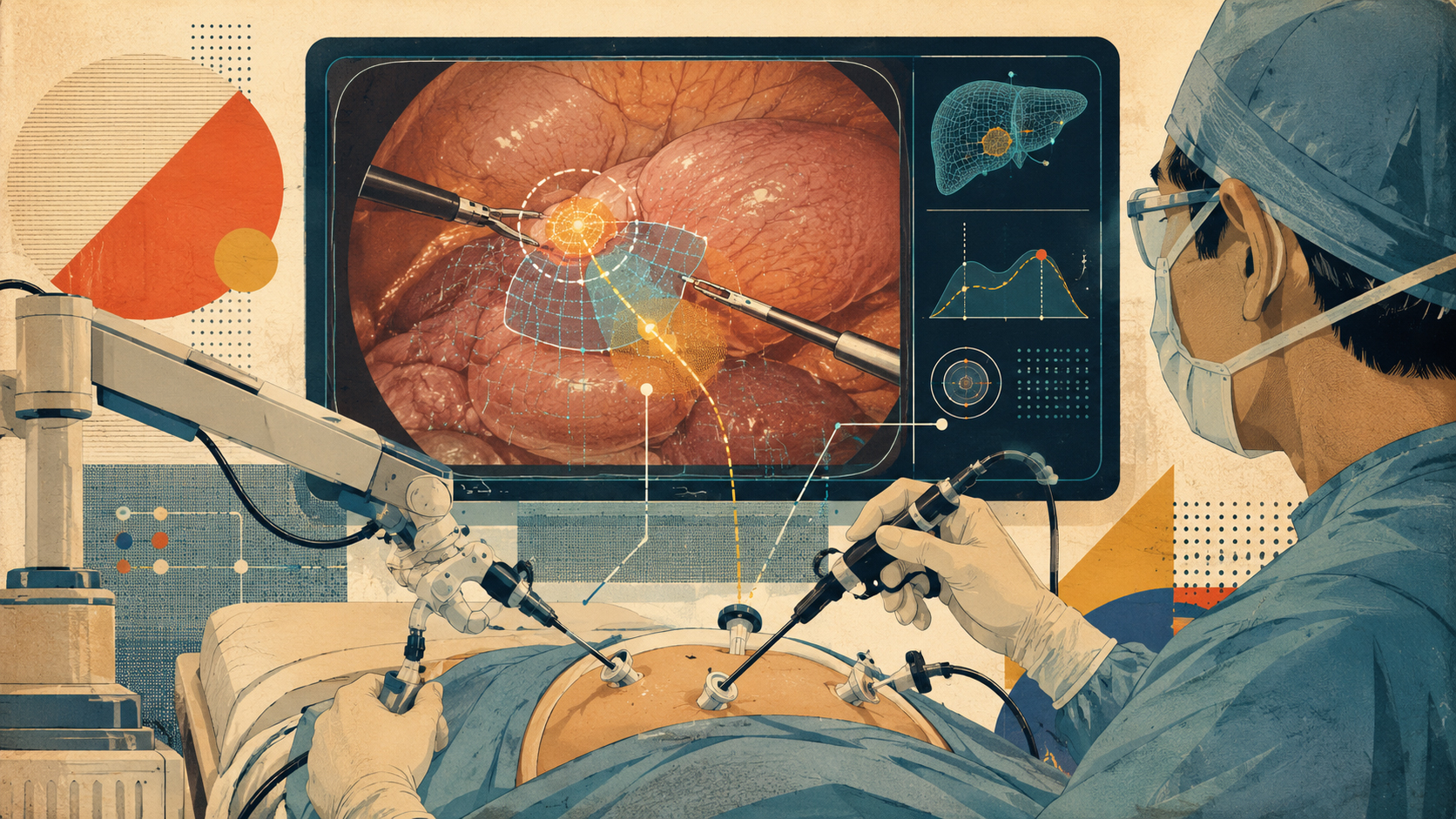
What a surgeon sees in the operating room is not merely video. It is blood vessels, nerves, pancreas, dissection layers, organ boundaries, danger, memory and the next safe move. An experienced surgeon reads a hidden map inside the image. Anaut’s EUREKA is an attempt to place part of that map on the screen, in real time, with artificial intelligence.
On May 13, 2026, Tokyo-based Anaut announced Series B financing to accelerate global expansion of its surgical-support AI. The company says its work began before incorporation, in 2018, under surgeon and CEO Nao Kobayashi. In April 2024, EUREKA α received Japanese manufacturing and marketing approval as a surgical image-recognition support program, and in January 2026 the product received additional approval for expanded functions covering pancreas, nerves and broader indications.
This is not another simple “AI will replace doctors” story. The real story is subtler and more important: how software can help share the eye of the expert surgeon, support young doctors, reduce variation between hospitals and turn Japanese surgical know-how into a global medical-device platform.
Series B: funding Japan’s surgical AI for the world
Anaut’s Series B was conducted in a March 2026 first close and a May 2026 second close. The lead investor was Japan Growth Capital Investment Corporation, managed by Nomura SPARX Investment. New investors included the Japan Bank for International Cooperation, Japan Green Investment Corp. for Carbon Neutrality and Vision Incubate, while existing investors Beyond Next Ventures, ANRI and KSP also participated. Anaut said it plans an extension round this summer involving domestic and overseas VCs, including venture arms connected to overseas medical institutions.
The use of funds is clear: expand EUREKA adoption in Japan, build overseas teams, prepare for regulatory pathways such as FDA clearance and CE marking, and push forward the company’s “EUREKA Inside” strategy — integrating its recognition AI into next-generation therapeutic devices and surgical systems.
What EUREKA α does: a map over the surgical field
EUREKA α analyzes surgical video from laparoscopic and robot-assisted procedures and estimates the location and area of structures that are difficult to recognize during surgery. The goal is not to make the decision for the surgeon, but to make important anatomy more visible at the moment of decision.
Hyogo Medical University Hospital described EUREKA α as a programmable medical device that supports doctors’ visual recognition by estimating and highlighting loose connective tissue in real time. The device received Japanese approval on April 12, 2024, and sales began on July 17, 2024. Loose connective tissue may sound obscure, but in surgery it can be a key clue: the right layer to follow, the safer plane to dissect, the difference between a confident move and a risky one.
Second generation: from visualization to decision support
In January 2026, Anaut received approval for added functions and expanded indications for EUREKA α. The second-generation product adds highlighting of the pancreas in the gastric region, highlighting of nerves in the colorectal region and expanded use of loose-connective-tissue visualization in gynecology. It also supports TilePro on the da Vinci Xi surgical system, allowing information to be integrated into the surgeon’s field in robot-assisted procedures as well as laparoscopic operations.
That matters because the pancreas and pelvic nerves are not abstract anatomical labels. Pancreatic injury can lead to serious postoperative complications such as pancreatic fistula or pancreatitis. Nerve preservation in rectal and pelvic surgery can affect urinary and sexual function and therefore long-term quality of life. AI that points to risk is not a gimmick; it is a layer of clinical infrastructure.
Timeline: how EUREKA entered the operating room
| Date | Milestone |
|---|---|
| 2018 | Work on AI support for surgical recognition begins before incorporation. |
| July 2020 | Anaut Inc. is established. |
| April 12, 2024 | EUREKA α receives Japanese manufacturing and marketing approval. |
| July 17, 2024 | EUREKA α sales begin in Japan. |
| January 28, 2026 | Additional approval covers new functions and expanded indications. |
| March/May 2026 | Series B first close and second close are completed. |
Why Japan needs this: surgeon shortages and knowledge transfer
Japan has world-class surgical expertise, but its hospitals face pressure from surgeon shortages, regional disparities, younger-doctor training and work-style reform. Even as surgical robots spread, the crucial act remains human: reading the field, avoiding danger and selecting the next move.
The expert surgeon’s eye is hard to transmit through textbooks alone. Which fiber should be followed? Which membrane should be preserved? Which white band might be a nerve? These judgments are built through years of cases, guidance, mistakes and repetition. EUREKA’s deepest promise is to add a software guide rail to that tacit knowledge.
A longer history: surgery becomes a visual discipline
The history of surgery can be read as the history of seeing. Anesthesia and antisepsis made modern surgery possible. X-rays and endoscopy opened the body to inspection. Laparoscopy moved surgery through small openings. Robotic systems enlarged the view and refined motion.
But seeing clearly is not the same as understanding correctly. High-definition images still require interpretation. The next surgical technology frontier is not simply a sharper camera; it is meaning layered onto the camera’s view. EUREKA belongs to that frontier.
EUREKA X and education: sharing the expert gaze
Anaut also presents EUREKA X as an AI program for surgical education. The company describes it as a system that shares what expert surgeons see with medical teams in the operating room and aims to improve educational efficiency.
That educational angle may become just as important as intraoperative use. If Japan wants to sustain surgical quality, it cannot depend only on a handful of masters. It must raise the floor across hospitals and regions. AI can become a second gaze — not replacing the surgeon, but helping the team see the same anatomy, the same risk and the same next lesson.
EUREKA Inside: when AI enters the device itself
The most intriguing phrase in Anaut’s Series B announcement may be “EUREKA Inside.” It suggests a future beyond a stand-alone product: Anaut’s recognition AI embedded inside surgical robots, endoscopic systems, display platforms and next-generation therapeutic devices.
Medical AI will not succeed only as a separate app on the side of the operating room. It must disappear into workflow — the screen, the robot console, the recording system, the training library, the procedure plan. EUREKA Inside suggests that Anaut is aiming for a deeper position in the operating-room stack.
Risk and responsibility
The stakes are high. Surgical AI must confront misrecognition, latency, overreliance, attention management, liability, reimbursement and different regulatory regimes across countries. A model that performs well in a demo must still fit the real rhythm of a surgical team.
The right way to read EUREKA is not “AI performs surgery.” It is “AI supports the surgeon’s visual recognition.” A map does not drive the car. But a good map can reduce wrong turns, make hazards visible and let the team share a common picture.
Japan.co.jp view
Anaut is one of the more serious stories in Japan’s 2026 AI landscape because it is not chasing generic productivity theater. It is addressing a narrow, difficult, life-critical problem where Japanese domain expertise matters. If Japan can convert surgical know-how into regulated software and export it responsibly, its AI advantage will not be model size; it will be depth of field.
The word EUREKA comes from the Greek word for discovery. In the operating room, discovery is not only a dramatic scientific breakthrough. It is finding the nerve before it is injured, finding the safe plane before bleeding begins, finding the expert’s line of sight, and finding a safer path for the patient. That is why this small Japanese company belongs near the front of the AI issue.
Sources and references
This article draws on Anaut releases, PR TIMES, Hyogo Medical University, Anaut’s EUREKA X materials, and surgical-AI / medical-device reporting.
- PR TIMES / Anaut: Series B financing for global expansion, May 13, 2026.
- PR TIMES / Anaut: EUREKA α second-generation approval and expanded functions, January 29, 2026.
- Hyogo Medical University: first surgery using EUREKA α and product explanation, September 26, 2024.
- Anaut: EUREKA X surgical-education program.
- PR Newswire / Anaut: Japanese regulatory approval of EUREKA α, May 2, 2024.