Japanese trains are famous for punctuality, cleanliness, and astonishing scale. But the deeper miracle is not mechanical. It is social. Millions of people move through stations and train cars every day because everyone agrees, silently, to make the shared space work.
Train etiquette in Japan is not about fear or stiffness. It is about awareness. The train is a temporary room shared by strangers: students, office workers, parents, travelers, elderly passengers, tired people, excited people, and people trying to get through the day with as little friction as possible.
To ride well is to notice. Where are people standing? Who needs space? Is your bag in the way? Is your voice too loud? Are you blocking a door? Japanese train manners begin with a simple question: How do I reduce the burden I place on others?
The culture of quiet
The first thing many visitors notice is the quiet. A packed train in Tokyo can contain hundreds of people and still feel strangely subdued. People may be reading, sleeping, looking at phones, studying, or simply standing in silence.
This does not mean Japanese trains are joyless. It means the train car is treated as a shared interior. The courtesy is not directed at one specific person. It is given to the room itself. Quietness becomes a kind of public gift.
For visitors, the rule is simple: speak softly. A brief conversation is usually fine, especially on less crowded trains, but loud storytelling, speakerphone calls, and group noise quickly feel intrusive. The more crowded the train, the more your voice matters.
Boarding, waiting, and the invisible choreography
Japanese station platforms are built around flow. Painted lines show where doors will open. People queue at marked positions. When the train arrives, passengers wait for people to get off before entering. This sounds obvious, but in a dense station, the habit matters.
The best practice is to stand to the side of the door area, allow exiting passengers to leave first, then board without pushing. Once inside, move away from the doorway if there is space. Doors are pressure points. Blocking them delays everyone.
- Wait in line. Use the platform markings when they exist. They are part of the system, not decoration.
- Let people off first. The train cannot receive new passengers smoothly until exiting passengers clear the door.
- Move inward. If you stop just inside the door, you become an obstacle for everyone behind you.
- Prepare before your stop. Start moving toward the door calmly before arrival if the train is crowded.
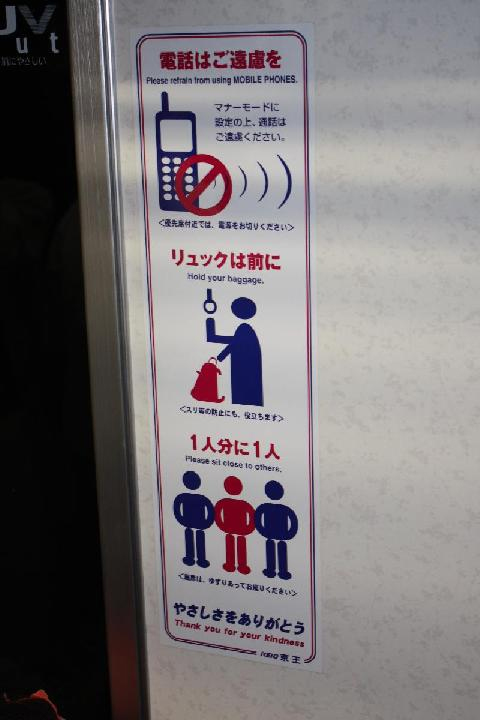
Train etiquette signs in Japan are often visual, gentle, and specific: phone use, baggage, spacing, priority seating, and boarding behavior.
Phones and headphones
Phone culture is one of the clearest differences for many visitors. Talking on the phone inside ordinary commuter trains is generally avoided. Texting, reading, browsing, and using apps are normal. Voice calls are not.
Headphones are fine, but sound leakage is not. If people nearby can hear your music, video, or game, it is too loud. Trains are full of small sounds already: announcements, doors, rails, footsteps, bags, station chimes. Adding private audio to the public space is considered careless.
On some trains and in some areas near priority seats, you may see signs asking passengers to switch phones to silent mode. Even where enforcement is soft, the expectation is clear: devices should not dominate the atmosphere.
Good habit
Put your phone on silent mode before boarding. Use messages instead of calls. Keep video sound off unless you are using headphones.
Best habit
When the train is crowded, put the phone away enough to stay aware of your body, bag, and stop.
Bags, bodies, and space
Space on Japanese trains is precious. A backpack worn normally can hit people behind you, especially during rush hour. Many commuters remove backpacks and hold them in front, place them at their feet, or use overhead racks when available.
Suitcases require special awareness. Tourists often travel with large luggage, especially between airports, hotels, and train stations. That is understandable. But large bags should be kept close, not placed where they block doors or walking paths.
The core principle is not complicated: your possessions should not occupy more social space than necessary. Your body should not lean, spread, swing, or block without awareness.
- Backpacks: remove or rotate them in crowded cars.
- Suitcases: hold them firmly and keep them out of doorways.
- Umbrellas: keep wet umbrellas pointed downward and away from other passengers.
- Food and drink: avoid messy eating on commuter trains. Long-distance trains are different.
Priority seats are not symbolic
Priority seats are reserved for elderly passengers, pregnant passengers, people with disabilities, passengers with injuries, and passengers traveling with infants or small children. They are often marked clearly by color, signage, or window decals.
Visitors sometimes treat priority seats as ordinary seats until someone visibly needs them. A better approach is to avoid them when possible, especially on busy trains. If you do sit there, stay alert and offer the seat quickly.
The hardest part is that need is not always visible. Someone may be ill, exhausted, pregnant early, or dealing with an injury you cannot see. This is why the priority seat area carries a different social expectation.
What travelers should remember
Japan does not expect every visitor to know every custom immediately. But effort matters. If you watch what local passengers do, you will learn quickly. Stand where others stand. Lower your voice when others are quiet. Move with the flow. Keep your things close. Step aside when you need to check directions.
Stations can be overwhelming, especially in Tokyo, Osaka, Kyoto, and major transfer hubs. When confused, it is better to step out of the moving stream than stop suddenly in the middle of it. Japan’s railway system works because movement has rhythm. Protect the rhythm and the whole place feels easier.
That is the larger lesson of train etiquette. The rules are not merely about trains. They reveal a broader Japanese idea of public life: freedom is preserved when everyone carries a little responsibility for the shared space.
A quick etiquette checklist
- Speak softly. Treat the train car as a shared quiet room.
- Do not talk on the phone. Message instead. Keep your device on silent.
- Queue properly. Follow platform markings and wait for passengers to exit first.
- Mind your bag. Remove backpacks in crowded cars and keep luggage close.
- Respect priority seats. Avoid them when possible and offer them immediately when needed.
- Do not block doors or corridors. Move inward and prepare for your stop early.
- Watch local behavior. The best guide is the quiet choreography around you.
Ride this way and Japan opens differently. The train becomes more than a way to move from one station to another. It becomes an introduction to the country’s everyday intelligence: order without shouting, cooperation without speeches, and courtesy practiced one commute at a time.