In Japan, some of the most powerful cultural encounters happen quietly. You turn a corner near an old temple. You walk beside a country road after rain. You notice a line of small stone figures wearing red bibs, red caps, or fresh flowers. Their faces may be weathered. Their hands may be folded. Their presence is soft, but unmistakable. This is Jizō.
Jizō is not an image that demands attention. He does not tower over the street. He waits at human height, often lower, close to the ground, close to the path, close to people. That closeness is part of his meaning. He belongs to the places where fear, travel, grief, childhood, memory, and hope meet.
Who is Jizō?
Jizō, often called Ojizō-sama with affection, is the Japanese form of the bodhisattva Kṣitigarbha. In Buddhist tradition, a bodhisattva is a being who postpones complete liberation in order to help others. Jizō is especially associated with protection, compassion, and guidance through difficult passages.
In Japan, Jizō has become deeply familiar. He appears in temple grounds, cemeteries, mountain paths, neighborhood corners, rural roads, and places where ordinary people pass every day. He is not only a religious figure in the formal sense. He is a cultural presence: a guardian who feels close enough to greet.
The roadside guardian
One of the reasons Jizō feels so intimate is his location. He is often found along roads, at crossroads, beside trails, near bridges, and at the edges of villages. These are threshold places. A road is not just a line between two destinations. It is a place of uncertainty, departure, exposure, and return.
In older Japan, travel could be dangerous. Mountains, rivers, weather, illness, and distance all carried risk. A roadside Jizō offered the feeling of being watched over. Even today, the figure keeps that emotional power. In a fast, modern country of bullet trains and expressways, the small stone guardian reminds us that every journey still has a human heart.
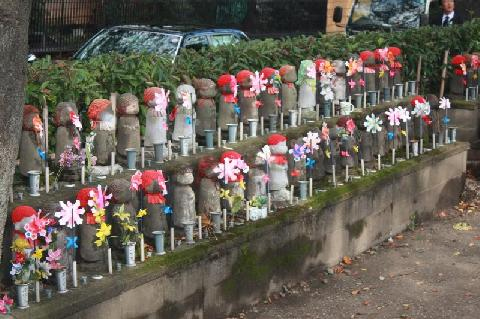
Jizō figures often appear with offerings, flowers, red cloth, or pinwheels — signs of affection and remembrance.
The red bibs, caps, flowers, and pinwheels
Visitors often notice that Jizō statues wear red cloth. The sight can be moving, especially when the statue is small, old, or weathered by rain. Red is associated with protection, vitality, and care. The cloth can feel like a garment, but also like a human gesture: someone came here, noticed, and dressed the stone figure with love.
Jizō is also connected with the protection of children, including children who died young. For this reason, some Jizō sites carry a deep tenderness. Pinwheels, toys, flowers, and small offerings may appear nearby. The atmosphere is not theatrical. It is private, communal, and restrained.
This is one of the great lessons of Japanese visual culture. Meaning does not always arrive as a monument. Sometimes it arrives as a red cap on a stone head, placed by hands we will never know.
Look closely
Each Jizō figure is different. Some are polished, some are rough, some are almost hidden by moss. Their individuality is part of the encounter.
Move respectfully
These are not props. They are religious and emotional objects. Photograph gently, avoid touching offerings, and follow local signs.
How to approach Jizō as a traveler
Travelers in Japan may encounter Jizō unexpectedly. The best approach is quiet attention. Do not rush to turn the figure into content. Pause first. Notice the surroundings. Is he near a temple gate? A cemetery? A mountain path? A neighborhood corner? The location is part of the story.
If you take a photograph, do it without disturbing offerings or blocking worshippers. If there are flowers, coins, water, toys, or cloth, leave them exactly where they are. The beauty of the scene is not merely visual. It belongs to someone’s prayer, memory, or habit of care.
This is also why Jizō belongs on Japan.co.jp. He teaches the reader how to look. Japan is not only temples, skyscrapers, sushi, bullet trains, and neon. It is also the small figure in the rain, the red cloth against stone, the flower left beside a path.
Why Jizō still matters
Modern Japan can feel dazzling: fast trains, dense stations, glowing signs, exquisite food, and extraordinary systems of public order. Jizō brings the scale back down to the human body. He reminds us of vulnerability. Children need protection. Travelers need guidance. Grief needs somewhere to rest.
That is why the figure endures. Jizō is not merely old Japan. He is a continuing language of care. He gives form to feelings that people still carry: the desire to protect, the need to remember, the hope that a journey will be watched over.
The next time you see a small stone figure in a red cap, do not pass too quickly. You may be standing before one of Japan’s quietest teachers.