Futomaki is the kind of food that looks simple until you look closely. A dark sheet of nori wraps vinegared rice around a bright interior: egg, cucumber, kanpyō, shiitake, fish, crab, pickles, greens, and sometimes ingredients chosen less for luxury than for color, balance, and memory.
It is sushi, yes. But it is also design. A futomaki roll is a small architecture of contrast: black seaweed, white rice, yellow egg, green vegetable, brown simmered mushroom, pink or red accents, and the soft geometry of a slice. On a plate, futomaki does not whisper. It arrives like a pattern.
In Japan, food often carries season, occasion, and feeling. Futomaki carries all three. It can be festive without being formal, homemade without being ordinary, nostalgic without being frozen in the past.
What is futomaki?
The word futomaki means “thick roll.” Unlike slimmer maki rolls, futomaki is larger and usually contains several fillings. It is sliced into round pieces that reveal the arrangement inside. The pleasure is both visual and textural.
The outside is nori. The structure is vinegared rice. The interior depends on region, household, season, and purpose. Common fillings may include tamagoyaki or sweet omelet, cucumber, kanpyō, shiitake mushrooms, sakura denbu, crab or seafood, spinach, pickled vegetables, and other ingredients that create balance.
Futomaki is not only about rare ingredients. Its beauty often comes from ordinary ingredients treated with respect: simmered, seasoned, cut, arranged, and rolled into harmony.
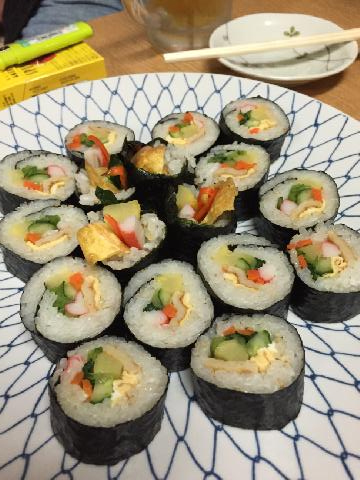
A sliced futomaki roll reveals its inner design — a small edible composition of color, texture, and balance.
The language of color
Japanese food is often read with the eyes before the mouth. Futomaki makes this especially clear. The black nori creates a border. The rice creates a calm field. The fillings create movement. Yellow, green, red, brown, and white are not random decoration. They give the roll rhythm.
This is why futomaki feels festive. It has a brightness that suits gatherings, lunch boxes, seasonal meals, and special days. Even when made at home, it can make the table feel arranged. A plate of futomaki slices looks like someone made an effort.
The colors also help explain one of Japan’s great food principles: beauty does not need to be expensive. Beauty can come from cutting cleanly, arranging carefully, and treating the ingredients as part of a whole.
Look for balance
A good futomaki slice is not only colorful. It has contrast: soft and crisp, sweet and savory, bright and earthy.
Look for memory
Futomaki often feels familiar to Japanese families because it belongs to home kitchens, gatherings, and seasonal habits.
Family, festivals, and the table
Futomaki has a social feeling. It can be bought at a shop, but it also belongs naturally to the home. Making it requires preparation: cook the rice, season the fillings, cool the omelet, cut the vegetables, lay out the nori, spread the rice evenly, place the fillings, roll with pressure, and slice with care.
That process gives futomaki its human quality. It is a food of hands. Someone decided what to include. Someone balanced the colors. Someone rolled it tightly enough to hold, but gently enough not to crush. Someone sliced it and hoped the pattern would open cleanly.
The result can be shared easily. One roll becomes many slices. The food already contains the gesture of distribution. In that sense, futomaki is not only made for eating. It is made for offering.
- At home: futomaki can turn ordinary ingredients into a festive-looking meal.
- For gatherings: the sliced rounds are easy to share and beautiful on a large plate.
- For bento: the roll carries color, structure, and satisfaction in a compact form.
- For seasonal moments: fillings and presentation can shift with the occasion.
Ehomaki and Setsubun
Many visitors encounter a related custom during Setsubun, the seasonal turning point before spring. Ehomaki is a thick sushi roll eaten while facing the year’s lucky direction. In many versions of the custom, the roll is eaten whole and in silence, with a wish in mind.
The modern popularity of ehomaki has made thick rolls highly visible in convenience stores, supermarkets, and department food halls around Setsubun. The custom is playful, commercial, ritualized, and memorable all at once — a very Japanese blend of season, marketing, food, and folk feeling.
Whether one approaches it as tradition, fun, or a seasonal habit, ehomaki shows how a sushi roll can become more than food. It becomes direction, silence, wish, and calendar.
The craft of rolling
Futomaki looks relaxed, but the construction requires judgment. Too much rice and the roll becomes heavy. Too little and it falls apart. Fillings must be placed so that the slice reveals balance. Wet ingredients need control. The knife must be sharp and often wiped between cuts.
The makisu, or bamboo rolling mat, gives the roll its shape. But the real tool is pressure. The hands must roll firmly, evenly, and with confidence. This is a small kitchen skill, but like many Japanese domestic arts, it rewards repetition.
A perfectly rolled futomaki is satisfying because it hides labor inside apparent simplicity. That is one of Japanese food culture’s recurring pleasures: the better the technique, the more natural the result feels.
Why futomaki matters
Futomaki matters because it shows Japan’s gift for making beauty portable. It is colorful, structured, and easy to share. It belongs to shops and home kitchens, festivals and lunch boxes, children and grandparents, ordinary days and special ones.
It also reminds us that Japanese food is not only the refined silence of omakase counters. It is also generous, colorful, practical, and family-facing. Japan’s table has many voices. Futomaki is one of the warm ones.
For travelers, futomaki is worth noticing not only as something to eat, but as something to read. Look at the slice. Notice the border, the rice, the filling, the color, the pattern. It is a tiny map of care.
A quick futomaki guide
- Notice the cut: clean slices reveal whether the roll is well balanced and tightly formed.
- Notice the color: yellow egg, green cucumber, brown mushroom, pink denbu, and white rice create rhythm.
- Notice the occasion: futomaki often appears where food is meant to be shared.
- Try seasonal versions: shops and families may vary fillings by time of year or event.
- Eat with your eyes first: the visual composition is part of the pleasure.
- Remember the hands: behind every clean roll is preparation, pressure, and care.
The next time you see futomaki on a patterned plate or in a department-store food hall, pause before eating. The slice is not only food. It is a little festival of order: a circle, a pattern, a memory, and a promise that ordinary ingredients can still become beautiful.