Solar energy often sounds abstract until you stand on a roof. Then it becomes physical: rails, modules, conduit, flashing, sealant, wire, inverters, meters, breakers, gloves, ladders, heat, wind, and the quiet calculation of how sunlight will move across a surface.
Japan is a country of dense cities, narrow lots, tile roofs, concrete apartments, mountain villages, fishing ports, factory roofs, school buildings, train stations, and family homes pressed into limited space. Solar in Japan is therefore not one story. It is a thousand small negotiations between sunlight and architecture.
The future does not always arrive as a grand announcement. Sometimes it arrives as a crew on a rooftop, a new meter on a wall, a conduit bend that looks clean, and a homeowner looking upward at a system that will quietly work for years.
The roof as frontier
A roof is one of the most overlooked landscapes in Japan. From the street, it is easy to miss. From above, it becomes a map: slopes, vents, shadows, neighboring buildings, antennas, access paths, and odd little geometries that determine what can be built.
Solar begins with respect for that roof. A bad design treats the roof as empty space. A good design reads it like a site: where water moves, where wind loads matter, where workers can stand, where future service access must remain, where shade will appear in winter, and where the system can be installed without turning the home into a science experiment.
In Japan, roofs can be compact and complicated. This makes the design more interesting. Every panel placement is a decision. Every decision has consequences.
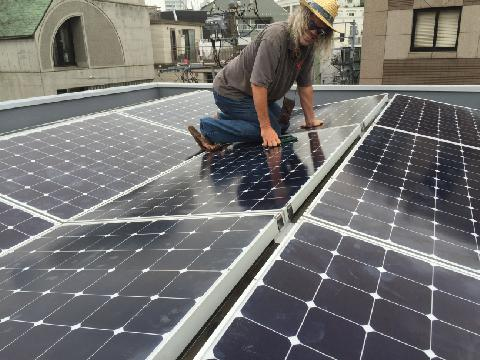
Solar energy becomes real when someone has to carry, fasten, wire, inspect, and maintain the system above the city.
The people on the roof
Solar is often discussed in terms of panels and power, but the human layer matters just as much. Installers turn policy into hardware. They translate engineering drawings into safe work on hot roofs, windy edges, narrow ladders, and real buildings with real surprises.
Every good solar system contains invisible labor. The rails are straight because someone measured carefully. The wire is protected because someone cared about the path. The penetration is sealed because someone understood that rain will test everything. The labels are readable because a future technician will need them.
Japan’s best craft traditions are not only found in temples, gardens, and ceramics. They also appear in practical work: the clean conduit run, the patient layout, the disciplined finish, the refusal to leave a sloppy detail behind.
Good solar is quiet
A well-built system does not call attention to its own cleverness. It produces, protects, survives weather, and can be serviced when needed.
Good solar is readable
Labels, wire paths, disconnects, access, drawings, and documentation matter because systems live longer than the installation day.
Solar in the city
Urban solar has its own poetry. It appears above dense neighborhoods, behind parapets, near temple roofs, beside laundry lines, over schools, on commercial buildings, and on homes where every square meter matters. In Tokyo, Osaka, Yokohama, Nagoya, Fukuoka, and countless smaller cities, the roof is one of the last open places.
City solar must deal with shade from neighboring buildings, limited access, tight electrical rooms, complicated roof shapes, and the constant negotiation between function and appearance. It is not the huge desert array. It is distributed, domestic, architectural, and often intimate.
That intimacy is part of its strength. A rooftop system makes energy visible at household scale. The sun is no longer merely weather. It becomes part of the home’s daily accounting.
- Small roofs: design discipline matters because there is little room for waste.
- Urban shade: nearby buildings, antennas, parapets, and seasonal sun angles can change performance.
- Service access: the system should be buildable, inspectable, and maintainable.
- Appearance: in dense neighborhoods, clean layout can make the system feel integrated rather than imposed.
Batteries and resilience
Solar panels make sunlight useful. Batteries make timing useful. That difference matters. A home or building does not only need power when the sun is strongest. It needs power in the evening, during outages, during storms, and during the hours when daily life refuses to match the production curve.
In Japan, where earthquakes, typhoons, grid stress, heat, and local outages are part of the practical imagination, battery-backed solar can become more than a financial calculation. It can become resilience infrastructure. Not every system needs to be heroic. But a modest system that keeps communication, refrigeration, lights, medical equipment, or essential circuits alive can change the meaning of a blackout.
Resilience begins with honest design. What loads matter? How long should they run? What happens in winter? Where will the battery live? How will it be protected? Who will maintain it? The romance of backup power must always be grounded in the discipline of load calculation.
The handmade future
The phrase “renewable energy” can feel too large to touch. But solar work is full of touch. Hands lift the module. Hands tighten the clamp. Hands strip the wire, land the conductor, label the breaker, seal the roof, test the voltage, photograph the finish, and close the panel.
That is why solar belongs in the same Japan.co.jp world as trains, food, Jizō, rural roads, and old houses. It is not only a technical system. It is part of how people live in place. It changes the roof, the utility bill, the emergency plan, the household’s relationship to weather, and the way a building participates in the future.
Japan’s handmade future will not be handmade because it rejects technology. It will be handmade because technology still has to be installed, adjusted, protected, inspected, and cared for by human beings.
Why solar matters
Solar matters because it changes the imagination of energy. Instead of power arriving only from somewhere far away, some portion of it can arrive from above the home, above the school, above the factory, above the parking structure, above the quiet roof everyone used to ignore.
It also matters because it asks better questions. What should a roof do? What is a building responsible for? How much resilience should a household have? What does local energy mean in a country that understands disaster memory? How can a system be both modern and respectful of place?
Solar Japan is not only a story of panels. It is a story of surfaces becoming useful, households becoming more aware, workers translating sunlight into hardware, and cities discovering that the future was overhead all along.
A practical solar checklist
- Read the roof first. Shade, slope, water flow, access, structure, and maintenance paths matter.
- Design for service. The system should be understandable years later by someone who was not there on installation day.
- Respect weather. Wind, rain, heat, salt air, and seasonal sun are all part of the design environment.
- Think about storage. Batteries should be sized around real loads and real expectations, not slogans.
- Protect the building. A solar system is only good if the roof, wiring, and occupants remain safe.
- Value craft. Clean workmanship is not decoration. It is reliability made visible.
On a clear day, a finished solar array can look almost still. Nothing seems to move. No engine sounds. No smoke rises. But electrons are moving, meters are changing, batteries may be filling, and a building is quietly becoming part of a different energy story.
That quiet is part of the promise.